Unknown's avatar

Does McAuliffe deserve that bad grade on climate and energy?

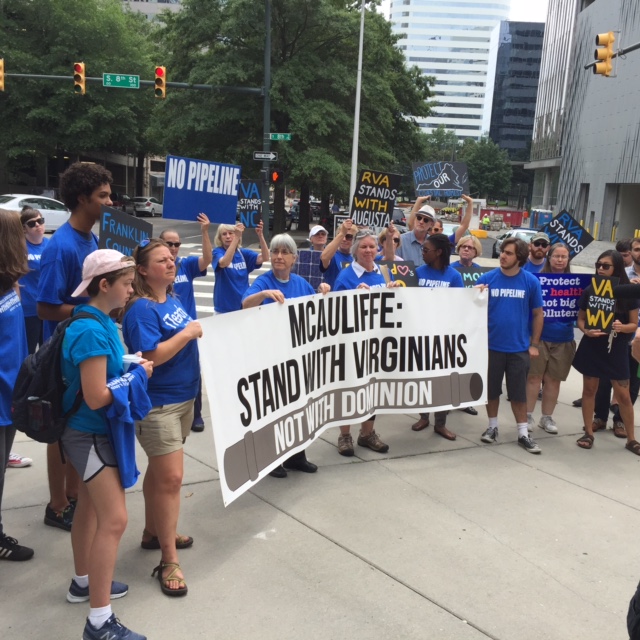
Protesters at an anti-pipeline rally aim their message at Governor McAuliffe

Protesters at an anti-pipeline rally aim their message at Governor McAuliffe

Clean energy advocates who scrutinize Virginia Governor Terry McAuliffe’s record see different things. Chesapeake Climate Action Network (CCAN), the Virginia Student Environmental Coalition (VSEC) and other groups recently released a mid-season “report card” that gave McAuliffe a D-plus on climate and energy. The bad grades primarily stem from his support of massive fracked-gas pipelines and offshore oil drilling, as well as Department of Environmental Quality’s (DEQ’s) approval of Dominion Virginia Power’s plans to “close” coal ash ponds by leaving toxic waste in unlined pits next to rivers.

Meanwhile, though, other environmental leaders are praising the governor for speaking out about the reality of climate change and promising to forge ahead with implementation of the EPA’s Clean Power Plan in spite of the current judicial stay. They also say McAuliffe should get more credit for his vetoes of bills attacking the Clean Power Plan and extending subsidies to coal companies.

It is possible to agree with both the criticism and the defense. McAuliffe’s enthusiastic support for Dominion’s Atlantic Coast Pipeline has been an enduring irritant to climate activists as well as to landowners along the planned routes of the ACP and other natural gas pipelines. A Sierra Club analysis concluded that the pipelines would increase the Commonwealth’s greenhouse gas footprint by more than twice the total emissions of all power plant generation in the state.

He is also rightly criticized for supporting off-shore drilling, which would increase climate pollution and sea level rise and threaten the Navy’s and tourism’s contributions to Hampton Roads’ economy—a potential double whammy for residents and businesses.

And the Virginia DEQ has begun to look a lot like its North Carolina counterpart, a captured agency incapable of defending our air and water from the corporate polluters it is supposed to regulate. Sure, the problem has festered through several administrations, but McAuliffe’s failure to intervene is impossible to reconcile with his pro-environment rhetoric.

The problem goes beyond DEQ. In response to a detailed petition to the Governor for an interagency review to modernize the state’s fracking regulations, McAuliffe’s Secretary of Commerce and Labor announced a plan to limit the issues and refer them to an industry-dominated organization funded by the American Petroleum Institute for decision. This is hardly a sign of a Governor committed to protecting the environment, safety and health.

Yet messaging matters, and McAuliffe is a vocal messenger on the topic of climate change. The governor points to the flooding that routinely shuts down streets in Norfolk as proof that human-caused sea level rise is already a problem right here in Virginia. And as a team player for the Democrats, he supports Obama’s Clean Power Plan even as he brags (superfluously and probably incorrectly) that he persuaded EPA to soften its Virginia targets to reduce our burden of compliance.

Besides which, if he’s no Jerry Brown or Jay Inslee leading his state towards a fossil-free future, McAuliffe is also not Ken Cuccinelli, hounding climate scientists out of state. Given a Republican majority in Virginia’s General Assembly that is dedicated to propping up the coal industry and blocking anything EPA does, it could have been so much worse.

So perhaps CCAN is letting the perfect be the enemy of the good—or in this case, letting the good be the enemy of the “meh.”

Regardless of how they feel about McAuliffe’s record, both the glass-half-full folks and the glass-half-empty folks agree there’s an “incomplete” on his report card that could make an enormous difference to his legacy. The ultimate test of the Governor’s climate credentials, they say, is whether he pushes DEQ to write a Clean Power Plan that puts a firm cap on total carbon emissions from the electric sector in Virginia. Though the General Assembly found a way to stop DEQ from completing work on the state implementation plan temporarily, nothing stops McAuliffe from taking a public stand on this most critical point.

That sounds like a no-brainer for a Democrat who is serious about reining in CO2. Unfortunately, it doesn’t meet with the approval of Tom Farrell, CEO of Dominion Resources, or Bob Blue, President of Dominion’s electric utility subsidiary, Dominion Virginia Power. They want DEQ to write a plan that leaves out new sources of emissions. That would let them continue building lots of big, new natural gas generating plants that, Blue assures us, will be capable of spewing carbon for at least another half century. All that burning of fracked gas would be lousy for the climate, but it would guarantee profits for Dominion’s utility and pipeline affiliate.

So on the one hand, the Governor can choose to be a climate hero, fighting sea level rise and deadly heat waves, creating tens of thousands of clean energy jobs and attracting forward-looking companies to the state, building his national reputation, doing what’s right for all our children and grandchildren, —

Or he can make Dominion happy.

It will be very interesting to see what becomes of that “incomplete” on his report card.

Unknown's avatar

Inside the minds of Dominion’s leaders, vacant space where climate thinking should be

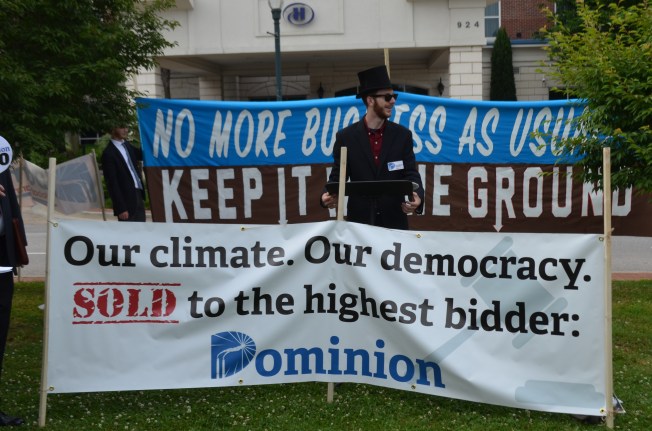
Climate activists protest outside Dominion Resources' May shareholder meeting in Columbia, SC. Photo credit Ian Ware, Chesapeake Climate Action Network.

Climate activists protest outside Dominion Resources’ May shareholder meeting in Columbia, SC. Photo credit Ian Ware, Chesapeake Climate Action Network.

At Dominion Resources’ annual May meeting, shareholders presented five resolutions designed to improve the company’s assessment of its opportunities and vulnerabilities on climate, renewable energy and nuclear power. The company’s Board opposed the resolutions and fought vigorously to keep them off the shareholder ballot. (All five failed.) Guest blogger Seth Heald attended the meeting and sent this report back.

Two senior Dominion Resources executives—Bob Blue and Thomas F. Farrell, II—gave speeches on consecutive days earlier this month. I’ll report here on what they said, but even more telling is what they failed to say. Neither man mentioned a critical topic for their company and our world: climate change.

In Arthur Conan Doyle’s short story Silver Blaze, Sherlock Holmes solves the kidnapping of a racehorse by focusing on what didn’t happen. A dog didn’t bark in the night when the crime was committed, suggesting that the perpetrator was friendly with the dog. As The New Yorker’s Maria Konnikova, author of How to Think Like Sherlock Holmes, describes Holmes’s insight: “pay attention to what isn’t there, not just what is. Absence is just as important and just as telling as presence.”

Here’s the context of the two Dominion speeches. Bob Blue, president of Dominion Resources’ Dominion Virginia Power (DVP) subsidiary, was the luncheon speaker on May 10 before several hundred people in Richmond at the Virginia Chamber of Commerce conference on “Energy, Sustainability & Resiliency.” Tom Farrell, Dominion Resources’ board chairman, president, and CEO, spoke the following day in Columbia, SC, addressing a small audience—many of them Dominion employees and board members—at Dominion Resources’ 107th annual shareholders meeting. (Dominion always draws smaller audiences, and smaller climate protests, when it holds its shareholder meeting away from its Richmond headquarters.) As best I can tell, Bob Blue and I were the only two people present at both events. I took detailed notes.

DVP is Virginia’s largest electric utility. Thanks to its fossil-fuel-fired power plants it’s also the commonwealth’s number one emitter of climate-disrupting carbon dioxide. It’s hard for serious people to think about “energy, sustainability, and resiliency” these days without thinking about how climate change is and will be affecting us and our children. The past year has certainly been filled with near-constant reminders of climate change for anyone paying attention. These include Pope Francis’s encyclical, record warm global-average temperatures, the Paris international climate accord, severe droughts, and severe floods.

So it seems reasonable to expect Blue might have expressed some thoughts on how the climate crisis will be affecting his company and the electric-power industry in the coming decades. It was, after all, a conference on energy, sustainability, and resiliency.

Blue said at the outset that “natural gas is the new default fuel” for electric-power generation. He mentioned his company’s new gas-fired power plants and said, “We expect the big things we build to last 50 years or more.” He alluded to the hits Dominion has taken recently on its environmental record by saying the company had done a lot of things well, “but our weakness is our inability to communicate in simple terms about complex matters.” (Translation: We’re doing everything just right, but folks don’t realize it because they can’t understand complex matters.)

If climate change is a subject Blue has given any thought to lately, he neglected to mention it. To be fair, he did briefly mention the EPA Clean Power Plan, saying he thinks it would cost Virginia between $5 billion and $13 billion. But then he claimed it was too complex and boring to go into in detail. And he also talked a bit about solar and wind power, but there was no reference at all to the underlying climate problem that is the primary reason we need to transition from fossil fuels.

What’s more, Blue brought up solar and wind mostly to justify DVP’s go-slow approach in deploying them. Speaking a few days after the Kentucky Derby, in what he called “Triple Crown season,” Blue said that with solar and wind power, “The earliest horse out of the gate doesn’t always win.” That’s true in horse racing (although sometimes the first horse out does win), but it’s a poor analogy to use when addressing climate change, where greater CO2 emissions today necessitate much sharper reductions later. Thinking about climate change means recognizing the need for early action.

Come to think of it, the horse-out-of-the-gate analogy is more apt for building gas-fired power plants than it is for deploying clean energy. There’s no need to rush to build multiple fossil-fuel plants when we know we have to kick our fossil-fuel habit. In fact, there’s a high likelihood that a rush to build huge new fossil-fuel infrastructure now will leave ratepayers on the hook later, paying for power plants that have to be shut down early for us to reach our future carbon-emission targets. Yet Dominion has certainly been moving with great speed lately to get gas-fired power plants built. There is a sense of urgency at Dominion, but it’s about building more fossil-fuel infrastructure, not addressing climate change.

By not mentioning or acknowledging climate change Blue accomplished at least two objectives that he must think serve his company’s short-term interests. First, he avoided offending the many Republicans in the room, including some state legislators, whose party still cannot bring itself to acknowledge the climate threat. Blue’s climate silence is understandable in that regard, although it hardly reflects moral courage or true business leadership. Problems ignored as unpleasant or “controversial” tend to get worse, not better.

Second, by not mentioning climate change Blue could avoid having to explain how Dominion’s business plan will affect the climate, or Virginia’s ability to transition from fossil fuels to carbon-free energy in time to help our country avoid catastrophic climate impacts. Stated another way, ignoring climate change allowed Blue to ignore the need to compare his company’s greenhouse-gas-emissions trajectory with what the science tells us must be done to retain a recognizable climate.

Climate silence is a topic of considerable interest to scholars these days. In fact, on the day after Blue’s speech The Washington Post ran an article describing a recent study of climate silence by two Penn State researchers. In his new book Moral Disengagement, renowned Stanford psychologist Albert Bandura explains, “If one ignores … the evidence of the harmful results of one’s conduct, one has few reasons to activate self-censure or any need to change behavioral practices.”

This may help to explain Blue’s silence. When your business model doesn’t square with your conscience, you may prefer not to activate your conscience.

Bandura’s insights also illuminate the lacuna where climate thinking should be in the mind of the Dominion Resources CEO. Farrell’s speech to shareholders in Columbia a day after Blue’s talk was preceded by a short video intended to show Dominion’s good works in South Carolina. I’ve attended the last four Dominion shareholder meetings (two in Richmond, one in Cleveland, and this one in Columbia). The videos about the company’s local charitable and civic involvement are a staple at each meeting, and they’re always well-produced, moving, and interesting.

This year’s video highlighted contributions (financial, in-kind, and services) that Dominion and its employees made to the Red Cross and others in South Carolina last fall, when the state suffered from catastrophic flooding. A news clip in the video from the time of the floods showed an emotional Governor Nikki Haley saying, “This is the heaviest flooding we’ve ever seen.” Another person could be heard saying, “Eastover [SC] lost everything.” Columbia’s mayor said the floods “changed our lives.” A number of scenes of devastation were shown.

Dominion’s employees clearly did great work in helping a stricken region recover, and the company’s donations to the Red Cross are certainly admirable. But there was a sad irony in employing that tragic event to highlight Dominion’s many good works. Did any of the assembled Dominion executives or board members think about climate change as the video rolled? Did they think about the wisdom of their company’s plans to build massive new fossil-fuel infrastructure? Certainly Farrell did not mention climate in his prepared remarks following the video.

When company executives rarely talk publicly about climate change it’s easier for them and their audiences and employees not to think about it. Executives’ public silence on the issue also makes it easier for the legislators with whom executives regularly interact not to think about climate. And if you don’t think about a problem much, you’re unlikely to gain a sense of urgency about having to address it. That’s Albert Bandura’s moral-disengagement theory in a nutshell.

Dominion’s public silence on climate is complemented by its support for the American Legislative Exchange Council (ALEC), which promotes climate-change disinformation to state legislators. That further promotes inaction on climate. A corporation’s use of front groups to do the corporation’s dirty work behind the scenes is another example of moral disengagement, according to Bandura.

Farrell started his talk by listing what he said are Dominion’s four core values: “safety, ethics, excellence, and one Dominion.” There’s a large and growing body of scholarly research on climate-change ethics, including a number of recent excellent books on the topic suitable for lay readers. But Farrell’s discussion of ethics had no references to the climate. A shareholder resolution on the Dominion proxy ballot this year called on the company to have at least one board member with environmental expertise. Such expertise might include familiarity with the field of climate ethics. But Dominion’s board recommended a “no” vote on the resolution, and it was defeated.

Farrell claimed that Dominion is a leader in environmental stewardship. “We’re a leader, but people don’t recognize it.” He discussed the company’s major expansion in the natural-gas transmission business in recent years, and said the Marcellus shale-gas formation in the East “will provide gas for the balance of this century at least.” He noted the company’s pending acquisition of Utah-based gas company Questar, which will allow the company to expand its gas business across the West.

Farrell took questions from shareholders after his talk. I asked him for his thoughts about climate change, after noting that we’d been through a year of record global temperatures, floods, and the Paris climate accord. He said he didn’t want to talk about the Paris agreement. “I’ll leave that to President Obama and Secretary Kerry. That’s above my pay grade.” Farrell’s pay package last year topped $20 million.


Seth Heald is a student in the Johns Hopkins University Master of Science in Energy Policy and Climate program. His article on climate communication and moral disengagement is published in the May-June 2016 issue of the journal Environment, Science and Policy for Sustainable Development. He serves as volunteer chair of the Sierra Club’s Virginia Chapter. 

Unknown's avatar

Battles over climate and coal go unresolved, but Virginians still paying more

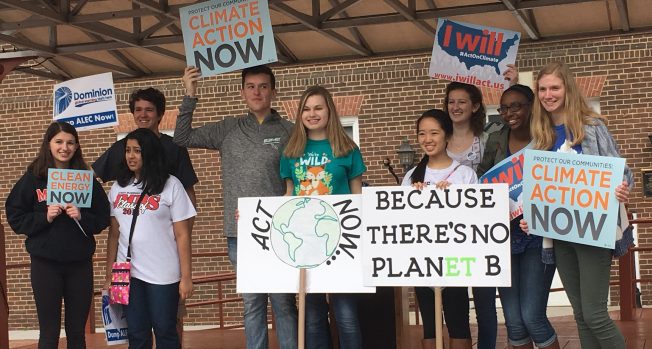
Students rally for climate action in Alexandria, Virginia. Photo courtesy of Sierra Club.

Students rally for climate action in Alexandria, Virginia. Photo courtesy of Sierra Club.

Virginia’s 2016 legislative session ended last week with a one-day veto session, an ideological battleground where both sides fought lustily but nobody won.

Republicans could not muster the votes to overcome McAuliffe’s veto of legislation extending taxpayer handouts for coal mining companies. Nor could they overcome vetoes of HB 2 and SB 21, bills requiring that any state plan implementing the EPA’s Clean Power Plan be submitted to the General Assembly for approval.

They did, however, succeed in defending a budget item prohibiting the Department of Environmental Quality (DEQ) from developing a state implementation plan while a federal stay of the Clean Power Plan remains in effect. (For that they needed only a majority; overriding a veto requires a two-thirds super-majority.)

These votes won’t end the skirmishing. The tax credit for companies that mine Virginia coal doesn’t expire until the end of 2016, and Terry Kilgore, Chairman of the House Commerce and Labor Committee and a reliable ally of the coal lobby, has already promised another effort next session to extend the handouts.

As for the Clean Power Plan, the budget maneuver will cause headaches, as intended, but it’s merely a stall tactic. Virginia may end up submitting a clumsier plan than it otherwise would, if it has to scramble to meet the deadline once the stay is lifted. Even that isn’t certain. DEQ has already completed much of the fact-gathering portion of its work, including issuance of a report from the stakeholder group it convened to consider options. And the new fiscal year, when the prohibition kicks in, doesn’t begin until July 1. A lot of work could get done in two months.

Moreover, Republicans seem to have a losing hand here, even if they block DEQ from completing its work. If the Clean Power Plan survives attack in the courts and Virginia doesn’t submit a plan, EPA will write one for us. On the other hand, if the Clean Power Plan fails judicial scrutiny, EPA will have to rewrite it in a way that might be even worse for coal.[1]

But the Republican attacks on the Clean Power Plan have never been about protecting our ability to plan our own energy future—or for that matter, about protecting ratepayers. Recall that a year ago the General Assembly passed Dominion Power’s SB 1349, with its so-called “rate freeze,” on the theory that the Clean Power Plan will cost so much money that electric rates needed to be frozen between now and the time the plan actually kicks in, and regulators forbidden from scrutinizing utilities’ books in the meantime.

I know: that makes no sense. But don’t ask me for a better explanation; the rationale never stood up to scrutiny. And Republicans weren’t the only ones supporting this peculiar legislation. Once the original anti-Clean Power Plan elements were stripped out, plenty of Democrats got on board to prove their fealty to Dominion.

We have since learned two things about SB 1349 and one thing about the Clean Power Plan:

  • According to one State Corporation Commission judge, SB 1349 will cost Virginia ratepayers a billion dollars in overpayments to Dominion.
  • Dominion Power customers are about to see their rates go up regardless of the “freeze,” as a result of Dominion getting approval to build a new gas-fired power plant;
  • The final Clean Power Plan requires almost nothing from Virginia, and compliance might even save us money.

Now that we know all this, wouldn’t you expect to hear legislators clamoring for the repeal of the faux rate freeze?

Cock an ear. What do you hear?

Crickets.

To be sure, many Republicans who pushed for SB 1349 were more interested in the threat the Clean Power Plan posed to the coal industry. Their support for the coal tax subsidies shows Republicans have no qualms about charging taxpayers tens of millions of dollars annually to help coal companies. Perhaps when you’re in the business of giving away other people’s money, another billion dollars doesn’t seem like a stretch.

Still, if concern for the people of coal country were really at work, we might have expected success for McAuliffe’s budget amendment that put one million dollars into funding for solar projects, with priority for those in Southwest Virginia. Compared to the coal subsidies, admittedly, this isn’t much. In NoVa, a million dollars is one high-end home, green features extra. Spread around the coalfields, though, it could have powered up to a hundred homes with solar. Maybe the symbolism was too hard to take. In any case, Republicans scuttled the funding.

Rhetoric triumphed over substance in other ways this session, too. The General Assembly voted to establish a Shoreline Resiliency Fund, but failed to fund it. Clean energy bills from both sides of the aisle fizzled; with few exceptions, those that weren’t killed outright were sent to a newly-announced subcommittee conceived as a dumping ground for solar bills. No meeting schedule has yet been announced for this subcommittee.

Given the urgency of the climate crisis and the pressing need to develop our clean energy sector, this year’s stalemate feels particularly frustrating. We should all ask for our money back.


[1] Sure, there’s a third possibility: the EPA plan could be withdrawn under a President Trump. But if that’s our future, then defending the Clean Power Plan could be the least of our worries. Hoo-boy. Best not to think about it.


Unknown's avatar

Republicans find new way to stop McAuliffe moving forward on Clean Power Plan

Must not be a Virginia Republican. Photo courtesy of Glen Besa.

Must not be a Virginia Republican. Photo courtesy of Glen Besa.

Virginia Republicans have found a new way to obstruct development of a state plan implementing the federal Clean Power Plan: take away funding for it. A line inserted by House Republicans in the state budget will prevent the Department of Environmental Quality from using any funds “to prepare or submit” a state implementation plan unless the U.S. Supreme Court’s stay of the Clean Power Plan is released.

Governor McAuliffe is fighting back, but the approach he has taken is expected to fail in the face of Republican majorities in the House and Senate. He has responded by offering an amendment to the budget item, removing “prepare or” from the Republicans’ budget amendment. The result would retain the prohibition on submitting a state plan while the Supreme Court’s stay is in effect (a harmless prohibition since EPA won’t accept them for now anyway), but allows DEQ to continue developing the state plan.

McAuliffe’s amendment accords with his support for the Clean Power Plan and his pledge to continue development of an implementation plan even while the EPA rule is in limbo. He has already vetoed Republican-backed bills that would have required DEQ to submit any implementation plan to the General Assembly for approval before sending it to the EPA. These vetoes can only be overridden by a two-thirds majority, and Republicans don’t have the numbers.

But the budget amendment is doomed to fail. A governor’s budget amendment can be defeated by a simple majority vote. House Republicans are expected to vote in lock step to reject the amendment when the General Assembly reconvenes April 20.

Environmental groups had expected the governor to use a line-item veto to strip out the offending language. Doing so would have meant the Republicans couldn’t muster a two-thirds majority to overcome the veto. We’re told McAuliffe changed his approach on the advice of attorneys who felt a line-item veto invited a constitutional challenge. The result, though, is a loss for the Governor.

Worse, it means Virginia will lose time in crafting a plan to diversify and de-carbonize our electricity grid. As a coastal state on the front lines of sea level rise, Virginia has more to lose than almost any other state from our fossil fuel addiction. And for Virginia, compliance with the Clean Power Plan is so easy that it’s hard to listen to Republicans fuss without picturing tempests in teapots.

Obviously, Republican opposition to a plan to cut carbon is neither more nor less than an act of spite aimed at President Obama. But what have they gained with this maneuver? At most it’s a “win” for an old energy model built on obsolete coal plants owned by bankrupt corporations that have laid off thousands of workers and cut the benefits of retired miners while lavishing campaign cash on legislators and paying millions of dollars in executive bonuses. That’s not the kind of win you put on campaign posters.

The Sierra Club and other climate activists plan to call out the House Republican leadership for their budget maneuver with a rally at the Capitol at 10 a.m. on April 20, during the veto session. The event, fittingly, is called “Turn Up the Heat in the House.”

Unknown's avatar

Why does Dominion Power support EPA’s Clean Power Plan?

DominionLogoWhen utility giant Dominion Resources Inc. filed a brief in support of the federal Clean Power Plan last week, a lot of people were caught off guard. Hadn’t Dominion CEO Tom Farrell said as recently as January that it would cost consumers billions of dollars? Why, then, is the utility perfectly okay with it now?

Well, first, because the mere threat of the plan has already cost Virginia consumers a cool billion, but it’s all going straight into Dominion’s pockets. What’s not to like? Otherwise, as applied to the Commonwealth, the Clean Power Plan itself is a creampuff that could even save money for ratepayers. Farrell’s claim that it will cost billions, made at a Virginia Chamber of Commerce-sponsored conference, seems to have been a case either of pandering to his conservative audience, or of wishful thinking. (Looking at you, North Anna 3!)

And second, Dominion’s amicus brief indicates its satisfaction with the way it thinks Virginia will implement the Clean Power Plan. Dominion has been lobbying the Department of Environmental Quality to adopt a state implementation plan allowing for unlimited construction of new natural gas plants (and perhaps that new nuclear plant), which happens to be Dominion’s business plan.

If you can get everything you want and still look like a green, progressive company, why wouldn’t you support the Clean Power Plan?

The only risk here is that it makes Virginia Republicans look like idiots. Their number one priority this legislative session was stopping the Clean Power Plan, largely on the grounds of cost. They ignored the hard numbers showing the plan essentially gives Virginia a pass, and instead relied on propaganda from fossil fuel-backed organizations like Americans for Prosperity and, crucially, the word of Dominion Power lobbyists.

Sure, it wasn’t just Republicans; a lot of Virginia Democrats swallowed Dominion’s argument during the 2015 legislative session that the Clean Power Plan would be so expensive for consumers that the General Assembly had to pass a bill—the notorious SB 1349—freezing electricity rates through the end of the decade so they would not skyrocket.

SB 1349 suspended the ability of regulators at the State Corporation Commission to review Dominion’s earnings. One outraged commissioner, Judge Dimitri, calculated that the effect of this “rate freeze” would be to allow Dominion to pocket as much as a billion dollars in excess earnings, money that ratepayers would otherwise have received in refunds or credits.

Nor has SB 1349 even prevented rates from going up, since the State Corporation Commission’s approval of Dominion’s latest mammoth gas plant[1] will tack on 75 cents to the average customer’s monthly bill.

Environmental groups had opposed the gas plant, arguing approval is premature since we don’t know what Virginia’s Clean Power Plan will look like, and that Dominion hadn’t properly considered other options.

It gets worse. Building more of its own gas plants allows Dominion to terminate contracts to buy power from other generators. In theory, this should represent an offsetting savings for consumers. But as Judge Dimitri explained in a concurrence, SB 1349 means Dominion doesn’t have to subtract this savings from the bill it hands those ratepayers.[2]

As Sierra Club Virginia Chapter Director Glen Besa noted, “The State Corporation Commission decision today proves that there really is no electricity rate freeze. The SCC just allowed Dominion to raise our electricity rates and increase carbon pollution for a power plant we don’t need.”

Now, let’s have a look at what is actually in Dominion’s Clean Power Plan brief. In part, it is a defense of EPA’s holistic approach to regulating generation and a rejection of the conservative claim that the agency should not be allowed to regulate “outside the fence line” of individual plants. Adopting the conservative view, argues Dominion, could lead to widespread, expensive coal plant closures.

But mostly, Dominion likes the Clean Power Plan because the company feels well positioned to take advantage of it. The brief makes this argument with classic corporate understatement:

Dominion believes that, if key compliance flexibilities are maintained in the Rule, states adopt reasonable implementation plans, and government permitting and regulatory authorities efficiently process permit applications and perform regulatory oversight required to facilitate the timely development of needed gas pipeline and electric transmission infrastructure, then compliance is feasible for power plants subject to the Rule.

What Dominion means by “reasonable implementation plans” requires no guesswork. Virginia clean energy advocates want a mass-based state implementation plan that includes new sources, so power plant CO2 emissions from Virginia don’t actually increase under the Clean Power Plan. You or I might think that reasonable, given the climate crisis and EPA’s carbon-cutting goals. But that’s not what Dominion means by “reasonable.”

Dominion’s business plan, calling for over 9,000 megawatts of new natural gas generation, would increase CO2 emissions by 60%. To Dominion, a 60% increase in CO2 must therefore be reasonable. Anything that hinders Dominion’s plans is not reasonable. QED.

“Needed gas pipeline . . . infrastructure” is no puzzle either. Dominion wants approval of its massive Atlantic Coast Pipeline. That pipeline, and more, will be needed to feed the gaping maws of all those gas plants. Conversely, Dominion, having gone big into the natural gas transmission business, needs to build gas generating plants to ensure demand for its pipelines.

Dominion is not the only electric utility betting big on natural gas. Southern Company and Duke Energy have also recently spent billions to acquire natural gas transmission and distribution companies. Moody’s is criticizing these moves because of the debt incurred. From a climate perspective, though, the bigger problem is that this commitment to natural gas comes right at the time when scientists and regulators are sounding the alarm about methane leakage.

There is surely some irony that Dominion, while defending the EPA’s plan to address climate change, is doing its level best to increase the greenhouse gas emissions that drive it.

Indeed, anyone reading Dominion’s brief and looking for an indication that Dominion supports the Clean Power Plan because it believes the utility sector needs to respond to the climate crisis would be sadly disappointed.

On the other hand, the brief positively sings the praises of “market-based measures” for producing the lowest possible costs. This is a little hard to take, coming from a monopoly that uses its political and economic clout to keep out competition and reap excessive profits through legislation like SB 1349, and which intends to use its captive ratepayers to hedge the risks of its big move into natural gas transmission.


[1] SCC case PUE-2015-00075 Final Order, March 29, 2016.

[2] Commissioner Dimitri, in a concurring opinion:

“I would find that SB 1349 cannot impact the Commission’s authority in this matter because it violates the plain language of Article IX, Section 2, of the Constitution of Virginia, for the reasons set forth in my separate opinion in Case No. PUE-2015-00027.

“Indeed, the instant case further illustrates how SB 1349 fixes base rates as discussed in that separate opinion. The evidence in this case shows that Dominion plans to allow certain NUG contracts, currently providing power to customers, to expire while base rates are frozen by SB 1349. The capacity costs associated with these contracts, however, are currently included in those base rates. Thus, as explained by Consumer Counsel, this means that “the Company’s base rates will remain inflated” because Dominion (i) will no longer be paying these NUG capacity costs, but (ii) will continue to recover such costs from its customers since base rates are frozen under SB 1349. Based on Dominion’s cost estimates, between now and the end of 2019, it will have recovered over $243 million from its customers for NUG capacity costs that the Company no longer incurs. While other costs and revenues are likely to change up and down during this period and would not be reflected in base rate changes precluded by SB 1349, these NUG costs are known, major cost reductions that will not be passed along to customers.” [Footnotes omitted.]


Unknown's avatar

McAuliffe’s stark choice on the Clean Power Plan: serve Virginia, or Dominion Power

Photo by Josh Lopez, courtesy of the Sierra Club.

Photo by Josh Lopez, courtesy of the Sierra Club.

After the Supreme Court issued a stay of the EPA’s Clean Power Plan pending its review by the D.C. Circuit, many Republican governors halted compliance efforts in their states, while most Democratic governors opted to continue. Among these was Virginia Governor Terry McAuliffe, who plans to unveil a draft state implementation plan this fall.

Deciding to move forward on President Obama’s signature climate effort was an easy call. Polls show strong support for reducing carbon pollution, and the Governor wants to prove himself a team player who supports his president and his party. McAuliffe often reiterates his conviction that climate change is already producing extreme weather and increasingly severe coastal flooding in Virginia, making government action urgent.

Governor McAuliffe has another choice before him now: he can craft a compliance plan that moves Virginia firmly in the direction of clean energy and lower carbon emissions, or he can adopt one that allows unbridled growth in new power generation from natural gas. The latter could still meet the letter of the law, but it would hugely increase greenhouse gas emissions from Virginia power plants.

McAuliffe has this choice because EPA’s rules come in two parts: the Clean Power Plan addresses existing power plants under one section of the Clean Air Act, while new power plants are addressed under another section of that law. As a result of the statutory structure and EPA’s rules, states can choose to cover both under one set of rules with a total cap on utilities’ CO2 emissions, or they can address new and existing sources separately.

If a state chooses to cover both under a single cap, new generation can be added up to the cap or go beyond if the utility buys emission allowances from another utility. But if a state treats new and existing sources separately, then new sources can grow without limit as long as each new unit meets a unit-specific standard. Of course, building more fossil-fueled power plants of any type will increase carbon emissions, at a time when the U.S. desperately needs to cut back.

The carbon reduction target EPA set for Virginia under the Clean Power Plan is extremely modest. EPA’s numbers show Virginia can meet the target for existing sources simply by not increasing emissions. If the state also includes new power plants under the cap, however, it creates a real incentive to invest in clean energy.

But there’s a problem. Dominion Resources, the Richmond-based parent company of Dominion Virginia Power, is heavily invested in the natural gas sector, primarily transmission and storage. That has led Dominion to lobby for an implementation plan that covers only existing power plants.

Excluding new sources would leave the company free to build as many new natural gas-burning power plants in the state as it wants, locking in years of increased carbon pollution, and further boosting demand for fracked gas and pipeline capacity. Dominion’s plans call for more than 9,500 megawatts of new gas generation in Virginia, equivalent in carbon impact to building eight average-sized coal plants in the state.

McAuliffe can do what Dominion wants, or he can do the right thing for the climate. He can’t do both.

The stakes are high on both sides. McAuliffe has made job creation his number one priority, and he lures new industry to the state with the promise of lower-than-average electricity rates. Dominion says supporting its natural gas plans is the way to deliver on that promise. Whether that is true or not doesn’t count in this calculus; with state law limiting governors to a single term, McAuliffe is focused on the present.

But adopting a plan that allows unlimited increases in greenhouse gas emissions would run contrary to Virginia’s long-term interests. Not only is the state on the front lines of sea level rise, it needs predictable, affordable electricity prices for decades to come. And nothing can provide that better than renewable power and increased energy efficiency.

Neither Dominion nor anyone else can guarantee the price of natural gas over the life of a new power plant. Questions of price and supply bedevil even the best analysts and make forecasting risky. Moreover, the growing awareness of the climate impacts of methane from leaking wells and pipelines is already producing calls for tighter regulation of natural gas. A carbon tax or cap-and-trade legislation would also make all fossil fuels more expensive relative to carbon-free renewables.

While the cost of using natural gas can only go up, the costs of wind, solar and battery storage are expected to continue their astonishing declines. Advances in energy efficiency promise huge savings for states that pursue programs to help customers cut their energy use.

From a bill-payer’s perspective, then, investments in clean energy make more sense than building gas plants, even without taking federal regulations into consideration. Recent analyses show Virginia can cap carbon pollution from new power plants and still save money for electricity customers.

Environmental groups say their number one energy priority this year is to ensure Virginia adopts a Clean Power Plan that includes both existing and new sources, and they are counting on Governor McAuliffe to deliver. Their message is simple: if McAuliffe wants to be on the climate team, Virginia’s compliance plan must reduce CO2 emissions, not let them grow.

Unknown's avatar

Only the good die young: A mid-way review of Virginia climate and energy bills

Photo credit: Corrina Beall

Photo credit: Corrina Beall

Virginia’s 2016 legislative session is only half over, but it’s already clear that the General Assembly is no more capable of dealing with climate change and a rapidly-evolving energy sector than it ever was. Republicans are stuck in denial, Democrats are divided between those who get it and those who don’t, and for most legislators in both parties, the default vote is whatever Dominion Power wants.

Republican attacks on EPA climate regulations sail through both houses, while popular RGGI legislation dies in committee.

Practically the first bills filed this session call for Virginia’s Department of Environmental Quality to submit for legislative approval any plan to comply with the EPA’s Clean Power Plan. Anxious to safeguard Virginia’s heritage of carbon pollution against the twin threats of clean energy and a more stable climate, the Republican leadership rammed through HB 2 and SB 21 on party-line votes. Governor McAuliffe has promised vetoes.

Eager as it was to defeat Obama’s approach to climate disruption, the Party of No supported no solutions of its own, even when proposed by one of its own. Virginia Beach Republican Ron Villanueva couldn’t even get a vote in subcommittee for his Virginia Alternative Energy and Coastal Protection Act, which would have had Virginia join the Regional Greenhouse Gas Initiative (RGGI). It was the only legislation introduced this year that would have lowered greenhouse gas emissions and raised money to deal with climate change. The Democratic-led Senate version also failed to move out of committee, on a party-line vote.

Republicans scoff at climate change, but they are beginning to worry about its effects. Bills have moved forward to work on coastal “resiliency” efforts and to continue studying sea level rise (referred to as “recurrent flooding,” as though it were a phenomenon unto itself and suggesting no particular reason it might get worse). The Senate passed SB 282, creating the Virginia Shoreline Resiliency Fund, and SJ 58, extending the work of the Joint Subcommittee to study recurrent flooding. The House passed HJ 84, a companion to SJ 58, and HB 903, establishing a Commonwealth Center for Recurrent Flooding Resiliency.

Bold energy efficiency measures die. Not-so-bold measures don’t do well either.

Virginia appears set to continue its woeful record on energy efficiency. Between the opposition of electric utilities and their regulators at the State Corporation Commission, bills that would have set the stage for cost-effective reductions in energy use got killed off early or watered down to nothing.

Among the latter were the fairly modest bills pushed by the Governor. They passed only when reduced to a provision for the SCC to evaluate how to measure the subject. Weirdly, even that found opposition from conservative members of the Senate and House.

The only bill to move forward more or less intact was Delegate Sullivan’s HB 1174, which requires state agencies to report on how badly the state is doing in meeting its efficiency goal. So we may not make progress, but at least we’ll have to acknowledge our failures. (Roughly the same group of conservatives didn’t think we should even go that far.)

Renewable energy bills won’t move forward this year, except the one Dominion wants.

As previously reported, the Republican chairmen of the House and Senate Commerce and Labor committees decided not to decide when it came to much-needed renewable energy reforms. Every bill to create new market opportunities for wind and solar was “carried over to 2017,” i.e., referred to a not-yet-existent subcommittee composed of unnamed people tasked with meeting at a not-yet-scheduled time, in order to do “something.”

“We do need to get moving on these solar bills faster than we have been going,” said House C&L Chairman Terry Kilgore, in explaining why his committee was not getting moving on any solar bills.

On the other hand, over in House Finance, Dominion Virginia Power’s bill to lower the taxes it pays for renewable energy property fared better. In exchange for an 80% tax exclusion for its own utility projects, Dominion offered up reductions in the tax savings currently afforded to the smaller projects being developed by independent solar companies. In an amusing sideshow, Republican leaders tried to use their support for this legislation to strong-arm liberal Democrats into supporting a bill extending coal subsidies, on the theory that passing one bill that benefits Dominion warrants passing another bill that benefits Dominion.

Given the lack of progress in opening the wind and solar markets, there is more than a little irony in the fact that legislation moved forward in both the House and Senate requiring utilities to direct customers to an SCC website with information about options for purchasing renewable energy. (Which leads to the question: if visitors to such a site encounter an error message, is it still an error?)

Coal subsidies remain everyone’s favorite waste of money.

Once again, the House and Senate passed bills extending corporate welfare for companies whose business model involves blowing up mountains and poisoning streams. Over the years legislators have spent more than half a billion dollars of taxpayer money on these giveaways, knowing full well it was money down a rat-hole. Community activists have pleaded with lawmakers to put the cash towards diversifying the coalfields economy instead, but there has never been a serious effort to redirect the subsidies to help mine workers instead of corporate executives and the utilities that buy coal.

This year the corporate handout went forward in the face of reports that one of the biggest recipients plans to pay multi-million-dollar bonuses to its executives while laying off miners and looking for ways to dodge its obligations to workers. Add to this the news that the same company owes two coalfields counties $2.4 million in unpaid taxes for last year, and you have to wonder what fairy tales legislators are hearing from lobbyists that makes them put aside common sense.

It’s not just Republicans who voted for these subsidies (though there is no excuse for them, either). Some Democrats did so, too. Governor McAuliffe has said he would veto these bills, which means senators like David Marsden, Jennifer Wexton, John Edwards and Chap Petersen will have a chance to redeem themselves by voting against an override.

Many thanks to Senators Howell, Ebbin, Favola, Locke, McEachin, McPike and Surovell for seeing through the propaganda of the coal lobby and voting no.

Dominion defeats legislation protecting the public from coal ash contamination

Senator Scott Surovell’s SB 537 would have required toxic coal ash to be disposed of in lined landfills rather than left in leaking, unlined pits and simply covered over. The bill failed in committee in spite of support from one Republican (Stanley), after Democratic Senator Roslyn Dance caved to pressure from Dominion and abstained. One might have expected more backbone from a legislator with coal ash contamination in her own district. (Nothing excuses the Republicans who voted against the public health on this, either. Last I heard, Republican babies are as vulnerable to water pollution as Democratic babies.)


Unknown's avatar

2016 Virginia legislative session opens with stark choices for dealing with climate change

Setting an example for Virginia leaders. But will they follow? Photo courtesy of Glen Besa.

Setting an example for Virginia leaders. But will they follow? Photo courtesy of Glen Besa.

One of the first bills filed in Virginia’s 2016 legislative session—and already passed through committee—would require the McAuliffe Administration to write a report about how awful the EPA’s Clean Power Plan is for Virginia, and then to develop a state implementation plan that won’t comply.

That’s not exactly how HB 2 (Israel O’Quinn, R-Bristol) puts it, but it’s hard to read the language any other way. The bill instructs the Department of Environmental Quality to write a report critiquing the Clean Power Plan’s terrible effects (stranded costs! price increases! coal plant retirements! shoeless children!). It neglects any mention of the Plan’s benefits—like less pollution, better public health, and bill savings from energy efficiency. DEQ is then directed to write a plan that details all the bad stuff (but not the good stuff) and submit that to the General Assembly for approval before it can go to EPA. Does anyone think the General Assembly will approve a plan that makes compliance sound as awful as Republicans want DEQ to describe it?

The irony here is that the bill assumes the Clean Power Plan is the huge game-changer for Virginia that environmentalists had hoped it would be. Sadly, the Clean Power Plan doesn’t demand much of Virginia; if we simply meet new electricity demand with energy efficiency and renewable energy, we would be at or near to full compliance.

But recognizing that Virginia got a pass would be inconvenient for the bill’s drafters over at the American Legislative Exchange Council (ALEC). ALEC has an agenda to promote, and the agenda demands that Republicans be outraged, regardless of the reality on the ground.

We hear outrage was in full display Tuesday as Republicans pushed the bill through Commerce and Labor on a party-line vote. Democrats patiently explained that if Virginia doesn’t submit a plan that complies with the Clean Power Plan, EPA will write one for us. Republicans responded with shoeless children.

SB 482 (Mark Obenshain, R-Harrisonburg, referred to Agriculture, Conservation and Natural Resources) and SB 21 (Ben Chafin, R-Lebanon, also in Agriculture) are Senate companion bills.

The flip side

If the Clean Power Plan doesn’t actually demand much of Virginia, nothing prevents the state from using the federal requirements to its own advantage. HB 351 (Ron Villanueva, R-Virginia Beach, referred to Commerce and Labor) and SB 571 (Donald McEachin, D-Richmond, referred to Agriculture) take this lemon-to-lemonade approach with the Virginia Alternative Energy and Coastal Protection Act. The bill would direct the Governor to join the Regional Greenhouse Gas Initiative (RGGI), the cap-and-trade plan that the northeastern states have used successfully to reduce carbon emissions and raise funds to further the RGGI goals.

The legislation is similar to last year’s Virginia Coastal Protection Act, which was unable to get out of committee due to Republican opposition. But as warming ocean water expands and lifts sea levels along our coast, even Republicans must wonder how they are going to deal with the costs. Right now, the only answer out there belongs to Villanueva and McEachin.

Other legislators, meanwhile, offer small steps in the right direction. HB 739 (Christopher Stolle, R-Virginia Beach, referred to General Laws) would establish the Virginia Flooding Adaptation Office. A Chief Resiliency Officer would oversee its operations, pursue funding opportunities, and recommend initiatives to help with adaptation efforts. (Maybe she will recommend joining RGGI!)

A similar but more limited bill, HB 1048 (Keith Hodges, R-Urbana, also referred to Agriculture) would create a position of Chief Resiliency Officer to coordinate “issues related to resilience and recurrent flooding,” recommend actions to increase resilience, and pursue funding.

HB 903 (also Stolle, referred to Agriculture, Chesapeake and Natural Resources) resolves to designate a Commonwealth Center for Recurrent Flooding Resiliency to study “recurrent flooding and resilience.” HJ 84 (Stolle again, referred to Rules) and SJ 58 (Mamie Locke, D-Hampton, referred to Rules) would continue the ongoing study of “recurrent flooding” and rename it as “coastal flooding.” (Yes, legislators are moving towards calling it “sea level rise” at about the same rate the sea is rising.)

SB 282 (Lynwood Lewis, D-Accomack, referred to Agriculture) would establish the Virginia Shoreline Resiliency Fund as a low-interest loan program to help residents and businesses that are subject to “recurrent flooding.” Funding, for the most part, would require appropriations from the General Assembly.

Unknown's avatar

If the power grid goes down, blame the war on solar

More, please. Photo credit Christoffer Reimer/Wikimedia

More, please.
Photo credit Christoffer Reimer/Wikimedia

A large number of electric utilities across the country are famously engaged in a war against customer-owned solar. Using policy barriers, “standby” charges and other tactics, utilities from Arizona to Virginia are doing everything possible to short-circuit a revolution that threatens their control of the electric sector. It won’t work. Trying to keep electric generation out of the hands of the rabble is a stop-gap solution, doomed to fail within a few years when battery storage allows customers with solar arrays (or wind turbines) to defect en masse.

But utilities won’t be the only ones hurt in the process. Stifling distributed generation and forcing grid defection is the worst possible outcome for the economy, the climate, and the security of the electric grid. The more utilities succeed, the more everyone loses.

With all its problems—and they are growing—the modern electric grid remains an efficient way of delivering competitively-priced power to American homes and businesses. Utilities, generators, and grid operators engage in a complicated dance that delivers power economically where it is needed, when it is needed, with no shortfalls and nothing left over, better than 99.9% of the time. If one generating plant suddenly breaks down, others are swiftly brought online. When demand for electricity peaks, grid operators call up “peaker” plants or pay some customers to curtail use. The balance is maintained.

But the sheer size and interdependence of the grid, and its reliance on large, centralized generating plants, makes it vulnerable to massive power disruptions resulting from weather events, electromagnetic pulses, solar storms or physical attack. Aging infrastructure, climate change-driven mega-storms, more intense heatwaves, drought, and potential cyberattacks are growing threats to the reliability of our power supply.

Distributed generation using renewable energy offers the simplest and most efficient way to reduce many of these threats. A power grid that includes thousands of solar and wind installations scattered across a service territory is inherently more secure than one reliant on a handful of huge generating plants and transformer stations. And when the fuel is wind or solar, supply lines can’t be disrupted.

Distributed solar is especially useful when the grid is under stress. Researchers found that just 500 megawatts of widely dispersed solar energy could have prevented the massive blackout of the Northeast in August of 2003.

Add in battery storage, and some small systems can be combined to form microgrids. Microgrids can be “islanded” when the larger grid fails, producing power continuously to ensure that critical needs are met—and decreasing the incentive for hackers and terrorists to target the grid in the first place.

The businesses and residents who are installing solar arrays today aren’t just saving money on energy bills and reducing their carbon footprint. They are buying the building blocks of a more resilient power grid that will serve all of us in the future. Some utilities like NRG and Vermont’s Green Mountain Power recognize the value of distributed solar to the grid and work to encourage customers to stay connected. Others, like Dominion Virginia Power and Appalachian Power in Virginia, NV Energy in Nevada, and the Arizona Public Service Company, are energetically working to impose barriers and punish solar owners with higher costs. If they succeed, the result will be less distributed generation and greater grid vulnerability.

Worse, customers who face these utility barriers and cost penalties will have an incentive to cut themselves off from the grid. Affordable battery storage is beginning to make that an option. Within a few years, disaffected customers could be leaving in droves. Rather than pay a punitive “fair share” of the wires that cross their property, they could opt to pay no share at all.

Then, instead of a stronger grid, we’d have a weaker one. Instead of increasing the security of our power supply, we would increase our vulnerability to attack. In place of a highly efficient, low-cost, interconnected grid, we’d move towards an inefficient, high-cost, Balkanized grid.

This is the worst possible direction for our grid—and it’s the logical conclusion to the war on solar that utilities are waging today. That makes it critical that regulators, customers and state legislatures push back hard in support of customer-owned solar. Protecting the grid is too important to let utilities win this war.

Unknown's avatar

Dominion shareholder votes reflect growing concerns on methane, climate

Protesters lined the road leading to the Dominion shareholder meeting in Richmond. Photo credit Corrina Beall.

Protesters lined the road leading to the Dominion shareholder meeting in Richmond. Photo credit Corrina Beall.


Shareholders attending Dominion’s shareholder meeting last week once again raised questions about the utility giant’s dependence on fossil fuels in a carbon-constrained world. Guest blogger Seth Heald brings us this view from inside the meeting.

News coverage of Dominion Resources Inc.’s May 6 annual shareholders meeting focused on the demonstration held outside the company’s suburban Richmond training facility. More than 150 people had traveled from all over Virginia and beyond to wave signs and banners protesting Dominion’s planned Atlantic Coast Pipeline for fracked natural gas and its unhealthy dominance over Virginia politicians (on full display during this year’s General Assembly session). Other signs condemned Dominion’s role as a major carbon polluter and its membership in the American Legislative Exchange Council (ALEC).

But developments inside the meeting, which I attended, were newsworthy too.

Like all publicly traded corporations, Dominion holds an annual meeting where shareholders vote on significant issues and have a chance to hear from and question corporate management. Most shares are voted online or by mail, but some shareholders choose to come to the meeting in person. Over the years Dominion has encouraged its electricity customers to buy stock, so many company shareholders live in Virginia.

Only shareholders or their proxies may attend the meeting, and this year security was exceptionally tight. Attendees had to show their admission ticket and driver’s license at three separate places and then go through a metal detector before getting to the meeting. No cameras, cell phones, or recording devices were permitted.

This was my third straight Dominion shareholder meeting. Perhaps most notable this time was the large number of people who lined up to address Dominion CEO and board chairman Thomas F. Farrell II, who told shareholders the company had allotted 30 minutes for their comments and questions. In previous years half an hour was more than enough time for all shareholder comments. But this time it was immediately clear that Farrell would have to allow more time or else those at the back of the line wouldn’t be able to speak. To his credit he allowed all waiting in line a chance to speak. The whole comment process took about an hour, causing the meeting to run significantly longer than in previous years.

Under Dominion’s standard meeting procedure, Farrell stands on the stage facing the audience, and people with comments or questions must deliver them from a microphone at the back of the large room, perhaps 50 feet away from Farrell. Members of the company’s board of directors all sit together in the front row, with their backs to the audience. Several of the shareholders this year spoke against the proposed Atlantic Coast Pipeline, describing how it would harm their land or their region or the planet. One woman movingly described how the pipeline would ruin land that had been in her family for hundreds of years. Many shareholders in the audience turned in their seats to look at the speakers, but not the board members. They sat in the front row and looked straight ahead.

Shareholders voted on a number of resolutions that asked the board or the company to take various actions. The ballot indicated that the board opposed all resolutions that had been submitted by shareholders. Nevertheless, three climate-related shareholder resolutions improved their vote count this year over last. For the first time ever one of them—seeking a report on emissions of the potent greenhouse gas methane—got 25 percent of voting (i.e., non-abstaining) shares, up from 21 percent a year ago.

Doing almost as well were shareholder votes seeking reports on climate-change business risk (23.5% this year versus 21 percent last year) and burning wood to generate electricity (22 percent this year versus 21 percent last year).

These are far from a majority of voting shares, it’s true, but these percentages represent close to $6 billion worth of shareholder value, and the totals are impressive when one considers that many large mutual funds routinely vote against resolutions that are opposed by a company’s board.

In opening comments to the board and shareholders Farrell spoke about efforts to reduce “carbon intensity” in electric power generation. That’s a measure comparing quantity of carbon-dioxide emissions to quantity of electricity produced. Dominion representatives always like to talk about how they’re reducing carbon intensity. They rarely if ever talk about reducing the company’s total carbon emissions.

Reducing carbon intensity is a fine thing, but the trouble is that you can reduce carbon intensity modestly just about forever while still increasing total carbon-dioxide emissions. That’s particularly true if, like Dominion, you resist meaningful efforts to make energy efficiency a significant part of your generation mix. As the Washington Post’s Chris Mooney has noted, doing something about climate, even doing a lot, isn’t the same as doing enough. Dominion and its ALEC partners who reflexively attack the EPA’s climate efforts are still resisting doing much of anything significant on climate, much less doing a lot, or enough.

What affects the climate is the total amount of carbon dioxide (and other greenhouse gases, like methane) in the atmosphere. At some point—and climate science tells us we’re well past that point—you can’t claim to be serious about climate change unless you’re willing to talk about (and commit to) reducing total carbon emissions, not just carbon intensity.

That was the subject of a shareholder question from Lindsay Mendoza of Mercy Investment Services, Inc., which manages assets of The Sisters of Mercy, the 180-year-old Catholic order renowned for its work in social justice, health care, and education. Mendoza asked Farrell when Dominion would begin to reduce total carbon-dioxide emissions, as opposed to carbon intensity. Farrell quickly responded: “That’s a good question.” (An overused cliché, no doubt, but Farrell seemed sincere in saying it, and he did not give that response to any other shareholder.) He went on at some length to discuss the company’s activities, but he didn’t specify a year, or decade, or even a century in which Dominion’s total carbon-dioxide emissions might actually begin to decline. That’s particularly disappointing in light of Dominion’s ranking, based on emissions reported to the EPA, as Virginia’s top carbon polluter.

Shareholders can try to press Farrell for a more specific answer at next May’s annual meeting. But in the meantime, asking Dominion and its board when the company will begin to reduce the company’s total carbon-dioxide emissions is a “good question” that Virginia’s governor, legislators, and the State Corporation Commission (Dominion Power’s state regulator) ought to be asking.

Besides being a Dominion shareholder, Seth Heald is Vice Chair of the Virginia Chapter of the Sierra Club and a student in the MS in Energy Policy and Climate program at Johns Hopkins University.