Unknown's avatar

After losing a vote on the double dip, is Dominion losing Power?

An earthquake shook Richmond, Virginia on the afternoon of Monday, February 12, rocking the House of Delegates just as it was supposed to be passing HB 1558, Dominion Energy’s Ratepayer Rip-Off Act of 2018. The bill was intended to help the utility lock in stupendous unearned profits for its parent company, courtesy of the monopoly’s captive customers, under the guise of supporting clean energy and grid investments.

And the bill did pass the House, but only after delegates adopted an amendment offered by Minority Leader David Toscano stripping away a lucrative provision that Dominion both desperately wanted and swore didn’t exist: the infamous “double dip” that the SCC has said would allow Dominion to charge customers more than twice over for a large portfolio of infrastructure projects. With billions of dollars worth of projects on the drawing board, the double dip meant serious money.

Anyone who didn’t believe the double dip was real only needed to listen to Dominion lobbyist Jack Rust respond to repeated questions about it during a Senate Commerce and Labor Committee hearing two weeks earlier. It was a “yes or no” question that Rust wouldn’t answer with a yes or a no.

Obfuscation, however, was good enough for the Senate, which passed SB 966 last week by a bi-partisan vote of 26-13. It was good enough for Governor Northam, too, who had already pledged to sign the bill. A few environmental groups broke ranks to support the bill, too, cheering the provisions for energy efficiency and the promise of more renewables.

Admittedly, the Attorney General’s Office of Consumer Counsel remained opposed. So did other environmental and consumer groups, complaining not just about the double dip, but about ceding control over the future of Virginia’s electric grid to a profit-driven monopoly. But when has the General Assembly ever cared what environmental and consumer groups thought? So passing the bill through the House should have been easy.

And then Toscano called Dominion’s bluff. If the double dip is real, said Toscano, his amendment would fix it. If the bill doesn’t already allow for double-dipping, then making doubly sure of that does no harm.

The logic was unassailable, though bill patron and Friend of Dominion Terry Kilgore assailed it anyway. As the Associated Press reported, Kilgore tried to persuade legislators to reject Toscano’s amendment. Yet even some fellow Republicans deserted him on the vote, helping Democrats pass it 55-41. A quick-thinking Delegate Habeeb, apparently recognizing bad optics for the Republicans, called for a second vote, and this time the amendment passed 96-1, with even Kilgore supporting it.

By all accounts, the vote was unprecedented. Dominion does not lose floor votes. The vote rocked the House.

In hindsight, perhaps Dominion should have known a fault line had formed. Grassroots groups were agitating against the power of monopoly. A new group called Clean Virginia was agitating against the bill. Almost all the freshmen Democrats had pledged not to accept Dominion money—and there were a lot of them, thanks to last fall’s “blue wave” election. But the Republicans had already scuttled most of their bills; surely they had learned humility? They had not. They all supported Toscano’s amendment, and all but one followed him in opposing final passage of the bill, which passed 63-35.

The earthquake could be felt over at Dominion headquarters, where reporters could be seen inspecting the foundation for damage. CEO Tom Farrell called in his damage control specialists, heavy-hitting lobbyists Eva Teig Hardy and Bill Thomas, to persuade legislators to support the Senate version of the bill over the House version—or failing that, to lard it up with new favors to the utilities.

According to the AP, Kilgore continued to maintain after the vote that the double dip was “more perception than reality.” But he also said, “Toscano’s amendment takes ‘a lot of stuff out that needs to stay in’ the legislation. ‘I’m going to have to fix it.’”

One might think Dominion and its allies would be embarrassed to defend a provision they say doesn’t exist. Reportedly they have pivoted to a different argument, that the company would have no incentive to invest in renewable energy if it isn’t allowed to rip off ratepayers in the process. Accordingly, they are holding solar investments hostage, knowing how much Democrats want them.

Dominion’s new argument is simply posturing. Its 2017 Integrated Resource Plan declared solar to be the cheapest form of energy in Virginia, and it had signaled via the Rubin Group its plan to build at least 3,000 MW of solar in the coming years. Saying now that it might take its ball and go home is a sign its lobbyists are out of good arguments.

In the past, good arguments were not a requirement for Dominion to get what it wants; political power has always been enough. It will be interesting to see now whether Dominion emerges with some semblance of its omnipotence intact, or whether this earthquake presages new shocks that could crack the fortress.


Unknown's avatar

General Assembly chews on, spits out healthy legislation, while still trying to digest a huge hunk of pork

They just keep getting fatter.

If you were bewildered by the sheer volume of bills addressing solar, efficiency, storage, and other energy topics that I outlined last month, take heart: clean energy advocates don’t have nearly as many bills to keep track of now. So few bills survived the Finance and Commerce and Labor Committees that it will be easier to talk about what is left than what got killed.

The bigger story, of course, is the Dominion Ratepayer Rip-Off Act of 2018, which the utility would dearly love you to think of as the “grid modernization bill,” but which might be better imagined as an oozing pork barrel. Recent amendments do make it less obnoxious than it was last week (begging the question of why it wasn’t introduced that way in the first place). The Governor now says he supports the bill, the Attorney General continues to oppose it, and the SCC keeps issuing poisonous analyses.

But right now let’s just run down the fate of the other bills we’ve been following. For explanations of these bills, see previous posts on solar; efficiency, storage and EVs; and energy choice, carbon and coal.

Of the bills affecting customer-sited solar, only a handful remain:

  • HB 1252 (Kilgore), expanding the pilot program for third-party PPAs in APCo territory to cover all nonprofits and local government: amendment ensures current Dominion pilot is unchanged, passes the House, goes to the Senate
  • HB 1451 (Sullivan), allowing a school district to attribute surplus electricity from a solar array on one school to other schools in the district: amendment turns it into a pilot program, passes House C&L
  • SB 191 (Favola), allowing customers to install solar arrays large enough to meet 125% of previous demand (up from 100% today): amended to exclude customers in coop territory*, passes Senate C&L

Delegate Toscano’s bills promoting energy storage remain alive. HB 1018, offering a tax credit for energy storage devices, passed a House Finance subcommittee last week with an amendment to delay its start date to 2020. HJ 101, calling for a study, passed Rules but then was sent to Appropriations, where it was to be heard yesterday. (The Legislative Information Service does not yet show its fate.)

HB 922 (Bulova), allowing localities to install EV charging stations, has been reported from General Laws with amendments. The companion bill, SB 908 (McClellan) passed the Senate.

The Rubin Group’s land use bills passed their respective houses with amendments. The bills are SB 429 (Stanley), its companion bill HB 508 (Hodges), SB 179 (Stanley) and companion bill HB 509 (Hodges).

All other customer-focused solar bills died. So did energy efficiency goals, the mandatory renewable portfolio standard, LED light bulb requirements, and tax credits for EVs and renewable energy. Direct Energy’s energy choice legislation died in both House and Senate in the face of Dominion’s opposition, in spite of an astonishingly diverse array of business supporters; even the support of Conservatives for Clean Energy was not enough to garner any Republican votes in the House C&L subcommittee.

Republicans also killed the Governor’s RGGI bills while passing Delegate Poindexter’s anti-RGGI bill, HB 1270, in the House. Delegate Yancey’s anti-regulation HB 1082, appears to be alive in a subcommittee, though Delegate Freitas’ anti-regulation bill died, and Senator Vogel’s effort to change the constitution to allow legislative vetoes of regulations died in committee.

Delegate Kilgore’s HB 665, restoring tax subsidies to coal companies to facilitate destroying Virginia mountains, passed House Finance on a party-line vote. Shockingly, Senator Chafin’s similar bill, SB 378, passed the Senate with support from Democrats Marsden, Petersen, Edwards, Dance, Lewis, Mason and Saslaw.

So once again, in spite of a remarkable election that swept progressive Democrats into the House and nearly upended Republican rule, clean energy advocates have done poorly this year. Some of their priorities are now part of the Dominion pork barrel legislation, to be sure. But that legislation enables utility solar and utility spending; it does nothing for customer-owned renewable energy, market competition, climate action, or consumer choice.

Dominion still rules the General Assembly, though the legislators who voted in line with the utility’s wishes won’t admit it—or give any other explanation. The Republican members of the House Commerce and Labor subcommittee slashed their way through the pro-consumer bills with ruthless efficiency, and did not bother explaining their votes. (A special shout-out goes to Democratic delegates Kory, Ward, Heretick and Bourne for just as stubbornly voting in support of the good bills.)

But over in Senate C&L, chairman Frank Wagner tried to maintain the pretense that he was merely “referring” his colleagues’ bills to the Rubin Group instead of actually killing them.

The closed-door, private, invitation-only, utility-centric Rubin Group has no legislators among its members and proposes only changes to the law that all its members like, so “sending” a bill there that the utilities oppose is pure farce. Yet that was the fate of Senator Edwards’ bills on third party PPAs, agricultural net metering, and community solar, and Senator Wexton’s community solar bill. Wagner instructed these Senators to “work with” the Rubin Group on their bills. None of the other committee members objected.

But it’s not like the Rubin Group achieved much, either. Its hallmark legislation putting 4,000 MW of utility solar in the public interest got thrown into the Dominion pork barrel (and was later upped to 5,000 MW), along with energy efficiency bills designed to eliminate the SCC’s over-reliance on the RIM test, requirements for utility spending on energy efficiency, and Delegate Habeeb’s nice battery storage pilot program. They all became tasty morsels designed to offset legislators’ queasiness over the ratepayer rip-off and, not incidentally, to maneuver advocates and bill patrons into supporting Dominion’s bill as the only way to get their own legislation passed into law.


Unknown's avatar

Think I was being harsh about the Dominion bill? Read what the SCC had to say.

Last week I called it a pig of a bill, because calling it a dog was too nice. The SCC must agree, because they just gave us the dirt.

The State Corporation Commission just weighed in on this year’s boondoggle legislation Dominion Energy concocted with Senators Dick Saslaw and Frank Wagner, and they are not happy.

Recall that when last we looked, eleven senators had sent a letter over to the SCC asking about effects of the legislation on ratepayers. The SCC responded with the kind of alacrity we do not customarily see from them, for example when we have to wait a year to get a decision on a case, and then get an order that avoids answering the important questions. This time it appears they were just waiting for the chance to make it very, very clear, they do not like this legislation.

Here is how the SCC answered the opening question:

Q: In general, how can the likely effect of SB 966 and SB 967 on ratepayers be summarized?

A: As explained in greater detail within this document, the key impacts on ratepayers can be summarized as follows:

  1. There will be no opportunity to consider base-rate reductions or refunds to customers for at least six years, and then only if the utility over-earns for two consecutive three-year periods effectively extending the current base-rate freeze further into the future.
  2. There may be only a partial return of the reduction in federal income taxes currently being collected in base rates.
  3. The provision in current law that allows utilities to keep more than 30% of their excess earnings is continued.
  4. The legislation allows the utilities to keep future excess earnings (i.e. customer overpayments) and, rather than return them to customers, use them for capital projects chosen by the utility. In addition, the utilities can charge customers for these same projects in base rates.
  5. The legislation deems certain capital projects to be “in the public interest,” thus impacting the SCC’s authority to evaluate whether such projects are cost-effective or whether there are alternatives available at lower costs to customers. This provision could potentially result in billions of dollars of additional costs that will be charged to customers in higher rates.
  6. An amount that appears to represent the customers’ portion of prior period excess earnings is returned to customers, but the amount has not been examined in a formal proceeding to determine its accuracy.

Answers to other questions mostly reiterate what a great deal this is for the utilities and what a terrible deal it is for ratepayers. Liberal use of underlining prevails throughout. But there is one answer I just have to reproduce here because it shows how truly ingenious the rip-off is:

Q: If customers’ refund money is reduced by distribution grid transformation and renewable generation projects (“Projects”), are the Projects considered paid in full?

A: No, under the legislation if the utility has spent money on Projects, customer refunds will be reduced by that amount and base rates will recover the same amount with interest and profit margin.

For example, suppose the SCC determines after two Triennial Reviews that customers are owed a refund of $100 million. Assume further, that during the six year period of the Triennial Review, an electric utility spends $100 million on distribution grid transformation investment. As a result, customer refunds are offset by this utility spending (customers would not receive any refunds). Then, customers will pay the full $100 million for these distribution grid transformation projects, plus interest and a profit margin, through base rates. Effectively, customers are more than $200 million out of pocket ($100 million lost refund + $100 million paid through base rates + interest/profit margin) for these $100 million of new distribution grid transformation projects.

Wow, get that? Dominion can charge customers for a project in order to spend enough money that it avoids having over-earnings. Having done that, it can then charge the customers for the same project all over again, and this time add a percentage for profit and another percentage for interest.

Come on, that’s impressive. I could never have come up with anything so devious and underhanded. I can’t even follow the money. Heck, I bet there isn’t a legislator in the General Assembly who could have figured out the tricks in this legislation!

We can only assume that was exactly the point. But now that the SCC has uncovered the tricks and laid it out for all to read how extraordinarily bad this bill is for consumers, Dominion, we hear, is making some concessions. Saslaw promises a new version next week.

My advice? Read the fine print.

Unknown's avatar

When a billion dollars is not enough: Dominion tries a hostile takeover of the SCC

I’d call this a dog of a bill, but this is my dog, and she’s pretty darned cute.

For this bill, we really need a different animal altogether. Photo credit bmani/Creative Commons.


We have seen the future, and it looks suspiciously like the past.

I’m referring, of course, to the much-anticipated legislation Dominion Energy Virginia’s friends are peddling in the Virginia legislature to replace the infamous rate rip-off of 2015 with a brand new way for utilities to skip regulatory oversight and avoid giving refunds.

Personally, I have to hand it to Dominion on this one. Its lobbyists spent the fall trying to convince legislators not to reverse the brilliantly—though falsely—named “rate freeze.” Dominion hoped legislators would ignore estimates that the utility would keep northwards of a billion dollars in unearned profit from it, not to mention the barrage of newspaper articles connecting Dominion’s campaign contributions to the votes of legislators in support of the law. Apparently, a lot of legislators made it clear they were done being snookered, because by December, Dominion had publicly announced that it, too, believed it was time to change the law.

So Dominion had a PR disaster on its hands, and what did it do? Offer massive refunds and a return to regulatory oversight? Heck, no. The new bill allows Dominion to avoid regulatory oversight pretty much forever, while rebating just a fraction of the loot. Awesome head fake, guys!

Mind you, there are a lot of great buzzwords in the bill. If you didn’t know any better—if you happen to be one of this year’s snookerees, as the rank-and-file legislators are meant to be—you might think this bill is intended to transform the grid and add massive amounts of solar energy and energy efficiency. It could have been written to do that, but it wasn’t.

For a fuller explanation of this legislation and how it fits into the long pattern of Virginia legislators giving away the store to Dominion, see this terrific analysis from Dan Casey of the Roanoke Times. As he demonstrates, this is not legislation aimed at transforming the business of energy in Virginia. It’s aimed at ensuring Dominion gains unfettered control.

If legislative leaders are serious about transforming our energy economy, they could amend the bill now to give the State Corporation Commission back its role in protecting consumers from unwise spending and by ordering refunds and rate reductions when utilities collect more than permitted by law. The current draft of the bill throws a small fraction of past overearnings back to customers, ignores 2017 overearnings altogether, and allows utilities to game the system so rates can only go up hereafter.

Grid transformation is indeed important—so important that it shouldn’t be left to profit-seeking utilities to decide what grid investments are in the public interest. This issue needs an independent study with in-depth analysis and extensive public input– the sensible approach that has been taken by numerous states across the country. Letting Dominion decide what investments to make guarantees we’ll see only the ones that allow Dominion to tighten its control over Virginia’s power supply.

The bill also tries to buy off environmentalists with a promise of up to 4,000 MW of solar by 2028, a figure that was already in play (and appears in other bills this year) as a result of negotiations between utilities and the solar industry. To put that in context, recall that The Solar Foundation analysis showed Virginia needs 15,000 MW of solar to equal just 10% of our electricity supply. Do the math: 4,000 MW is well under 5% under the best of circumstances. When a bunch of other states are getting 20% of their electricity from wind and solar resources today, the promise of less than 5% over ten years is not only grossly inadequate, it’s insulting. Perhaps we environmentalists can be bought, but not that cheaply.

But will legislators wise up in time? Senate Minority Leader Dick Saslaw’s version of the legislation (there are several), SB 967, runs for 22 pages of mind-numbing detail that can’t be fully understood by anyone but a lawyer specializing in electric utility regulation. I’m not one, and I’m grateful for the help of people who are. Saslaw’s bill was introduced Friday—the last possible day to file legislation—and did not appear online until Tuesday. The Senate legislation may come before the Commerce and Labor committee as soon as Monday, and House versions may be in subcommittee on Tuesday.

Not everyone is being snookered, to be sure. Senator Chap Petersen has renewed his earlier effort for a more straightforward repeal of the “rate freeze,” and a bipartisan group of 11 senators have fired off a letter to the SCC asking for a report on what effect the various bills will have “on refunds owed to rate payers for past payments” and “the effects on future rates.” Six House members have done the same.

Finally, this afternoon Governor Northam weighed in, saying he has “significant concerns about the bill that is on the table.” An email from the Governor’s office laid out goals that echo what critics have been saying. First, more money should be refunded to ratepayers. Grid modernization should be defined, the focus on clean energy increased, and the SCC should be involved to make sure Virginians “are getting the best bang for the buck.” And perhaps most critically, the legislation should “restore the SCC’s authority to ensure that Virginia families and businesses do not pay more for power than they should under state law.”

Perhaps having the Governor weigh in will put a stop to the plan to turn electric utility regulation over to the monopolies themselves. Associated Press reporter Alan Suderman quotes Dominion spokesman David Botkins as saying by way of response that the legislation is a “work in progress.”

But why is this up for negotiation? Legislators should insist on a return to regular order, put an independent agency in charge of grid transformation, and set mandatory targets for decarbonizing our electricity supply. It’s time for the snookering to stop.

Unknown's avatar

Sierra Club takes State Corporation Commission to court over failure to review Atlantic Coast Pipeline deal

Photo credit Chesapeake Climate Action Network

Sierra Club is asking the Supreme Court of Virginia to require the State Corporation Commission (SCC) to review a key deal for shipping capacity on the Atlantic Coast Pipeline. The SCC has thus far declined to exercise its oversight authority over this arrangement, despite a Sierra Club petition filed last May urging that Virginia’s Affiliates Act requires the Commission’s review in this case. In Sierra Club’s appeal filed yesterday by attorneys with Appalachian Mountain Advocates, the law firm representing it in court, the Club argues that the SCC was wrong to reject its petition and seeks an order reversing the SCC’s decision.

The Atlantic Coast Pipeline (ACP) is being developed by a partnership called Atlantic Coast Pipeline LLC, whose largest shareholder – Dominion Energy – is parent company of the public utility Virginia Electric and Power Company, now operating as Dominion Energy Virginia (having changed its name earlier this year from Dominion Virginia Power). Under the arrangement noted above, Dominion Energy Virginia must, through one of its subsidiaries, purchase pipeline capacity on the ACP for a period of 20 years, with Atlantic Coast Pipeline LLC— the utility’s own corporate affiliate—bringing in tens or even hundreds millions of dollars per year in revenue. What’s more, Dominion is nearly certain to request that Virginia’s ratepayers ultimately foot the bill for this arrangement.

The utility’s deal with Atlantic Coast Pipeline LLC underpins Dominion Energy’s claim that the ACP has enough customers to justify its construction. Without that arrangement, Dominion and its partners would likely have had trouble getting approval from the Federal Energy Regulatory Commission (FERC) to build the pipeline.

Under the Virginia Affiliates Act, public utilities like Dominion Energy Virginia are required to submit their “contracts or arrangements” with affiliated companies to the SCC for approval before they can take effect, something the utility failed to do. But on September 19, the SCC rejected Sierra Club’s petition for an order holding that Dominion must comply with the Act and requiring a formal proceeding to determine whether the ACP deal is in the public interest.

Sierra Club and other critics contend that this arrangement is a loser for ratepayers because Dominion Energy Virginia already has all the pipeline capacity it needs: several years ago, it purchased 20 years’ worth of capacity from Transcontinental to service the same power plants that it now claims must receive gas—at a much higher shipping rate—from the ACP. As a result, the utility’s arrangement with Atlantic Coast Pipeline LLC will very likely increase, not decrease, electricity prices in Virginia. It is hard to imagine that if the SCC were to examine the facts of the deal, as the Affiliates Act requires it do, it would find that this expensive and redundant arrangement is actually in the public interest.

“We have grave concerns that Dominion’s deal for shipping capacity on the ACP will only serve to benefit the company’s bottom line, not the needs of the public,” says Andres Restrepo, a Sierra Club lawyer involved in the matter. “Luckily, the Affiliates Act is crystal clear: arrangements like Dominion’s must be reviewed and approved by the SCC before they can take effect. That’s why we’re confident that the Supreme Court will rule in our favor and require Dominion and its subsidiaries to comply with this critical review requirement.”

According to Restrepo, the Supreme Court will likely solicit briefing on the appeal and hold oral arguments during the first half of 2018. If Sierra Club is successful, Dominion would then have to file its agreement under the Affiliates Act, and the SCC would have to open a case docket and hold a hearing to consider whether the deal is in the public interest.

A ruling by the SCC rejecting Dominion’s plan could have significant ramifications. Namely, it would undermine the basis on which FERC approved construction of the ACP this fall. FERC approval for new pipeline rests on a showing that the pipeline is “needed,” and the Commission has recently found that such need exists where the project proponent has customer contracts for most or all of the pipeline’s capacity. Without valid contracts, this basis for a need determination vanishes.

Sierra Club and other pipeline opponents have asked FERC to reconsider its approval of the ACP, based in part on the question of whether Dominion and its partners have properly shown need. A decision by the SCC rejecting Dominion Energy Virginia’s deal with Atlantic Coast Pipeline LLC could prompt FERC to reconsider its prior approval.

An SCC ruling could also impact the ACP’s construction timetable and even its economic rationale. How will investors feel about spending $5 billion to build a pipeline through Virginia when most of its Virginia customer base has disappeared?

But first, the SCC must actually review the deal. In its September order rejecting Sierra Club’s petition, the SCC essentially said that it didn’t need to make a determination now; it could wait until Dominion comes to it asking to charge ratepayers for the ACP deal in future proceedings. But the Affiliates Act requires review and approval of inter-affiliate agreements before they take effect. Furthermore, any later proceedings to determine rate impacts would happen only after the pipeline had been built and become operational.

Yes, that’s nuts. Dominion seems to be willing to construct the pipeline now and gamble on SCC’s approval of cost reimbursement further down the road, but the rest of us—Virginia’s ratepayers—shouldn’t be forced into such a gamble. Virginians, who have to suffer the environmental destruction the ACP will cause in addition to likely impacts to their electric rates, deserve to have their needs considered now, just as the law requires, and not later, as Dominion would prefer.

The fact is simple: contrary to its ruling in September, the SCC must review Dominion Energy Virginia’s deal for ACP shipping capacity now to determine whether it is in the public interest. The Affiliates Act requires no less. Here’s hoping Virginia’s Supreme Court holds the SCC to its obligations and mandates a formal review process. After all, better late than never.

Unknown's avatar

Times-Dispatch articles expose Dominion’s manipulation of government for its own enrichment—and that ain’t the half of it

Over the past few days the Richmond Times-Dispatch has run a three-part special report detailing Dominion Energy’s grip on the Virginia General Assembly and the company’s abuse of that power to enrich itself at the expense of its captive customers. Journalists Robert Zullo and Michael Martz examine how Dominion’s use of business and personal connections, campaign contributions and lobbying led to a series of laws that enriched the company and eroded the State Corporation Commission’s regulatory authority.

And Dominion still gets off too easy.

But before we get into that, first let me praise the RTD for even running this series. As recently as a few years ago, the paper assiduously avoided printing anything critical of Dominion outside the narrow confines of letters to the editor. News articles almost invariably adopted Dominion’s messaging and quoted Dominion spokespersons with no effort at independent verification. A single quote from an environmentalist or other critic, buried deep in the text, represented the only nod towards journalistic balance.

This has changed, as the paper’s remarkable exposé demonstrates. Zullo and Martz are not alone; columnist Jeff Schapiro frequently criticizes Dominion in ways that would never have seen print before. Somehow the RTD’s editors have found their spine.

The authors don’t editorialize. They quote a wide array of insiders and observers, though the absence of voices from the environmental community is striking. The coverage of personalities is sometimes even positive; Dominion CEO Tom Farrell, for example, comes off more as an upstanding citizen than as a master manipulator.

Indeed, many of the critics interviewed for the series pull their punches. Most of those quoted are full participants in the “Virginia Way,” a system in which going along to get along is embedded in the political culture. They are careful when criticizing Dominion, unwilling to tar their colleagues and, perhaps, aware they owe their own professional success to the same system that got us into this mess.

Overall, however, Dominion is right to hate the hot white light of journalistic scrutiny. Corporate greed doesn’t look good in print when the readers are its victims, and Dominion’s machinations are recorded here in excruciating detail. They culminate in the passage of 2015’s SB 1349, the law stripping the State Corporation Commission of its authority to review utility base rates and order refunds until 2022.

Dominion positioned its bill as a way to “protect” customers from the costs of complying with the federal Clean Power Plan, but it was not hard to recognize the Clean Power Plan as a politically charged fig leaf. SB 1349 was always about letting Dominion keep excess earnings. The Clean Power Plan, after all, was not scheduled to kick in until 2022, when rates would unfreeze. Meanwhile, as one SCC commissioner estimates, Dominion will keep as much as a billion dollars of money it has not earned.

Yet by concentrating on the money, the RTD misses bigger implications. Dominion’s corruption of our legislative process doesn’t just mean consumers are getting ripped off. It means Dominion has been able to undermine efforts to reduce energy use, protect our electric grid, move to greater use of renewable energy, and free us from dependence on fossil fuels.

Heck, under Dominion’s influence, elected leaders don’t even appreciate why these should be their priorities. Politicians genuinely think building fracked-gas pipelines like the Atlantic Coast and Mountain Valley pipelines will lower energy costs. (In case you missed it, they won’t.) This is the real damage Dominion does, that legislators don’t even know they’ve internalized the utility’s propaganda. This is the exercise of the “third dimension of power,” the hidden type of power described in former UVA professor Vivian Thomson’s recent book Climate of Capitulation.

As a result it doesn’t occur to our elected leaders to ask questions when Dominion promises to reduce carbon emissions while planning to build more fossil fuel generation. (The answer to the question is in the fine print; or if you prefer blunt speech, it’s a lie.)

These leaders acquiesce when Dominion lobbyists urge them to reject mandatory energy efficiency standards on the basis that Virginia has such low-cost electricity (wrong) that we can’t succeed at energy efficiency the way other states do (and anyway the SCC won’t let us, so we shouldn’t even try).

Dominion takes baby steps on renewable energy, and elected officials express their gratitude without noticing how dismally far behind our neighboring states we remain. (How kind of Dominion! Let’s give them some more money!) Democrats used to try to pass renewable energy mandates; they don’t any more. Dominion doesn’t like to be told what to do. So rather than fight and lose, legislators now say they don’t like mandates. That’s a true climate of capitulation.

In short, the people’s representatives pass bills Dominion wants, or reject ones Dominion opposes, and persuade themselves the legislature is in charge.

The RTD cites one especially telling example of this. “Since 1996, Dominion has been [Delegate Ken Plum’s] top political donor, contributing $105,750, according to the Virginia Public Access Project.” Yet, “’I’ve never felt squeezed by them,’ Plum said of the utility’s lobbying corps. ‘I have felt informed by them.’”

That’s what you call good lobbying. The lobbied official never feels squeezed, just informed.

It’s obvious enough that Dominion distributes money to legislators from both parties because it expects to buy influence. Legislators know this, and many acknowledge that it works on their colleagues. As for themselves, however, they are certain they can take money without being influenced. Even Ken Cuccinelli, who advocates for the SCC to regain its authority over Dominion, dismisses the idea of banning campaign contributions from public utilities. (Mind you, he offers no other solutions.)

Voters are rightly more skeptical, as demonstrated by the groundswell of support for Senator Chap Petersen’s proposals to repeal the rate freeze and to bar campaign contributions from regulated public utilities. Dozens of candidates seeking office this year have pledged not to take Dominion money, and according to the group Activate Virginia, 8 incumbents and 46 House candidates have promised to roll back the rate freeze.

In both cases, the question is why so few incumbents have signed on. Perhaps, after reading the RTD’s report, they will understand why they should. What’s at stake goes way beyond money.

Unknown's avatar

A 5-year plan for economic growth: 10% solar and 50,000 new jobs

Source: The Solar Foundation

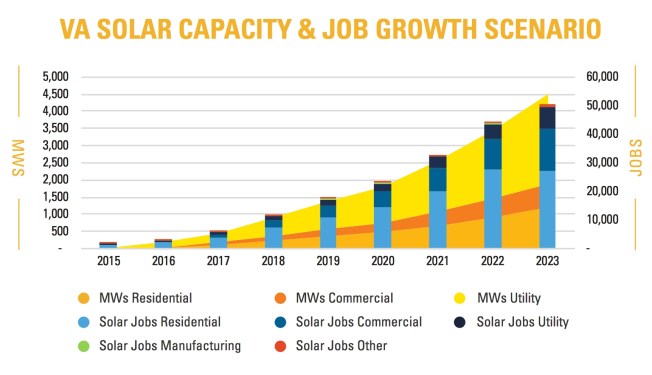
A new analysis from the non-profit Solar Foundation shows Virginia could create 50,400 jobs if it commits to building enough solar energy in the next five years to provide just 10% of our electricity supply.

The analysis takes the form of an “infographic” showing the implications of 10% solar. It would require building 15,000 megawatts of solar, divided among utility-scale solar farms, commercial installations, and the rooftops of houses. At the end of 2016, Virginia had a total of only 241 MW of solar installed, representing one-tenth of 1 percent of total electricity consumption. Getting to 10% by the end of 2023 would mean an annual growth rate of 61 percent. That would be impressive growth, but well below the 87 percent growth rate averaged by California and North Carolina over the past 6 years.

So 10% in five years should be doable. And indeed, viewed against the need to dramatically lower our carbon footprint, it seems like a very small step indeed. The McAuliffe administration wants to significantly cut statewide carbon emissions, and it is hard to see how we can do that without replacing the dirtiest fossil fuels with solar (and wind, and energy efficiency).

The good news is that the market is in our favor. Dominion Energy’s 2017 Integrated Resource Plan (IRP) identified utility-scale solar as the least-cost energy resource available in Virginia today. And participants in local cooperative buying programs for homeowners and businesses, known as “Solarize” programs, report payback times of under 10 years for rooftop solar, after which they will have nearly free electricity for 20 or 30 years.

Recent solar deals involving Amazon, Microsoft, and now Facebook show just how strong the demand is from customers. The very companies that our political leaders want so desperately to attract to Virginia are insisting on renewable electricity.

These deals demonstrate the direction of the market, and they will give an initial boost to solar employment, especially in the rural communities that are the best locations for solar farms. But restricting solar to a handful of new companies just coming into Virginia won’t get us to 15,000 MW and 10% solar. It’s also fundamentally unfair to the rest of us who are stuck with a dirty grid. Why should existing customers get left with polluting sources, while big tech companies get solar?

For us, Dominion’s IRP caps its solar plans at 240 MW per year, an amount it admits is arbitrary. In other words, Amazon got 260 MW, Facebook is getting 130 MW, but all the rest of Dominion’s customers put together will get just 240 MW per year.

As for customers who are determined to take matters into their own hands with rooftop solar, a host of unnecessary restrictions continue to limit growth. Virginia needs to put policies in place to push utilities to do more, to support local governments and schools that want solar, and to remove the barriers that limit private investment.

Solar companies around the state say if we can do that, they will do their part by hiring more Virginians. Here’s what some of them had to say about the 10% solar goal, and how to achieve it:

“We believe, as Virginians, that we can solve our energy challenges. Ours is a Virginia company founded and based in Charlottesville, and we are committed to building Virginia-based energy production facilities that benefit all Virginians. But the fact is that over the past few years our growth has come from business in other states. We have 26 employees in Virginia now, and we could increase that dramatically if Virginia promotes solar through policy changes that incentivize business owners to invest, allows competition, and supports the environmental message.” –Paul Risberg, President of Altenergy, Charlottesville

“The economics have never been better for solar in Virginia than they are right now. Prospect Solar has grown from two employees in 2010 to 16 full time employees today. Roles such as electricians, skilled labor, engineers, project managers, and sales people are integral to the success of each project. We hope Virginia will commit to a rapid, sustained buildout of all sectors of the solar industry, allowing us to continue adding local jobs.” –Andrew Skinner, Project Manager at Prospect Solar, Sterling

“Nationwide, the solar market was a 23 billion dollar industry in 2016. One out of every 50 new jobs in America was created by the solar industry last year. Sigora has been part of that. We have doubled in size in the past year and now employ 80 people in the Commonwealth.” –Karla Loeb, Vice President of Policy and Development for Sigora Solar, Charlottesville

“Local energy, local jobs, local investment. Our workforce is made up of local people—three of us went to Virginia Tech, one went to New River Community College, which has an Alternative Energy Program. An increase in demand of this scale would mean we’d hire more local people.” –Patrick Feucht, Manager of Baseline Solar, Blacksburg

“Residential and commercial rooftop solar has created most of the solar jobs in Virginia to date, and it has to be a part of the push to 10 percent. As we know, rooftop solar creates more jobs than utility solar, and these are good-paying, local jobs for local people. That’s one reason Virginia should lift the outdated 1 percent cap on net-metered solar, and leave the market open to anyone who wants to invest in their own home-grown energy supply.” –Sue Kanz, President of Solar Services, Virginia Beach

“Ten percent solar is a modest goal to shoot for given the strong economics of solar and the demand we are seeing from customers. Virginia has been held back by restrictive policies that have made it a ‘dark state.’ Reforming our policies would lead to a lot more economic development around solar.” –Tony Smith, President of Secure Futures LLC, Staunton


Unknown's avatar

New pipelines report shows the ACP is part of a widespread, systemic market failure

Photo courtesy of Chris Tandy.

Anyone who examines the corporate deals that underlie the Atlantic Coast Pipeline comes away with a strong sense of looking at a broken regulatory system. The Federal Energy Regulatory Commission (FERC) is supposed to approve only those pipelines that can demonstrate they are actually needed. Pipeline companies demonstrate need by showing that customers have contracted for most or all of the pipeline’s capacity. In the case of the ACP, Dominion Energy and its partners manufactured the need by making their own affiliates the customers of the pipeline.

What’s weird is that FERC seems to be okay with this. It recently approved another pipeline with a similar setup—the Nexus pipeline that will carry fracked gas from Ohio through Michigan to Canada. FERC ignored blatant self-dealing between the pipeline company and its regulated utility affiliate, including clear evidence the regulated utility affiliate increased its share of the pipeline’s capacity only to create a “need” for its parent company’s project.

A new report from Oil Change International concludes the U.S. is currently building unneeded fracked-gas pipelines as a result of FERC’s regulatory failures, including its failure to police self-dealing. The result will be excess pipeline capacity, paid for by regulated utility customers.

The primary cause of the overbuilding, and the reason companies like Dominion engage in self-dealing to create the impression of “need,” is that FERC sets an absurdly high rate of return on pipelines—14%, compared to a typical utility rate of return of 10%. FERC set the high rate back in 1997 when interest rates were double what they are now, so it was more expensive to build large infrastructure. FERC hasn’t changed the rate since then even though it is causing obvious market distortions—and creating an incentive for utilities to jump into the pipeline business.

What is even weirder is that Virginia’s State Corporation Commission seems to be okay with self-dealing, too. The ACP is also using affiliate contracts that commit the customers of state-regulated electric utilities (including Dominion Energy Virginia) to pay for the use of the pipelines.

The SCC’s job is to protect electric utility customers from precisely this kind of exploitation. These customers don’t have the option to walk away from the likes of Dominion Energy Virginia; they are required by law to get their electricity from that utility and no other. If the SCC looks at self-dealing and shrugs, where are the customers supposed to go for protection?

That’s why Virginia has a law called the Affiliates Act that requires SCC approval before a regulated utility can commit its customers to any contract or arrangement with an affiliated company. Dominion had to commit electricity customers to the ACP in order to show FERC the pipeline was needed. Yet Dominion never even asked the SCC for approval.

Recognizing the risk to ratepayers, the Sierra Club petitioned the SCC to require Dominion to comply with the Affiliates Act by disclosing the affiliate relationship and seeking approval of the arrangement that affects captive customers. Without SCC approval, Dominion would seem to be on thin ice telling FERC it has the contracts in place that demonstrate the “need” for the ACP.

One would have thought the SCC would jump at the chance to weigh in. The FERC filings show it will cost ratepayers three to four times more to use the ACP than to stick with the competing pipeline that Dominion already has long-tem contracts with.

But on September 19, the SCC denied the Sierra Club’s petition. One of the reasons cited was that Dominion will have to get SCC approval before it actually charges ratepayers for any gas carried by the pipeline.

Meaning, the SCC says it will consider the merits of the problem only after Dominion has secured FERC approval, and after the ACP has already ripped a 600-mile gash across the countryside, dispossessing landowners, tearing up forests, and endangering streams and water supplies.

Well, that poses a bit of a problem, doesn’t it? If the SCC turns down Dominion’s rate recovery request at that point, its decision will cancel out the very argument of “need” that Dominion and its partners used to get the ACP approved by FERC. Meaning, the ACP should never have been built.

But the pipeline will be there in all its razed-earth, $5 billion glory. What then? Perhaps Dominion will instead use the pipeline to serve its LNG export terminal at Cove Point or go hawking its expensive gas to new industrial customers, as some politicians hope. But more likely, this being Virginia, we would expect our General Assembly to order the SCC to grant rate recovery anyway, citing energy security or whatever fig leaf Dominion comes up with.

And a systemic market failure will leave Virginians, along with residents of other states, paying more to burn fracked gas for decades, unwillingly and unfairly doing our part to exacerbate the climate crisis.

Unknown's avatar

Virginia could soon have more than 2,500 MW of solar. We just need customers.

Photo by Activ Solar via Wikimedia Commons.

A review of the Virginia Department of Environmental Quality website reveals developers have at least started the permitting process for 64 solar farms across 40 jurisdictions, representing over 2,400 megawatts (MW) of solar capacity.

This includes projects that are already in operation, like the thousand-acre, 80 MW Amazon Web Services farm in Accomack that kicked off the solar gold rush here in 2015. Amazon also has another 5 projects in development. By the end of 2017, Amazon will have 260 MW of solar in Virginia, accounting for more than half the solar in the state.

The DEQ total only includes projects above 5 MW. It also omits another 94 MW of Dominion Energy projects permitted by the State Corporation Commission, all of which will be in operation by late fall. (Under legislation passed this year, Dominion’s projects will now also follow the DEQ Permit By Rule process, which applies to projects between 5 and 150 MW.)

In all, Virginia would have over 2,550 MW of utility-scale solar if all the projects were to be completed, at the maximum size for which they are seeking permits. But a closer look at the DEQ “notices of intent” suggests that so far the projects seem to have attracted only a limited number of customers: Amazon, our utilities, and the Commonwealth of Virginia itself.

Governor McAuliffe pledged that the Commonwealth would buy 110 MW of solar, enough to meet 8% of its electrical demand, split between onsite and offsite arrays. Announced deals include 18 MW at Naval Station Oceana and two projects totaling 32 MW that will serve the University of Virginia. The Commonwealth is also the off-taker of a project that provides Microsoft with RECs, to date the only announced deal involving a corporation other than Amazon.

Dominion Energy Virginia committed to 400 MW in 2015, and the utility’s 2017 integrated resource plan proposes a continuous build-out of 240 MW per year for the next 25 years. Old Dominion Electric Cooperative has also contracted for 30 MW of solar at two locations, with Dominion Energy owning the projects. Most recently, Central Virginia Electric Cooperative contracted for the output of two 5-MW solar farms. (These do not appear on the DEQ site.)

Where can we find more customers?

This leaves most proposed solar farms in Virginia without identified customers. Certainly, Dominion will prove to be the buyer for many, and there is no good reason it should stop at 240 MW per year. Appalachian Power is also considering sites in Virginia and West Virginia, but its appetite appears limited to 25 MW. The Commonwealth probably has a couple more deals in the works to complete McAuliffe’s pledge, and the next governor could up the ante—especially now we know that purchases by public colleges and universities count.

But for renewable energy to make a serious contribution to our energy supply, new customers have to commit. Fortunately they don’t need to sign onto Dominion’s half-baked green tariff proposal; they can contract directly with developers, as Amazon did initially. When Dominion Energy bought the first Amazon project from its from developer, the parties negotiated a special rate. Industry members say that deal is too complicated to serve as a model for others, but Dominion has indicated an interest in finding a solution.

Dominion’s participation was not necessary for Amazon to move forward, and it would not be required for other large customers to follow suit. In particular, a financial model known as a “virtual PPA” may offer an attractive option. In this arrangement, a large user contracts for the output of a solar or wind farm, but does not actually take delivery of the electricity. Instead, the power is sold into the wholesale market while the customer buys electricity from its utility as usual. The sale of electricity in the wholesale market offsets the cost of power purchased from the utility, acting as a hedge against rising energy prices. The customer gets the renewable energy certificates (RECs) to legally “green” its electricity supply.

A virtual PPA avoids treading on the monopoly power of a utility because it does not require a customer to take delivery of energy from the solar farm. According to Niels Crone of Customer First Renewables, a company that helps large businesses and institutions maximize the value of renewables, virtual PPAs could be a good option for customers located in Virginia.

Crone says that although virtual PPAs (as well as physical PPAs) deliver the greatest bottom-line benefit with larger projects, smaller customers can aggregate their demand to take advantage of economies of scale. That means the benefits don’t have to be limited to the Amazons of the world. Smaller corporations, universities, hospitals and even local government can band together to lower their energy costs—and make a positive impact on Virginia’s environment and economy.

Unknown's avatar

To Understand Pipeline Economics, Follow the Money

By Thomas Hadwin

I have worked for electric and gas utilities in other states, so I am interested in seeing a modern energy system developed in Virginia. I prefer to find solutions where everyone wins, but Virginia is currently split between those who want to protect our land and waters and those who want the lower cost energy and jobs they think pipelines will bring. We can find ways where all interests are served, but we will have to reshape the plans that have been proposed.

The promised economic benefits are what have motivated many political and business leaders to support the Atlantic Coast Pipeline (ACP). Let’s set aside the environmental issues and focus on the economics. In dealing with contentious issues, it’s often hard to find agreement on the “facts.” We can avoid disagreement by using information that the pipeline owners (Dominion Energy, Duke Energy, and Southern Company, the parent company of Virginia Natural Gas) have filed with the Federal Energy Regulatory Commission (FERC).

To show FERC that a new pipeline would be needed, the pipeline owners had their utility subsidiaries in Virginia and North Carolina sign 20-year firm transportation agreements with the Atlantic Coast Pipeline. FERC’s own guidelines say that this is not enough to prove true market need for a new pipeline, especially if the companies signing those contracts are owned by the pipeline developers. U.S. Department of Energy studies and reports from independent consultants show that existing pipelines can provide all of the gas we need in Virginia and North Carolina. Unfortunately, FERC has not requested any substantive data to prove the need for a new pipeline. Signed contracts are all that have been used to approve pipelines for the past several decades and it appears that this substandard practice will continue.

Dominion claims that the cost savings provided by the ACP are enough to prove it is necessary. Will the ACP actually save ratepayers money in Virginia and North Carolina? Enough to spur new job creation, as has been advertised? The truth is revealed by examining who pays for the $5 billion ACP, and how much it costs compared to other options.

Data filed with FERC show the ACP will cost customers more than existing pipelines

Pipelines charge a fee to transport natural gas. The gas itself is purchased separately. Traditionally, large users of natural gas, such as utilities, have signed long-term contracts to reserve capacity on a particular pipeline. These contracts must be paid in full, whether or not all of the capacity is used. Having the capacity reserved assures that natural gas can be delivered when it is needed and reduces the price volatility compared to paying for pipeline transportation only as it is needed.

Capacity reservations can be a good idea, but not when the cost of the long-term contract is far higher than other alternatives. Based on the fee and the capacity reservation filed with FERC, Dominion’s utility customers could be obligated to pay over $4 billion during the next 20 years to the ACP for the long-term transportation agreement.

Existing pipelines, currently serving Virginia, can transport the same or greater amount of gas as the ACP for a much lower cost, because existing pipelines have been mostly paid for by previous customers. Using gas prices from May of this year, which show a price advantage at the Dominion South zone (the source of supply used by the ACP), the total price of gas delivered by the ACP to Dominion’s Brunswick plant would be 28% more expensive than gas delivered by the connection to the Transco pipeline built in 2015. The fee to use the ACP is over three times more expensive than using the Transco connection. Using existing pipelines in other parts of the state would save even more money compared to the ACP.

The ACP will be one of the most expensive pipelines on the East Coast. The fee to transport gas using the ACP is over 60% of the current price of natural gas. If this seems like a lot to pay just for transportation, it is. A fee this high raises the delivered price of gas compared to what can be delivered by other pipelines.

Dominion study shows savings from the ACP, but doesn’t tell the whole story

The study used by Dominion to publicize the presumed $377 million per year cost savings from the ACP examined a short-term phenomenon that was over in 2016, but was assumed to last until 2038. The calculation of savings during that anomalous period was extended over twenty years and subjected to a magic multiplier to increase the apparent savings even more. But the study left out one important factor, the cost of transportation. If the FERC rate for using the ACP to transport the gas was added to the savings in the price of gas during this especially favorable period, there would be no savings, just added costs.

The ACP is more expensive than using existing pipelines

As new takeaway pipelines are added in 2017-2018 to the production zone used by the ACP, it is expected that the gas price in this zone will equalize with other regions, so that the difference in the price of delivered gas will be due mainly to pipeline transportation costs. This will put the ACP at a considerable disadvantage to other alternatives. Using the ACP to deliver gas over the long-term is far more expensive than using existing pipelines.

Long-term agreements with existing pipelines cost money too, and differences do occur from time to time between production zones. An independent analysis identifies that using the ACP in Dominion’s territory compared to existing pipelines will create a net cost to ratepayers of $1.6 to $2.3 billion over the next 20 years. Perhaps about half that amount would be an extra cost to Virginia Natural Gas customers to use the ACP rather than connections to existing pipelines during that same period. In general terms, the ACP would add about $3 billion in costs to Virginia energy consumers over the next 20 years. The ACP will raise energy costs and therefore, diminish job creation, exactly the opposite of what has been claimed.

Can existing pipelines deliver the gas? Dominion’s actions say yes.

Dominion argues it can’t get enough gas from other pipelines, but its actions indicate otherwise. The ACP’s FERC application identifies that the Columbia Gas Pipeline can deliver Dominion’s full allotment of gas from West Virginia to Virginia for use in power plants. Columbia Gas is adding about 87 percent of the capacity of the ACP to its system in the region. Transco is adding 400 percent of the capacity of the ACP to its corridor moving southbound through Virginia and North Carolina. Dominion says the capacity being added to the Columbia Gas and Transco systems isn’t available. Yet Dominion obtained capacity from Transco for use at the Cove Point LNG plant that it claims is “unavailable” for use in power plants.

Cabot Oil & Gas Corp., the gas supplier over the Transco Pipeline to Cove Point, plans to increase production by 1.7 Bcf/d (more than the capacity of the ACP) in the next two years. Dan Dinges, Cabot’s CEO, says Cabot is getting calls “from various people looking to secure . . . long-term supplies . . . and we are definitely answering those calls.”

It certainly appears that Dominion could receive its full allotment of 0.3 Bcf/d using existing pipelines, much cheaper than using the ACP, if only it was willing to ask.

Gas service to southeast Virginia and to North Carolina could be accomplished with connections to existing pipelines, mostly over existing rights-of-way, at a fraction of the cost and impacts associated with the ACP. Southeast Virginia could obtain as much, or more, natural gas using a connection to existing pipelines, entirely over existing rights-of-way. The region could have its own source of supply for 80 years for a fraction of the price it would pay for the 20-year contract with the ACP.

North Carolina would receive as much, or more, capacity to supply the same customers in the same locations as proposed by the ACP. A connection to Transco would be made over 105 miles of the Cardinal Pipeline corridor, then connect to the last 90 miles of the ACP right-of-way to serve the same delivery points. This shorter pipeline would meet the same needs but save North Carolina residents billions of dollars compared to the ACP and avoid disruption of West Virginia and Virginia mountains and pristine streams, as well as national forest lands.

Connections to the Transcontinental Pipeline corridor serve the same customers in North Carolina as the ACP, saving billions.

With demand for natural gas slowing, rushing to build the ACP risks making a costly mistake

Dominion and Duke have been scaling back the number of gas-fired units that require service from the ACP and pushing back the expected dates for initial operation. Just this year, the two companies cut in half the number of large gas-fired power plants needed in the next 15 years. The first unit is not needed until 2025, in Virginia. There is no need to rush through the regulatory process. We have time to do a thorough evaluation of the need, costs and impacts of new pipeline projects.

Growth in U.S. natural gas use has slowed markedly, further undermining the ACP’s need argument and the artificial sense of urgency to gain regulatory approvals. An industry analyst says, “With domestic demand gains slowing across power burn, residential, commercial, and industrial, the North American gas market must find new levers to pull. It is likely that the biggest demand lever for the U.S. gas market over the next five years and beyond will be LNG exports.” This statement indicates that the rapid growth in natural gas use is not shaping up as policymakers were led to believe. The industry is looking to greater LNG exports as a way to increase natural gas prices and rescue Wall Street’s failing investments in natural gas developers.

As the red line of the chart shows, pipeline capacity in the Appalachian Basin is growing much faster than the supply of natural gas.

The Appalachian Basin is not producing enough gas to fill all of the pipelines that are currently in front of FERC for approval. The production of natural gas would have to increase by 50 percent in the Marcellus/Utica shale plays to fill the pipelines currently proposed over the next several years. Rather than reducing the number of pipelines built, the industry is suggesting that we need to drill for more gas.

Australia tried to use its ample reserves of natural gas to increase domestic use and LNG exports. They converted many factories to natural gas in hopes of creating more jobs. Instead of greater prosperity, domestic gas prices rose 3-4 times in 10 years, factories closed or converted back to coal, and utility bills skyrocketed.

Learning from others’ mistakes: Florida’s example

The ACP is not the only pipeline project to overestimate demand. Further south, Sabal Trail, the most recent pipeline to go into operation, is running at 25% capacity, all of it taken from existing pipelines. This new pipeline, in rapidly growing Florida, was promoted as being absolutely necessary to meet growth in natural gas demand by its utility holding company owners, NextEra and Duke Energy. Yet, total natural gas usage in Florida is down 4% over last year, undercut by cheaper renewables.

If Virginia’s families and businesses lose, who wins?

It can be puzzling to understand why utility holding companies want to build a pipeline if it isn’t needed. It seems unlikely that an unregulated, private corporation would invest billions of dollars in a project the market doesn’t support. The answer has to do with the way the utility subsidiaries are compensated. Our utilities get paid more when they build more. Today, there is little reason to build new power plants, because demand for electricity is no longer growing nationwide, even though there is growth in our economy and population. Demand for electricity in Virginia is growing only because of new data centers and Dominion’s studies show that growth from that source will taper off by 2023.

FERC offers a 50% higher return for gas pipelines than for interstate transmission lines. The holding company executives are making what they see as a prudent decision to chase this extra money, while revenues from their utility subsidiaries are flat, and shift the risk and higher costs to the utility ratepayers.

A choice that is good for the shareholders but bad for the ratepayers is not one that we should encourage. A company cannot be successful in the long run setting the interests of its owners against the interests of its customers. If Dominion builds the pipeline and successfully convinces the SCC to pass on the full costs of the 20-year agreements to the ratepayers, customers will pay billions more for no benefit. This would give them a reason to do less business with Dominion in the long run (using energy efficiency and self-generation with solar to reduce their usage). The higher costs due to the pipeline would create a less healthy state economy and a less healthy utility.

We need to create different approaches where everyone can benefit. To do that, we must reset the role of our utilities and pay them differently so they can prosper when they serve us better, as other states are doing.

Given that the economic benefits we have been promised will not materialize, we should ask the state and federal regulators to fully analyze the need for this project and make a thorough assessment of its impacts. We have the time. The process could take two more years and still not affect the operation of any of the new power plants in Virginia or North Carolina that were used to justify the pipeline.


Thomas Hadwin

Waynesboro, VA

Thomas Hadwin worked for electric and gas utilities in Michigan and New York.  He led a department which was responsible for the site selection and approval of multi-billion dollar projects working with state and federal agencies, as well as assuring that all company facilities complied with existing environmental regulations.  He founded a computer and telecommunications business about which the Wall Street Journal wrote an article describing its innovative business model.  As a “healer of businesses” he helped ailing companies throughout the U.S. get back on their feet.  He is currently working to help establish a 21st century energy system for Virginia.