[A downloadable PDF of this guide is available here.]
Introduction
Advocates for wind and solar finally begin to feel cautiously optimistic about the prospects for clean energy in Virginia. Prices for wind and solar have dropped to the point where the question is no longer whether they can compete with fossil fuels, but whether fossil fuels can compete with them. Support for renewable energy is high in the General Assembly, new solar projects are popping up across the state, and interest in offshore wind is on the rise again, after a years-long nap.
Still, Virginia’s energy laws were written by and for monopoly utilities that are heavily invested in coal, gas and nuclear. The Virginia Code contains a thicket of barriers that protect utility profits from competition and limit the options of developers, consumers, local governments and businesses.
This survey of current policy is intended to help decision-makers, industry, advocates and consumers understand what options for wind and solar exist today, where the barriers lie, and what we could be doing to take fuller advantage of the clean energy opportunities before us.
A few disclaimers: I don’t cover everything, the opinions expressed are purely my own, and as legal advice it is worth exactly what you’re paying for it.
- Overview: Virginia making headway on solar, but still no wind
|
Virginia |
Maryland |
North Carolina |
W. Virginia |
Tennessee |
| Solar* |
631.26 |
932.7 |
4,411.65 |
6.05 |
236.36 |
| Wind** |
0 |
191 |
208 |
686 |
29 |
| Total |
631.26 |
1,123.7 |
4,619.65 |
692.05 |
265.36 |
Installed capacity measured in megawatts (MW) at the end of 2017. One megawatt is equal to 1,000 kilowatts (kW).
*Source: Solar Energy Industries Association **Source: American Wind Energy Association
Virginia installed almost 400 megawatts (MW) of solar last year, bringing the total at the end of 2017 to 631 MW, up from 238 at the end of 2016. This nudges us closer to Maryland, though it leaves us further behind North Carolina than ever.
Most of the Virginia solar to date has been installed to serve large tech companies, not the general public. This reflects the companies’ renewable energy commitments, their buying power, and their willingness to pursue new financing models that make the most of solar’s increasingly low cost.
Corporate demand will likely continue to drive the majority of Virginia installations in the near term, but Virginia utilities are starting to add solar to the resource mix that serves ordinary customers.
On the other hand, Virginia remains the only state in our 5-state neighborhood without a wind farm. To be fair, all 5 states have been stuck in the doldrums; an American Wind Energy Association update showed no new wind farms opening in any of them in 2017. That leaves Apex Clean Energy’s 75 MW Rocky Forge wind farm still in limbo; it received its permit more than a year ago and remains construction-ready whenever a buyer shows up.
Among the recent developments showing momentum for solar:
- In 2017, Dominion Energy Virginia acknowledged for the first time that solar had become the cheapest form of energy in Virginia. In May of this year, a news source reported that the utility’s parent company, Dominion Energy, has given up on building any new combined-cycle (baseload) gas plants and will build only large solar plants, though the company proposes many more of the smaller gas combustion turbines.
- A new law passed in 2018 (SB 966) puts 5,000 MW of utility wind and solar “in the public interest,” although this language is not a mandate.
- The 2018 law also makes it in the public interest for utilities to develop up to 500 MW of distributed solar (some parts of the bill say just 50 MW).
- Dominion’s 2018 Integrated Resource Plan (IRP) includes up to 6,400 MW by 2033 in most of the scenarios it modeled. The IRP is not binding, but it gives regulators and the public a look into how a utility plans to meet customer demand over a 15-year period.
- Some rural cooperatives and municipal electric utilities in Virginia are now adding solar.
- Solar projects keep getting bigger. A few years ago, a 20 MW solar farm was considered huge; today it is at the low end for utility-scale. In 2015 Amazon Web Services stunned us all by announcing an 80 MW facility. By the end of 2017 it had contracted for 260 MW of solar in Virginia, including a 100 MW project. In March of this year Microsoft announced it had reserved 315 MW of a planned 500 MW project.
- An analysisby the Solar Foundation found that Virginia could add over 50,000 jobs by building enough solar to meet 10% of the Commonwealth’s electricity supply over five years.
The Virginia Department of Environmental Quality (DEQ) website contains a list of projects that have begun the permitting process under Virginia’s permit-by-rule provisions, which govern projects up to 150 MW. Larger projects need permission from the State Corporation Commission (SCC). All projects must also obtain local permits.
Like onshore wind, offshore wind still hasn’t taken off in Virginia. In 2014 Dominion Energy Virginia won the right to develop an estimated 2,000 MW of wind power offshore of Virginia Beach, but it still hasn’t offered a timeline for a commercial offshore wind project or even included one in its IRP. The 2018 IRP does include Dominion’s two-turbine, 12 MW pilot project, with a projected in-service date of 2021. Last year Dominion formed a partnership with Danish energy giant Ørsted (formerly DONG Energy) to see the pilot project through.
- Customers’ ability to purchase renewable energy is still limited
Currently, the average Virginia resident or business can’t pick up the phone and call their utility to buy electricity generated by wind and solar farms. Customers of a few rural cooperatives are the exception; see the next section on green power programs, and section 4 on community solar.
Section 56-577(A)(6) of the Virginia code allows utilities to offer renewable energy tariffs, and if they don’t, customers are supposed to be able to go elsewhere for it. Neither of our two major investor-owned utilities, Dominion Energy Virginia (formerly Dominion Virginia Power) and Appalachian Power Company (APCo), currently has an approved tariff for renewable energy. The SCC has previously rejected renewable energy tariffs from APCo and Dominion that the SCC ruled were not in the public interest, mostly because they were too expensive.
Both utilities are trying again. APCo’s latest proposed renewable energy tariff, dubbed Rider WWS, combines wind, hydro, and new solar, and would cost residential customers a premium of 4.25 percent over brown power—a huge drop from the 18 percent increase associated with the earlier, rejected program. (The case is PUR-2017-00179.)
Dominion’s new renewable energy tariff is intended for residential and non-residential customers with a peak demand of less than 1 MW. Rate Schedule CRG-S (case PUR-2017-00157) would consist of hydro, wind and new solar, but possibly also other sources from within the PJM region. Dominion calculates the premium at 17.87 percent over brown power, a surprisingly high premium given how cheap solar, wind and hydro have become.
The SCC has not yet ruled on either program, so it is not clear when, or if, Dominion and APCo will implement these renewable energy tariffs.
Can you go elsewhere? Since the State Corporation Commission has ruled that REC-based programs do not qualify as selling renewable energy, under the terms of §56-577(A)(6), customers are currently permitted to turn to other licensed suppliers of electric energy “to purchase electric energy provided 100 percent from renewable energy.”
That means you should be able to go elsewhere to buy wind and solar, at least for the limited time before Dominion and APCo can get tariffs approved. But Virginia utilities claim that the statute’s words should be read as requiring not only that another licensed supplier provide 100% renewable energy, but that it also supply 100% of the customer’s demand, all the time. Obviously, the owner of a wind farm or solar facility cannot do that. Ergo, say the utilities, a customer cannot really go elsewhere.
In spite of the roadblocks, an independent power seller called Direct Energy announced plans in 2016 to sell a renewable energy product to Virginia residents in Dominion’s territory. (The company described the product as a combination of wind and municipal waste biomass.) Dominion fought back, but in 2017 the SCC confirmed Direct Energy’s right to enter the Virginia market; however, the SCC also ruled that Direct Energy will have to stop signing up customers once Dominion has its own approved renewable energy tariff.
Legislation defeated in the General Assembly this year would have allowed customers of Dominion and APCo to purchase electricity generated 100 percent from renewable energy from any supplier licensed to business in the state, regardless of whether the utility had its own approved program.
Ron Cerniglia, Director of Corporate and Regulatory Affairs for Direct Energy, says Direct Energy “will be ready to begin offering a full suite of product and service offerings that customers currently receive in other competitive markets including a 100% renewable product by August to non-residential customers (e.g, commercial and industrial) within the Dominion Virginia Power service territory.”
Dominion will soon have a solar option. Legislation passed in 2017 under the misleading banner of “community solar,” authorizes Dominion and APCo to contract for power from solar farms to sell to consumers. Dominion’s program is awaiting approval at the SCC (case PUR-2018-00009). Rider VCS will be available to all retail customers at a premium of about 2.01 cents/kWh in the first year. As of this writing, APCo does not appear to have proposed a similar program.
The legislation states that these “community solar” programs explicitly do not count as ones selling “electric energy provided 100 percent from renewable energy,”though ironically, they may be the first programs from Dominion and APCo to do exactly that for residential and small commercial consumers.
Large customers have more options. As discussed in section 14, Dominion has worked with large tech companies, including Amazon, Microsoft and Facebook, to meet their demands for electricity from solar. Customers of this size also have the market power to sidestep utility control to achieve their aims through the wholesale energy market.
Other companies, institutions, and even local governments can aggregate their demand to achieve the same result, without affecting their retail purchase contracts with their utility (and thus not incurring the ire of the utility). For example, the Northern Virginia Regional Commission has hired a consultant to help area governments develop large-scale solar projects using a wholesale power purchase agreement, an undertaking I wrote about last fall.
- “Green power” products: mostly brown power painted green
Instead of offering renewable energy tariffs, for years Dominion and APCo have offered voluntary programs under which the utilities pay brokers to buy renewable energy certificates (RECs) on behalf of the participants. Participants sign up and agree to be billed extra on their power bills for the service. Meanwhile, they still run their homes and businesses on regular “brown” power.
As I wrote a few years back in What’s wrong with Dominion’s Green Power Program, there is little evidence that voluntary RECs from Midwestern wind farms are driving any new renewable energy, whether you buy them from a utility or a third-party supplier like Arcadia. But if you’re considering this route, read this post first so you understand what you are getting. Personally, I recommend instead making monthly tax-deductible donations to GRID Alternatives to put solar on low-income homes.
The situation is better with some rural cooperatives. Old Dominion Electric Cooperative (ODEC), which supplies power to most of Virginia’s coops, signed long-term contracts for the output of three wind farms in Maryland and Pennsylvania, which it resells to some member coops. Customers of participating coops can choose to buy wind power for an additional cost. (See the information posted by Shenandoah Valley Electric Cooperative as an example.) ODEC has contracted for two solar farms in Virginia as well.
But not all coops do this. Most have REC-only offerings. In the case of Rappahannock Electric Cooperative, the RECs come from a biomass plant somewhere “in the greater mid-Atlantic area.” That is, customers voluntarily pay extra to subsidize the burning of trees for power, probably at a facility out of state. Because of wood’s high moisture content, this kind of biomass is a highly polluting way to make energy and an important source of carbon dioxide emissions, calling into question the value of the program to customers who want to support renewable energy.
- Community solar: what’s in a name?
Community solar, in its purest form, enables people to work together to develop and own a solar facility in their community for the use of all the participants. This kind of community solar is not currently an option in Virginia. Solar advocates have introduced enabling legislation for several years running, but it has been defeated every year in the face of utility opposition.
Two Virginia rural electric cooperatives offer programs that come close. In both cases, the coop has contracted for the output of a solar project in its territory and offers shares of the electricity to coop members. BARC, in southwestern Virginia, was the first to offer such a program, using a small 500 kW solar facility. This year Central Virginia Electric Cooperative(CVEC) launched a 4 MW program. Subscribers can lock in the rate for 20 years, one of the most attractive features of community solar.
As noted in Section 2, legislation enacted in 2017 enables a kind of pseudo-community solar controlled by a utility. Using this authority, Dominion has contracted for the development of a number of smaller (up to 2 MW) solar projects around Virginia, and will offer customers the option of paying a 2.01 cents/kWh premium to buy solar. Unlike a true community solar program (or CVEC’s), the price is not fixed but will change annually based on market factors, and it includes a profit margin for Dominion.
It looks like a renewable energy tariff, and it quacks like a renewable energy tariff, but all concerned call it community solar. The program now awaits approval by the SCC (case PUR-2018-00009) and is expected to be available to Dominion customers by the end of the year.
- Virginia’s RPS: modest, and with much to be modest about
Most states have adopted renewable portfolio standards (RPS) or other mandates to require utilities to build or buy renewable energy. Leading states have been ratcheting up their percentages while tightening the rules for what qualifies, giving priority to new wind and solar.
Virginia is not among these leading states.
Virginia Code §56-585.2 creates a voluntary RPS, which means utilities have the option of participating but don’t have to. Renewable energy is defined in §56-576 to include not just wind, solar, and falling water, but also highly polluting forms of energy like trash incineration and burning trees, a/k/a biomass (“sustainable or otherwise”), as well as old, large hydroelectric plants that don’t qualify for other states’ programs. Utilities are also allowed to include up to 20% of RECs from renewable energy research and development activities, providing a subsidy to a few Virginia universities with good lobbyists.
Utilities demonstrate compliance with the RPS through the retirement of renewable energy certificates (RECs). The SCC insists that utilities take a least-cost approach to meeting the RPS, which means RECs from trash incinerators, wood burning, and old out-of-state hydro will always edge out wind and solar, simply because there is little competition for those junky RECs. If utilities build wind and solar, they are required to sell the high-value RECs from these projects (to utilities out of state or to the voluntary market) and buy low-cost junky ones instead. Thus, no matter how much solar Dominion builds, customers will never see solar as part of the RPS.
Perhaps it goes without saying that the RPS makes no provision for Virginia utilities to buy RECs from solar homes or businesses.
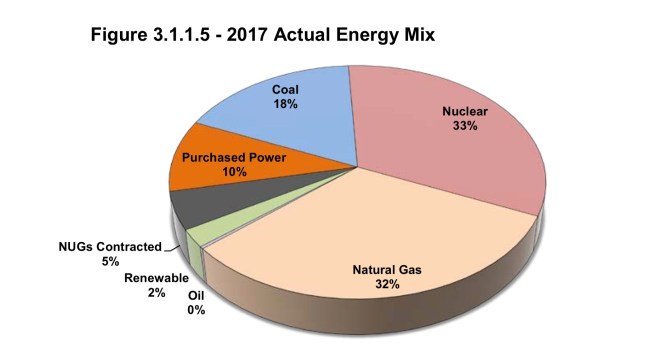
The targets are also modest to a fault. Although nominally promising 15% renewables by 2025, the statute uses a 2007 baseline, ignoring load growth, and contains a sleight-of-hand in the definitions section by which the target is applied only to the amount of energy after nuclear is excluded. Nuclear makes up a third of Dominion’s energy mix. Thus the combined result is an effective RPS target of well under 10% in 2025.
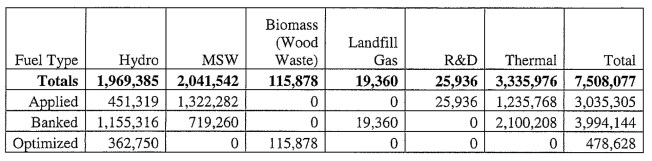
According to Dominion’s 2017 Annual Report to the State Corporation Commission on Renewable Energy, the “fuel” types used to meet the RPS in 2016 consisted entirely of hydro, municipal solid waste incineration, woody biomass, landfill gas, research and development, and “thermal energy” (another unusual source). The in-service dates of facilities generating renewable energy or RECs range from the 1910s to the 2010s, with the majority clearly pre-dating adoption of the RPS. Almost half the energy or RECs come from out of state. The report does not say who Dominion bought and sold RECs from and to, or for how much.
The General Assembly has rejected numerous bills to make the RPS mandatory, and efforts to narrow the definition of renewable energy have repeatedly failed in the face of utility and other industry opposition. The utilities have offered no arguments why the goals should not be limited to new, high-value, in-state renewable projects, other than that it would cost more to meet them than to buy junk RECs.
But with the GA hostile to a mandatory RPS and too many parties with vested interests in keeping the kitchen-sink approach going, it is hard to imagine our RPS becoming transformed into a useful tool to incentivize wind and solar.
That doesn’t mean there is no role for legislatively-mandated wind and solar. But it would be easier to pass a bill with a simple, straightforward mandate for buying or building a certain number of megawatts than it would be to repair a hopelessly broken RPS. The GA passed up an opportunity to do just that in this year’s SB 966, which makes up to 5,500 MW of solar and wind “in the pubic interest,” but not mandatory.
Short of that, the GA could require that Dominion apply the RECs from its solar projects to the voluntary RPS, instead of selling them, and allow the utility to buy other RECs only to fill any gaps left over.
- Customer-owned generation
The low cost of solar panels and the federal 30% tax credit make it cost-effective for most customers to install solar on a sunny roof or field, with homeowners reporting payback periods of less than 10 years. The federal tax credit will be available in full for projects that commence construction by the end of 2019. It drops to 26% for projects commenced in 2020 and 22% for projects commenced in 2021. Thereafter it drops to 10% for commercial and utility projects but disappears for homeowners entirely. Virginia itself offers no cash incentives or tax credits for wind or solar.
The emergence of bulk purchasing coops, sometimes also called “solarize” programs, such as those offered through nonprofits Solar United Neighbors of Virginia and LEAP, makes the process easy for homeowners and businesses and reduces costs.
Virginia allows net energy metering at the retail rate, though with limits (see section 7). Commercial customers can also reap the advantages of solar in reducing high demand charges.
In 2016 the General Assembly passed legislation enabling Property Assessed Clean Energy (PACE) loans for commercial customers. Localities now have an option to offer low-cost financing for energy efficiency and renewable energy projects at the commercial level. Arlington County has launched the first C-PACE program and is accepting applications now. Several other counties have initiated studies or are developing their own programs. PACE is not available for residential customers.
The lack of a true RPS in Virginia means Virginia utilities generally will not buy solar renewable energy certificates (SRECs) from customers. Back in the old days utilities in other states would buy SRECs generated in Virginia, but those markets have gradually closed. Pennsylvania, which had been the last remaining SREC market for Virginia residents, closed its borders last year.
The fact that the federal tax credit is such an important part of financing solar presents a challenge to customers who don’t pay any taxes, or enough taxes to use the credit. This includes non-profits, government entities, and low-income residents. Third-party financing offers a viable solution for tax-exempt entities, where available (see Section 10), but serving low-income residents remains a challenge.
- Limits on retail net metering
Section 56-594 of the Virginia Code allows utility customers with wind and solar projects to net energy meter at the retail rate. System owners get credit from their utility for surplus electricity that’s fed into the grid at times of high output, such as during the middle of a sunny day. That offsets the grid power they draw on when their systems are producing less than they need. Their monthly bills reflect only the net of the energy they draw from the grid.
Residential customers can net meter systems up to 20 kW, although standby charges will apply to those between 10 and 20 kW, generally making the larger sizes uneconomical.
Commercial customers can net meter up to 1,000 kW (1 MW). There is an overall cap of 1% of a utility’s peak demand that can be supplied by net metered systems (as measured at their rated capacity).
If a system produces more than the customer uses in a month, the credits roll over to the next month. However, at the end of the year, the customer will be paid for any excess credits only if they have entered a power purchase agreement with the utility. This will likely be for a price that represents the utility’s “avoided cost” of about 4 cents, rather than the retail rate, which for homeowners is about 12 cents. This effectively stops most people from installing larger systems than they can use themselves.
In 2015, the definition of “eligible customer-generator” was tightened to limit system sizes to no larger than needed to meet 100% of a customer’s demand, based on the previous 12 months of billing history. The SCC wrote implementing regulations (see20VAC5-315-10 et seq.) but failed to address what happens with new construction; in practice, utilities have simply told customers how much they can install.
In 2018 the House Commerce and Labor subcommittee on energy defeated a bill that would have increased the limit to 125% of previous demand and extended this to new construction, for residents in Dominion territory. Dominion had agreed to the change, recognizing that there is already a financial disincentive for customers to install more solar than they can use.
A number of other barriers also restrict customer solar. A building owner cannot install a solar facility and sell the output to tenants. A condo association or homeowners association cannot build a central solar facility to share the output. The owner of two or more separately metered buildings cannot share the output of a solar facility on one building with another building, with a limited exception for farmers (see section 8). A local government cannot install a solar facility at one site to serve another site.
These barriers reflect an argument, promoted by utilities, that customers who install solar for their own use don’t pay their fair share of the upkeep of the grid, shifting costs to those who don’t own solar. A range of “value of solar” studies in other states have generally found the reverse, concluding that distributed solar provides a net benefit to utilities, other customers, and society at large. A stakeholder group in Virginia completed the initial phase of a value of solar study in 2014 but got no further after the utilities pulled out of the process.
Over many years the utilities and the solar industry have tried to resolve their differences on net metering, without success. Efforts began in 2013 with the Small Solar Working Group, a broad stakeholder group facilitated by DEQ. That morphed into the Solar Working Group in 2014, then collapsed when the utilities walked away from a “Value of Solar” report the group drafted. In 2016 the utilities and the solar industry began meeting again privately in the “Rubin Group” (named for the moderator, Mark Rubin). This group produced consensus legislation in 2017 and 2018, primarily enabling the utilities to pursue their own solar goals, but they found no common ground on customer-owned solar.
In the absence of state tax credits or rebates, net metering remains critical to the financial viability of most customer-owned solar, making solar installers unwilling to give it up. For their part, utilities have put themselves into a box by insisting that customers ought to share grid costs equally. Reaching a resolution that allows the private solar market to grow will require taking the top off the box and valuing benefits as well as costs.
The issue is poised to come to a head this year. In addition to ongoing Rubin Group discussions, the Northam Administration has announced that net metering issues will be one focus of attention as the Department of Mines, Minerals and Energy (DMME) develops the 2018 Energy Plan, due at the end of October. DMME appears to have handed the solar work over to Dominion, which, as part of 2018’s SB 966 legislation, had tasked itself with conducting a study of net metering. Dominion has hired a consultant, Meridian Institute, “to design and facilitate a stakeholder engagement process” to consider “improvements” to net metering.
- Agricultural customers and meter aggregation
Under a bill passed in 2013, owners of Virginia farms with more than one electric meter are permitted to attribute the electricity produced by a system that serves one meter (say, on a barn) to other meters on the property (e.g., the farmhouse and other outbuildings). This is referred to as “agricultural net metering.” Unfortunately, there have been complaints from installers about a lack of cooperation from utilities in actually using this provision.
Advocates had hoped that agricultural net metering would be a first step towards broader meter aggregation options, but 2017 legislation instead took agricultural customers in a new direction. Farmers can now elect to devote up to a quarter of their acreage to solar panels, up to 1.5 MW or 150% of their own electricity demand. The electricity must be sold to the utility at its avoided cost, while the farmer must buy all its electricity from the utility at retail. A farmer who chooses to do this cannot also use agricultural net metering. Agricultural net metering will be terminated entirely in 2019 in territory served by electric cooperatives, though existing customers are grandfathered.
- Homeowner associations cannot ban solar (but they sure keep trying)
Homeowner association (HOA) bans and restrictions on solar systems have been a problem for residential solar. In the 2014 session, the legislature nullified bans as contrary to public policy. The law contains an exception for bans that are recorded in the land deeds, but this is said to be highly unusual; most bans are simply written into HOA covenants. In April of 2015 the Virginia Attorney issued an opinion letter confirming that unrecorded HOA bans on solar are no longer legal.
Even where HOAs cannot ban solar installations, they can impose “reasonable restrictions concerning the size, place and manner of placement.” This language is undefined. The Maryland-DC-Virginia Solar Energy Industries Association has published a guide for HOAs on this topic.
Because of the vagueness of “reasonable restrictions,” HOAs continue to be a problem for many would-be solar homeowners.
- Limits on third-party financing (PPAs)
One of the drivers of solar installations in other states has been third-party ownership of the systems, including third-party power purchase agreements (PPAs). In a typical third-party PPA, the customer pays no money upfront and is charged only for the power produced by the system. At the end of the contract, or at some intermediate point, the customer usually can buy the system outright at a greatly reduced cost.
For customers that pay no taxes, including non-profit entities like churches and colleges as well as local government, PPAs are an especially important financing tool because they can’t use the 30% federal tax credit to reduce the cost of the system if they purchase it directly. Under a PPA, the system owner can take the tax credit (as well as accelerated depreciation) and pass along the savings in the form of a lower electricity price.
The Virginia Code seems to sanction this approach to financing solar facilities in its net metering provisions, specifically §56-594, which authorizes a “customer generator” to net meter, and defines an eligible customer generator as “a customer that owns and operates, or contracts with other persons to own or operate,or both, an electrical generating facility that . . . uses as its total source of fuel renewable energy. . . “ (emphasis added).
Notwithstanding this provision, in 2011, when Washington & Lee University attempted to use a PPA to finance a solar array on its campus, Dominion Virginia Power issued cease and desist letters to the university and its Staunton-based solar provider, Secure Futures LLC. Dominion claimed the arrangement violated its monopoly on power sales within its territory.
Given the threat of prolonged and costly litigation, the parties turned the PPA contract into a lease, allowing the solar installation to proceed but without the advantages of a PPA. (Note that PPAs are sometimes referred to as “leases,” but they are distinct legally. Leasing solar equipment is like renting a generator; both provide power but don’t involve the sale of the electricity itself. I have never heard of a utility objecting to a true lease.)
In 2013 Dominion and the solar industry resolved the dispute via compromise legislation that specifically allows customers in Dominion territory to use third-party PPAs to install solar or wind projects under a pilot program capped at 50 MW. Projects must have a minimum size of 50 kW, unless the customer is a tax-exempt entity, in which case there is no minimum. Projects can be as large as 1 MW. The SCC is supposed to review the program every two years beginning in 2015 and has authority to make changes to it. I’m not aware the SCC has reviewed the program to date.
Although the program got off to a slow start, PPA projects are beginning to come online at a rapid clip, and solar companies say an increase in the program size will be needed so installations don’t suddenly stall.
Outside of Dominion territory, the story is less rosy. Appalachian Power and the electric cooperatives declined to participate in the PPA deal-making. In 2017, the legislature passed a bill to allow private colleges and universities—but no one else—in APCo territory to use PPAs to install a maximum of 7 MW of renewable energy. This year a bill to expand the program for APCo customers was scuttled at the last moment due to APCo’s opposition.
Meanwhile, Secure Futures has developed a third-party-ownership business model that it says works like a PPA for tax purposes but does not include the sale of electricity. This allows the company to install larger projects in more parts of Virginia (including most recently a 1.3 MW solar array at Carilion New River Valley Medical Center in Christiansburg, which I have to mention here because the project combines solar and sheep farming and therefore will make for cute photos). Currently Secure Futures is the only solar provider offering this option, which it calls a Customer Self-Generation Agreement.
Solar schools. The availability of PPA financing has had a direct and noticeable impact on the ability of pubic schools to install solar. The projects that I know about include the following; most (but not all) of these use the PPA structure.
- Bath County (three schools)
- Arlington County (two schools; county is currently evaluating bids for other schools)
- Albermarle County (six schools)
- City of Lexington (one school)
- Middlesex County (two schools)
- Augusta County (seven schools)
- City of Richmond (ten schools)
- City of Harrisonburg (RFP issued)
- Personal property tax exemption for solar developers
In 2014 the General Assembly passed a law exempting solar generating equipment “owned or operated by a business” from state and local taxation for installations up to 20 MW. It did this by classifying solar equipment as “pollution abatement equipment” under §58.1-3660 of the Code. Note that this applies only to the equipment, not to the buildings or land underlying the installation, so real estate taxes aren’t affected.
The law was a response to a problem that local “machinery and tools” taxes were mostly so high as to make third-party PPAs uneconomic in Virginia. In a state where solar was already on the margin, the tax could be a deal-breaker. A separate code provision (§58.1-3661) permitted localities to exempt solar equipment from taxation, but seeking the exemptions on a county-by-county and city-by-city basis proved crushingly onerous for small developers.
The initial 20 MW cap was included at the request of the Virginia Municipal League and the Virginia Association of Counties, and it seemed at the time like such a high cap as to be irrelevant. However, with solar increasingly attractive economically, Virginia’s tax exemption rapidly became a draw for solar developers, including Virginia utilities.
In 2016 Dominion proposed changing the exemption to benefit its own projects at the expense of those of independent developers. In the end, the statute was amended in a way that benefits utility-scale projects without unduly harming smaller projects. Many new projects are now only 80% exempt, rather than entirely exempt. However, the details are complex, with different timelines and different size classes, and anyone looking to use this provision should study it carefully.
The exemption applies only to solar, not to wind.
- Dominion-owned distributed solar
Solar Partnership Program (commercial customers). In 2011, the General Assembly passed a law allowing Dominion to build up to 30 MW of solar energy on leased property, such as roof space on a college or commercial establishment. The demonstration program was intended to help Dominion learn about grid integration. The SCC approved $80 million of spending, to be partially offset by selling the RECs (meaning the solar energy would not be used to meet Virginia’s RPS goals). The “Solar Partnership Program” resulted in several commercial-scale projects on university campuses and corporate buildings, but the program did not offer any economic advantages, and it seems to have fizzled out. The Dominion Energy web pageon distributed generation still mentions it, but the link does not lead to more information (and didn’t last year either).
Dominion seems to be ready to try again. The 2018 legislation (SB 966) contains language saying it is in the public interest for utilities to develop or own up to 500 MW of distributed solar. Elsewhere in the same legislation the limit is shown as 50 MW, and it is not clear which one is the typo. Either number gives Dominion plenty of leeway to try out fancy technology involving grid integration of renewables to enhance system reliability and community resilience, or just make another go at undercutting customer-owned solar.
Dominion Solar Purchase Program (residential and business customers). The same 2011 legislation that enabled the “Solar Partnership” initiative also authorized Dominion to establish “an alternative to net metering” as part of the demonstration program. The alternative Dominion came up with was a buy-all, sell-all deal for up to 3 MW of customer-owned solar. As approved by the SCC, the program allows owners of small solar systems on homes and businesses to sell the power and the associated RECs to Dominion at 15 cents/kWh, while buying regular grid power at retail for their own use. Dominion then sells the power to the Green Power Program at a hefty markup. It is not clear whether the program continues to be available; as with the Solar Partnership Program, the links on the Dominion Energy website don’t lead anywhere helpful.
I ripped this program from the perspective of the Green Power Program buyers who pay for other people to install solar on their homes. While some installers advertised it as an option, others felt it was a bad deal for customers, given the costs involved, the likelihood that the payments represent taxable income, and the fact that selling the electricity could make new system owners ineligible for the 30% federal tax credit on the purchase of the system.
There are many good ways Dominion could work with the General Assembly to offer alternatives to net metering that also support customer solar. This program isn’t one of them.
- Utility renewable energy tariffs for large customers
Large customers that want wind and solar have had to force the issue in the past. In 2013, Dominion Power introduced a Renewable Generation (RG) Tariff to allow customers to buy renewable power from providers, with the utility simply acting as a go-between and collecting a monthly administrative fee. The program was poorly designed and got no takers.
In 2015, Amazon Web Services made Dominion’s RG tariff irrelevant. Amazon contracted directly with a developer for an 80 MW solar farm, avoiding Dominion’s monopoly restrictions with a plan to sell the electricity directly into the PJM (wholesale) market. Dominion Energy bought the project, and negotiated a special rate with Amazon for the power. This contract became the basis for an “experimental” tariff (Schedule MBR) that Dominion Energy Virginia offered to customers with a peak demand of 5 MW or more, with a program cap of 200 MW.
Since that first deal, Dominion and Amazon have followed up with contracts for an additional 180 MW of solar in five Virginia counties.
Dominion used a different approach for a deal with Microsoft. After the SCC turned down Dominion’s application to charge ratepayers for a 20-MW solar farm in Remington, Virginia, Dominion reached an agreement with Microsoft and the Commonwealth of Virginia under which the state buys the output of the project, while Microsoft buys the RECs. This seems to have been done as a favor to Dominion by then-governor Terry McAuliffe, as a way to move the Remington project forward, and I wouldn’t expect to see it repeated.
In the fall of 2017, Facebook negotiated its own terms with Dominion for 130 MW of a 300 MW solar project. With this as its basis, Dominion created yet another new tariff, Schedule RF.
The alphabet soup of tariffs suggest Dominion is still finding its way in serving large corporations. The utility has a strong incentive to make deals with large corporations that want a lot of renewable energy: if they don’t like what Dominion is offering, they can make an end run around the utility by working through the PJM wholesale market, as discussed above in section 2. This appears to be Microsoft’s plan for a 500 MW solar farm announced last year. Perhaps we should watch for Dominion to propose yet another new tariff, if they haven’t run out of letters.
For a customer without the market power of Amazon, Facebook or Microsoft, buying renewable energy from Dominion remains challenging. As noted in section 2, the SCC already rejected one set of voluntary schedules Dominion had proposed for customers with a peak demand of at least 1,000 kW (1 MW). The rejection can’t be called a loss for customers, since the plan was to use a mix of sources that count as renewable under the Virginia Code but still pollute, including biomass—making it only sort-of green. The SCC said the tariff was too expensive, possibly because biomass is expensive compared to other kinds of renewable energy.
While that particular renewable energy tariff was more an effort to close off competition from Direct Energy than to serve the needs of customers, Dominion seems serious about finding solar options for large customers. One of the tasks the Rubin Group says it plans to take on this year is considering further changes to help large customers who want solar.
- Dominion plans for utility-scale solar
As early as 2014, Dominion had announced it wanted to begin developing large-scale solar projects in Virginia. In 2015, two bills promoted the construction of utility-scale solar by declaring it in the public interest for utilities to build or buy solar energy projects of at least 1 MW, and up to an aggregate of 500 MW. This year’s legislation increased that number to 5,000 MW and included wind in the total.
Dominion got off to a rocky start when the SCC rejected the company’s plan to charge ratepayers for its first project, a 20 MW solar farm in Remington, Virginia because the company had not considered cheaper third-party alternatives. Governor McAuliffe helped save the project by working out a deal with Microsoft, as discussed above. Further projects fared better, however, and Dominion is now so enthusiastic about solar that its 2018 Integrated Resource Plan (IRP) calls for up to 480 MW per year, all for the benefit of its regular ratepayers.
Dominion’s website currently lists several solar projects in Virginia, but only three of them, totaling 56 MW, serve the Dominion Energy Virginia rate base. Even with the boost from the General Assembly, future projects will still have to gain SCC approval. And while Dominion will be able to charge ratepayers for projects that do get approved, the SCC will probably insist that the RECs be sold—whether to utilities in other states that have RPS obligations, or to customers who want them for their own sustainability goals, or perhaps even to voluntary green power customers. If this happens, the result will be that Dominion still won’t use solar to meet the Virginia RPS, and ordinary customers will still not have solar as part of the electricity they pay for. That’s the weird world of RECs for you.
- Governor McAuliffe’s program to purchase solar for state government will be continued under Northam
Following a recommendation by the Governor’s Climate Change and Resiliency Commission, on December 21, 2015, Governor McAuliffe announced that the Commonwealth would commit to procuring 8% of its electricity from solar, a total of 110 MW, with 75% of that built by Dominion and 25% by private developers.
The first deal to count towards this goal was an 18 MW project at Naval Station Oceana, announced on August 2, 2016. The Commonwealth will buy the power and the RECs. (The Remington Project did not count, because as the buyer of the RECs, only Microsoft can claim the right to be buying solar power.) Two solar farms supplying the University of Virginia and its Darden School of Business also counted towards the 8%.
Although no other projects have been announced since McAuliffe left office, Deputy Secretary of Commerce and Trade Angela Navarro confirmed to me that the 110 MW goal remains in place. She adds, “We also have around 2 MW of agency-owned solar installed or slated to be installed this year. We’re still working toward the 110MW goal, and we hope to announce an even more ambitious goal through the Energy Plan process.”
- Onshore wind
No Virginia utility is actively moving forward with a wind farm on land. Dominion Energy’s website used to list 248 MW of land-based wind in Virginia as “under development,” without any noticeable progress. The current web page doesn’t mention specific projects or sizes, only that “we are evaluating wind energy projects in Virginia.” If so, none of them has made it into any recent IRP.
On the other hand, Appalachian Power continues to try to add wind power to its mix, though so far not from any Virginia sites. In April of this year, the SCC denied APCo’s request to acquire two wind projects in West Virginia and Ohio, saying the company didn’t need the power.
With no utility buyers, Virginia has not been a friendly place for independent wind developers. In previous years a few wind farm proposals made it to the permitting stage before being abandoned, including in Highland County and on Poor Mountain near Roanoke.
Nonetheless, Apex Clean Energy has obtained a permit to develop a 75-MW Rocky Forge wind farm in Botetourt County. The company says the project is construction-ready and believes it can produce electricity at a competitive price, given its good location and improved turbine technology. However, the company will not move forward until it has a customer.
Looking forward a few years, the ability of wind to complement solar may give it a role as solar dominates new capacity additions in Virginia. Currently, Dominion’s IRP proposes to pair solar with gas combustion turbines, not battery storage. Wind energy paired with solar would reduce the need for gas back-up, perhaps tilting the equation in favor of battery storage instead.
- Offshore wind
Progress towards harnessing Virginia’s great offshore wind resource remains slow. Dominion won the federal auction for the right to develop about 2,000 MW of wind power off Virginia Beach in 2013, and last year the company received approval for its Site Assessment Plan (SAP).
We had originally been told the federal government’s timeline would lead to wind turbines being built off Virginia Beach around 2020. Later, however, the Bureau of Ocean Energy Management said Dominion has five years from approval of the SAP to submit its construction and operations plan, after which we’ll have to wait for review and approval. Presumably the project will also require an environmental impact statement.
That would put first construction in the mid-2020s—if Dominion can be prodded into going forward. Right now the company’s Integrated Resource Plan (IRP) does not include offshore wind in any of its scenarios for the next 15 years, except for 12 MW from two test turbines.
Those test turbines may become a reality, now that Dominion has partnered with the Danish energy company, Ørsted, formerly known as DONG Energy, to see the 12 MW project through to completion. Dominion is expected to make some sort of filing with the SCC this summer to move the project along. The IRP lists an in-service date of 2021.
All this is promising, as Ørsted clearly has its eyes on the commercial lease area. Governor Ralph Northam also seems keen to reignite offshore wind in Virginia. This spring DMME issued a Request for Proposals for a plan “to position Virginia as the East Coast offshore wind supply chain industry location of choice,” the first step in what advocates hope will become a Master Plan for Virginia offshore wind.
DMME is also including offshore wind as one focus of the 2018 Energy Plan, with plans for a public listening session and a facilitated stakeholder group.
- State carbon trading rules
The Trump administration’s pullbacks on the Paris accord and the Clean Power Plan prompted Governor McAuliffe last year to order the Department of Environmental Quality (DEQ) to write rules lowering carbon emissions from Virginia power plants by 30% by 2030. Under draft rules set to be finalized this fall, Virginia power plants will trade carbon allowances with those in member states of the Regional Greenhouse Gas Initiative (RGGI).
Any rules that put pressure on carbon-emitting power plants should be good for wind and solar, but at this writing there is still some uncertainty about what the final rules will look like.
Governor Northam pushed for legislation this year that would have had Virginia formally join RGGI, rather than just trading with it. Joining RGGI would allow Virginia to auction carbon allowances instead of merely handing them out free to power plants. Auction money would support investments in wind and solar, among other priorities. Republicans in the General Assembly defeated the legislation, but advocates expect it to be re-introduced next year.