Unknown's avatar

Virginia utilities back legislation to offer consumers a solar option

Photo credit iid.com

Photo credit iid.com

A group comprised primarily of Virginia utilities and solar industry members has proposed four pieces of legislation for the 2017 Virginia legislative session. The bills address four areas the group agreed to work on: creating a pilot program to offer solar energy to customers on a voluntary basis, under the name of “community solar”; raising from 100 MW to 150 MW the size limit for wind and solar projects that can take advantage of the streamlined Permit by Rule process, and allowing utilities to use that process in some circumstances; creating a program to allow farmers to sell some surplus solar to the grid; and allowing utilities to earn a profit on solar facilities they don’t build themselves (an incentive for them to do more deals with developers, whose costs are less and who receive more favorable tax treatment).

The group, referred to as the Rubin Group after its moderator, Richmond lawyer Mark Rubin, formed earlier this year when the Commerce and Labor Committees of the General Assembly refused to act on a suite of renewable energy and energy efficiency bills offered during the 2016 session. The committee chairmen, Senator Frank Wagner and Delegate Terry Kilgore, said members needed more time to consider the proposals, though they were similar to ones submitted (and killed) in previous years. Wagner and Kilgore assigned a special subcommittee to study the legislation and make recommendations for next year.

The subcommittee met once in the spring to hear summaries of the bills. It took no further action until December 8, when four members showed up to hear presentations from the Rubin Group and ask a few questions. The hearing took half an hour. No one mentioned energy efficiency.

Setting aside more contentious issues, the Rubin Group had agreed to focus on drafting legislation where they felt compromise between the solar industry and the utilities was possible. That left out a lot, including the many bills dealing with net metering issues and third-party ownership. They also chose not to bring in environmental or consumer groups until they had nearly completed drafting their bills, though they did include an advocacy group called Powered by Facts that focused on agricultural customers. Representatives from Southern Environmental Law Center and League of Conservation Voters were finally brought in to review and comment solely on the community solar bill. Other stakeholders were briefed on the bills in late November but not allowed to see the legislation until today. (As of this writing, the bills had not yet been posted anywhere I can link to.)

The community solar bill has generated the most interest, especially from residential customers who can’t put solar on their own roofs and are eager for options. And a review of the language suggests that in concept, at least, this bill holds a great deal of promise for bringing solar to average Virginians.

However, the name “community solar” is something of a misnomer for the Rubin Group’s bill, which might better be described as enabling a program for utility-administered, community-scale solar. The legislation provides for the utility to solicit bids for new solar facilities to be built by private developers around the state. The utility will contract for the output of the facilities and sell the electricity to customers who want to buy solar. Customers will never own the projects.

The bill is labeled a three-year pilot program. It consists of generating facilities up to 2 megawatts in size, for an initial total of 4 MW for APCo and 25 MW for Dominion. When a program is 90% subscribed, the utilities will add facilities up to a total of 10 MW for APCo and 40 MW for Dominion. Each utility will issue requests for proposals (RFPs) from developers, and will purchase the output and the associated renewable energy certificates (RECs). The utility will retire the RECs on the customer’s behalf, which assures customers they are actually getting solar. Electric cooperatives are also authorized to conduct similar pilot programs.

The utilities will be allowed to recover all of their costs through a rate schedule, including for squishy categories like administrative and marketing charges, plus a margin determined by the “weighted average cost of capital.”

The legislation does not set the price of the electricity, something left to the State Corporation Commission to decide under tight parameters. Leaving the price out of the legislation is reasonable, given that the RFPs haven’t even been issued yet, but it does mean we have no idea at this point whether customers will see a savings from the program either immediately (highly unlikely) or in the future. But the legislation does allow customers to lock in a fixed price for as long as they are in the program, giving them the price stability that is one of the major benefits of solar.

In addition, the members of the Rubin Group say they have agreed to abide by a Memorandum of Understanding they drafted to guide implementation of the bill at the SCC. This MOU has not been made public, and in any case the SCC would not be bound by it, but it may help ensure that regulations implementing the pilot program meet the parties’ expectations.

So how much of a difference could this program make? As a rule of thumb, supplying an average Virginia household with 100% solar energy requires the output of 10 kilowatts (kW) worth of solar panels. Thus the program total of 50 MW (50,000 kW) would be enough to supply 5,000 average Virginia households if they were to meet their entire electric load this way, or more if they are energy efficient or plan to meet only a portion of their load with solar. By comparison, Dominion alone claims to have over 30,000 customers in its Green Power Program. That program offers mostly wind RECs from other states, and does not reduce customers’ use of ordinary grid power from fossil fuels and nuclear. Thus there seem to be more than enough customers primed to sign up for a program that is infinitely better than what they are paying extra for today.

The astute reader will wonder why Dominion didn’t just change its Green Power Program to a Virginia solar program, something it could do through the State Corporation Commission without new legislation. If any astute reader figures that out, please let me know, because I’ve been wondering about it for years.

Regardless, the Rubin bill holds promise as an option for customers who can’t put solar on their own rooftops. It would mean more solar projects get built in Virginia, creating jobs and bringing new economic development to localities across the state. It would decrease demand for dirty power and possibly persuade our utilities that the future really does lie with solar, not with fracked gas.

Calling it community solar seems unwise, however. Virginians are wary of a bait-and-switch from a utility with a long history of promising the moon and delivering green cheese.

For real community solar, we will have to look to legislation developed by the Virginia Distributed Solar Collaborative. This broad-based group of solar stakeholders includes consumers, local government employees and environmentalists as well as solar industry representatives (but not utilities). The Collaborative developed its own model bill this summer based on legislation from other states. The model bill gives much greater freedom to customers to cooperate in the development and ownership of renewable energy facilities for their own benefit. Customers don’t have to wait for their utility to choose a developer, and they can choose to own a share of a facility, not just buy some of the electricity generated. Utilities can own facilities, but so can non-profit or for-profit entities. Utilities are required to purchase the output of the community facilities, and to issue bill credits to its customers who are subscribers.

As a practical matter, members of the Virginia Distributed Solar Collaborative don’t expect the General Assembly to adopt their model instead of something that comes with the Dominion Power seal of approval. But it’s important for legislators to understand what the alternative looks like, and why their constituents may feel that a utility-operated program shouldn’t be the only option.
Unknown's avatar

Will Virginia run roughshod over local zoning power to help gas drilling companies?

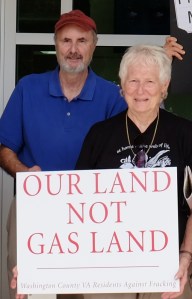
Although Virginia’s 2017 General Assembly session is still more than three months off, fossil fuel interests will already be planning how to win more special favors from the legislature. In past years they’ve gotten subsidies or a relaxation of environmental safeguards. This year, it could be help dealing with pesky local governments that want to protect communities from fracking. Guest blogger Linda Burchfiel brings us the story.

Photo credit Virginia Sierra Club

Photo credit Virginia Sierra Club

Even in a Dillon Rule state like Virginia, where local governments have only the authority conferred on them by the state, localities have some authority over matters that affect the daily life of residents. Traditionally they have authority to enact zoning ordinances to maintain their sense of community. Recently, counties have started to use their authority to limit the ability of natural gas drilling companies to conduct fracking operations within their borders. Now the industry is pushing back—hard.

Indeed, any action that limits fracking sends the oil and gas industry into high gear. The industry is already working to undermine new state regulations governing disclosure of chemicals used in fracking operations. Based on the experience of other states, we expect to see the industry seek legislation in Virginia’s upcoming General Assembly Session to block local authority over fracking.

New forms of “unconventional drilling,” including hydraulic fracturing or “fracking,” make drilling for natural gas potentially profitable in parts of Virginia that have no history of oil and gas development. Fracking companies have been travelling to new areas, leasing acres of land and approaching local governments for permits. Before considering permits, some local governments have insisted on researching fracking and its consequences.

This happened in 2010 in Rockingham County, which sits in the Shenandoah Valley atop a sliver of the Marcellus Shale. When a Texas-based drilling company requested permits to conduct fracking operations there, county supervisors decided they had better educate themselves on the subject. A Republican board member took the lead, investigating the safety records of fracking companies in other states and sounding the alarm about his findings. Facing growing opposition and unwilling to wait, and with falling gas prices making fracking in the county less profitable, the drilling company eventually withdrew its request.

Fracking also threatens the Tidewater area, where the U.S. Geological Survey estimates the Taylorsville Basin may contain over a trillion cubic feet of shale gas in an area underlying parts of more than a dozen Virginia counties. (A map of the Taylorsville Basin can be found here.) But while the potential for industry profits may be good, the potential risks are much greater. This low-lying region is in the Chesapeake Bay watershed and contains the Potomac Aquifer, which supplies water for drinking, agriculture and industry for almost half of Virginia’s population. In recognition of these unique environmental challenges, the Virginia Oil and Gas Act includes special provisions to protect the Tidewater Region. Two such provisions are the requirement of an environmental impact assessment for a permit, and a prohibition of drilling for oil or natural gas within 500 feet of the Chesapeake Bay or any tributary.

To add further safeguards, the King George Board of Supervisors proposed an ordinance in August 2015 with specific restrictions intended to protect the community from the noise, traffic and environmental degradation of fracking. After the gas industry threatened to sue, the Board held a new public hearing this year, then passed the ordinance with only slight modifications. Restrictions include a prohibition on well drilling within 750 feet of a waterway or road or occupied building, limiting drill sites to four acres, prohibiting holes from being bored within 100 feet of a property line, and requiring each company interested in drilling to apply for a special exception permit and to submit extensive information.

Although the oil and gas industry had tried to influence the Board’s decision with the threat of long and expensive litigation, its legal theory is weak. A 2015 opinion by Attorney General Mark Herring affirms that municipalities have the authority to use zoning ordinances to restrict fracking, including authority to prohibit it entirely within a jurisdiction. His opinion overturned that of the previous Attorney General, Ken Cuccinelli, who had stated that localities could not “ban altogether” oil and gas exploration and drilling through zoning ordinances. Even Cuccinelli, however, had conceded that a county “may adopt a zoning ordinance that places restrictions on the location and siting of oil and gas wells that are reasonable in scope and consistent” with applicable state laws.

If the industry can’t win in court, though, it may attempt to use the legislature to pass legislation taking away local governments’ ability to limit fracking. Given the historic influence the fossil fuel industry has on Virginia’s General Assembly, this poses a serious threat to localities that want to control their own fate.

The industry has an ally in this effort: the American Legislative Exchange Council (ALEC), a lobbying organization heavily funded by the fossil fuel industry. ALEC counts many conservative Virginia legislators among its members, as well as utility giant Dominion Resources. ALEC members draft and share model state-level legislation that favors corporate interests. ALEC claims to support sending power back to the local level, but in fact it consistently favors unlimited fossil-fuel extraction and burning, regardless of ALEC’s ostensible principles. So if local governments want to restrict fracking, while state legislatures are less inclined to do so, ALEC will likely favor blocking local government restrictions.

A recent news account revealed that ALEC and its local government affiliate, the American City-County Exchange (ACCE) are working to block local government action in states where the state legislature is more corporate-friendly than local governments. Thus we should be prepared to see ALEC insert itself in Virginia’s legislative process to try to block local restrictions on fracking.

Indeed, ALEC has already been working in other states to stop local governments from restricting fracking. This includes Texas, which passed a preemptive ban on local government efforts to stop fracking in 2015. In Florida, a similar ALEC-supported ban was defeated after opponents pointed out that the measure threatened localities’ traditional control over other local issues, such as education.

Linda Burchfiel is the Fracking Issues Chair for the Virginia Chapter of the Sierra Club.

Unknown's avatar

Sierra Club scorecard plumbs divisions among Virginia legislators

SC ScorecardBy and large, Virginia Republicans are still locked in a fossil fuel echo chamber, where “all of the above” and “war on coal” guide their votes. Virginia Democrats mostly acknowledge the damage climate change is doing to the commonwealth and around the planet and support a course correction. And regardless of ideology, large majorities from both parties vote for whatever Dominion Power wants.

These are the major takeaways from this year’s legislative session and the 2016 Climate and Energy Scorecard, just released by the Virginia Chapter of the Sierra Club. Constituents and clean energy advocates will want to look at not just the raw grades of individual legislators, but also the discussion provided in the report, to understand the dynamics of our General Assembly.

Twenty-eight Democrats earned perfect scores. All but a handful of Republicans earned failing grades. Sierra Club gave extra credit to legislators who introduced bills that advanced clean energy. This included several Republicans highlighted in the scorecard, but their bad votes on other bills dragged down their overall scores.

This is really a shame, since some Republicans have worked hard to advance clean energy legislation. Leesburg Delegate Randy Minchew comes to mind here for his dogged efforts on behalf of distributed solar energy, something you might not guess from his overall grade of D.

Often, it seems, reform-minded Republicans go along with their party’s more retrograde positions where they are pressured to do so by their party leaders, or where the votes are so lopsided that there is nothing to gain from breaking with the majority.

If party leaders have an outsize influence on voting, so too does Dominion Power. In fact, if you want to know who the true champions of the people are, don’t look at party affiliation. Look for the few legislators who will stand up to the most powerful political force in Richmond.

That assumes you can find votes to examine. In the introduction to the Sierra Club scorecard, Legislative Chair Susan Stillman noted with frustration this year’s paucity of recorded votes available to score:

The challenges of producing a fair and even scorecard are growing, as are the opportunities for Virginia citizens to have a clear and accurate picture of their elected representative’s voting record. Transparency in the General Assembly sunk to a new low this year: 95% of the bills defeated in the House of Delegates were done so on an unrecorded vote or no vote at all. This is not business-as-usual: just over a decade ago, nearly every bill that passed through the House received a recorded vote.

An ongoing problem, both for scorecard referees and for clean energy advocates, is that most bills that would advance the cause of renewable energy and energy efficiency never make it out of committee; in the House, the bills are heard in a tiny subcommittee. Not only do votes go unrecorded, but this approach deprives most of our elected representatives of the opportunity to vote on some of the most important energy policy issues facing Virginia.

And then there was this year, in which even the subcommittee members never got a chance to vote. A dozen or so of the most promising clean energy bills were never heard at all, but were sent to a newly-formed interim study subcommittee, ostensibly for the purpose of giving these bills the benefit of greater deliberation. The effect was to kill them quietly for the year.

As Stillman notes, all these unrecorded votes make it hard to know where the vast majority of legislators stand:

Without a recorded vote, the public is deprived of the full measure of his or her elected official’s voting history. And the problem of unrecorded votes is growing worse. This year’s unprecedented rate of unrecorded votes in the House is up from 76% in 2015—a 25% jump in one year. Virginia legislators are killing more bills than ever without accountability for their actions. This practice is wrong, and it’s dangerous for our democracy.

Stillman gives a shout-out to the founding members of the new, bipartisan Transparency Caucus for its efforts to make all votes public and ensure every bill gets a hearing.

These would be modest reforms, but welcome. If sunlight is the best disinfectant, there’s a big, dirty House (and Senate) in Richmond that need cleaning.

Unknown's avatar

Only the good die young: A mid-way review of Virginia climate and energy bills

Photo credit: Corrina Beall

Photo credit: Corrina Beall

Virginia’s 2016 legislative session is only half over, but it’s already clear that the General Assembly is no more capable of dealing with climate change and a rapidly-evolving energy sector than it ever was. Republicans are stuck in denial, Democrats are divided between those who get it and those who don’t, and for most legislators in both parties, the default vote is whatever Dominion Power wants.

Republican attacks on EPA climate regulations sail through both houses, while popular RGGI legislation dies in committee.

Practically the first bills filed this session call for Virginia’s Department of Environmental Quality to submit for legislative approval any plan to comply with the EPA’s Clean Power Plan. Anxious to safeguard Virginia’s heritage of carbon pollution against the twin threats of clean energy and a more stable climate, the Republican leadership rammed through HB 2 and SB 21 on party-line votes. Governor McAuliffe has promised vetoes.

Eager as it was to defeat Obama’s approach to climate disruption, the Party of No supported no solutions of its own, even when proposed by one of its own. Virginia Beach Republican Ron Villanueva couldn’t even get a vote in subcommittee for his Virginia Alternative Energy and Coastal Protection Act, which would have had Virginia join the Regional Greenhouse Gas Initiative (RGGI). It was the only legislation introduced this year that would have lowered greenhouse gas emissions and raised money to deal with climate change. The Democratic-led Senate version also failed to move out of committee, on a party-line vote.

Republicans scoff at climate change, but they are beginning to worry about its effects. Bills have moved forward to work on coastal “resiliency” efforts and to continue studying sea level rise (referred to as “recurrent flooding,” as though it were a phenomenon unto itself and suggesting no particular reason it might get worse). The Senate passed SB 282, creating the Virginia Shoreline Resiliency Fund, and SJ 58, extending the work of the Joint Subcommittee to study recurrent flooding. The House passed HJ 84, a companion to SJ 58, and HB 903, establishing a Commonwealth Center for Recurrent Flooding Resiliency.

Bold energy efficiency measures die. Not-so-bold measures don’t do well either.

Virginia appears set to continue its woeful record on energy efficiency. Between the opposition of electric utilities and their regulators at the State Corporation Commission, bills that would have set the stage for cost-effective reductions in energy use got killed off early or watered down to nothing.

Among the latter were the fairly modest bills pushed by the Governor. They passed only when reduced to a provision for the SCC to evaluate how to measure the subject. Weirdly, even that found opposition from conservative members of the Senate and House.

The only bill to move forward more or less intact was Delegate Sullivan’s HB 1174, which requires state agencies to report on how badly the state is doing in meeting its efficiency goal. So we may not make progress, but at least we’ll have to acknowledge our failures. (Roughly the same group of conservatives didn’t think we should even go that far.)

Renewable energy bills won’t move forward this year, except the one Dominion wants.

As previously reported, the Republican chairmen of the House and Senate Commerce and Labor committees decided not to decide when it came to much-needed renewable energy reforms. Every bill to create new market opportunities for wind and solar was “carried over to 2017,” i.e., referred to a not-yet-existent subcommittee composed of unnamed people tasked with meeting at a not-yet-scheduled time, in order to do “something.”

“We do need to get moving on these solar bills faster than we have been going,” said House C&L Chairman Terry Kilgore, in explaining why his committee was not getting moving on any solar bills.

On the other hand, over in House Finance, Dominion Virginia Power’s bill to lower the taxes it pays for renewable energy property fared better. In exchange for an 80% tax exclusion for its own utility projects, Dominion offered up reductions in the tax savings currently afforded to the smaller projects being developed by independent solar companies. In an amusing sideshow, Republican leaders tried to use their support for this legislation to strong-arm liberal Democrats into supporting a bill extending coal subsidies, on the theory that passing one bill that benefits Dominion warrants passing another bill that benefits Dominion.

Given the lack of progress in opening the wind and solar markets, there is more than a little irony in the fact that legislation moved forward in both the House and Senate requiring utilities to direct customers to an SCC website with information about options for purchasing renewable energy. (Which leads to the question: if visitors to such a site encounter an error message, is it still an error?)

Coal subsidies remain everyone’s favorite waste of money.

Once again, the House and Senate passed bills extending corporate welfare for companies whose business model involves blowing up mountains and poisoning streams. Over the years legislators have spent more than half a billion dollars of taxpayer money on these giveaways, knowing full well it was money down a rat-hole. Community activists have pleaded with lawmakers to put the cash towards diversifying the coalfields economy instead, but there has never been a serious effort to redirect the subsidies to help mine workers instead of corporate executives and the utilities that buy coal.

This year the corporate handout went forward in the face of reports that one of the biggest recipients plans to pay multi-million-dollar bonuses to its executives while laying off miners and looking for ways to dodge its obligations to workers. Add to this the news that the same company owes two coalfields counties $2.4 million in unpaid taxes for last year, and you have to wonder what fairy tales legislators are hearing from lobbyists that makes them put aside common sense.

It’s not just Republicans who voted for these subsidies (though there is no excuse for them, either). Some Democrats did so, too. Governor McAuliffe has said he would veto these bills, which means senators like David Marsden, Jennifer Wexton, John Edwards and Chap Petersen will have a chance to redeem themselves by voting against an override.

Many thanks to Senators Howell, Ebbin, Favola, Locke, McEachin, McPike and Surovell for seeing through the propaganda of the coal lobby and voting no.

Dominion defeats legislation protecting the public from coal ash contamination

Senator Scott Surovell’s SB 537 would have required toxic coal ash to be disposed of in lined landfills rather than left in leaking, unlined pits and simply covered over. The bill failed in committee in spite of support from one Republican (Stanley), after Democratic Senator Roslyn Dance caved to pressure from Dominion and abstained. One might have expected more backbone from a legislator with coal ash contamination in her own district. (Nothing excuses the Republicans who voted against the public health on this, either. Last I heard, Republican babies are as vulnerable to water pollution as Democratic babies.)


Unknown's avatar

Virginia legislators look to tax breaks and barrier-busting to boost renewable energy

Let's get these projects moo-ving. Photo credit NREL

Let’s get these projects moo-ving. Photo credit NREL

The orchestrated mayhem of the Virginia General Assembly session is well underway. Thirteen days are gone and only twenty-one days remain until what’s known as “Crossover,” after which any bill that hasn’t passed its own chamber is effectively dead. This year Crossover falls on February 16. After that, each chamber considers only bills already passed by the other.

By that measure, yours truly is one lazy blogger, because I’m only just getting to the renewable energy bills. On the other hand, bills were still being filed until Friday, and some bills are undergoing revisions before they are heard in committee. These are moving targets; advocates beware.

Removing barriers to investment 

Readers of this blog know that Virginia law is riddled with barriers that restrain the market for wind and solar in Virginia. This year several bills take aim at the policies holding us back.

HB 1286 (Randy Minchew, R-Leesburg, in Commerce and Labor) is barrier-busting legislation developed by the solar industry in consultation with the wind industry and solar advocates. It clarifies that renewable energy companies that sell to retail customers under power purchase agreements (PPAs) are not public utilities and don’t have to meet the statutory requirements for public utilities and suppliers. Customers can use third-party PPAs to purchase renewable energy electricity generated by facilities located on the customer’s property, everywhere in the state. The bill also lifts the one percent cap on net metering programs relative to total utility sales, and authorizes community net metering programs. It also expands the concept of “agricultural net metering” to cover other customers who want to attribute electricity from one facility to multiple meters on the customer’s property.

In addition, the bill amends the Commonwealth’s energy policy by adding the goals of encouraging private sector distributed renewable energy, increasing security of the electricity grid by supporting distributed renewable energy projects, and augmenting the exercise of private property rights by landowners desiring to generate their own energy from renewable energy sources on their lands. None of this language by itself forces action, but the State Corporation Commission takes note of energy policy in its decision-making.

SB 140 (John Edwards, D-Roanoke, in Commerce and Labor) attacks the standby charges that have been so controversial. It increases the size of electrical generating facilities operated by residential or agricultural net energy metering customers that are subject to a monthly standby charge from those with a capacity of 10 kilowatts to those with a capacity of 20 kilowatts. Since residential solar facilities that are net-metered are already limited to 20 kW, this would effectively repeal standby charges for residential net metering.

SB 139 (John Edwards, D-Roanoke, in Commerce and Labor) makes a small change to the existing agricultural net metering option.

SB 148 (John Edwards, D-Roanoke, in Commerce and Labor) replaces the pilot program enacted in 2013 that authorized a limited pilot program for third-party PPAs. generation facilities. The bill requires the State Corporation Commission to establish third-party power purchase agreement programs for each electric utility. The existing pilot program applies only to Dominion Virginia Power and sets the maximum size of a renewable generation facility at one megawatt; the programs authorized by SB 148 apply to all electric utilities and do not set limits on the size of facilities.

Although SB 148 is similar to HB 1286 in attempting to ensure the legality of third-party PPAs, solar advocates prefer HB 1286. Giving the State Corporation Commission authority here should not be necessary and might lead to higher costs and more regulations.

Community energy/solar gardens

It’s darned hard to buy renewable energy in Virginia if you are among the approximately 75% of residents who can’t put solar panels on your own roof or build a wind turbine out on the back forty. That’s an enormous untapped market.

SB 1286, above, contains a provision authorizing community energy programs In addition, HB 1285 (Randy Minchew, R-Leesburg, in Commerce and Labor) is a stand-alone bill that authorizes (but does not require) investor-owned utilities and coops to establish community energy programs.

HB 618 (Paul Krizek, D-Alexandria, referred to Commerce and Labor) would require the State Corporation Commission to adopt rules for “community solar gardens” that would let customers subscribe to a portion of the output of a solar facility located elsewhere in their area. The solar electricity and the renewable energy credits (RECs) would be sold to the local utility, which would then credit the subscribers on their utility bills.

But whereas customers who have solar panels one their own roof get credited at full retail value and own the associated renewable energy credits, HB 618 allows the SCC to devise rules that could result in a much worse deal for solar garden subscribers, including allowing the utility to impose a “reasonable charge” to cover ill-defined costs.

That’s an unfortunate invitation to the utilities to pile on fees. Unless the utilities involved really want to make the program work for their customers, it’s hard to imagine this turning out well. We would not expect to see viable programs in Dominion or APCo territory if this passes. On the other hand, some municipal utilities have been more responsive to the interests of their customers, so it could work for them.

Tax credits and exemptions

An important tax bill to watch this year is HB 1305 (Jackson Miller, R-Manassas, referred to Finance), which changes the state and local tax treatment of solar and wind energy facilities. It exempts utility solar and wind from taxation, but lowers from 20 MW to 1 MW the size of other solar projects that are exempt from local machinery and tools tax (a kind of personal property tax; securing that exemption was a major win for the solar industry in 2014). The bill replaces the hard-won 100% exemption with an 80% exemption. The change is very nice for utilities (Virginia is always very nice to utilities), but it makes the economics worse for third-party owned facilities in the 1 MW to 20 MW range—exactly the ones the state should be trying to attract.

SB 743 (Frank Wagner, R-Virginia Beach, referred to Agriculture, Conservation and Natural Resources) helps solar projects below 5 MW qualify for the above-mentioned tax exemption passed in 2014. The bill makes the Department of Mines, Minerals and Energy the agency that certifies solar projects as “pollution control equipment and facilities,” eligible for exemption from state and local taxation. This exemption from state sales tax and local machinery and tools taxes is one of the few perks Virginia can offer commercial-scale solar developers here, where margins on projects are very thin compared with projects in North Carolina or Maryland with stronger incentives.

Tax credits are also on the agenda this year. Tax credits fell into disfavor in Virginia following an audit that revealed that many tax credits aren’t achieving their objectives (see: tax subsidies for coal mining). Senate Finance Committee members resolved to end them just about the same time the solar industry came asking for one themselves two years ago, with unhappy results for solar. But tax credits are legislative candy, and there’s no telling how long the diet will last. Hopeful persons may as well put out their own plate of chocolates. If the diet is off, then the main problem with this year’s bills, from the point of view of the Republicans who make up the majority of our legislature, is simply that they come from Democrats.

HB 480 (Rip Sullivan, D-Arlington, referred to Finance) establishes a 35% tax credit for renewable energy property, to be claimed over 5 years, with a $5 million program cap. The credit would apply not just to wind and solar but also some biomass, combined heat and power, geothermal and hydro systems.

SB 142 (John Edwards, D-Roanoke, referred to Finance) and HB 1050 (Sam Rasoul, D-Roanoke, referred to Finance) establish a tax credit of up to 30% for solar thermal systems used for water heating or space heating and cooling. Solar PV systems are not included in the bill.

State funding through carbon cap and trade

SB 571 (Donald McEachin, D-Richmond, referred to Agriculture, Conservation and Natuaral Resources) and HB 351 (Villanueva, R-Virginia Beach, referred to Commerce and Labor) would require the Governor to join the Regional Greenhouse Gas Initiative (RGGI), the cap-and-trade program that has successfully ratcheted down carbon emissions in the northeastern states. Funds generated by auction allowances would fund sea level rise adaptation in coastal areas, economic transition efforts for southwest Virginia, energy efficiency for low-income families, and distributed renewable energy programs.

Financing

HB 941 (David Toscano, D-Charlottesville, referred to Counties, Cities and Towns) expands the authorization for Property Assessed Clean Energy (PACE) programs to include residential and condominium projects. This would allow localities to offer low-interest financing to homeowners for both energy efficiency and renewable energy investments.

Utility cost recovery

HB 1220 (David Yancey, R-Newport News, referred to Commerce and Labor) is billed as a technical fix for language added to the Code last year that encourages utilities to invest in solar. The bill clarifies that a utility that purchases a solar facility is allowed cost recovery on the same favorable terms it would get by building the facility itself.

Energy storage

Energy storage is emerging as the hot new energy technology area, about where solar was five years ago. Interest in it has been driven by recent price declines as well as the success of wind and solar and the growing awareness that these carbon-free sources are likely to make up a significant portion of our electricity supply in coming years. So while the use of storage is by no means limited to renewable energy applications, I include it here because it will interest those who follow wind and solar policy.

HB 452 (Patrick Hope, D-Arlington, in Commerce and Labor) and SB 403 (Ebbin, D-Alexandria, in Commerce and Labor) create the Virginia Energy Storage Consortium to promote research, development, commercialization, manufacturing and deployment of energy storage. It’s a great idea.

HB 1137 (David Toscano, D-Charlottesville, in Commerce and Labor) directs the State Corporation Commission to develop a program to enable commercial and industrial customers to sell battery storage services to the grid. If you’ve heard of the concept known as “vehicle-to-grid” (using electric cars to put power back on the grid as well as drawing from it), you’ll understand what this is about. It would allow these and other “energy balancing devices” to provide value to the grid in the form of spinning reserves, frequency regulation, distribution system support, reactive power, demand response, or other electric grid services. It’s an idea whose time has come.

Biomass

Wind and solar have several less popular relatives with more tenuous claims on the renewable energy family name. Virginia’s definition of “renewable” embraces them all, regardless of merit. It treats biomass to a special place of honor, including even the burning of trees that haven’t been harvested sustainably, and regardless of how much pollution gets spewed into the atmosphere.

SB 647 (Barbara Favola, D-Arlington, in Commerce and Labor) and HB 973 (Alfonso Lopez, D-Arlington, in Commerce and Labor) would change that to require that electricity from new biomass plants, to qualify as renewable energy, would have to meet a minimum efficiency level. Burning wood from trees would generally meet that standard only when it produces both electricity and heat (or, through the magic of science, cooling).

Consumer choice

HB 444 (Manoli Loupassi, R-Richmond, in Commerce and Labor) and SB 745 (Frank Wagner, R-Virginia Beach, in Commerce and Labor) would expand the current requirement that utilities inform ratepayers about their options for purchasing renewable energy.

Which might lead you to ask, “what options?” since for most of us here in Virginia they are sadly lacking. But maybe this year’s session will start to change that.

A note about House Commerce and Labor: Bills noted above that have been assigned to the House Committee on Commerce and Labor have all been assigned to its Subcommittee on Energy. This powerful subcommittee typically meets only once or twice before Crossover. I’m told it will meet on the afternoon of Tuesday, February 9, likely continuing well into the evening due to the number of bills assigned.

February 9 is also Clean Energy Lobby Day, when members of the renewable energy and energy efficiency industries descend on Richmond to educate legislators about the need for sound reforms. This year the solar industry trade association MDV-SEIA is organizing the lobby day, which is free to participants. The organization has also created a petition to support third-party financing of solar in Virginia.


UPDATE:

Senator McEachin files bill for mandatory RPS. SB 761 Donald McEachin (D-Richmond) would make Virginia’s pathetic, voluntary RPS into a mandatory RPS that would rank as one of the best in the country. It would require utilities to meet an increasing percentage of electricity sales from solar, onshore wind, offshore wind, and energy efficiency, reaching 25% of base year sales by 2025 (and deleting the current, obnoxious slight-of-hand that leaves nuclear out of the equation, but keeping a base year of 2007). By 2017, half of it would have to come from sources located within Virginia.

Unknown's avatar

2016 bills show Virginia might finally get serious (sort of) about energy efficiency

Clive Upton/Wikimedia Commons

Clive Upton/Wikimedia Commons

Energy efficiency: it’s the resource that everyone praises and few pursue. If Dominion Virginia Power approached efficiency programs with the enthusiasm it devotes to building natural gas plants, then—well, it wouldn’t need the new gas plants.

And that’s the crux of the problem. Virginia’s utilities earn more money by building stuff than by not building it, and the excuse to build new stuff comes when demand for electricity increases. If people use less electricity—say, by buying more efficient lighting and appliances—that’s good for consumers, but bad for utility profits.

The Virginia State Corporation Commission hasn’t helped matters; it takes a skeptical view of utility-sponsored energy efficiency programs, rarely approving the kind of programs that would be needed for Virginia to make progress towards its modest goal of lowering electricity use 10% by 2022. Changing the SCC’s attitude through legislation is hard; doing so without the support of the utilities is impossible.

This is where the Governor finds his opportunity for modest progress. Terry McAuliffe has been very, very good to Dominion. He’s supported its fracked-gas pipeline, its budget-busting nuclear ambitions, its new gas plants, and even the rate boondoggle it secured last year that allows it to pick the pockets of Virginia ratepayers to the tune of a billion dollars.

So the least Dominion can do is to support the Governor’s efforts to improve Virginia’s dismal record on energy efficiency, reflected in HB 1053 (referred to House Commerce and Labor) and SB 395 (Senate Commerce and Labor). In a sign the utility may have acquiesced, the bills patrons are Delegate Terry Kilgore, the powerful chairman of the House Commerce and Labor Committee, and Senator Kenny Alexander, a Democrat on Senate Commerce and Labor who has shown no previous interest in reforming energy policy—but who, like Kilgore, ranks utilities among his top donors.

The legislation replaces an ineffective lost-revenue provision in the Code with an incentive-based approach intended to reward investor-owned utilities for success. According to a fact sheet the Administration is sharing with legislators, the utilities will reap bonuses in proportion to the amount of energy saved through implementing cost-effective programs:

  • An additional 1% of the actual costs of the program, if the utility achieves a levelized cost of saved energy (LCSE) for the program at or below six cents per kilowatt-hour;
  • An additional 2% of the actual costs of the program, if the utility achieves a LCSE for the program at or below five cents per kilowatt-hour;
  • An additional 3% of the actual costs of the program, if the utility achieves a LCSE for the program at or below four cents per kilowatt-hour;
  • An additional 4% of the actual costs of the program, if the utility achieves a LCSE for the program at or below three cents per kilowatt-hour.

These two Administration bills have the most momentum behind them, but they are not the only legislation out there looking for ways to make serious energy efficiency gains. The best of the bills is HB 576 (Rip Sullivan, D-Arlington, in Commerce and Labor). It requires the SCC to approve cost-effective efficiency programs and, more significantly, establishes robust new energy efficiency goals that utilities would be required to meet.

Sullivan has clearly spent a lot of time this year thinking about the policy barriers to energy efficiency. He correctly pegs SCC procedure as one of the problems.

HB 575 (in Commerce and Labor) as well as HB 352 (Lee Ware, R-Powhatan, also in Commerce and Labor) take aim at the way the SCC evaluates energy efficiency programs. Sullivan’s bill would make it easier for a program to meet the SCC’s standards. As currently written, Ware’s would actually make it harder; however, we hear this may be a drafting error, so we will be watching for amendments that would make this a bill to support.

Two more good bills from Sullivan also deserve mention. HB 1174 (in Commerce and Labor) requires the SCC to report on Virginia’s progress towards our 10% energy reduction goal. HB 493 (referred to Appropriations) creates an Energy Efficiency Revolving Fund to provide no-interest loans to localities, school divisions, and public institutions of higher education.

Freshman Delegate John Bell (D-Chantilly) has introduced a modest bill of such remarkable common sense that it shouldn’t be needed (but is). HB 808 requires government agencies to use LED light bulbs instead of incandescent bulbs when installing, maintaining or replacing outdoor light fixtures. The bill has been referred to the Committee on General Laws.

It’s also worth noting that two bills I previously included in the roundup of climate-related legislation would also have a significant impact on energy efficiency investments. HB 351 (Ron Villanueva, R-Virginia Beach, referred to Commerce and Labor) and SB 571 (Donald McEachin, D-Richmond, referred to Agriculture) would direct the Governor to join the Regional Greenhouse Gas Initiative (RGGI), the cap-and-trade plan that the northeastern states have used successfully to reduce carbon emissions and raise funds to further the RGGI goals. In Virginia, these funds would include millions of dollars for energy efficiency.

Finally, there’s a bill expanding Virginia’s authorization for Property Assessed Clean Energy (PACE) programs, which allow localities to loan money to property owners for energy efficiency and renewable energy. HB 941 (David Toscano, D-Charlottesville) expands the authorization for PACE programs to include residential and condominium projects.


Unknown's avatar

2016 Virginia bills show King Coal still calling the shots

Virginia rorschach test: some see a destroyed landscape, others see campaign contributions.

Virginia rorschach test: some see a destroyed landscape, others see campaign contributions.

Legislation introduced in the General Assembly would keep Virginia’s gravy train rolling for coal companies. SB 44 (Charles Carrico, R-Alpha Natural Resources) and HB 298 (Terry Kilgore, R-Alpha Natural Resources) are framed as “limits” because the taxpayer-financed subsidies for coal mining would top out at $7.5 million per year. But watch your wallets: the primary objective of the legislation is to extend the coal subsidies an extra three and a half years, through 2019. So these bills should more accurately be seen as $25 million giveaways. The bills have been referred to the committees on Finance.

It appears the coal companies need the money to pay bonuses to their executives. Alpha Natural Resources, which filed for bankruptcy in August to avoid paying creditors, plans to pay its top executives bonuses worth up to $11.9 million. Meanwhile, Alpha laid off more than 160 coal miners a week before Christmas.

According to the Virginia Public Access Project, Alpha Natural Resources gave almost $500,000 in campaign contributions to Virginia legislators during the 2014-2015 election cycle. Carrico was the top recipient, raking in $24,267 from Alpha; Kilgore snagged fifth place with $20,000.

Consol Energy gave over $236,000 to legislators over the same time period. Kilgore was their top recipient, at $12,500, while Carrico received $10,000. Note that both Carrico and Kilgore ran unopposed.

In a separate attempt to give back to the coal industry, Ben Chafin has introduced SB 365 (referred to Transportation), a bill that would remove the Coalfields Expressway from the transportation prioritization process. If it were to pass, this strip mine disguised as a highway wouldn’t have to meet the normal standards required of real roads to be eligible for state funding. The disastrous Route 460 would also be excused, in case any future administration is dumb enough to revive it. Chafin is another Coalfields Republican who ran unopposed while hauling in more than $100,000 from donors in the energy and mining industries, including $15,000 from Alpha Natural Resources and $9,500 from Consol.

The bankruptcy of Alpha, like that of dozens of other coal companies in recent years, threatens more than the campaign coffers of Virginia legislators. Coal mining has declined steadily in Virginia, leaving displaced workers who could make much better use that $7.5 million annually if it were redirected for job retraining and education. Right now, in contrast to the Republican rhetoric, only the Obama Administration seems to care about out-of-work coal miners.

While ignoring workers, legislators are at least waking up to the threat posed to taxpayers when bankrupt coal companies walk away from their obligations to clean up and reclaim the land they’ve mined. HB 1169 (Todd Pillon, R-Abingdon, referred to Agriculture) would increase the amount of the reclamation bonds that mine operators must post, and give the Commonwealth a lien against the land.

Coal ash pollution prompts legislation on proper closure of storage ponds

Meanwhile, Virginia’s coal legacy continues to have repercussions for communities across the state, wherever waste from burning coal has piled up in toxic ponds next to rivers and streams. For years utilities have taken an out-of-sight, out-of-mind approach to coal ash, quietly ignoring the potential for devastating spills like the one that contaminated the Dan River.

In Prince William County, Dominion Virginia Power proposes to close one of these leaky coal ash ponds by draining the water out of it and slapping on a cover. A compliant Department of Environmental Quality just issued Dominion a permit to discharge the partially-treated wastewater into Quantico Creek, which flows directly into the Potomac River.

In response, Democratic Senator Scott Surovell, whose district includes this section of Prince William County, has filed SB 537 (referred to Agriculture, Conservation and Natural Resources) to require the removal of all waste from closed coal ash ponds for proper disposal in permitted landfills that meet federal standards.


UPDATE: A January 21 news report informs us that Alpha Natural Resources owes Wise County, Virginia, nearly $1.46 million in unpaid taxes for 2015, with another $1 million owed to Dickenson County. Please feel free to make the appropriate snarky comments; I’m still stuck in a “you gotta be kidding” loop.

UPDATE 2: Not content to let Senator Carrico get all the glory giving away Virginia taxpayer money to pay multi-million dollar bonuses to tax-evading coal bosses, Ben Chafin has filed his own bill to do the same thing.  SB 718 appears to be the same as SB 44 and has also been referred to Finance.


Unknown's avatar

2016 Virginia legislative session opens with stark choices for dealing with climate change

Setting an example for Virginia leaders. But will they follow? Photo courtesy of Glen Besa.

Setting an example for Virginia leaders. But will they follow? Photo courtesy of Glen Besa.

One of the first bills filed in Virginia’s 2016 legislative session—and already passed through committee—would require the McAuliffe Administration to write a report about how awful the EPA’s Clean Power Plan is for Virginia, and then to develop a state implementation plan that won’t comply.

That’s not exactly how HB 2 (Israel O’Quinn, R-Bristol) puts it, but it’s hard to read the language any other way. The bill instructs the Department of Environmental Quality to write a report critiquing the Clean Power Plan’s terrible effects (stranded costs! price increases! coal plant retirements! shoeless children!). It neglects any mention of the Plan’s benefits—like less pollution, better public health, and bill savings from energy efficiency. DEQ is then directed to write a plan that details all the bad stuff (but not the good stuff) and submit that to the General Assembly for approval before it can go to EPA. Does anyone think the General Assembly will approve a plan that makes compliance sound as awful as Republicans want DEQ to describe it?

The irony here is that the bill assumes the Clean Power Plan is the huge game-changer for Virginia that environmentalists had hoped it would be. Sadly, the Clean Power Plan doesn’t demand much of Virginia; if we simply meet new electricity demand with energy efficiency and renewable energy, we would be at or near to full compliance.

But recognizing that Virginia got a pass would be inconvenient for the bill’s drafters over at the American Legislative Exchange Council (ALEC). ALEC has an agenda to promote, and the agenda demands that Republicans be outraged, regardless of the reality on the ground.

We hear outrage was in full display Tuesday as Republicans pushed the bill through Commerce and Labor on a party-line vote. Democrats patiently explained that if Virginia doesn’t submit a plan that complies with the Clean Power Plan, EPA will write one for us. Republicans responded with shoeless children.

SB 482 (Mark Obenshain, R-Harrisonburg, referred to Agriculture, Conservation and Natural Resources) and SB 21 (Ben Chafin, R-Lebanon, also in Agriculture) are Senate companion bills.

The flip side

If the Clean Power Plan doesn’t actually demand much of Virginia, nothing prevents the state from using the federal requirements to its own advantage. HB 351 (Ron Villanueva, R-Virginia Beach, referred to Commerce and Labor) and SB 571 (Donald McEachin, D-Richmond, referred to Agriculture) take this lemon-to-lemonade approach with the Virginia Alternative Energy and Coastal Protection Act. The bill would direct the Governor to join the Regional Greenhouse Gas Initiative (RGGI), the cap-and-trade plan that the northeastern states have used successfully to reduce carbon emissions and raise funds to further the RGGI goals.

The legislation is similar to last year’s Virginia Coastal Protection Act, which was unable to get out of committee due to Republican opposition. But as warming ocean water expands and lifts sea levels along our coast, even Republicans must wonder how they are going to deal with the costs. Right now, the only answer out there belongs to Villanueva and McEachin.

Other legislators, meanwhile, offer small steps in the right direction. HB 739 (Christopher Stolle, R-Virginia Beach, referred to General Laws) would establish the Virginia Flooding Adaptation Office. A Chief Resiliency Officer would oversee its operations, pursue funding opportunities, and recommend initiatives to help with adaptation efforts. (Maybe she will recommend joining RGGI!)

A similar but more limited bill, HB 1048 (Keith Hodges, R-Urbana, also referred to Agriculture) would create a position of Chief Resiliency Officer to coordinate “issues related to resilience and recurrent flooding,” recommend actions to increase resilience, and pursue funding.

HB 903 (also Stolle, referred to Agriculture, Chesapeake and Natural Resources) resolves to designate a Commonwealth Center for Recurrent Flooding Resiliency to study “recurrent flooding and resilience.” HJ 84 (Stolle again, referred to Rules) and SJ 58 (Mamie Locke, D-Hampton, referred to Rules) would continue the ongoing study of “recurrent flooding” and rename it as “coastal flooding.” (Yes, legislators are moving towards calling it “sea level rise” at about the same rate the sea is rising.)

SB 282 (Lynwood Lewis, D-Accomack, referred to Agriculture) would establish the Virginia Shoreline Resiliency Fund as a low-interest loan program to help residents and businesses that are subject to “recurrent flooding.” Funding, for the most part, would require appropriations from the General Assembly.

Unknown's avatar

Dominion gets what it wants, but Virginia doesn’t get what we need

DominionLogoNo, you can’t always get what you want.   You can’t always get what you want.   You can’t always get what you want.     But if you try sometime you find,           You get what Dominion Power wants.

With apologies to the Rolling Stones

I guess there’s a reason I never made it as a songwriter. That last line is a disaster. But that, in a nutshell, is what happened to SB 1349, known as the rate-freeze bill, the ratepayer rip-off, or the Dominion bill, depending on whether you were pro, con, or still trying to figure it out.

The bill began and ended as a way for Dominion Virginia Power to shield excess profits from the possibility of regulators ordering refunds to customers. Along the way, Appalachian Power jumped on board, even though its president had already admitted the company had been earning more than it should.

When we last looked, SB 1349 was undergoing radical rewriting on the floor of the Senate, in real time. Conflicting amendments were being passed around. Outside the chamber, lawmakers from both parties were huddled in hallways with Dominion lobbyists. The coal caucus had already tacked on language making it harder to close coal-fired power plants. Now the Governor, progressive leaders and clean energy supporters were pushing amendments guaranteeing more solar and energy efficiency programs.

To get a sense of how impossible it was for the rank and file to follow, check out the bill history with its amendments offered and rejected, and the readings of the amendments waived.

With cameras rolling and the clock ticking, senators made speeches about provisions other people told them were now in the bill, but without anyone having the time to read the language they were expected to vote on. That being normal, they voted on the strength of promises made and assurances given.

With Dominion Power insisting on passage, the result was never in real doubt. Few legislators want to cross the most powerful force in Virginia politics, and the source of so much campaign cash, perks, and donations to local charities. But they needed to hear those promises made and assurances given; otherwise, what would they tell their constituents, when newspapers across the state had been blasting this bill?

The promises made and assurances given also quieted the environmentalists who had led the opposition. Consumers, we were told, would now see investments in solar and energy efficiency that would bring long-term savings, energy diversity and greater price stability, as well as lower pollution and new jobs. The bill would contain firm commitments and produce meaningful investments in energy efficiency and solar power.

The Senate passed the bill, and then finally everyone read what had been voted on. Yes, Dominion had got what it wanted, but then it got . . . even more of what it wanted!

The bill contains a solar provision that smooths the way for utilities to develop or buy up to 500 megawatts of solar power, using Virginia suppliers. But it doesn’t require any minimum solar investment or contain a deadline for getting that solar power on the grid.

As for efficiency, SB 1349 does now contain a provision requiring utilities to create ”pilot programs” for energy assistance and weatherization for low-income, elderly and disabled customers, but it doesn’t say how big a program has to be or how much money must be spent. A “pilot program,” by definition, is small and experimental. It is a baby step, when we were expecting adult strides.

While clean energy advocates were still trying to figure out what happened to the promise of firm commitments and deadlines on solar power, SB 1349 blew through the House.

In short, the final bill language now on the Governor’s desk gives Dominion the authority, but not the obligation, to make clean energy investments.

Virginia law gives our governor an option that most states don’t offer: rather than sign it or veto a bill outright, he can amend it and send it back to the legislature for a final vote. That makes Governor McAuliffe the one person who can still salvage something from this miserable bill. He can put in the solar numbers and dates that went missing—or raise them further—and put hard targets into the efficiency programs. Doing so would finally put McAuliffe on the path to creating all those clean energy jobs he campaigned on.

Dominion will still get what it wants, but if McAuliffe will try, we might get what we need.

Unknown's avatar

Pass the Coastal Protection Act to cut carbon, raise millions

With today’s start of the Virginia legislative session, a lot of energy and climate bills are pouring in–some good, some not so good, some downright terrible. I’ll have an overview of them coming soon, but meanwhile guest blogger Dawone Robinson gives us a look at one of the best of the bills, the Coastal Protection Act, HB 2205 (Villanueva). A shorter version of his post appeared as an oped in the January 12 edition of the Richmond Times-Dispatch. Many thanks to Dawone for letting me run this. 

——————————

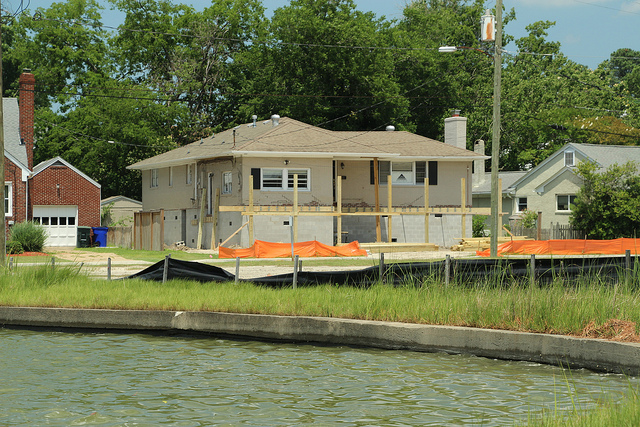
A house in the process of being elevated, a very expensive solution to the problem of recurrent flooding due to sea level rise in Virginia. Photo credit: CCAN

A house in the process of being elevated, a very expensive solution to the problem of recurrent flooding due to sea level rise in Virginia. Photo credit: CCAN

Have you ever put together a list of items you would purchase if you won the lottery—before you remembered that you haven’t even purchased a ticket? Upon reflection, how premature was that list you so perfectly pieced together?

In Virginia, we face a similar dilemma when it comes to addressing the mounting crisis of flooding along our coast.

We’ve got plenty of laudable lists in the works. Last year, Virginia lawmakers unanimously passed a resolution establishing a joint subcommittee to study recurrent flooding issues and adopt recommendations. Legislators from both parties sent a unified message: flooding is a problem in Hampton Roads and we need to do something about it.

In 2008, former Governor Tim Kaine’s Climate Change Commission laid out more than 100 recommendations to mitigate and adapt to climate change and sea level rise. So far the state has failed to adopt a plan to execute them. To his credit, Governor Terry McAuliffe recently launched a similar commission. This panel, the state’s Secure Commonwealth Panel, and the General Assembly’s aforementioned recurrent flooding subcommittee all have the same mandate: convene, discuss, deliberate, and draft a set of recommendations.

So what’s the catch? While what needs to be done is relatively easy to identify, the cost is significant—if not staggering. Virginia needs to win the equivalent of a multi-hundred-million-dollar lottery every year to fund the adaptation measures required to protect coastal residents and infrastructure.

Hampton Roads is home to the world’s largest naval base, more than $80 billion in economic activity, and 1.7 million residents who routinely feel the effects of sea level rise. Streets need to be raised, levees need to be built, and homes and businesses need to be protected. The U.S. branch of the Dutch engineering firm Fugro estimated that it would cost the city of Norfolk at least $1 billion to fully adapt to rising seas and frequent flooding—which equals Norfolk’s entire annual government operating budget.

The non-profit group Wetlands Watch reports that the cost to either elevate or purchase the homes of residents in just five Hampton Roads localities that have sustained multiple flood losses of $1,000 or more in the last ten years would exceed $430 million. Relying on federal assistance alone, it could take up to 244 years to assist all homeowners seeking help in these five localities.

Meanwhile, the Virginia Institute of Marine Science warns that sea levels could rise by as much as seven feet along Virginia’s coast within this century. We can’t afford to keep creating unfunded wish lists, and we can’t wish the problems away.

Virginia needs a dedicated stream of state funding to help coastal families and localities fight climate change. Obviously, there’s no lottery for this. But thankfully there is a common-sense legislative approach being introduced in the Virginia General Assembly by Republican Virginia Beach Delegate Ron Villanueva. His bill, called the Virginia Coastal Protection Act, would help solve our massive coastal flooding problem with a first-ever state funding mechanism that is good for the economy and good for our communities.

By joining the state into the highly successful and fully established Regional Greenhouse Gas Initiative, or RGGI, the bill would generate more than $200 million per year in new state funds to invest in coastal adaptation and other climate change solutions. This relief could come when localities in Hampton Roads need it most. It would come without adding any new demands to the state’s tight budget. It would also come through a system proven to rein in energy costs while reducing emissions and raising revenue.

RGGI is a cooperative effort of nine East Coast states that caps and reduces greenhouse gas pollution. Since the program’s inception in 2008, RGGI states have reduced their carbon footprint 2.7 times faster than non-RGGI states. In the same time period, electricity prices have dropped by 8 percent in participating states, compared to a 6 percent rise throughout the rest of the nation.

Under RGGI, power plants purchase allowances for every ton of carbon they emit. The sale of carbon allowances gets reinvested back to the states. Under Del. Villanueva’s bill, half of Virginia’s projected $200 million in annual auction revenues would fund coastal adaptation efforts, 35 percent would fund energy efficiency and renewable energy projects, and 10 percent would fund workforce development, education, and economic assistance in Southwest Virginia.

The Virginia Coastal Protection Act is a win-win-win solution. We can establish a consistent and significant source of revenue to tackle flooding in Hampton Roads and generate funds to invest in other statewide priorities, while putting policies in place to help Virginia meet carbon reduction goals in an efficient and practical manner.

Virginia’s lawmakers are on the record in their overwhelming bipartisan support for finding solutions to the state’s growing flooding woes. Delegate Villanueva has put forward the best plan to take us beyond wish lists, and to start funding urgently needed solutions.

Dawone Robinson is Virginia Policy Director with the Chesapeake Climate Action Network, a regional climate-change policy and advocacy organization with more than 30,000 supporters in Virginia. You can reach him at dawone@chesapeakeclimate.org

UPDATE: State Senator Don McEachin (D-Richmond) has agreed to introduce the Coastal Protection Act into the Senate as a companion bill to Delegate Villanueva’s (SB 1428), making this now a bipartisan effort.