Unknown's avatar

Does McAuliffe deserve that bad grade on climate and energy?

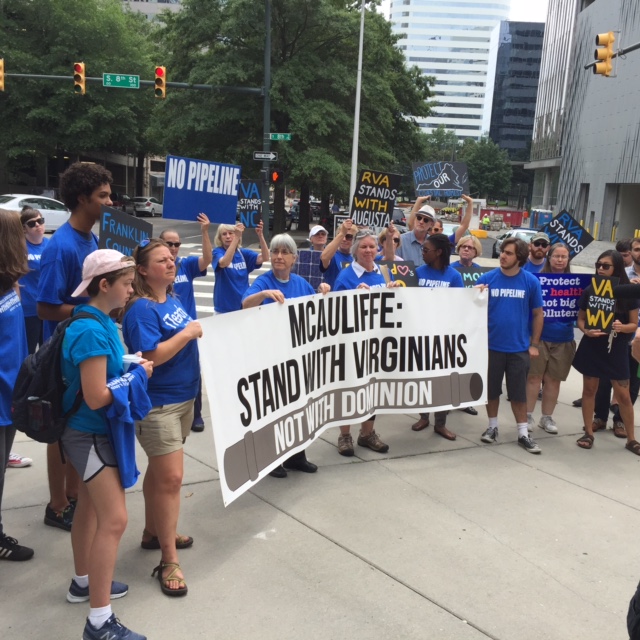
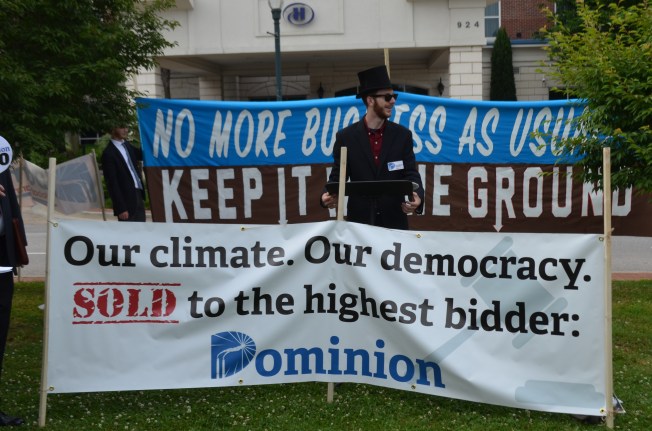
Protesters at an anti-pipeline rally aim their message at Governor McAuliffe

Protesters at an anti-pipeline rally aim their message at Governor McAuliffe

Clean energy advocates who scrutinize Virginia Governor Terry McAuliffe’s record see different things. Chesapeake Climate Action Network (CCAN), the Virginia Student Environmental Coalition (VSEC) and other groups recently released a mid-season “report card” that gave McAuliffe a D-plus on climate and energy. The bad grades primarily stem from his support of massive fracked-gas pipelines and offshore oil drilling, as well as Department of Environmental Quality’s (DEQ’s) approval of Dominion Virginia Power’s plans to “close” coal ash ponds by leaving toxic waste in unlined pits next to rivers.

Meanwhile, though, other environmental leaders are praising the governor for speaking out about the reality of climate change and promising to forge ahead with implementation of the EPA’s Clean Power Plan in spite of the current judicial stay. They also say McAuliffe should get more credit for his vetoes of bills attacking the Clean Power Plan and extending subsidies to coal companies.

It is possible to agree with both the criticism and the defense. McAuliffe’s enthusiastic support for Dominion’s Atlantic Coast Pipeline has been an enduring irritant to climate activists as well as to landowners along the planned routes of the ACP and other natural gas pipelines. A Sierra Club analysis concluded that the pipelines would increase the Commonwealth’s greenhouse gas footprint by more than twice the total emissions of all power plant generation in the state.

He is also rightly criticized for supporting off-shore drilling, which would increase climate pollution and sea level rise and threaten the Navy’s and tourism’s contributions to Hampton Roads’ economy—a potential double whammy for residents and businesses.

And the Virginia DEQ has begun to look a lot like its North Carolina counterpart, a captured agency incapable of defending our air and water from the corporate polluters it is supposed to regulate. Sure, the problem has festered through several administrations, but McAuliffe’s failure to intervene is impossible to reconcile with his pro-environment rhetoric.

The problem goes beyond DEQ. In response to a detailed petition to the Governor for an interagency review to modernize the state’s fracking regulations, McAuliffe’s Secretary of Commerce and Labor announced a plan to limit the issues and refer them to an industry-dominated organization funded by the American Petroleum Institute for decision. This is hardly a sign of a Governor committed to protecting the environment, safety and health.

Yet messaging matters, and McAuliffe is a vocal messenger on the topic of climate change. The governor points to the flooding that routinely shuts down streets in Norfolk as proof that human-caused sea level rise is already a problem right here in Virginia. And as a team player for the Democrats, he supports Obama’s Clean Power Plan even as he brags (superfluously and probably incorrectly) that he persuaded EPA to soften its Virginia targets to reduce our burden of compliance.

Besides which, if he’s no Jerry Brown or Jay Inslee leading his state towards a fossil-free future, McAuliffe is also not Ken Cuccinelli, hounding climate scientists out of state. Given a Republican majority in Virginia’s General Assembly that is dedicated to propping up the coal industry and blocking anything EPA does, it could have been so much worse.

So perhaps CCAN is letting the perfect be the enemy of the good—or in this case, letting the good be the enemy of the “meh.”

Regardless of how they feel about McAuliffe’s record, both the glass-half-full folks and the glass-half-empty folks agree there’s an “incomplete” on his report card that could make an enormous difference to his legacy. The ultimate test of the Governor’s climate credentials, they say, is whether he pushes DEQ to write a Clean Power Plan that puts a firm cap on total carbon emissions from the electric sector in Virginia. Though the General Assembly found a way to stop DEQ from completing work on the state implementation plan temporarily, nothing stops McAuliffe from taking a public stand on this most critical point.

That sounds like a no-brainer for a Democrat who is serious about reining in CO2. Unfortunately, it doesn’t meet with the approval of Tom Farrell, CEO of Dominion Resources, or Bob Blue, President of Dominion’s electric utility subsidiary, Dominion Virginia Power. They want DEQ to write a plan that leaves out new sources of emissions. That would let them continue building lots of big, new natural gas generating plants that, Blue assures us, will be capable of spewing carbon for at least another half century. All that burning of fracked gas would be lousy for the climate, but it would guarantee profits for Dominion’s utility and pipeline affiliate.

So on the one hand, the Governor can choose to be a climate hero, fighting sea level rise and deadly heat waves, creating tens of thousands of clean energy jobs and attracting forward-looking companies to the state, building his national reputation, doing what’s right for all our children and grandchildren, —

Or he can make Dominion happy.

It will be very interesting to see what becomes of that “incomplete” on his report card.

Unknown's avatar

Virginia’s energy future is up for discussion this Wednesday in Arlington

Visitors tour the solar installation on the roof of Wakefield HS in Arlington. Photo credit Phil Duncan

Visitors tour the solar installation on the roof of Wakefield HS in Arlington. Photo credit Phil Duncan

Those of you in Northern Virginia might be interested in attending a screening of the film “The Future of Energy” at the Arlington Cinema and Drafthouse on Wednesday, May 25 at 7:30 p.m. I will be leading a discussion of energy issues and the future of renewable energy in Virginia following the movie.

“The Future of Energy: Lateral Power to the People” is billed as “a positive film about the renewable energy revolution,” and “the people and communities leading the way towards a renewable energy future.” You can watch the trailer on the website of the Arlington Cinema and Drafthouse.

Arlingtonians for a Clean Environment (ACE) is hosting the screening. Tickets are $10, or $5 for students at the door. Doors open at 6:30, which is a good time to arrive if you want to order dinner and drinks and talk to some of the local environmental leaders who are attending.

ACE and the Sierra Club have teamed up on a campaign called “Ready for 100,” with a goal of leading Arlington and the city of Alexandria towards a goal of 100% renewable energy for the electric sector by 2035. ACE’s director, Elenor Hodges, and Dean Amel, Chair of the Mount Vernon Group of the Sierra Club, will be on hand to provide more information about the “Ready for 100” campaign. Arlington Energy Manager John Morrill will also be there to answer questions.

ACE is also working with VA-SUN on a new solar bulk-purchasing cooperative for Northern Virginia residents and businesses called the Potomac Solar Co-op and will have information available about it on Wednesday. An information session for the co-op is planned for June 8.

Arlington is already recognized for its leadership on clean energy, with groundbreaking projects like a net-zero-energy elementary school. But getting to 100% will take a truly determined, collective effort on the part of homeowners, businesses and local government. We will also likely need to see reforms to state policies and laws that currently present barriers to renewable energy. These state barriers affect all Virginians, so while Wednesday’s focus will be on Arlington, the discussion will be relevant to everyone who wants to see a clean energy future in Virginia.

Unknown's avatar

Inside the minds of Dominion’s leaders, vacant space where climate thinking should be

Climate activists protest outside Dominion Resources' May shareholder meeting in Columbia, SC. Photo credit Ian Ware, Chesapeake Climate Action Network.

Climate activists protest outside Dominion Resources’ May shareholder meeting in Columbia, SC. Photo credit Ian Ware, Chesapeake Climate Action Network.

At Dominion Resources’ annual May meeting, shareholders presented five resolutions designed to improve the company’s assessment of its opportunities and vulnerabilities on climate, renewable energy and nuclear power. The company’s Board opposed the resolutions and fought vigorously to keep them off the shareholder ballot. (All five failed.) Guest blogger Seth Heald attended the meeting and sent this report back.

Two senior Dominion Resources executives—Bob Blue and Thomas F. Farrell, II—gave speeches on consecutive days earlier this month. I’ll report here on what they said, but even more telling is what they failed to say. Neither man mentioned a critical topic for their company and our world: climate change.

In Arthur Conan Doyle’s short story Silver Blaze, Sherlock Holmes solves the kidnapping of a racehorse by focusing on what didn’t happen. A dog didn’t bark in the night when the crime was committed, suggesting that the perpetrator was friendly with the dog. As The New Yorker’s Maria Konnikova, author of How to Think Like Sherlock Holmes, describes Holmes’s insight: “pay attention to what isn’t there, not just what is. Absence is just as important and just as telling as presence.”

Here’s the context of the two Dominion speeches. Bob Blue, president of Dominion Resources’ Dominion Virginia Power (DVP) subsidiary, was the luncheon speaker on May 10 before several hundred people in Richmond at the Virginia Chamber of Commerce conference on “Energy, Sustainability & Resiliency.” Tom Farrell, Dominion Resources’ board chairman, president, and CEO, spoke the following day in Columbia, SC, addressing a small audience—many of them Dominion employees and board members—at Dominion Resources’ 107th annual shareholders meeting. (Dominion always draws smaller audiences, and smaller climate protests, when it holds its shareholder meeting away from its Richmond headquarters.) As best I can tell, Bob Blue and I were the only two people present at both events. I took detailed notes.

DVP is Virginia’s largest electric utility. Thanks to its fossil-fuel-fired power plants it’s also the commonwealth’s number one emitter of climate-disrupting carbon dioxide. It’s hard for serious people to think about “energy, sustainability, and resiliency” these days without thinking about how climate change is and will be affecting us and our children. The past year has certainly been filled with near-constant reminders of climate change for anyone paying attention. These include Pope Francis’s encyclical, record warm global-average temperatures, the Paris international climate accord, severe droughts, and severe floods.

So it seems reasonable to expect Blue might have expressed some thoughts on how the climate crisis will be affecting his company and the electric-power industry in the coming decades. It was, after all, a conference on energy, sustainability, and resiliency.

Blue said at the outset that “natural gas is the new default fuel” for electric-power generation. He mentioned his company’s new gas-fired power plants and said, “We expect the big things we build to last 50 years or more.” He alluded to the hits Dominion has taken recently on its environmental record by saying the company had done a lot of things well, “but our weakness is our inability to communicate in simple terms about complex matters.” (Translation: We’re doing everything just right, but folks don’t realize it because they can’t understand complex matters.)

If climate change is a subject Blue has given any thought to lately, he neglected to mention it. To be fair, he did briefly mention the EPA Clean Power Plan, saying he thinks it would cost Virginia between $5 billion and $13 billion. But then he claimed it was too complex and boring to go into in detail. And he also talked a bit about solar and wind power, but there was no reference at all to the underlying climate problem that is the primary reason we need to transition from fossil fuels.

What’s more, Blue brought up solar and wind mostly to justify DVP’s go-slow approach in deploying them. Speaking a few days after the Kentucky Derby, in what he called “Triple Crown season,” Blue said that with solar and wind power, “The earliest horse out of the gate doesn’t always win.” That’s true in horse racing (although sometimes the first horse out does win), but it’s a poor analogy to use when addressing climate change, where greater CO2 emissions today necessitate much sharper reductions later. Thinking about climate change means recognizing the need for early action.

Come to think of it, the horse-out-of-the-gate analogy is more apt for building gas-fired power plants than it is for deploying clean energy. There’s no need to rush to build multiple fossil-fuel plants when we know we have to kick our fossil-fuel habit. In fact, there’s a high likelihood that a rush to build huge new fossil-fuel infrastructure now will leave ratepayers on the hook later, paying for power plants that have to be shut down early for us to reach our future carbon-emission targets. Yet Dominion has certainly been moving with great speed lately to get gas-fired power plants built. There is a sense of urgency at Dominion, but it’s about building more fossil-fuel infrastructure, not addressing climate change.

By not mentioning or acknowledging climate change Blue accomplished at least two objectives that he must think serve his company’s short-term interests. First, he avoided offending the many Republicans in the room, including some state legislators, whose party still cannot bring itself to acknowledge the climate threat. Blue’s climate silence is understandable in that regard, although it hardly reflects moral courage or true business leadership. Problems ignored as unpleasant or “controversial” tend to get worse, not better.

Second, by not mentioning climate change Blue could avoid having to explain how Dominion’s business plan will affect the climate, or Virginia’s ability to transition from fossil fuels to carbon-free energy in time to help our country avoid catastrophic climate impacts. Stated another way, ignoring climate change allowed Blue to ignore the need to compare his company’s greenhouse-gas-emissions trajectory with what the science tells us must be done to retain a recognizable climate.

Climate silence is a topic of considerable interest to scholars these days. In fact, on the day after Blue’s speech The Washington Post ran an article describing a recent study of climate silence by two Penn State researchers. In his new book Moral Disengagement, renowned Stanford psychologist Albert Bandura explains, “If one ignores … the evidence of the harmful results of one’s conduct, one has few reasons to activate self-censure or any need to change behavioral practices.”

This may help to explain Blue’s silence. When your business model doesn’t square with your conscience, you may prefer not to activate your conscience.

Bandura’s insights also illuminate the lacuna where climate thinking should be in the mind of the Dominion Resources CEO. Farrell’s speech to shareholders in Columbia a day after Blue’s talk was preceded by a short video intended to show Dominion’s good works in South Carolina. I’ve attended the last four Dominion shareholder meetings (two in Richmond, one in Cleveland, and this one in Columbia). The videos about the company’s local charitable and civic involvement are a staple at each meeting, and they’re always well-produced, moving, and interesting.

This year’s video highlighted contributions (financial, in-kind, and services) that Dominion and its employees made to the Red Cross and others in South Carolina last fall, when the state suffered from catastrophic flooding. A news clip in the video from the time of the floods showed an emotional Governor Nikki Haley saying, “This is the heaviest flooding we’ve ever seen.” Another person could be heard saying, “Eastover [SC] lost everything.” Columbia’s mayor said the floods “changed our lives.” A number of scenes of devastation were shown.

Dominion’s employees clearly did great work in helping a stricken region recover, and the company’s donations to the Red Cross are certainly admirable. But there was a sad irony in employing that tragic event to highlight Dominion’s many good works. Did any of the assembled Dominion executives or board members think about climate change as the video rolled? Did they think about the wisdom of their company’s plans to build massive new fossil-fuel infrastructure? Certainly Farrell did not mention climate in his prepared remarks following the video.

When company executives rarely talk publicly about climate change it’s easier for them and their audiences and employees not to think about it. Executives’ public silence on the issue also makes it easier for the legislators with whom executives regularly interact not to think about climate. And if you don’t think about a problem much, you’re unlikely to gain a sense of urgency about having to address it. That’s Albert Bandura’s moral-disengagement theory in a nutshell.

Dominion’s public silence on climate is complemented by its support for the American Legislative Exchange Council (ALEC), which promotes climate-change disinformation to state legislators. That further promotes inaction on climate. A corporation’s use of front groups to do the corporation’s dirty work behind the scenes is another example of moral disengagement, according to Bandura.

Farrell started his talk by listing what he said are Dominion’s four core values: “safety, ethics, excellence, and one Dominion.” There’s a large and growing body of scholarly research on climate-change ethics, including a number of recent excellent books on the topic suitable for lay readers. But Farrell’s discussion of ethics had no references to the climate. A shareholder resolution on the Dominion proxy ballot this year called on the company to have at least one board member with environmental expertise. Such expertise might include familiarity with the field of climate ethics. But Dominion’s board recommended a “no” vote on the resolution, and it was defeated.

Farrell claimed that Dominion is a leader in environmental stewardship. “We’re a leader, but people don’t recognize it.” He discussed the company’s major expansion in the natural-gas transmission business in recent years, and said the Marcellus shale-gas formation in the East “will provide gas for the balance of this century at least.” He noted the company’s pending acquisition of Utah-based gas company Questar, which will allow the company to expand its gas business across the West.

Farrell took questions from shareholders after his talk. I asked him for his thoughts about climate change, after noting that we’d been through a year of record global temperatures, floods, and the Paris climate accord. He said he didn’t want to talk about the Paris agreement. “I’ll leave that to President Obama and Secretary Kerry. That’s above my pay grade.” Farrell’s pay package last year topped $20 million.


Seth Heald is a student in the Johns Hopkins University Master of Science in Energy Policy and Climate program. His article on climate communication and moral disengagement is published in the May-June 2016 issue of the journal Environment, Science and Policy for Sustainable Development. He serves as volunteer chair of the Sierra Club’s Virginia Chapter. 

Unknown's avatar

Charging green customers more without doing more: Appalachian Power discovers the beauty of market segmentation, and moves to block competition

This wind farm isn't in Virginia, and APCo's proposal doesn't include building any new wind. But the cows are cute. Photo credit: NREL

This wind farm isn’t in Virginia, and APCo’s proposal doesn’t include building any new wind. But the cows are cute. Photo credit: NREL

Appalachian Power Company has asked the State Corporation Commission to approve a 100% renewable energy product it wants to offer its environmentally-conscious electricity customers. These customers would pay about 18% more for a combination of wind and hydro than they currently do for “brown” power. But APCo doesn’t plan to build new facilities. It will simply segregate out some of its existing wind and hydro (none of it in Virginia) to package as a new, higher-priced product.[i] The case is PUE-2016-00051.

Since APCo currently sells the renewable energy certificates (RECs) associated with these wind and hydro projects to buyers elsewhere, the change means it would terminate those contracts and provide the RECs to its green energy customers along with the electricity. RECs represent the “renewable attributes” of the power (the bragging rights, if you will), so the electricity by itself doesn’t count as renewable if it doesn’t come with the RECs.

The price of RECs represents only a part of the 18% premium. RECs are really cheap nationally, because supply exceeds demand.[ii] Another driver of the premium is that wind energy was more expensive back in 2007-2010, when these projects were built. Falling wind prices and a natural gas glut have pushed overall energy prices down since then. APCo customers are still paying off the cost of its wind farms (or in the case of two of them, are still paying on power purchase contracts). APCo proposes to shift the burden of paying for those wind farms onto the customers it believes are willing to pay more. At least theoretically, this means it will also reduce the price it charges the rest of its customers, who (it assumes) don’t care where their power comes from.

APCo says if demand is high enough, it will invest in new renewable energy facilities to add supply, which might decrease the cost of the tariff in the future. Cost declines have made new wind competitive with fossil fuels, so a tariff based on new facilities would have lower pricing.

Page 37 of APCo’s filing shows the effect of the accounting change on a customer’s bill for a residential customer using 120 kWh/month:

100% RE: $160,  non-RE customers: $135

or an extra $25/month, $300/year

By my math that comes out to:

100% RE: 13.3 cents/kWh,   non-RE customers: 11.3 cents/kWh

No doubt APCo is responding to consumer demand in proposing this renewable energy tariff. Virginians have become much more vocal, and much less patient, about wanting their utilities to invest in clean energy. But APCo has less virtuous motives as well. Offering electricity generated by 100% renewable energy closes off one avenue under which solar developers currently argue that third-party power purchase agreements (PPAs) are legal. PPAs are a common tool for financing solar projects, and are the only way some customers can afford to buy renewable energy. They are not being used today in APCo territory because of the risk that the utility will sue, claiming a violation of its monopoly on electricity sales.

The Virginia Code contains an exception to utilities’ exclusive monopoly in their territory: if a utility doesn’t sell 100% renewable energy to its customers, anyone else can. The SCC previously ruled that selling RECs doesn’t count, so APCo and Dominion’s own green power programs (consisting mostly of overpriced RECs) do not close the loophole. I have always wondered why they didn’t just do what APCo now proposes, if for no other reason than to close the loophole. The Code says nothing about the green power having to be reasonably priced.

Recall that we are still waiting for the SCC to rule on APCo’s terrible PPA-alternative proposal. The solar industry and environmental groups opposed the proposal not just because it was expensive, convoluted and certain to fail, but also because the Code’s renewable energy exception appears to allow PPAs already, making the APCo program unnecessary.[iii]

APCo and Dominion argue that the Code exception applies only where the seller supplies 100% of the customer’s demand, 100% of the time, with 100% renewable energy. A single wind farm can’t guarantee around-the-clock output, so APCo has combined wind energy with some hydro. That’s something a wind or solar developer can’t do, especially when the developer is merely putting solar panels on a customer’s roof.

These are nice legal arguments guaranteed to keep lawyers employed and the market in limbo. From the public policy point of view, though, there is nothing to be gained by suppressing the renewable energy market. Why squelch private investment and deny customers the right to use a popular financing tool to install wind and solar? For customers willing to pay a premium, why limit them to APCo’s product? If a company wants only wind power or solar power, why not let them contract with any willing provider?

The SCC should definitively declare in favor of PPAs, open the market to competition, and let the free market get to work. If the SCC won’t do it, the legislature should. If customers want APCo’s renewable energy product, terrific. If they can do better elsewhere, let them. We all win by creating new clean energy jobs, having carbon-free electricity displace fossil fuels, and giving customers the products they want.


[i] Page 6 of APCo’s Petition states: “Initially, the Company will assign to Rider REO the output of its renewable generators that are currently under long-term Purchased Power Agreements (the ‘Renewable PPAs’): the Summerville hydro-electric facility, and the Camp Grove, Fowler Ridge, Beech Ridge, and Grand Ridge wind facilities.” The Summersville dam, in West Virginia, was built in 2001. The Camp Grove Wind farm is in Illinois and began operation in 2007. Fowler Ridge, in Indiana, was commissioned in 2008. Beech Ridge, in West Virginia, became operational in 2010. Grand Ridge, in Illinois, was built in 2009.

[ii] It appears from APCo’s filing that its wind RECs sell for $18/MWh, or 1.8 cents/kWh. I don’t see a price stated for hydro RECs in APCO’s filing, but they typically have little value.

[iii] A second basis for believing that PPAs are legal does not rely on the Code exception. Rulings from Iowa and New Hampshire have recognized that PPAs involving rooftop solar are not the kind of electricity sales covered by public utility regulations. APCo’s new offering does not undercut that argument.


Update: on June 21, 2017, a Hearing Examiner recommended that the SCC reject APCo’s application, finding it not in the public interest. See my discussion of that ruling here. The SCC commissioners will have the final say, however.

Unknown's avatar

Virginia legislators named to review clean energy bills

Workers install solar panels at the University of Richmond.

Workers install solar panels at the University of Richmond.

Virginia’s 2016 legislative session began with a host of worthy bills promoting energy efficiency, wind and solar, but ended with almost none of the legislation even having been considered in committee. The Republican chairmen of the Senate and House Commerce and Labor committees instead “carried over” the bulk of the bills, announcing plans for a new subcommittee to study them and make recommendations for 2017.

Members of the subcommittee have now been named. Senator Frank Wagner has tapped Senators Black, Cosgrove, Stuart and Dance to serve. This information is now on the General Assembly website. Delegate Terry Kilgore has named Delegates Ware, Hugo, Ransome, Miller and Keam.

No meeting schedule has been announced, but lobbyists for the utilities and the solar industry trade association, MDV-SEIA, have begun meeting in private to discuss potential compromises. This can’t be called a stakeholder process; the meetings are not open to the public, and they have not invited participation by environmentalists or, with one exception, anyone on the consumer side representing the interests of local government, colleges and universities, churches, eco-friendly businesses or residential customers.

(The exception is a lobbyist for Loudoun County landowner Karen Schaufeld, a newcomer to energy issues who formed a group called Powered by Facts and hired lobbyists to advocate for expanded agricultural net metering and other pro-solar reforms.)

Anything that emerges from these meetings will likely have a significant impact on the subcommittee. Yet, given the importance of this issue to the commonwealth, the subcommittee should ensure it hears from all solar stakeholders. More importantly, committee members should explicitly adopt as their measure of progress a simple test: whether the language of a bill will lead to greater private investment in solar in Virginia. Wagner and Kilgore have said they want to see the growth of solar here, and all of the legislators publicly subscribe to the values of free market competition and consumer choice. But without a guidepost, we are likely to see the utilities bully the solar industry into a “compromise” that shifts the ground a bit but continues to strangle the private market–and leaves us further than ever behind other states.

Who’s who on the committee

All of the legislators named to the study committee are Commerce and Labor committee members, but beyond that, many of these appointments are surprising, as they don’t necessarily reflect demonstrated interest in the subject. It is also disturbing that only one Democrat was named from each side. (Dance is the Senate Democrat, Keam the House Democrat. They are also the only minorities represented.) There is no reason energy efficiency and renewable energy should be partisan issues, but in the past, party affiliation has been the single most powerful predictor of votes on clean energy.

To gage how these legislators approach the issues, I took a look at the Sierra Club’s Climate and Energy Scorecard for 2014 and 2015. Scores for 2016 are not yet available. It is important to note that in the House, most renewable energy legislation has been killed by unrecorded voice votes in the Commerce and Labor subcommittee, preventing the votes from being scored. So the scorecard is only a starting point.

The Senators

Frank Wagner himself earned a D in 2015, with a voting percentage of 60%. This was up from an F in 2014. The Virginia Beach Republican is the only member on this subcommittee to have exhibited a serious interest in energy issues, having shaped many of Virginia’s current policies. Unfortunately, he is closely allied with Dominion Power, voted for tax subsidies for the coal industry, tends to doubt the reality of climate change, and has been sharply critical of the EPA Clean Power Plan. On the plus side, he believes renewable energy should play an important role and was instrumental in launching the state’s bid for offshore wind. He also genuinely welcomes input from the public at meetings he runs.

That makes his committee choices all the more peculiar. Dick Black is better known as a social crusader who lines up with the far right wing of his party, most notably in opposition to abortion, gay rights and gun limits. Most recently, he made headlines by meeting with Syrian president Bashar Assad and urging the U.S. to lift economics sanctions against the Assad regime.

Black is a climate denier of the delusional variety, insisting at an event last August that global temperatures have not risen in 17 years and that no major hurricanes have hit the American mainland in 9 years. (2014 was the hottest year on record until 2015 seized the trophy. Superstorm Sandy, the largest Atlantic hurricane on record, struck in 2012.)

The forum was an “American for Prosperity grassroots event” (sic). The “crowd of about 18 people” included former Senator Ken Cuccinelli, no slouch himself in the climate denial department. Black compared EPA employees to “Bolshevik communists.” He and Cuccinelli used the event to criticize the Clean Power Plan as “part of a government scheme to send billions in taxpayer funds to ‘wind and solar scams’ and ‘billionaire liberals.’”

He received a grade of F from the Sierra Club in both 2014 and 2015. With a voting percentage of just 14% last year, he had the worst record in the Senate on climate and energy bills. In sum, the appointment of Dick Black to this committee can’t be called an effort to seek out thoughtful voices on the issues.

John Cosgrove is a solid conservative on name-brand issues like guns and abortion, though decidedly lacking Black’s flair for headlines. With a 67% score, he received a grade of D from the Sierra Club in 2015, up from an F in 2014. A review of the bills he has introduced in the last two years showed none related to climate or energy, again raising the question of why he was chosen for this particular subcommittee.

Richard Stuart’s voting record of 50% earned him an F in 2015, down from a C in 2014. However, he earned an award from the Sierra Club in 2014 for introducing a bill to regulate fracking; the bill did not pass. Senator Stuart also received “extra credit” on the 2015 scorecard for introducing the bill that established the Virginia Solar Energy Development Authority. In 2016, he also introduced one of the more ambitious renewable energy bills, working with Schaufeld’s Powered by Facts.

Roslyn Dance is the lone Democrat and only woman selected from the Senate. She has consistently voted on the side of clean energy, and was the patron of 2015 legislation raising the size limit on net-metered projects from 500 kW to 1 megawatt. This work earned her an award from the Sierra Club that year.

Dance scored 100% on both the 2014 scorecard (when she was a delegate) and the 2015 scorecard, for a grade of A+ each year. However, she came in for intense criticism in the 2016 session for abstaining on Senator Surovell’s coal ash bill, knowing it would fail in committee without her vote. The bill would have required Dominion Virginia Power to move stored coal ash out of unlined ponds along rivers for disposal in lined facilities away from water sources. Dance’s abstention was widely thought to be a favor to Dominion Power, saving the company from what might have been a nasty fight on the Senate floor.

The Delegates

Terry Kilgore, Chairman of House Commerce and Labor, represents part of rural southwest Virginia, and has close ties to Appalachian Power Company and the coal industry, both of which contribute generously to his campaigns. Bills opposed by utilities have little chance in his committee. In 2015, he earned an F on the energy and climate scorecard, with a 50% score, down from a D (63%) in 2014.

Lee Ware represents a suburban and rural area west of Richmond, stretching from the western side of Chesterfield County. He earned a C (75%) in 2014 and an F (50%) in 2015. In spite of these scores, he has shown an independent, thoughtful approach to energy legislation, and has demonstrated a serious interest in promoting energy efficiency. His bill to change how the State Corporation Commission evaluates utility efficiency programs is one of the pieces of legislation to be considered this summer.

Tim Hugo represents a suburban Northern Virginia district. He earned a D (67%) in 2014, with extra credit for introducing a bill that reclassified solar equipment as “pollution control equipment,” earning it a critical exemption from a local business property tax known as a “machinery and tools” tax. In 2015 his score dropped to an F (56%), in spite of an extra credit bump from introducing the House version of the Solar Development Authority bill.

As Majority Caucus Chair, Hugo’s poor scores reflect the leadership’s pro-coal, anti-regulation platform. He is nonetheless keenly interested in promoting solar energy, at least where he can do so without running into utility opposition. His close ties to Dominion have often meant he led the opposition to pro-solar net metering reforms, keeping them from moving out of the committee.

Margaret Ransone is the only woman named to the House subcommittee. She received an F (57%) in 2015, down from a C (71%) in 2014. She represents counties along the Northern Neck, near Richmond. She is not on the Commerce and Labor energy subcommittee, and has shown no particular interest in the subject. Her website suggests a mix of the ideological (pro-gun, anti-abortion) and the practical (high speed internet for rural areas).

Jackson Miller received an F (44%) in 2015, down from a D (63%) in 2014. His district is close to Hugo’s, covering the City of Manassas and part of Prince William County in the outer suburbs of Northern Virginia. Miller is Majority Whip for the House. He has consistently voted against expanding net metering options.

Mark Keam is the only Democrat on the House subcommittee as well as the only ethnic minority (he is Korean). He received an A+ (100%) in 2015, up from an A (88%) in 2014. He has generally supported expanded opportunities for renewable energy.

Unknown's avatar

Battles over climate and coal go unresolved, but Virginians still paying more

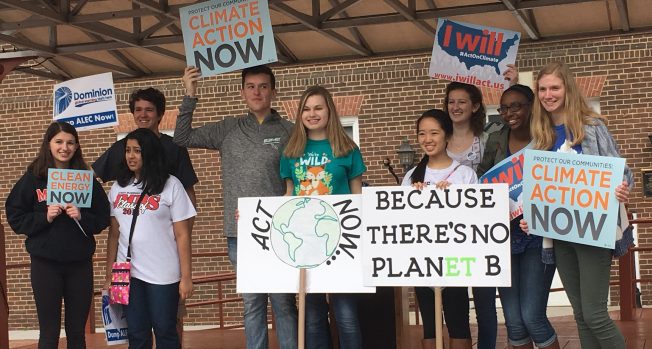
Students rally for climate action in Alexandria, Virginia. Photo courtesy of Sierra Club.

Students rally for climate action in Alexandria, Virginia. Photo courtesy of Sierra Club.

Virginia’s 2016 legislative session ended last week with a one-day veto session, an ideological battleground where both sides fought lustily but nobody won.

Republicans could not muster the votes to overcome McAuliffe’s veto of legislation extending taxpayer handouts for coal mining companies. Nor could they overcome vetoes of HB 2 and SB 21, bills requiring that any state plan implementing the EPA’s Clean Power Plan be submitted to the General Assembly for approval.

They did, however, succeed in defending a budget item prohibiting the Department of Environmental Quality (DEQ) from developing a state implementation plan while a federal stay of the Clean Power Plan remains in effect. (For that they needed only a majority; overriding a veto requires a two-thirds super-majority.)

These votes won’t end the skirmishing. The tax credit for companies that mine Virginia coal doesn’t expire until the end of 2016, and Terry Kilgore, Chairman of the House Commerce and Labor Committee and a reliable ally of the coal lobby, has already promised another effort next session to extend the handouts.

As for the Clean Power Plan, the budget maneuver will cause headaches, as intended, but it’s merely a stall tactic. Virginia may end up submitting a clumsier plan than it otherwise would, if it has to scramble to meet the deadline once the stay is lifted. Even that isn’t certain. DEQ has already completed much of the fact-gathering portion of its work, including issuance of a report from the stakeholder group it convened to consider options. And the new fiscal year, when the prohibition kicks in, doesn’t begin until July 1. A lot of work could get done in two months.

Moreover, Republicans seem to have a losing hand here, even if they block DEQ from completing its work. If the Clean Power Plan survives attack in the courts and Virginia doesn’t submit a plan, EPA will write one for us. On the other hand, if the Clean Power Plan fails judicial scrutiny, EPA will have to rewrite it in a way that might be even worse for coal.[1]

But the Republican attacks on the Clean Power Plan have never been about protecting our ability to plan our own energy future—or for that matter, about protecting ratepayers. Recall that a year ago the General Assembly passed Dominion Power’s SB 1349, with its so-called “rate freeze,” on the theory that the Clean Power Plan will cost so much money that electric rates needed to be frozen between now and the time the plan actually kicks in, and regulators forbidden from scrutinizing utilities’ books in the meantime.

I know: that makes no sense. But don’t ask me for a better explanation; the rationale never stood up to scrutiny. And Republicans weren’t the only ones supporting this peculiar legislation. Once the original anti-Clean Power Plan elements were stripped out, plenty of Democrats got on board to prove their fealty to Dominion.

We have since learned two things about SB 1349 and one thing about the Clean Power Plan:

  • According to one State Corporation Commission judge, SB 1349 will cost Virginia ratepayers a billion dollars in overpayments to Dominion.
  • Dominion Power customers are about to see their rates go up regardless of the “freeze,” as a result of Dominion getting approval to build a new gas-fired power plant;
  • The final Clean Power Plan requires almost nothing from Virginia, and compliance might even save us money.

Now that we know all this, wouldn’t you expect to hear legislators clamoring for the repeal of the faux rate freeze?

Cock an ear. What do you hear?

Crickets.

To be sure, many Republicans who pushed for SB 1349 were more interested in the threat the Clean Power Plan posed to the coal industry. Their support for the coal tax subsidies shows Republicans have no qualms about charging taxpayers tens of millions of dollars annually to help coal companies. Perhaps when you’re in the business of giving away other people’s money, another billion dollars doesn’t seem like a stretch.

Still, if concern for the people of coal country were really at work, we might have expected success for McAuliffe’s budget amendment that put one million dollars into funding for solar projects, with priority for those in Southwest Virginia. Compared to the coal subsidies, admittedly, this isn’t much. In NoVa, a million dollars is one high-end home, green features extra. Spread around the coalfields, though, it could have powered up to a hundred homes with solar. Maybe the symbolism was too hard to take. In any case, Republicans scuttled the funding.

Rhetoric triumphed over substance in other ways this session, too. The General Assembly voted to establish a Shoreline Resiliency Fund, but failed to fund it. Clean energy bills from both sides of the aisle fizzled; with few exceptions, those that weren’t killed outright were sent to a newly-announced subcommittee conceived as a dumping ground for solar bills. No meeting schedule has yet been announced for this subcommittee.

Given the urgency of the climate crisis and the pressing need to develop our clean energy sector, this year’s stalemate feels particularly frustrating. We should all ask for our money back.


[1] Sure, there’s a third possibility: the EPA plan could be withdrawn under a President Trump. But if that’s our future, then defending the Clean Power Plan could be the least of our worries. Hoo-boy. Best not to think about it.


Unknown's avatar

Republicans find new way to stop McAuliffe moving forward on Clean Power Plan

Must not be a Virginia Republican. Photo courtesy of Glen Besa.

Must not be a Virginia Republican. Photo courtesy of Glen Besa.

Virginia Republicans have found a new way to obstruct development of a state plan implementing the federal Clean Power Plan: take away funding for it. A line inserted by House Republicans in the state budget will prevent the Department of Environmental Quality from using any funds “to prepare or submit” a state implementation plan unless the U.S. Supreme Court’s stay of the Clean Power Plan is released.

Governor McAuliffe is fighting back, but the approach he has taken is expected to fail in the face of Republican majorities in the House and Senate. He has responded by offering an amendment to the budget item, removing “prepare or” from the Republicans’ budget amendment. The result would retain the prohibition on submitting a state plan while the Supreme Court’s stay is in effect (a harmless prohibition since EPA won’t accept them for now anyway), but allows DEQ to continue developing the state plan.

McAuliffe’s amendment accords with his support for the Clean Power Plan and his pledge to continue development of an implementation plan even while the EPA rule is in limbo. He has already vetoed Republican-backed bills that would have required DEQ to submit any implementation plan to the General Assembly for approval before sending it to the EPA. These vetoes can only be overridden by a two-thirds majority, and Republicans don’t have the numbers.

But the budget amendment is doomed to fail. A governor’s budget amendment can be defeated by a simple majority vote. House Republicans are expected to vote in lock step to reject the amendment when the General Assembly reconvenes April 20.

Environmental groups had expected the governor to use a line-item veto to strip out the offending language. Doing so would have meant the Republicans couldn’t muster a two-thirds majority to overcome the veto. We’re told McAuliffe changed his approach on the advice of attorneys who felt a line-item veto invited a constitutional challenge. The result, though, is a loss for the Governor.

Worse, it means Virginia will lose time in crafting a plan to diversify and de-carbonize our electricity grid. As a coastal state on the front lines of sea level rise, Virginia has more to lose than almost any other state from our fossil fuel addiction. And for Virginia, compliance with the Clean Power Plan is so easy that it’s hard to listen to Republicans fuss without picturing tempests in teapots.

Obviously, Republican opposition to a plan to cut carbon is neither more nor less than an act of spite aimed at President Obama. But what have they gained with this maneuver? At most it’s a “win” for an old energy model built on obsolete coal plants owned by bankrupt corporations that have laid off thousands of workers and cut the benefits of retired miners while lavishing campaign cash on legislators and paying millions of dollars in executive bonuses. That’s not the kind of win you put on campaign posters.

The Sierra Club and other climate activists plan to call out the House Republican leadership for their budget maneuver with a rally at the Capitol at 10 a.m. on April 20, during the veto session. The event, fittingly, is called “Turn Up the Heat in the House.”

Unknown's avatar

Why does Dominion Power support EPA’s Clean Power Plan?

DominionLogoWhen utility giant Dominion Resources Inc. filed a brief in support of the federal Clean Power Plan last week, a lot of people were caught off guard. Hadn’t Dominion CEO Tom Farrell said as recently as January that it would cost consumers billions of dollars? Why, then, is the utility perfectly okay with it now?

Well, first, because the mere threat of the plan has already cost Virginia consumers a cool billion, but it’s all going straight into Dominion’s pockets. What’s not to like? Otherwise, as applied to the Commonwealth, the Clean Power Plan itself is a creampuff that could even save money for ratepayers. Farrell’s claim that it will cost billions, made at a Virginia Chamber of Commerce-sponsored conference, seems to have been a case either of pandering to his conservative audience, or of wishful thinking. (Looking at you, North Anna 3!)

And second, Dominion’s amicus brief indicates its satisfaction with the way it thinks Virginia will implement the Clean Power Plan. Dominion has been lobbying the Department of Environmental Quality to adopt a state implementation plan allowing for unlimited construction of new natural gas plants (and perhaps that new nuclear plant), which happens to be Dominion’s business plan.

If you can get everything you want and still look like a green, progressive company, why wouldn’t you support the Clean Power Plan?

The only risk here is that it makes Virginia Republicans look like idiots. Their number one priority this legislative session was stopping the Clean Power Plan, largely on the grounds of cost. They ignored the hard numbers showing the plan essentially gives Virginia a pass, and instead relied on propaganda from fossil fuel-backed organizations like Americans for Prosperity and, crucially, the word of Dominion Power lobbyists.

Sure, it wasn’t just Republicans; a lot of Virginia Democrats swallowed Dominion’s argument during the 2015 legislative session that the Clean Power Plan would be so expensive for consumers that the General Assembly had to pass a bill—the notorious SB 1349—freezing electricity rates through the end of the decade so they would not skyrocket.

SB 1349 suspended the ability of regulators at the State Corporation Commission to review Dominion’s earnings. One outraged commissioner, Judge Dimitri, calculated that the effect of this “rate freeze” would be to allow Dominion to pocket as much as a billion dollars in excess earnings, money that ratepayers would otherwise have received in refunds or credits.

Nor has SB 1349 even prevented rates from going up, since the State Corporation Commission’s approval of Dominion’s latest mammoth gas plant[1] will tack on 75 cents to the average customer’s monthly bill.

Environmental groups had opposed the gas plant, arguing approval is premature since we don’t know what Virginia’s Clean Power Plan will look like, and that Dominion hadn’t properly considered other options.

It gets worse. Building more of its own gas plants allows Dominion to terminate contracts to buy power from other generators. In theory, this should represent an offsetting savings for consumers. But as Judge Dimitri explained in a concurrence, SB 1349 means Dominion doesn’t have to subtract this savings from the bill it hands those ratepayers.[2]

As Sierra Club Virginia Chapter Director Glen Besa noted, “The State Corporation Commission decision today proves that there really is no electricity rate freeze. The SCC just allowed Dominion to raise our electricity rates and increase carbon pollution for a power plant we don’t need.”

Now, let’s have a look at what is actually in Dominion’s Clean Power Plan brief. In part, it is a defense of EPA’s holistic approach to regulating generation and a rejection of the conservative claim that the agency should not be allowed to regulate “outside the fence line” of individual plants. Adopting the conservative view, argues Dominion, could lead to widespread, expensive coal plant closures.

But mostly, Dominion likes the Clean Power Plan because the company feels well positioned to take advantage of it. The brief makes this argument with classic corporate understatement:

Dominion believes that, if key compliance flexibilities are maintained in the Rule, states adopt reasonable implementation plans, and government permitting and regulatory authorities efficiently process permit applications and perform regulatory oversight required to facilitate the timely development of needed gas pipeline and electric transmission infrastructure, then compliance is feasible for power plants subject to the Rule.

What Dominion means by “reasonable implementation plans” requires no guesswork. Virginia clean energy advocates want a mass-based state implementation plan that includes new sources, so power plant CO2 emissions from Virginia don’t actually increase under the Clean Power Plan. You or I might think that reasonable, given the climate crisis and EPA’s carbon-cutting goals. But that’s not what Dominion means by “reasonable.”

Dominion’s business plan, calling for over 9,000 megawatts of new natural gas generation, would increase CO2 emissions by 60%. To Dominion, a 60% increase in CO2 must therefore be reasonable. Anything that hinders Dominion’s plans is not reasonable. QED.

“Needed gas pipeline . . . infrastructure” is no puzzle either. Dominion wants approval of its massive Atlantic Coast Pipeline. That pipeline, and more, will be needed to feed the gaping maws of all those gas plants. Conversely, Dominion, having gone big into the natural gas transmission business, needs to build gas generating plants to ensure demand for its pipelines.

Dominion is not the only electric utility betting big on natural gas. Southern Company and Duke Energy have also recently spent billions to acquire natural gas transmission and distribution companies. Moody’s is criticizing these moves because of the debt incurred. From a climate perspective, though, the bigger problem is that this commitment to natural gas comes right at the time when scientists and regulators are sounding the alarm about methane leakage.

There is surely some irony that Dominion, while defending the EPA’s plan to address climate change, is doing its level best to increase the greenhouse gas emissions that drive it.

Indeed, anyone reading Dominion’s brief and looking for an indication that Dominion supports the Clean Power Plan because it believes the utility sector needs to respond to the climate crisis would be sadly disappointed.

On the other hand, the brief positively sings the praises of “market-based measures” for producing the lowest possible costs. This is a little hard to take, coming from a monopoly that uses its political and economic clout to keep out competition and reap excessive profits through legislation like SB 1349, and which intends to use its captive ratepayers to hedge the risks of its big move into natural gas transmission.


[1] SCC case PUE-2015-00075 Final Order, March 29, 2016.

[2] Commissioner Dimitri, in a concurring opinion:

“I would find that SB 1349 cannot impact the Commission’s authority in this matter because it violates the plain language of Article IX, Section 2, of the Constitution of Virginia, for the reasons set forth in my separate opinion in Case No. PUE-2015-00027.

“Indeed, the instant case further illustrates how SB 1349 fixes base rates as discussed in that separate opinion. The evidence in this case shows that Dominion plans to allow certain NUG contracts, currently providing power to customers, to expire while base rates are frozen by SB 1349. The capacity costs associated with these contracts, however, are currently included in those base rates. Thus, as explained by Consumer Counsel, this means that “the Company’s base rates will remain inflated” because Dominion (i) will no longer be paying these NUG capacity costs, but (ii) will continue to recover such costs from its customers since base rates are frozen under SB 1349. Based on Dominion’s cost estimates, between now and the end of 2019, it will have recovered over $243 million from its customers for NUG capacity costs that the Company no longer incurs. While other costs and revenues are likely to change up and down during this period and would not be reflected in base rate changes precluded by SB 1349, these NUG costs are known, major cost reductions that will not be passed along to customers.” [Footnotes omitted.]


Unknown's avatar

McAuliffe rides to Dominion’s rescue on Remington solar plant

photo credit Kanadaurlauber

photo credit Kanadaurlauber

Last October, Virginia’s State Corporation Commission turned down an application from Dominion Virginia Power to build a 20-megawatt solar facility on land it owns near Remington, Virginia. The SCC told Dominion it had failed to meet its statutory obligation to consider third-party market alternatives that could save ratepayers money.

Rather than going back to the drawing board, we learned today that Dominion has found another way to build the project. In what is being billed as a “public-private partnership,” Dominion will sell the power from the project to the state of Virginia, and then will sell the associated renewable energy certificates (RECs) to Microsoft to help it meet its renewable energy goals for its data centers.

Governor McAuliffe announced the deal today at an event in Richmond, touting its ability “to reduce Virginia’s carbon emissions and diversify our energy portfolio.”

The deal seems to offer a great outcome for Dominion and Microsoft. A Dominion spokesperson told me the company will have to file a new application with the SCC for a certificate of public convenience and necessity, which they anticipate doing in May. But with no ratepayer impact now, they don’t expect the SCC would deny it this time around.

In this way, Dominion avoids having to consider less expensive means of acquiring solar energy, such as power purchase agreements or bids from third party developers.

The announcement did not say whether the state would pay a premium for power generated at the Remington site. It is also not clear how the deal relates to Governor McAuliffe’s goal, announced last December 21, of having the state derive 8% of its electricity from solar energy within three years. Legally, if Microsoft buys the RECs from the Remington project, the state cannot claim to be purchasing solar energy. So we hope the Governor has not been misled into thinking the state is buying solar energy with this deal.

As a general matter, though, supporting a large solar project fits well within the Governor’s ambitious jobs agenda, and it may be money well spent if it leads to more projects and greater investment. Certainly it beats handing out tens of millions of dollars annually to an ever-shrinking coal industry, as Virginia still does.

But we should keep this 20 MW project in perspective. North Carolina installed 1,134 MW of solar in 2015 alone. And meanwhile over at the SCC, Dominion is awaiting approval of its latest natural gas plant, the 1,600-MW Greensville Power Station, which will increase Virginia’s CO2 emissions by much more than the Remington project could possibly reduce them.

Which is to say, the further we go, the behinder we get.

Unknown's avatar

McAuliffe’s stark choice on the Clean Power Plan: serve Virginia, or Dominion Power

Photo by Josh Lopez, courtesy of the Sierra Club.

Photo by Josh Lopez, courtesy of the Sierra Club.

After the Supreme Court issued a stay of the EPA’s Clean Power Plan pending its review by the D.C. Circuit, many Republican governors halted compliance efforts in their states, while most Democratic governors opted to continue. Among these was Virginia Governor Terry McAuliffe, who plans to unveil a draft state implementation plan this fall.

Deciding to move forward on President Obama’s signature climate effort was an easy call. Polls show strong support for reducing carbon pollution, and the Governor wants to prove himself a team player who supports his president and his party. McAuliffe often reiterates his conviction that climate change is already producing extreme weather and increasingly severe coastal flooding in Virginia, making government action urgent.

Governor McAuliffe has another choice before him now: he can craft a compliance plan that moves Virginia firmly in the direction of clean energy and lower carbon emissions, or he can adopt one that allows unbridled growth in new power generation from natural gas. The latter could still meet the letter of the law, but it would hugely increase greenhouse gas emissions from Virginia power plants.

McAuliffe has this choice because EPA’s rules come in two parts: the Clean Power Plan addresses existing power plants under one section of the Clean Air Act, while new power plants are addressed under another section of that law. As a result of the statutory structure and EPA’s rules, states can choose to cover both under one set of rules with a total cap on utilities’ CO2 emissions, or they can address new and existing sources separately.

If a state chooses to cover both under a single cap, new generation can be added up to the cap or go beyond if the utility buys emission allowances from another utility. But if a state treats new and existing sources separately, then new sources can grow without limit as long as each new unit meets a unit-specific standard. Of course, building more fossil-fueled power plants of any type will increase carbon emissions, at a time when the U.S. desperately needs to cut back.

The carbon reduction target EPA set for Virginia under the Clean Power Plan is extremely modest. EPA’s numbers show Virginia can meet the target for existing sources simply by not increasing emissions. If the state also includes new power plants under the cap, however, it creates a real incentive to invest in clean energy.

But there’s a problem. Dominion Resources, the Richmond-based parent company of Dominion Virginia Power, is heavily invested in the natural gas sector, primarily transmission and storage. That has led Dominion to lobby for an implementation plan that covers only existing power plants.

Excluding new sources would leave the company free to build as many new natural gas-burning power plants in the state as it wants, locking in years of increased carbon pollution, and further boosting demand for fracked gas and pipeline capacity. Dominion’s plans call for more than 9,500 megawatts of new gas generation in Virginia, equivalent in carbon impact to building eight average-sized coal plants in the state.

McAuliffe can do what Dominion wants, or he can do the right thing for the climate. He can’t do both.

The stakes are high on both sides. McAuliffe has made job creation his number one priority, and he lures new industry to the state with the promise of lower-than-average electricity rates. Dominion says supporting its natural gas plans is the way to deliver on that promise. Whether that is true or not doesn’t count in this calculus; with state law limiting governors to a single term, McAuliffe is focused on the present.

But adopting a plan that allows unlimited increases in greenhouse gas emissions would run contrary to Virginia’s long-term interests. Not only is the state on the front lines of sea level rise, it needs predictable, affordable electricity prices for decades to come. And nothing can provide that better than renewable power and increased energy efficiency.

Neither Dominion nor anyone else can guarantee the price of natural gas over the life of a new power plant. Questions of price and supply bedevil even the best analysts and make forecasting risky. Moreover, the growing awareness of the climate impacts of methane from leaking wells and pipelines is already producing calls for tighter regulation of natural gas. A carbon tax or cap-and-trade legislation would also make all fossil fuels more expensive relative to carbon-free renewables.

While the cost of using natural gas can only go up, the costs of wind, solar and battery storage are expected to continue their astonishing declines. Advances in energy efficiency promise huge savings for states that pursue programs to help customers cut their energy use.

From a bill-payer’s perspective, then, investments in clean energy make more sense than building gas plants, even without taking federal regulations into consideration. Recent analyses show Virginia can cap carbon pollution from new power plants and still save money for electricity customers.

Environmental groups say their number one energy priority this year is to ensure Virginia adopts a Clean Power Plan that includes both existing and new sources, and they are counting on Governor McAuliffe to deliver. Their message is simple: if McAuliffe wants to be on the climate team, Virginia’s compliance plan must reduce CO2 emissions, not let them grow.