Unknown's avatar

Nuking clean energy: how nuclear power makes wind and solar harder

Dominion Resources CEO Tom Farrell is famously bullish on nuclear energy as a clean solution in a carbon-constrained economy, but he’s got it wrong. Nuclear is a barrier to a clean-energy future, not a piece of it. That’s only partly because new nuclear is so expensive that there’s little room left in a utility budget to build wind and solar. A more fundamental problem is that when nuclear is part of the energy mix, high levels of wind and solar become harder to achieve.

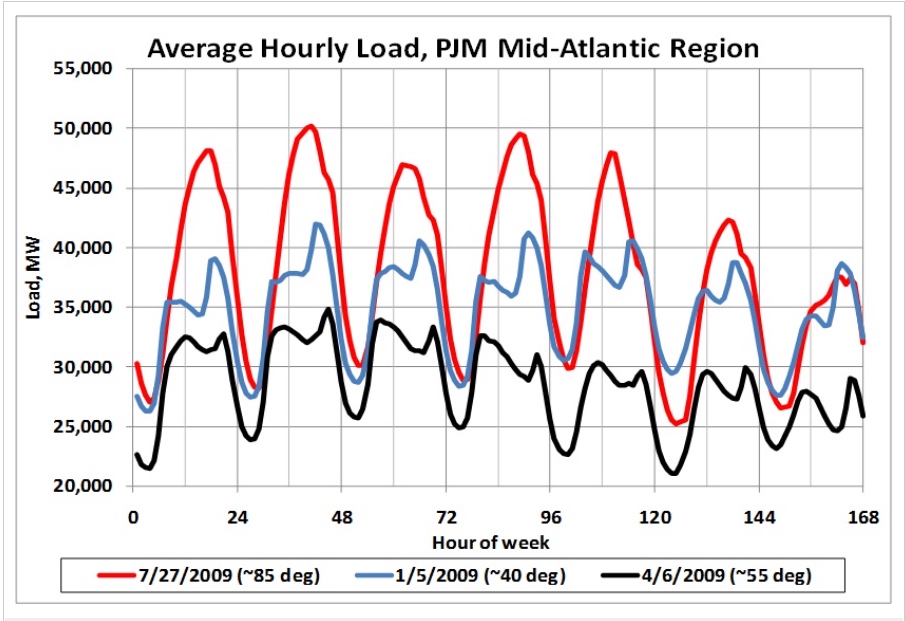
To understand why, consider the typical demand curve for electricity in the Mid-Atlantic, including Virginia. Demand can be almost twice as high at 5 p.m. as it is at 5 a.m., especially on a hot summer day with air conditioners running.

Average hourly load over a one-week period in January, April and July 2009. Credit B. Posner.

Average hourly load over a one-week period in January, April and July 2009. Credit B. Posner.

The supply of electricity delivered by the grid at any moment has to exactly match the demand: no more and no less. More than any other kind of generating plant, though, the standard nuclear reactor is inflexible in its output. It generates the same amount of electricity day in and day out. This means nuclear can’t be used to supply more than the minimum demand level, known as baseload. In the absence of energy storage, other fuel sources that can be ramped up or down as needed have to fill in above baseload.

Wind and solar have the opposite problem: instead of producing the same amount of electricity 24/7, their output varies with the weather and time of day. If you build a lot of wind turbines and want to use all the electricity they generate (much of it at night), some of it will compete to supply the baseload. Although solar panels produce during daylight when demand is higher, if you build enough solar you will eventually have to cut back on your baseload sources, too.

With enough energy storage, of course, baseload generating sources can be made flexible, and wind and solar made firm. Storage adds to cost and environmental footprint, though, so it is not a panacea. That said, Virginia is lucky enough to have one of the largest pumped storage facilities in the country, located in Bath County. Currently Dominion uses its 1,800 MW share of the facility as a relatively low-cost way to meet some peak demand with baseload sources like coal and nuclear, but it could as easily be used to store electricity from wind and solar, at the same added cost.

Without a lot of storage, it’s much harder to keep wind and solar from competing with nuclear or other baseload sources. You could curtail production of your wind turbines or solar panels, but since these have no fuel cost, you’d be throwing away free energy. Once you’ve built wind farms and solar projects, it makes no sense not to use all the electricity they can produce.

But if nuclear hogs the baseload, by definition there will be times when there is no load left for other sources to meet. Those times will often be at night, when wind turbines produce the most electricity.

The problem of nuclear competing with wind and solar has gotten little or no attention in the U.S., where renewables still make up only a small fraction of most states’ energy mixes. However, at an October 27 workshop about Germany’s experience with large-scale integration of renewable energy into the grid, sponsored by the American Council on Renewable Energy, Patrick Graichen of the German firm Agora Energiewende pointed to this problem in explaining why his organization is not sorry the country is closing nuclear plants at the same time it pursues ambitious renewable energy targets. Nuclear, he said, just makes it harder.

How big a problem is this likely to be in the U.S.? Certainly there is not enough nuclear in the PJM Interconnection grid as a whole to hog all the baseload in the region, and PJM has concluded it can already integrate up to 30% renewable energy without affecting reliability. But the interplay of nuclear and renewables is already shaping utility strategies. Dominion Virginia Power is on a campaign to build out enough generation in Virginia to eliminate its imports of electricity from out of state. And in Virginia, nuclear makes up nearly 40% of Dominion’s generation portfolio.

Now Dominion wants to add a third nuclear reactor at its North Anna site, to bring the number of its reactors in Virginia to five. If the company also succeeds in extending the life of its existing reactors, the combination would leave precious little room for any other energy resource that produces power when demand is low.

That affects coal, which is primarily a baseload resource. It would also impact combined-cycle natural gas plants, which are more flexible than coal or nuclear but still run most efficiently as baseload. But the greatest impact is on our potential for renewables.

This desire to keep high levels of nuclear in its mix explains Dominion’s lack of interest in land-based wind power, which produces mostly at night and therefore competes with nuclear as a baseload source. Dominion’s latest Integrated Resource Plan pretty much dismisses wind, assigning it a low value and a strangely high price tag in an effort to make it look like an unappealing option.

Dominion shows more interest in solar as a daytime source that fills in some of the demand curve above baseload. But given Dominion’s commitment to nuclear, its appetite for Virginia solar is likely to be limited. Already it insists that every bit of solar must be backed up with new natural gas combustion turbines, which are highly flexible but less efficient, more expensive and more polluting than combined-cycle gas, and add both cost and fuel-price risk.

Dominion’s seeming insistence that solar must be paired with gas to turn it into something akin to a baseload source is plainly absurd. It seems to be an effort to increase the cost of solar, part of an attempt to improve the company’s prospects of getting the North Anna 3 nuclear reactor approved in the face of its dismal economics.

Good resource planning would consider all existing and potential sources together, including using the existing pumped storage capacity in the way that makes most sense. We already know that North Anna 3 would be breathtakingly expensive. Evaluating it in the full context of other supply options will show it is even worse than Dominion acknowledges.

Dominion’s campaign to isolate Virginia’s power supply from the larger PJM grid also does a disservice to ratepayers. Keeping generation local benefits grid security when the generation is small-scale and distributed, but not when it’s a huge nuclear reactor sited on a fault line right next to two others. Otherwise, there is nothing wrong with importing power from other states. These are not hostile foreign nations. Pennsylvania is not going to cut us off if we don’t release their political prisoners.

In truth, it seems to be Tom Farrell’s plan to secure Dominion’s profitability for decades to come by walling off Virginia into a corporate fiefdom and controlling the means of production within it, like some retrograde Soviet republic. Utility customers, on the other hand, benefit much more from having our grid interconnected with PJM and the thousands of other power sources that help balance load and ensure reliability. One can only hope that Dominion’s regulators at the State Corporation Commission will see that.

Over the course of the next couple of decades, Virginia, like the rest of the U.S.—and indeed, the rest of the world—has to transition to an electricity supply that is almost entirely emissions-free. Very little planning has gone into making this happen, but several studies have shown it can be done. The Solutions Project offers a broad-brush look at how Virginia can combine onshore wind, offshore wind, solar and small amounts of other sources to reach a 100% clean energy future. Other researchers have done the same for PJM as a whole.

No doubt this will be a long and challenging journey, but the path we start out on should be the one most likely to get us to our goal. Nuclear seems likely to prove a stumbling block along the way, and an expensive one at that. Certainly, we shouldn’t make the problem worse.


Update: A number of commenters from the pro-nuclear camp have argued that nuclear is, or could be, more flexible than I’ve made it out to be. A new article in Utility Dive addresses this issue, concluding it is possible, but not easy, to make nuclear plants more load-following. France and Germany have succeeded to some degree, but U.S. nuclear plants pose greater challenges. “It can be done, but ‘the issue is that nuclear power plants weren’t designed to do that in the United States,’ said Jim Riley, senior technical advisor for nuclear operations at the Nuclear Energy Institute, an industry group that develops policy on issues related to nuclear energy.”

According to the article, some U.S. utilities are looking to tackle the challenge rather than retire their nuclear plants. These are nuclear plant owners that have to bid power into the wholesale market, where a nuclear plant, with its fixed operating costs, can’t compete with low-cost natural gas and renewable energy, especially at night. But of course, if you run a high-cost plant for fewer hours of the day, the average cost per kilowatt-hour increases.

Dominion doesn’t have to bid its nuclear into a wholesale market, so it has no incentive to try to run its plants flexibly. And given the astoundingly high cost of North Anna 3, curtailing its operation, and increasing the cost per kilowatt-hour produced, would be out of the question.

Unknown's avatar

Virginia regulators rain on Dominion’s solar parade; 76 MW in doubt

A tough stance from the SCC means delays for Dominion's solar plans. Photo by Activ Solar via Wikimedia Commons.

A tough stance from the SCC means delays for Dominion’s solar plans. Photo by Activ Solar via Wikimedia Commons.

Last week Virginia’s State Corporation Commission rejected Dominion Virginia Power’s proposed 20-MW solar facility in Remington, Virginia, citing the company’s failure to evaluate third-party market alternatives. Although the solar industry had urged this result, the ruling throws the Remington project into limbo—and with it, three other solar projects Dominion has in the works. Moreover, the language in the order has many advocates concerned the SCC may be setting a higher bar for solar projects than for fossil fuel projects.

The ruling that utilities must consider market alternatives to a self-build project is a win for Virginia’s solar industry, which argued that ratepayers would be better served if Dominion let the industry build and operate the Remington project through a third-party power purchase agreement (PPA). That approach would take advantage of third-party developers’ access to more favorable treatment under the federal tax code. Ratepayers would also benefit from the slimmer profit margins of private sector companies compared to the 10% return-on-investment guaranteed to Virginia utilities.

I made the same argument in this space back in June, and lamented the fact that Dominion’s greed put an otherwise good project in jeopardy. As indeed it has: there is no certainty now that Dominion’s first utility-scale solar facility will get built before the federal investment tax credit (ITC) for commercial and utility solar projects drops to 10% from its current 30% at the end of 2016. Without the higher ITC, the project will become more expensive for ratepayers, and surely make it even more difficult to get approved.

In theory, Dominion can respond to the SCC ruling by converting the Remington project from a self-build to a PPA, allowing developers to bid. Then the utility would recalculate the cost to ratepayers, offer up the savings, and renew its application to the SCC. Given the time crunch, the SCC might allow the current case to be reopened instead of starting from scratch. There might not be time for a perfect competitive bidding process this time around, but arguably it is more important to get the additional 20% savings from the ITC than it is to have a picture-perfect bidding process that causes the project to miss the 2016 tax-credit deadline.

For Dominion, though, going back to the SCC with a better deal for ratepayers would mean admitting its first application wasn’t good enough. And the utility is showing no taste for humble pie. Immediately following the decision, Dominion lobbyist Dan Weekly sent a letter to every member of Virginia’s General Assembly complaining that “we are puzzled by and very much disagree with the findings in this decision.”

If the puzzlement persists, Dominion might file a motion asking the SCC to reconsider its ruling, instead of working on a fix. Perhaps Dominion could persuade the SCC to let the utility proceed with the Remington plant as proposed, given the tight timeline, in exchange for Dominion’s agreement that future solar projects will follow a fully transparent RFP process.

However, there is more at stake here for Dominion than just Remington. This summer the utility put out a Request for Proposals (RFP) for additional solar projects. On October 1, it announced it had selected three projects totaling 56 MW, all of which it expected to be operational by December 2016 in time to earn the 30% tax credit. But instead of using PPAs and buying the power, Dominion planned to buy the projects from the developers straight off, once again giving up the tax advantages of the PPA approach. It’s not at all clear how Dominion will proceed with these projects now.

On a brighter note, Dominion’s press release also stated it is considering buying some solar power through PPAs. Four weeks ago this mention read almost like an afterthought, but these projects now may offer the most promising way forward.

But Dominion faces another problem with its regulator: the SCC hasn’t actually pledged to approve a new-and-better deal if the utility offers one. The Order merely states that “Dominion is free to refile an application that meets all statutory requirements, including the Code’s requirement regarding third-party market alternatives, and that establishes the reasonableness and prudence of any costs proposed for recovery from consumers.”

Note that word “and.” The SCC clearly remains deeply skeptical of solar’s value. Never mind that the plummeting cost of solar has made it the fastest-growing energy source in the country today, that it offers advantages in price stability and carbon reductions that fossil fuels can’t match, and that Virginia legislators and citizens are clamoring for more of it.

I have trouble believing the SCC would actually reject a utility solar PPA that emerged from a transparent bidding process. It wasn’t solar that doomed this application, it was Dominion’s greed and over-reach.

That said, surely there is a whiff of unfairness here. As the SCC concedes, Virginia law pronounces solar “in the public interest.” That’s a seal of approval that has never been accorded natural gas. Yet the SCC hasn’t put gas plant proposals through the same hoops it now insists on for solar.

The SCC will soon take up Dominion’s latest gas plant proposal, a $1.3 billion, 1,600-MW behemoth to go up in Greensville County, Virginia. When that happens, we’ll be watching to see how much “prudence” really matters to the SCC.

As for solar, Dominion has got itself into a pickle, but there should still be time to correct its mistakes and get these projects up and running by the end of 2016. Meanwhile, the General Assembly should hedge its bets by freeing up the private market for solar, clearing away the barriers that hold back solar investments by businesses, local governments and individuals.

The SCC has this much right: competition is good. Competition that helps us transition to a clean energy economy is even better.


NOTE: An earlier version of this article took the SCC to task for overruling a hearing examiner who recommended in a 2013 case that Dominion be required to look at market alternatives to its Brunswick natural gas generating plant. A reader noted that the law specifically requiring the consideration of market alternatives had not taken effect at the time and so was not binding on the SCC. I regret the error.


Unknown's avatar

North Anna 3 would raise rates for Dominion Virginia Power customers by 25%

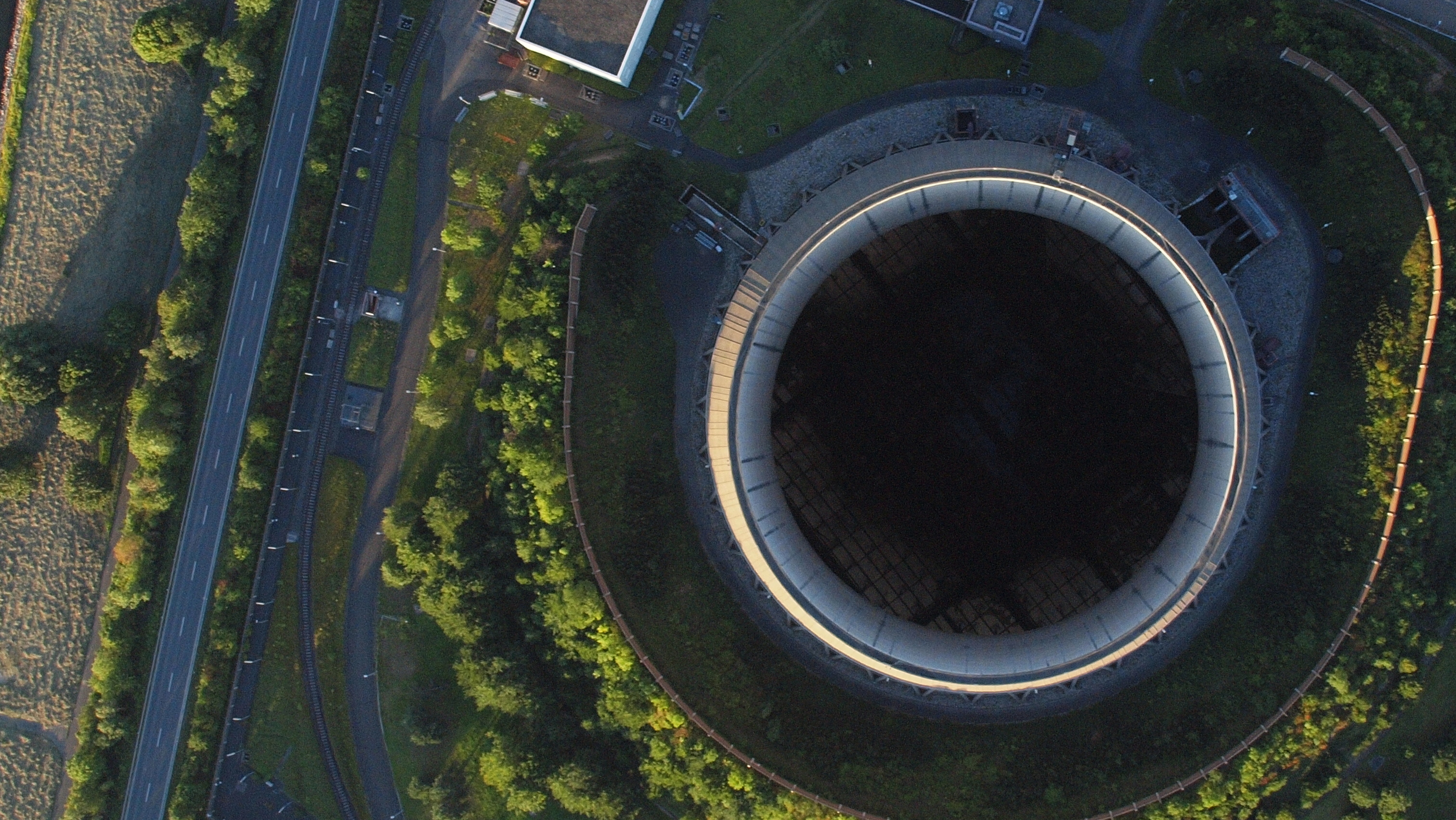
Some see a nuclear power plant cooling tower. Others see a rat-hole. Hang onto your wallet. Photo credit Wollenkratzer/Wikimedia Commons.

Some see a nuclear power plant cooling tower. Others see a rat-hole. Hang onto your wallet. Photo credit Wollenkratzer/Wikimedia Commons.

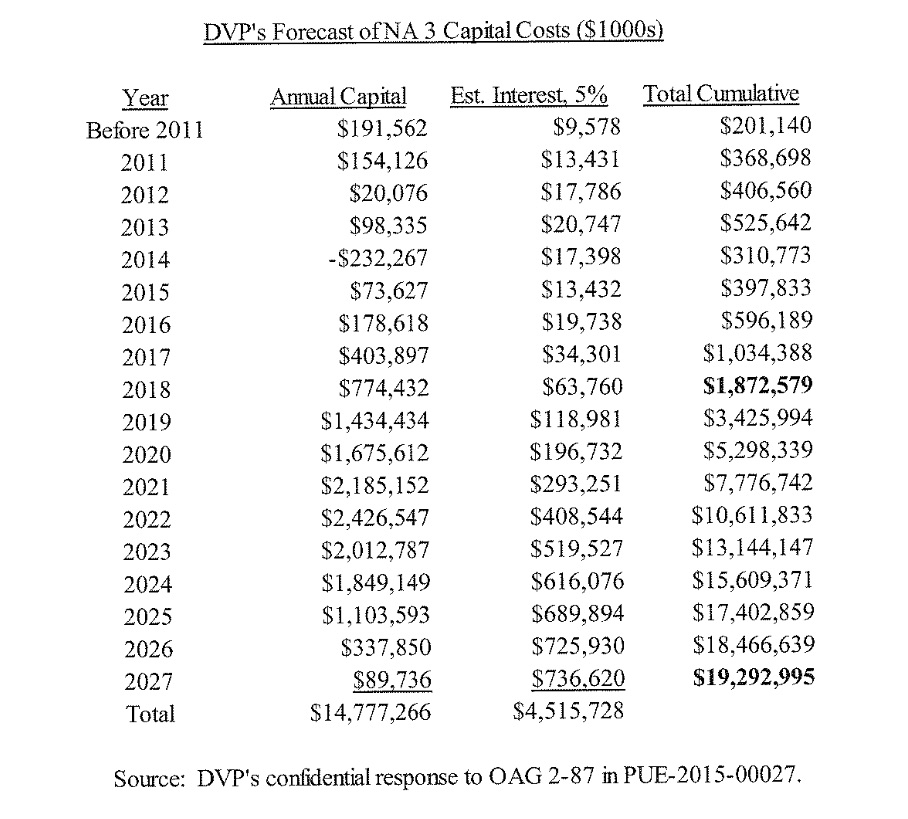
Dominion Virginia Power’s latest Integrated Resource Plan (IRP) includes construction of a third nuclear reactor at North Anna, just as previous IRPs have done every year since 2008. What’s new this year is that we finally have a price tag. Scott Norwood, a witness for the Attorney General’s Office of Consumer Counsel, says Dominion’s $19 billion forecast will mean an average rate increase of approximately 25.7% over current Virginia retail residential rates.

The 2015 IRP shows cost estimates for the new nuclear plant have spiraled upwards. Norwood notes that the forecasted capital cost is currently 55% higher than in 2011. This capital cost is not only ten times the cost of new natural gas generation, it is also higher than Dominion’s solar energy option—which happens also to be its least-cost option for complying with EPA’s Clean Power Plan.

Indeed, the NA3 price tag makes it far more expensive even than the other nuclear plants currently under construction in Tennessee, Georgia and South Carolina. All three are behind schedule and over budget, which hardly inspires confidence in the industry’s ability to contain costs anywhere.

In his testimony to the State Corporation Commission, Norwood argues that North Anna 3’s high price tag means it is not reasonable to keep it in the IRP. Section 56-599 of the Virginia Code requires the Commission to make a determination whether the IRP is “reasonable” and in the public interest.

Including nuclear in an IRP doesn’t commit Dominion to building a reactor or the SCC to approving it, so the SCC has not previously chosen to weigh in. Nor have elected leaders yet responded to the rising cost numbers.

Legislators may be tempted to ignore North Anna 3 until Dominion secures an operating license from the Nuclear Regulatory Commission (anticipated in 2017) and applies to the SCC for a Certificate of Public Convenience and Necessity (with a decision likely in 2018).

Yet delaying the conversation is expensive. Dominion is already spending hundreds of millions of dollars annually on North Anna 3 development—and one way or another, Dominion expects customers to bear the cost.

In 2014 the company successfully lobbied for legislation shifting the costs it had incurred through 2013 onto its ratepayers, a move that sopped up Dominion’s overearnings and prevented a rate cut.

But those costs were chicken feed compared to what’s coming. By the end of 2018, Dominion will have spent close to $2 billion dollars on North Anna 3. The company can afford to front the money, in part because of 2015 legislation “freezing” rates until 2020 and allowing the company to keep what could amount to hundreds of millions of dollars more in excess earnings.

NAr costsIf the SCC waits until 2018 to consider the merits of North Anna 3 and then denies Dominion permission to move forward, the company will argue for the right to bill ratepayers for all that money it threw down the rat-hole. The SCC might not prove sympathetic, but General Assembly members maintain a strong record of doing anything Dominion wants.

Still, allowing Dominion to soak customers for $2 billion would be a welcome outcome compared to the alternative. Worse would be for the SCC to approve the plant—or more likely, for legislators to take it out of the hands of the SCC and simply vote to let Dominion proceed. Dominion has begun spinning a tale about North Anna 3 being needed for energy security, resource diversity, and compliance with new environmental rules. All of these are wrong, but they play into narratives that resonate with many lawmakers.

Meanwhile, the vast sums required for a new reactor would siphon money away from much more cost-effective strategies that can deliver carbon pollution reductions far sooner, including investments in solar and energy efficiency. That makes it critical for the SCC to put an end to the North Anna 3 rat-hole this year.

The Commission will hold a hearing on Dominion’s IRP on October 20. The case is PUE-2015-00035.

Unknown's avatar

Dominion to offer community solar, minus the community and the solar

The Emperor's New Clothes. By Vilhelm Pedersen (1820 - 1859) [Public domain], via Wikimedia Commons

The Emperor’s New Clothes. By Vilhelm Pedersen (1820 – 1859) [Public domain], via Wikimedia Commons

In the children’s story The Emperor’s New Clothes, a couple of shysters convince an insecure monarch to fork over gold in exchange for what they assure him are the most beautiful clothes ever made—clothes with the remarkable quality of being invisible to stupid people. Too embarrassed to admit he can’t see the clothes, the emperor allows the fraud to proceed. Public humiliation ensues.

Perhaps the fairy tale inspired Dominion Virginia Power’s new scheme to extract money from customers who want to buy solar power, without actually selling them solar power. The solar hopefuls are to be bilked of extra payments on their utility bills by the promise of having their drab fossil electricity turned into golden sunlight-powered electrons.

As in the children’s story, the customers will be fooled into thinking they have bought something special. Instead, they will have bought invisible clothes.

The program is called “Dominion Community Solar” (or Rider DCS), though it has nothing to do with true community solar.

Publicly, Dominion has described it this way: Dominion will build a 2-megawatt (MW) solar facility and put the electricity it produces onto the grid. Customers can buy it by paying an extra 4 cents per kWh (in $4 blocks) on top of the regular retail rate of about 11 cents.

If this were an accurate description, the program would be a valid offering. In fact, I might have gone for it myself. As someone with a shaded roof, it would be the only way for me to buy solar, given Virginia’s backward policies. And buying solar matters to me because I want to be part of the solution to the climate disruption caused by our burning of fossil fuels.

But it seems to be an article of faith among utility executives that people’s intelligence is inversely related to their desire to do good in the world. If we’re dumb enough to pay extra for solar electricity, they figure, maybe we’re dumb enough to pay extra for what we’re persuaded to think is solar electricity, even if the premium really buys us nothing at all.

This program presents the chance to test their theory. As the filings in the SCC case reveal, Dominion will not actually sell solar energy to participants. (See SCC Case PUE-2015-00005.) It will use their “contributions” to “offset” the costs of its Solar Partnership Program, which will enable it to build an extra 2 MW of solar capacity and put that electricity onto the grid. Then it will sell the renewable energy certificates (RECs) associated with that electricity to someone else—not to the people who are funding the facility.

The result is that although Dominion will bill the do-gooders extra to build a solar facility, it won’t deliver solar energy to them. The altruists will pay 15 cents/kWh for the same drab fossil fuel electricity everyone else buys for 11 cents/kWh.

Imagine Exxon soliciting motorists to pay an extra dollar per gallon for gas so the company can build a biofuel facility to sell renewable fuel to other customers. If you would contribute to such a scheme, please email me, as I have some other great offers for you.

The most remarkable thing about Dominion’s plan is not its cynicism, but the fact that the State Corporation Commission approved it. The SCC should understand that the program will work only to the extent customers are deceived into thinking they are buying solar energy. Indeed, lawyers for the Attorney General’s Office of Consumer Counsel actually pointed this out.[1]

The SCC’s order, dated August 7, 2015, notes that the Consumer Counsel “remains concerned that the DCS Pilot, if approved, may not be marketed clearly by the Company,” and that it “wishes to ensure that the DCS Pilot will not be marketed as a solar energy tariff or as an option for consumers to purchase electric energy output from a renewable energy facility.”

The SCC’s response to this concern was to tell Dominion it has to be really clear that participants are merely “supporting” Dominion’s development of solar energy, and to require it to submit to the SCC staff its marketing and promotional materials prior to publication.

But of course, accurate marketing information wouldn’t sell this program. Imagine the shysters telling the emperor, “See, Your Majesty, we’ll pretend to make clothes for you, and you’ll pretend you’re wearing clothes. Then while you march around naked, we’ll use your gold to fund our business selling real clothes to smart people.” Even a stupid emperor would know enough to keep a tight hold on his purse.

[1] From the Consumer Counsel’s Comments on Hearing Officer’s Report: “Dominion has not described the DCS Pilot program accurately . . .” In reality, “DCS Pilot customers would continue to purchase 100% of their energy requirements under their standard service tariff and would not be allocated any power from a renewable energy facility. DCS participants would be making a voluntary contribution to Dominion, which the company claims would be used to support the future development of solar. But Rider DCS participants would not be purchasing any solar energy output. The Commission should direct the Company to not market the program in a manner that leads potential customers to believe that by participating in the DCS program they would be purchasing renewable energy.”

Unknown's avatar

Virginia wind and solar policy, 2015 update

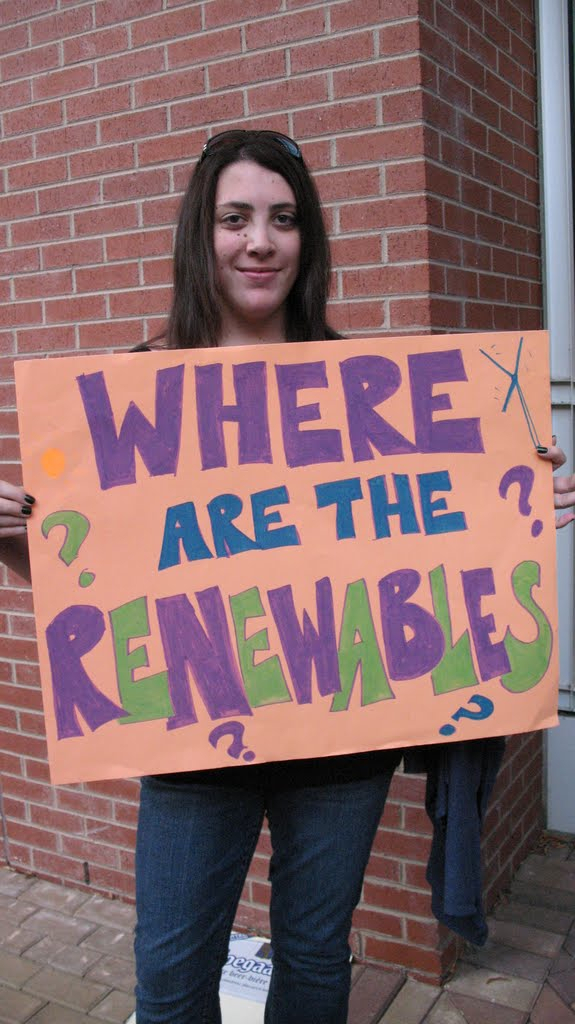
where are the renewables 1

[Note: Although this is a terrific article, it is now a bit dated.  You can find the 2017 update to the Virginia Wind and Solar Policy Guide here.]

The past year has seen a lot of activity on wind and solar in the Old Dominion, and yet Virginia lags further than ever behind neighboring states in installations to date. Why? And more importantly, what can we do about it?

I’ll try to answer these questions as briefly as possible in this third annual update of Virginia renewable energy law and policy. But yes, this is a long post. If you’re the kind of person who only reads executive summaries or prefers the elevator pitch to the full Ted Talk, let me try this:

Virginia’s utility model is built on monopoly control and large, centralized generating systems, and this model does not serve 21st century needs and technologies. The free market solution is to open Virginia’s electricity market to competition and lower the barriers to customer-sited wind and solar generation.

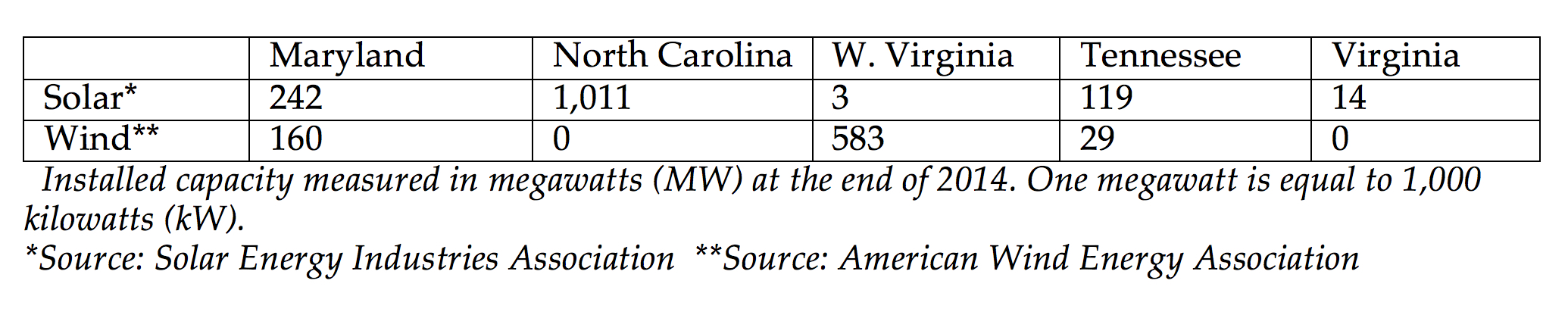
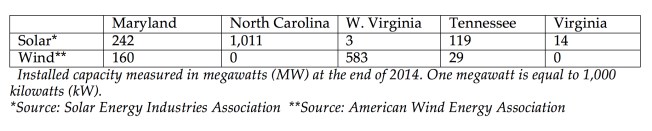
Virginia is further than ever behind
2015 wind and solar table copy

Virginia still has no utility scale wind or solar projects and very little in the way of customer-owned and other distributed generation. The 2015 legislative session improved prospects for solar at the utility scale, but utility interest in wind remains low. Meanwhile, barriers to the rapid adoption of customer-owned generation remain firmly in place.

Virginia utilities won’t sell wind or solar to customers (and they won’t let anyone else do it either)

With one very narrow exception for commercial customers, Virginia residents can’t pick up the phone and call their utility to buy electricity generated by wind and solar farms. Worse, they can’t even buy renewable energy elsewhere.

This wasn’t supposed to happen. Section 56-577(A)(6) of the Virginia code allows utilities to offer “green power” programs, and if they don’t, customers are supposed to be able to go elsewhere for it. (See the section on third-party-owned systems for what happened when one customer tried to go elsewhere.)

Ideally, a utility would use money from voluntary green power programs to build or buy renewable energy for these customers. However, Virginia utilities have not done this, except in very tiny amounts. Instead, utilities pay brokers to buy renewable energy certificates (RECs) on behalf of the participants. Participation by consumers is voluntary. Participants sign up and agree to be billed extra on their power bills for the service. Meanwhile, they still run their homes and businesses on regular “brown” power.

In Dominion’s case, these RECs meet a recognized national standard, and some of them originate with wind turbines, but they primarily represent power produced and consumed out of state, and thus have no effect on the power mix in Virginia. For a fuller discussion of the Dominion Green Power Program, see What’s wrong with Dominion’s Green Power Program.

In the case of Appalachian Power, the RECs come from an 80 MW hydroelectric dam in West Virginia. No wind, and no solar.

The State Corporation Commission ruled that REC-based programs like these do not qualify as selling renewable energy, so under the terms of §56-577(A)(6), customers are permitted to turn to other licensed suppliers of electric energy “to purchase electric energy provided 100 percent from renewable energy.” Unfortunately (and in this English major’s opinion, wrongly), Virginia utilities claim that the statute’s words mean that not only must another licensed supplier provide 100% renewable energy, it must also supply 100% of the customer’s demand. Obviously, the owner of a wind farm or solar facility cannot do that; the customer will need to draw from the grid part of the time. Ergo, say the utilities, a customer cannot go elsewhere. Checkmate!

The SCC may rule on this interpretation some day, but there is still another problem with the statute: under its terms, customers are allowed to turn to other electric suppliers only if their own utility doesn’t offer a qualifying program. So if the SCC sides with the English majors on this one, Dominion could (and surely would) gin up a variation of its Green Power Program consisting of true renewable energy. It would still not have to offer Virginia-based wind and solar—crappy biomass and old hydro would do, so long as it was actual energy “bundled” with the RECs. Nor would it have to offer a competitive price.

Really, the statute doesn’t ask much. It’s astonishing the utilities haven’t taken steps already to close that loophole. But surely they’re ready, and that’s enough to scare off any would-be competitors.

Earlier this year Dominion seemed poised to offer customers a program to sell electricity from solar panels, which would have qualified. Notwithstanding its name, however, the “Dominion Community Solar” program is not an offer to sell electricity generated from solar energy, and seems likely to attract customers only to the extent they are deceived into believing it is something it is not.

For customers to have real energy choice in Virginia, the GA has to change the terms of §56-577(A)(6). Let people buy wind and solar from any willing seller, whether it be their utilities or the private market. Utilities will benefit by customers taking on their job of lowering Virginia’s carbon emissions. Virginians will benefit from cleaner air, new clean energy jobs, and a stronger grid.

Virginia’s Renewable Portfolio Standard (RPS) is a miserable sham

Many advocates focus on an RPS as a vehicle for inducing demand. In Virginia, that’s a mistake. Virginia has only a voluntary RPS, which means utilities have the option of participating but don’t have to. On the other hand, it costs them nothing to do it, because any costs they incur in meeting the goals can be charged to ratepayers. Until a few years ago, utilities even got to collect bonus money as a reward for virtue, until it became clear that there was nothing very virtuous going on.

Merely making our RPS mandatory rather than voluntary would do nothing for wind and solar in Virginia without a complete overhaul. Most important, the statute takes a kitchen-sink approach to what counts as renewable energy, so meeting it requires no new investment and no wind or solar.

The targets are also modest to a fault. Although nominally promising 15% renewables by 2025, the statute sets a 2007 baseline and contains a sleight-of-hand in the definitions section by which the target is applied only to energy not produced by nuclear plants. The combined result is an effective 2025 target of about 7%.

The RPS is as impotent in practice as it is in theory. In the case of Dominion Virginia Power, the RPS has been met largely with old hydro projects built prior to World War II, trash incinerators, and wood burning, plus a small amount of landfill gas and—a Virginia peculiarity—RECs representing R&D rather than electric generation.

There appears to be no appetite in the General Assembly for making the RPS mandatory, and even efforts to improve the voluntary goals have failed in the face of utility opposition. The utilities have offered no arguments why the goals should not be limited to new, high-value, in-state renewable projects, other than that it would cost more to meet them than to buy junk RECs.

But with the GA hostile to a mandatory RPS and too many parties with vested interests in keeping the kitchen-sink approach going, it is hard to imagine our RPS becoming transformed into a useful tool to incentivize wind and solar.

That doesn’t mean there is no role for legislatively-mandated wind and solar. But it will be easier to pass a bill with a simple, straightforward mandate for buying or building a certain number of megawatts than it would be to repair a hopelessly broken RPS.

Customer-owned generation: for most, the only game in town

Given the lack of wind or solar options from utilities, people who want renewable energy generally have to build it themselves. A federal 30% tax credit makes it cost-effective for those with cash or access to low-cost financing. The credit is available until the end of 2016 (when it falls to 10% for commercial but goes away entirely for residential).

This year the GA passed legislation enabling Property Assessed Clean Energy (PACE) loans for commercial customers. This should help bring low-cost financing to energy efficiency and renewable energy projects at the commercial level. That would make it the year’s most helpful piece of legislation from the standpoint of customer-owned generation.

Now that some barriers to residential PACE have been removed at the federal level, we hope the legislature will extend the law to let localities offer PACE loan programs to homeowners in the near future.

Virginia offers no cash incentives or tax credits for wind or solar. The Virginia legislature passed a bill in 2014 that would offer an incentive, initially as a tax credit and then as a grant program, but it did not receive funding, and the same bill, reintroduced in 2015, died in a subcommittee. North Carolina’s tax credit for solar is widely credited with making that state a solar leader, and it could have the same effect here. With solar panel prices continuing their breathtaking descent, utility and commercial-scale solar probably won’t need that kind of help for long, so a modest program of three-to-five years duration would suffice to catalyze the market. Residential solar would benefit from longer-lasting support.

The lack of a true RPS in Virginia means Virginia utilities generally will not buy solar renewable energy certificates (SRECs) from customers. SRECs generated here can sometimes be sold to utilities in other states (as of now only Pennsylvania) or to brokers who sell to voluntary purchasers.

Limits to net metering hamper growth

Section 56-594 of the Virginia code allows utility customers with wind and solar projects to net energy meter. System owners get credit from their utility for surplus electricity that’s fed into the grid at times of high output. That offsets the grid power they draw on when their systems are producing less than they need. Their monthly bills reflect only the net energy they draw from the grid.

If a system produces more than the customer uses in a month, the credits roll over to the next month. However, at the end of the year, the customer will be paid for any excess credits only by entering a power purchase agreement with the utility. This will likely be for a price that represents the utility’s “avoided cost” of about 4.5 cents, rather than the retail rate, which for homeowners is closer to 11 cents. Given the current cost of installing solar, this effectively stops people from installing larger systems than they can use themselves.

Legislation passed in 2015 makes it less likely that new solar owners will have any surplus. At Dominion’s insistence, the definition of “eligible customer-generator” was amended to limit system sizes to no larger than needed to meet the customers demand, based on the previous 12 months of billing history. The SCC is currently writing regulations that should address issues of new construction as well as questions arising from other new language in the law.

This limitation is crazy, no? If customers want to install more clean, renewable energy than they need and sell the surplus electricity into the grid at the wholesale power price, why would you stop them from performing this service to society? And what were Dominion lobbyists thinking, since it is clearly in their company’s interest to buy peak power at a cut-rate price? We can only speculate that the primal fear of customers with solar must be stronger even than the smell of money.

Virginia law also does not allow system owners to share the electricity with other consumers through community net metering or solar gardens. Several bills that would have permitted this were introduced in the 2013 and 2014 sessions but defeated due to utility opposition. Community net metering remains one of the solar industry’s highest priorities as a way to open the market to people who can’t own solar facilities themselves. It would also spur the market for community wind.

In August of this year, Dominion received permission from the SCC to begin a program the company is calling “Dominion Community Solar.” Reading the fine print, however, makes it apparent that participants will not actually buy solar power. They will pay a significant premium on their electric bills to fund construction of a solar installation, but the electricity generated will be sold to other people rather than credited to the participants.

Under a bill introduced by Delegate Randy Minchew (R-Leesburg) and passed in 2013, owners of Virginia farms with more than one electric meter are permitted to attribute the electricity produced by a system that serves one meter (say, on a barn) to other meters on the property (the farmhouse and other outbuildings). This is referred to as “agricultural net metering.” The law took effect July 1, 2014 for investor-owned utilities (Dominion and Appalachian Power) and July 1, 2015 for the cooperatives.

Standby charges hobble the market for larger home systems and electric cars

Dominion Power and Appalachian Power are at the forefront of a national pushback against policies like net metering that facilitate customer-owned generation.

The current system capacity limit for net-metered solar installations is 1 MW for commercial, 20 kW for residential. However, for residential systems between 10 kW and 20 kW, a utility is allowed to apply to the State Corporation Commission to impose a “standby” charge on those customers.

Seizing the opportunity, Dominion won the right to impose a standby charge of up to about $60 per month on these larger systems, eviscerating the market for them just as electric cars were increasing interest in larger systems. (SCC case PUE- 2011-00088.) Legislative efforts to roll back the standby charges were unsuccessful, and more recently, Appalachian Power instituted even more extreme standby charges. (PUE-2014-00026.)

The standby charges supposedly represent the extra costs to the grid for transmission and distribution. In the summer of 2013, in a filing with the SCC (PUE-2012-00064, Virginia Electric and Power Company’s Net Metering Generation Impacts Report), Dominion claimed it could also justify standby charges for its generation costs, and indicated it expected to seek them after a year of operating its Solar Purchase Program (see discussion below). As far as I can tell, it hasn’t carried out this threat yet, and it would likely need legislation to do so.

A bit of good news for residential solar: homeowner association bans on solar are largely a thing of the past

Homeowner association (HOA) bans and restrictions on solar systems have been a problem for residential solar. In the 2014 session, the legislature nullified bans as contrary to public policy. The law contains an exception for bans that are recorded in the land deeds, but this is said to be highly unusual; most bans are simply written into HOA covenants. In April of 2015 the Virginia Attorney issued an opinion letter confirming that unrecorded HOA bans on solar are no longer legal.

Even where HOAs cannot ban solar installations, they can impose “reasonable restrictions concerning the size, place and manner of placement.” This language is undefined. The Maryland-DC-Virginia Solar Energy Industries Association has published a guide for HOAs on this topic.

Third-party ownership of renewable energy facilities could open the market, but Virginia utilities won’t step aside

One of the primary drivers of solar installations in other states has been third-party ownership of the systems, including third-party power purchase agreements (PPAs), under which the customer pays only for the power produced by the system. For customers that pay no taxes, including non-profit entities like churches and colleges, this is especially important because they can’t use the 30% federal tax credit to reduce the cost of the system if they purchase it directly. Under a PPA, the system owner can take the tax credit and pass along the savings in the form of a lower electricity price.

In 2011, when Washington & Lee University attempted to use a PPA to finance a solar array on its campus, Dominion Virginia Power issued cease and desist letters to the university and its Staunton-based solar provider, Secure Futures LLC. Dominion claimed the arrangement violated its monopoly on power sales within its territory, under that same §56-577(A)(6) we previously discussed. Secure Futures and the university thought that even if what was really just a financing arrangement somehow fell afoul of Dominion’s monopoly, surely they were covered by the exception available to customers whose own utilities do not offer 100% renewable energy.

Yet the threat of prolonged and costly litigation was too much. The parties scuttled the PPA contract, though the solar installation was able to proceed using a different financial arrangement.

After a long and very public fight in the legislature and the press, in 2013 Dominion and the solar industry negotiated a compromise that specifically allows customers in Dominion territory to use third-party PPAs to install solar or wind projects under a pilot program capped at 50 MW. Projects must have a minimum size of 50 kW, unless the customer is a tax-exempt entity, in which case there is no minimum. Projects can be as large as 1 MW. The SCC is supposed to review the program every two years beginning in 2015 and has authority to make changes to it.

Appalachian Power and the electric cooperatives declined to participate in the PPA deal-making, so the legal uncertainty about PPAs continues in their territories. In June of this year, Appalachian Power proposed an alternative to PPAs that does not offer anything like a viable solution. The matter is before the SCC. The case is No. PUE-2015-00040. An evidentiary hearing is scheduled for September 29, 2015.

Meanwhile, Secure Futures has developed a third-party-ownership business model that it says works like a PPA for tax purposes but does not include the sale of electricity, and therefore should not trigger a challenge from Appalachian Power or other utilities. Currently Secure Futures is the only solar provider offering this option, which it calls a Customer Self-Generation Agreement.

Tax exemption for third-party owned solar may prove a market driver

In 2014 the General Assembly passed a law exempting solar generating equipment “owned or operated by a business” from state and local taxation for installations up to 20 MW. The law now classifies solar equipment as “pollution abatement equipment.” Note that this applies only to the equipment, not to the buildings or land underlying the installation, so real estate taxes aren’t affected.

The law was a response to a problem that local “machinery and tools” taxes were mostly so high as to make third-party PPAs uneconomic in Virginia. In a state where solar was already on the margin, the tax could be a deal-breaker.

The 20 MW cap was included at the request of the Virginia Municipal League and the Virginia Association of Counties, and it seemed at the time like such a high cap as to be irrelevant. However, with solar now becoming increasingly attractive economically, Virginia’s tax exemption is turning out to be a draw for solar developers. We are told Amazon’s 80 MW solar farm will proceed in four stages, indicating a desire to work around the cap—and suggesting that the tax exemption may have been a factor in the choice of Virginia as the project’s location.

Dominion “Solar Partnership” Program suggests distributed solar might be better left to the private sector

In 2011, the General Assembly passed a law allowing Dominion to build up to 30 MW of solar energy on leased property, such as roof space on a college or commercial establishment. The SCC approved $80 million of spending, to be partially offset by selling the RECs (meaning the solar energy would not be used to meet Virginia’s RPS goals). The program has resulted in several commercial-scale projects on university campuses and corporate buildings. Unfortunately, it has also been plagued by delays and over-spending.

The program was supposed to proceed in two phases, with 10 MW in place by the end of 2013, and another 20 MW by December 31, 2015. However, the program got off to a very slow start. In August of 2014 the company acknowledged it was behind schedule and would likely not achieve more than 13 or 14 MW of the 30 MW authorized before it ran out of money. On May 7, 2015 Dominion filed a notice with the SCC that it needed to extend the phase 2 end date to December 31, 2016, and confirmed that it would install less than 20 MW altogether.

Dominion’s Solar Purchase Program: bad for sellers, bad for buyers, and not popular with anyone

The same legislation that enabled the Community Solar initiative also allowed Dominion to establish “an alternative to net metering” as part of the demonstration program. The alternative turned out to be a buy-all, sell-all deal for up to 3 MW of customer-owned solar. As approved by the SCC, the program allows owners of small solar systems on homes and businesses to sell the power and the associated RECs to Dominion at 15 cents/kWh, while buying regular grid power at retail for their own use. Dominion then sells the power to the Green Power Program at an enormous markup.

I’ve ripped this program from the perspective of the Green Power Program buyers, but the program is also a bad deal for most sellers. Some installers who have looked at it say it’s not worth the hassle given the costs involved and the likelihood that the payments represent taxable income to the homeowner. There is also a possibility that selling the electricity may make homeowners ineligible for the 30% federal tax credit on the purchase of their system. Sellers beware.

And then there’s the problem that selling the solar power means you aren’t powering your home or business with solar—which is the whole point of installing it, right?

Dominion’s Renewable Generation tariff for large users of energy finds no takers; Amazon votes with its feet

Currently renewable energy projects are subject to a size limit of 1 MW. These limitations constrain universities, corporations, data centers, and other large users of energy that might want to run on wind or solar. On top of this, the utilities’ interpretation of Virginia law prohibits a developer from building a wind farm or a solar array and selling the power directly to users under a power purchase agreement.

In 2013, Dominion Power rolled out a Renewable Generation Tariff (PUE-2012-00142) to allow customers to buy larger amounts of renewable power from providers, with the utility acting as a go-between and collecting a monthly administrative fee.

From the start the program appeared flawed, cumbersome and bureaucratic, and as far as we know there have been no takers. Amazon Web Services chose to contract directly with a developer for the 80 MW solar farm it announced this year (avoiding Dominion’s monopoly restrictions by selling the electricity directly into the PJM market).

2015 marks Dominion’s foray into utility-scale solar

Late in 2014, Dominion signaled an interest in building utility-scale solar in Virginia. In 2015, at the utility’s behest, two bills promoted the construction of utility-scale solar by declaring it in the public interest for utilities to build solar energy projects of at least 1 MW, and up to an aggregate of 500 MW. At the solar industry’s urging, the bill was amended to allow utilities the alternative of entering into PPAs for solar power prior to purchasing the generation facilities at a later date, an option with significant tax advantages.

Dominion’s first solar project is expected to be a 20 MW solar farm in Remington, Virginia. The proposal is before the SCC (PUE-2015-00006). Dominion proposes to build and operate the facility itself, which will earn it a return on investment but give up tax advantages that would save money for ratepayers.

On July 17, Dominion issued a Request for Proposals for third party bidders to develop up to 20 MW of additional projects. The RFP came with an absurdly short deadline, surely limiting the number of good responses, but developers are nonetheless hopeful the results will be strong enough to convince Dominion to follow it with a larger request.

2015 will be another year without a wind farm, but there is hope

No Virginia utility is actively moving forward with a wind farm on land. For the past few years, Dominion Power’s website has listed 248 MW of land-based wind in Virginia as under development, without any noticeable progress. There has been a lot of press about the current standoff in Tazewell County, where supervisors are blocking Dominion’s proposed wind farm. Yet Dominion’s advocacy for its project feels perfunctory. The company has signaled it prefers solar, and its 2015 IRP dismisses wind as too costly. On the other hand, Appalachian Power’s IRP suggests an interest in wind as a low-cost renewable resource that could help it meet the Clean Power Plan.

With no utility buyers, Virginia has not been a friendly place for independent wind developers. In previous years a few wind farm proposals made it to the permitting stage before being abandoned, including in Highland County and on Poor Mountain near Roanoke.

As of 2015, however, Apex Clean Energy is in the development stages for a wind farm of up to 80 MW in Botetourt County. No customer has been announced, but the company believes the project can produce electricity at a competitive price.

As for Virginia’s great offshore wind resource, the perception that offshore wind energy will be costly continues to hold back progress. In 2013 Dominion won the federal auction for the right to develop about 2000 MW of offshore wind power, and the lease terms call for the company to file construction plans within five years. The federal government’s timeline leads to wind turbines being built off Virginia Beach around 2020. As I’ve discussed elsewhere, Dominion is something less than committed to seeing the process through. This puts advocates in the legislature and in the business and environmental communities in the odd position of being keener on a development than the developer is.

Meanwhile, however, Dominion is part of a Department of Energy-funded team designing a pilot project of two 6-MW offshore wind test turbines, originally scheduled for installation in 2017. This year Dominion declared it was taking a “step back” when the sole bid for the contract came in way too high. Stakeholders have been meeting this summer to help chart a path forward.

Will a Solar Development Authority help?

One of the MacAuliffe Administration’s initiatives this year was a bill to establish the Virginia Solar Development Authority. The Authority is explicitly tasked with helping utilities find financing for solar projects; there is no similar language about supporting customer-owned solar. The Authority is supposed to identify barriers to solar, but isn’t given any tools to remove them. The Authority has not been given funding. And members have not been named yet. Meanwhile, the clock is ticking on that December 31, 2016 expiration of the 30% federal tax credit.

The Clean Power Plan: better to switch than fight

On August 3, 2015, EPA issued the final rule known as the Clean Power Plan. Under the rule, states with existing fossil-fuel generating plants must develop plans to reduce total carbon pollution from power plants. In Virginia, the task will fall to the Department of Environmental Quality.

While Virginia’s goals under the plan are modest, the rule means the state, utilities and the SCC must for the first time take carbon emissions into account in their planning. The EPA has signaled a strong interest in seeing wind and solar deployed as solutions.

Some legislators have succumbed to partisan pressure to attack the Clean Power Plan, using talking points provided by fossil fuel front groups. Not only does this do a disservice to Virginians already suffering the effects of climate change, it’s bad economic policy. EPA’s analysis shows Virginia is already on track to meet or come close to our Clean Power Plan goals. Wasting time fighting the plan, or mandating that utilities keep outdated coal plants open, makes far less sense than using the plan as a catalyst to begin an efficient and cost-effective energy transition.

The transition need not even happen fast, as EPA’s numbers suggest that all we need to do is keep our total carbon emissions from increasing over time. Energy efficiency has a huge role to play in achieving this, but so would a requirement that utilities meet any increases in electrical demand with wind and solar. Freeing up the private market will go a long way towards achieving that goal. And of course, when customers install solar “behind the meter,” it keeps electric demand from growing.

The Department of Environmental Quality will be holding “listening sessions” this fall to take public comment prior to developing a state implementation plan under the rule.


 

Unknown's avatar

For Virginia, EPA’s Clean Power Plan more like a powderpuff

Photo credit: Corrina Beall

Photo credit: Corrina Beall

On August 3 the EPA released the final version of its Clean Power Plan, the Obama Administration’s effort to lower carbon pollution from existing power plants. It’s a big, complex rule—in large measure because it gives states so many options for compliance—but a few things are immediately clear. One, it’s just as well I never got around to reading the fine print of the proposed plan, because the final rule is practically a do-over. Two, this do-over goes so easy on Virginia that the Republican hissy fit about the proposed rule was (and is) a total waste of time. And three, Dominion Virginia Power’s little “rate freeze” gamble, rushed through the General Assembly this year, is set to pay off big for the company.

The proposed rule was never as tough for Virginia to meet as opponents asserted. Their claims of billions of dollars in added costs had little basis in fact—indeed, a recent University of Virginia analysis found numerous errors in the Virginia Tech cost study that many detractors relied on. But the proposed rule had enough of a bite that it would have been a major driver of new policies and investments. By contrast, the final rule is so soft on Virginia that it will likely take a back seat to customer demand and market forces in shaping our energy future.

This is welcome news to some, like Governor Terry McAuliffe, who pushed EPA to go easier on Virginia and is trumpeting the results as a good outcome. It’s a disappointment, though, to those who are worried about climate change and who believe Virginia is well positioned to make much steeper cuts in carbon pollution than the new rule requires.

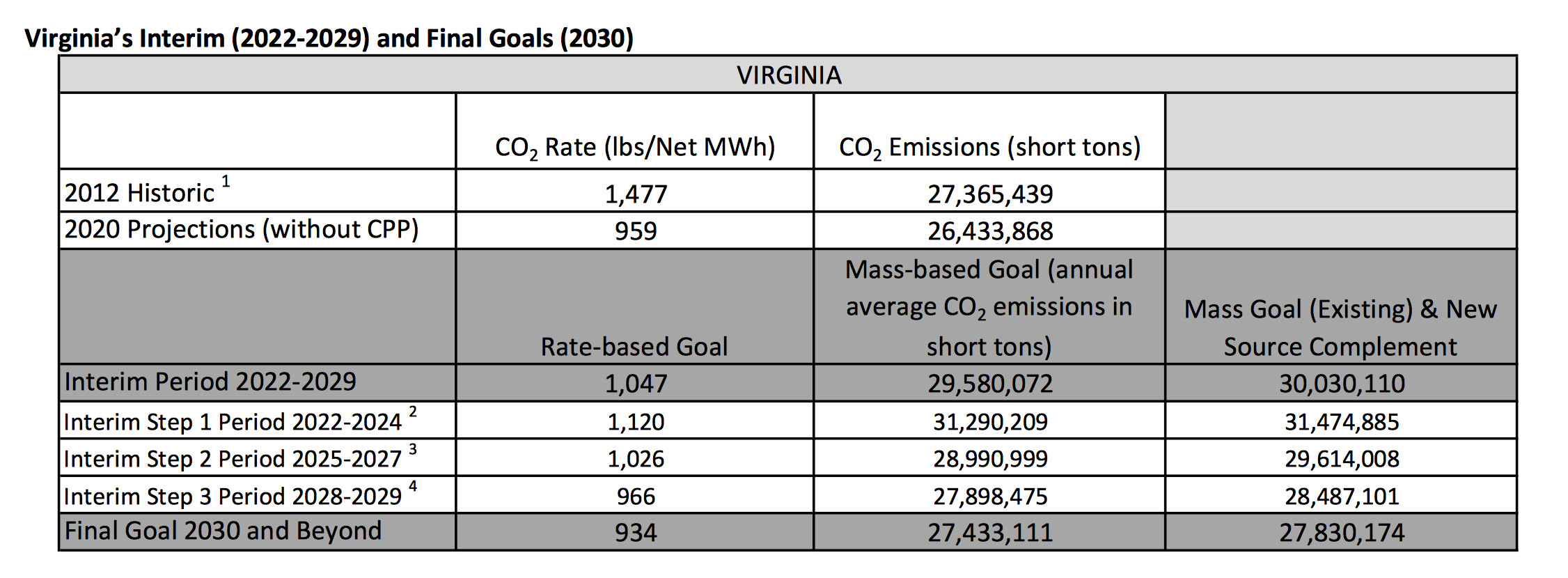
Look at EPA’s table below and you will see how easy our path is. The Clean Power Plan allows states to choose whether to measure carbon emissions by rate or by mass. Using rate, EPA’s analysis of the business-as-usual case projects Virginia would arrive at an emissions rate of 959 pounds of carbon dioxide (CO2) per megawatt-hour by 2020 without the Clean Power Plan. With the Plan in place, that number will have to drop to 934. That’s a difference of only 3%, an easy target to meet just by adding enough emissions-free wind and solar to the existing fuel mix.

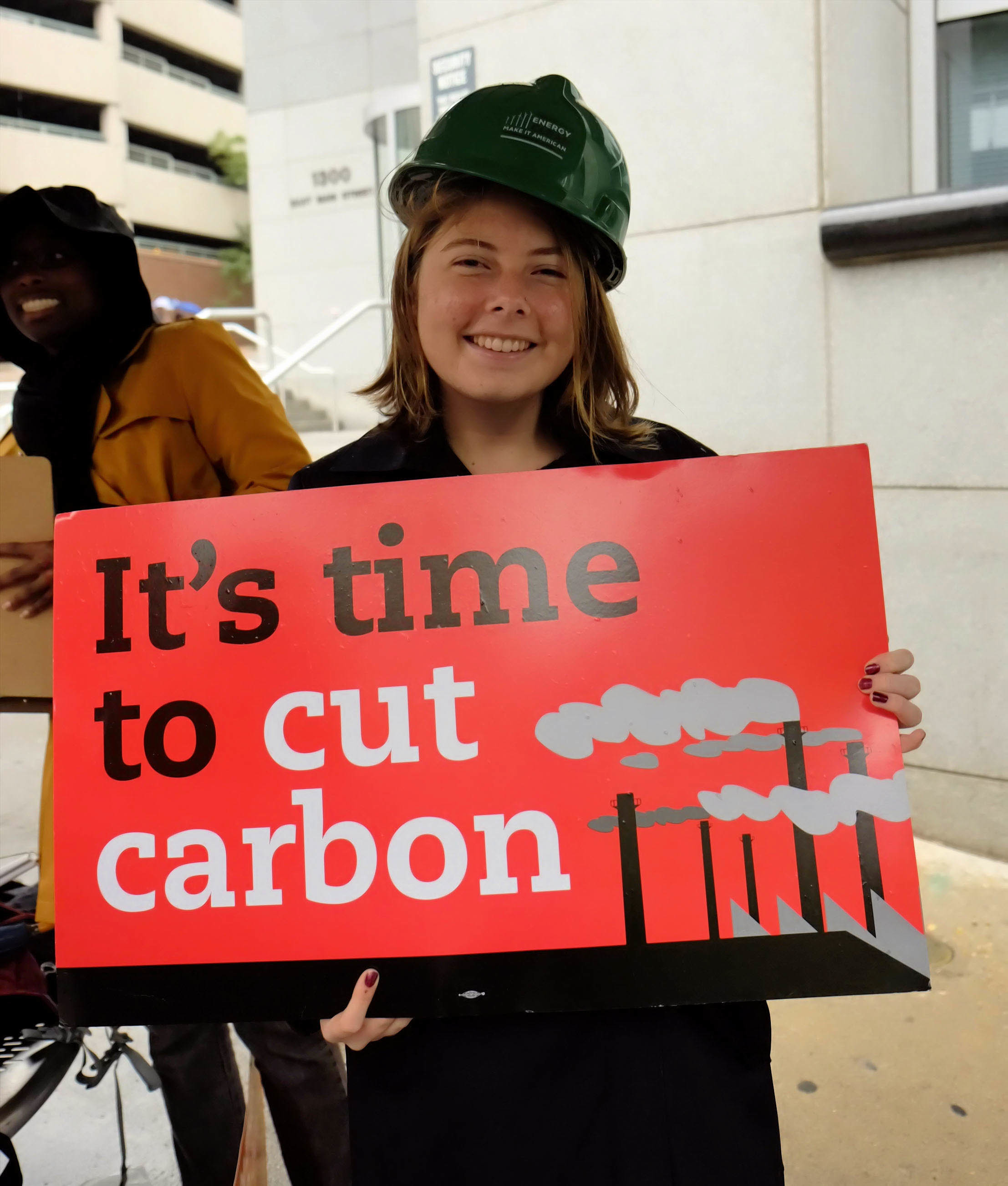
VA goals under CPP

Alternatively, the state can choose to measure CO2 emissions by mass (total short tons of CO2 emitted). Using that approach, EPA says all Virginia has to do is ensure CO2 emissions are no higher in 2030 than they were in 2012. Indeed, the 2030 goal is higher than what EPA expects Virginia to accomplish under business as usual without the plan!

In other words, we can achieve our assigned goals just by using energy a bit more efficiently and meeting any increase in electric demand with renewable energy. Lucky for us, this happens to be exactly what customers are asking for—especially the companies that are driving the growth in demand, including data centers and hi-tech companies. Companies like Apple, Google and Amazon are committed to running on wind and solar.

And given that leaders from both parties in Virginia support energy efficiency and want to see our utilities add wind and solar to their portfolios, compliance with the Clean Power Plan is a no-brainer. Heck, if the utilities aren’t interested in deploying renewables, the private sector will be glad to do it. The legislature could just loosen up the utilities’ monopoly protections, open up the solar and wind sectors to fair competition, and let private renewable companies and big utilities have at it in an open market.

But wait, there’s more: remember all the bellyaching from legislators about how West Virginia and Kentucky had it so much easier than we did under the proposed rule? No longer.* Not only does the final rule make it harder for them than for us, but it also proposes a system for buying and selling clean energy credits known as Emission Rate Credits, opening the possibility of a tidy little profit opportunity. If Virginia ramps up renewable energy production beyond what we need for compliance, as we can easily do, there might be some eager buyers just over the border.

Of course, anyone truly concerned about climate change has to hope our neighbors will proudly surpass their carbon reduction goals and even set tougher ones for themselves. Even if they don’t, we hope Virginia will set aggressive climate goals for itself, foregoing the opportunity to profit from selling credits. But it’s nice to know that if we don’t achieve these heights of virtue, there is money to be made.

For the moment, Virginia Republicans are still bashing the EPA as though the Clean Power Plan were anything but an opportunity. One has to wonder whether they’ve even read the new, final plan. In an op-ed published August 8, Delegates Israel O’Quinn and Scott Taylor claim the Clean Power Plan will have “severe” effects on Virginia’s economy, citing the highly questionable claims of conservative State Corporation Commission staff, made months ago about the proposed plan.

No doubt the delegates wrote their piece before the final rule came out, and didn’t want to consign it to the dustbin just because the rule turned out to be a creampuff. That must also be why Virginia Republican leaders joined the Koch-funded Americans for Prosperity at a rally at the University of Richmond on Monday evening to lambaste the EPA. There, they launched a bill that would require General Assembly approval of any state implementation plan (an approval which, they assure us, will not be forthcoming). Republicans don’t intend to give up their talking points just because it turns out their hysteria was misplaced. Anti-regulatory zealotry is impervious to reality.

They’re not the only ones who don’t want to admit the final rule will be cheap to meet, and could even save customers money. Dominion lobbyists spent the whole of the 2015 legislative session ginning up fears that the Clean Power Plan would cause skyrocketing electricity bills unless legislators passed a law (SB 1349) freezing rates and limiting regulatory review. The lobbyists’ pitch was that the legislation would keep Dominion from passing along compliance costs to ratepayers. The immediate effect, however, was to protect the utility’s excess earnings, avoiding rebates and rate reductions for customers.

The upshot is that for the second year in a row, and for several years to come, the General Assembly will allow Dominion to overcharge consumers. Recall that in 2014, the utility won the ability to charge ratepayers for 70% of the hundreds of millions of dollars it had spent so far on a new nuclear plant that may never get approval (especially now that we’ve seen the price tag). The maneuver soaked up enough of the company’s excess earnings to avoid a refund.

A consultant for the Attorney General’s Office of Consumer Counsel has analyzed the effects of the 2014 and 2015 bills and concluded that last year’s nuclear boondoggle cost ratepayers $188.4 million that would otherwise have been refunded, while the 2015 bill allows Dominion to avoid reducing rates as it would otherwise be required to do. (See SCC Case PUE2015-00027 OAG Smith Testimony, available through the State Corporation Commission website.)

As a result, concludes the analyst, Dominion will rack up excess earnings. “Looking forward, projected revenues for the 2016 rate year will exceed the Company’s cost, including a fair rate of return, by approximately $229.4 million.” But, he adds, “because of Virginia law, the Company’s base rates cannot be adjusted downwards prospectively in the current case.” That’s just 2016. SB 1349 shields Dominion’s earnings from review through the end of the decade and prevents rate adjustments until 2022.

During the fight over SB 1349, a lot of people voiced skepticism that the Clean Power Plan would cause utility bills to rise by very much, if at all. But no one expected Dominion’s tactic to pay off so quickly. With compliance so easily attainable, Dominion’s excuse for SB 1349 has crumbled, but the payoff is just beginning.**


*There is a delicious irony here. Under pressure to produce a rule that will withstand legal attacks from coal states, EPA changed the approach to be more even-handed and thus more defensible—but with the result that it is now much harder for coal states to comply.

**Dominion’s maneuvers may be bad for customers, but they have been very good for shareholders. Dominion Resources just reported second-quarter earnings of $413 million, more than twice as much as the same period last year. SB 1349’s patron, Senator Frank Wagner, did pretty well, too. Since January of this year, Wagner has collected $6,000 in campaign contributions from Dominion and another $23,000 in contributions from several of its top executives—including CEO Tom Farrell, who can easily afford it out of his $17.3 million compensation.

Unknown's avatar

Dominion admits cost of North Anna 3 will top $19 billion

photo by Peter Burke/Wikimedia

A nuclear plant in Pennsylvania. Photo by Peter Burke/Wikimedia

Dominion Virginia Power is projecting that the capital cost of a third nuclear reactor at its North Anna facility will total over $19 billion, according to filings in its 2015 biennial review before the State Corporation Commission (PUE-2015-00027).

This works out to over $13,000 per installed kilowatt, according to the testimony of Scott Norwood, an energy consultant hired by the Attorney General’s Department of Consumer Counsel to analyze Dominion’s earnings evaluations. He notes that this capital cost is “approximately ten times the capital cost of the Company’s new Brunswick combined cycle unit,” which will burn natural gas.

As a result of this high capital cost, the “total delivered cost of power from NA3 is more than $190 per MWh in 2028.” That translates into 19 cents per kilowatt-hour.

By comparison, in 2014 the average wholesale price of electricity in the PJM region (which includes Virginia) was 5.3 cents per kWh. Dominion currently sells electricity to its customers at retail for between 5.5 and 11 cents/kWh.

In other words, NA3 is ridiculously expensive.

Dominion had kept its cost projections for NA3 secret until this rate case forced the disclosure. Previously, executives had acknowledged only that the cost would be “far north of 10 billion.”

This cost revelation may point to the real reason Dominion pushed so hard for SB 1349, the 2015 legislation that insulates the company from rate reviews until 2022.

As Norwood testifies, “DVP forecasts a dramatic increase in NA3 development costs over the next five years, during which there will be no biennial reviews.”

These costs are dramatic. A table included in Norwood’s testimony shows Dominion expects to have spent $4.7 billion on NA3 development by the end of 2020. By the time the SCC is allowed to review this spending, more than one-quarter of the total cost will have been spent, and Dominion will be looking to ratepayers to cover the bills.

With perfect deadpan, meanwhile, Dominion executives told legislators this year that SB 1349 was necessary to protect ratepayers from higher costs to be imposed by compliance with the Environmental Protection Agency’s Clean Power Plan.

This isn’t the first time legislators have been snookered in the cause of NA3. Recall that in 2014 Dominion succeeded in lobbying for a law that allowed it to shift 70% of already-spent NA3 development costs onto ratepayers, some $323 million. The effect was to soak up the company’s over-earnings so it would not have to rebate millions of dollars to customers.

This year’s snookering was more comprehensive. Given that Dominion has continued to over-earn, those who opposed SB 1349 assumed it was this year’s version of the 2014 maneuver, designed to protect over-earnings this year and for years to come. Now it appears the real purpose of SB 1349 was to allow Dominion to spend freely on NA3 development costs in amounts that it knew would be unacceptable to state regulators, not to mention the public.

That Dominion thought it could do so in secret is especially reprehensible. Lawmakers and the Governor should be outraged by this deception, whether they voted for SB 1349 or not.

The Attorney General’s office is now trying to force Dominion to justify NA3 to regulators before it racks up billions in sunk costs. Norwood recommends that the SCC “initiate a proceeding to address the prudence of DVP’s planned future investments for development of NA3. This proceeding would allow the Company to present its case regarding the need for and cost effectiveness of NA3, including the value of the proposed project from a fuel diversity perspective and as a means to comply with any final version of the Environmental Protection Agency’s proposed Clean Power Plan and other potential future environmental regulations.”

Unknown's avatar

Are small changes eating away at net metering?

A new law expanding opportunities for commercial solar and wind has unexpected consequences for homeowners. Advocates worry it's one more attack on net metering in Virginia.

A new law expanding opportunities for commercial solar and wind has unexpected consequences for homeowners. Advocates worry it’s one more attack on net metering in Virginia.

Many owners of solar homes were surprised this spring to get letters in the mail from their utilities, informing them of pending changes in Virginia’s net metering rules. Virginia’s State Corporation Commission will be writing regulations to implement a law passed this year that was applauded for increasing the commercial net metering cap to 1 megawatt, from 500 kilowatts. (The SCC case is PUE-2015-00057.)

Unbeknownst to anyone not working on the bill, a late addition to the text restricts the capacity of net-metered projects to just what is needed to meet the customer’s “expected annual energy consumption based on the previous twelve months of billing history or an annualized calculation of billing history if twelve months of billing history is not available.” And while the bill is otherwise directed at commercial installations, the added language contains no such limitation—hence the unexpected letters to homeowners.

Although customers with existing systems aren’t affected by the changes, the letters have prompted concern among consumers and renewable energy advocates, especially those who are working on the various “solarize” programs around the state that use bulk purchasing to bring down costs and draw in new customers.

According to many installers, limiting a solar array to the size that just meets a customer’s electricity needs won’t matter to most homeowners, because their roofs generally won’t accommodate more solar panels than that anyway. In addition, over-producing isn’t financially rational because the utility doesn’t have to pay you the full retail value of any extra electricity you produce.

But a problem arises when it comes to new construction, or when solar is added as part of an addition or renovation that will increase electricity demand, making past use an inaccurate predictor of future demand. The same problem would arise if a homeowner decided to buy an electric car and wanted to power it with solar. The law makes no provision for these situations, so the State Corporation Commission will either have to decide how these should be handled, or leave it to the utilities.

Leaving it to the utilities seems like a bad idea to people who have witnessed the tendency of Dominion Virginia Power and Appalachian Power to interpret ambiguity in ways that further constrain the solar market. Environmental groups and MDV-SEIA, the solar industry trade association, are filing comments urging the SCC to include language in the implementing regulations to ensure that customers have the right to install a solar array big enough to cover their needs when past use alone isn’t an adequate measure.

But let’s take a step back to look at the broader policy implications of the legislation. This effort to control the size of net-metered facilities is not just a pain in the neck for potential new customers, but it also runs counter to Virginia’s stated goal of increasing the share of electricity from renewable energy. If customers aren’t going to be paid more than a few cents per kilowatt-hour for their excess electricity anyway, surely it would be in everyone’s interest to let them build surplus solar to their hearts’ content (assuming their infusions of electricity don’t create grid issues, a problem that is best addressed directly). The same holds true whether we are talking about residential or commercial, solar or wind. People who are willing to take on the cost of building clean, renewable energy should be encouraged to do so, period.

In addition to restricting the size of solar installations, the new law makes other changes. Customers now must notify their utility 30 days prior to installation of the solar facility, rather than 30 days prior to interconnection, a change some installers say may benefit customers by alerting them to problems before an installation goes forward. Additionally, the utility must approve the facility before installation; however, language in the existing law provides only a few narrow grounds for withholding approval.

Finally, the new law authorizes utilities to charge customers “all reasonable costs of equipment required for the interconnection to the supplier’s electric distribution system, including costs, if any, to (a) install additional controls, (b) perform or pay for additional tests, and (c) purchase additional liability insurance.” It also states that the reason for this is “to ensure public safety, power quality, and reliability of the supplier’s electric distribution system.” The existing law had required customers to “bear the reasonable cost, if any, as determined by the Commission, to (a) install additional controls, (b) perform or pay for additional tests, (c) purchase additional liability insurance.”

A lot of people have asked how this bill passed without any public discussion of the restrictive language and its effect on homeowners. A fair question, and one I asked, too, because when it was introduced back in January, the legislation merely provided for an increase in the commercial net metering limit. However, a look at the bill history shows that, as often happens, the added language first appeared in a committee substitute distributed to legislators at the same meeting where it was to be voted on.

It wasn’t a nefarious deal; an environmental lobbyist helped negotiate the bill, and the solar industry signed off on the changes, all under pressure to get a deal done that would improve the prospects for solar in the state. But they were also distracted. The first week of February is crunch time at the General Assembly, with dozens of other important bills in play simultaneously, many of them going through rapid-fire changes likely to either help or hurt (mostly hurt) Virginia’s energy future and its environment.

The General Assembly cannot be called a deliberative body. With thousands of bills to deal with in a 45-day session, only a few people know what is going on, and those are usually the paid lobbyists. In this contest, the person with the most paid lobbyists wins. And no one has more paid lobbyists than Dominion Power. So when pro-renewable energy bills get amended, the results favor the utility.

Progress on renewable energy in Virginia tends to run more sideways than forward, and this is no exception. Over the long run, though, the utilities face a losing battle to control and minimize their customers’ access to solar. In the next few years, battery technology will upend the top-down structure of the utility markets, and utilities will plead for access to their customers’ batteries to help meet the need for peak power and grid services.

Until then, we renewable energy advocates, customers and industry members have to keep on educating legislators about what good policy looks like. Wind and solar afford us huge opportunities in decarbonizing the electric grid, reducing pollution, and increasing business opportunities in the nation’s fastest-growing energy sector. If we open up the market instead of constraining it, everyone will benefit.

Unknown's avatar

Apex moves forward with Rocky Forge wind farm as the Clean Power Plan makes Virginia utilities look harder at renewables

Wind turbines in the Poconos, Pennsylvania. Photo credit Mitchazenia/Wikimedia Commons.

Wind turbines in the Poconos, Pennsylvania. Photo credit Mitchazenia/Wikimedia Commons.

It had begun to look like no one would ever build a wind farm on land in Virginia. Appalachian Power Company (APCo) hasn’t shown interest since the State Corporation Commission bounced its proposal for West Virginia wind farms several years ago. Just this past November, Dominion Resources let it be known the company saw no future in land-based wind. One after the other, wind development companies put their Virginia plans on hold, citing permitting issues, anti-wind local ordinances, and—especially—a challenging policy environment.

But interest in Virginia wind never went away, and now Charlottesville-based Apex Clean Energy is pushing ahead with plans for up to 25 turbines on a tract of private land in Botetourt County, 30 miles north of Roanoke. Although development is still in the early stages, the company expects construction to take place in 2017, with electricity flowing that same year.

Apex has years of experience developing wind farms across the country, but this would be its first venture in its home state. The timing seems good; the EPA Clean Power Plan will make renewable energy more valuable to utilities and state officials, and wind energy costs have grown more competitive every year. And while previous wind farm proposals in Virginia have run into opposition from landowners and others, Botetourt County officials unanimously passed a wind ordinance that will allow the project to move forward, with public backing that included an endorsement from the Roanoke Group of the Sierra Club.

Yet anyone who has followed the fates of previous wind farm proposals has to wonder whether Apex can succeed where others have failed. With that in mind, I talked with Apex’s Tyson Utt, Director of Development for the Mid-Atlantic, to gage just how likely we are to see turbines up and running two years from now.

Utt explained that the project is still in the design phase, so a lot of the pieces still have to fall into place. Studies are ongoing to determine the optimal size, type and number of turbines. The project could be as large as 80 megawatts (MW), enough to power up to 20,000 homes, and would represent an investment of up to $150 million. A transmission line crosses the site, and Apex is working with Dominion to ensure grid access.

Apex has not lined up a buyer for the electricity at this stage. Utt said options would include a power purchase agreement (PPA) or sale of the completed project to a utility such as Dominion or APCo. Other possibilities include striking a deal with a corporation that wants to buy wind energy, as Apex has done with Ikea in Illinois and Texas.

Recent events suggest the utilities could be persuaded to take a close look. APCo’s 2015 Integrated Resource Plan (IRP) lists wind energy as a low-cost option for complying with the Clean Power Plan. And Dominion, in spite of all-but-dismissing wind in its own IRP, is still pushing aggressively for the right to put turbines on land it owns in Tazewell County.

Apex is not alone in thinking this year could be a turning point for wind energy in our region. Just over the border in eastern North Carolina, the Spanish wind company Iberdrola will hold a groundbreaking ceremony this week on a $600 million, 102-turbine wind farm near Elizabeth City. That project has been in the works since 2011 and was once thought dead after utilities including Dominion and Duke Energy turned down opportunities to buy the power. There has been no word yet on who will buy the power from Iberdrola.*

Making the money work

The wind industry has been buffeted by the stop-start history of the federal Production Tax Credit (PTC). With the credit, the industry boomed. With each expiration, it tanked. Today most observers doubt it will be reauthorized. This isn’t fatal in parts of the country where flat land means low development costs. Wind remains the least-cost energy option in many states. But building wind farms in mountainous areas of the east is a more expensive proposition. (Consider the logistics of hauling hundred-foot-long turbine blades up winding mountain roads.)

So almost my first question to Utt was how he thought Rocky Forge could produce power at a competitive price. Utt acknowledged the challenge posed by the loss of the PTC but insisted that even in Virginia, wind power can be competitive so long as there is some mechanism that levels the playing field with fossil fuels. If it’s not the PTC, he said, perhaps it will be Master Limited Partnerships, which currently offer tax advantages for development of oil and gas but not for wind and solar. Sales of Renewable Energy Certificates will also help bridge the money gap.

With Rocky Forge still in the early stages, and no nearby projects of its own to compare it to, Apex doesn’t yet know where the cost per kilowatt-hour will fall. But bottom line, said Utt, “We think we can be competitive with gas plants.”

These days, of course, solar energy dominates the news, with solar prices tumbling at a breathtaking rate. (Just this month we learned that First Solar Inc. has contracted to sell solar electricity to Nevada Power for 3.87 cents per kilowatt-hour, a new low price record for solar.)

Apex develops solar projects, too, said Utt. But wind and solar “are different,” and both will have roles to play under the Clean Power Plan, which he described as “a game-changer.”

“Millions of dollars in local economic benefit”

Clean energy is popular, but local economic benefits often carry more weight with county officials. Utt said the project will provide “millions of dollars in local economic benefit through tax revenues and local spending on goods and services over the 30 year life of the project.” It will also “create up to 100 full-time equivalent construction jobs and 5 to 10 long-term local operations jobs.”

It surely helps that Apex is itself based in Charlottesville, making it a known quantity. Utt said Apex “has a track record of hiring wind turbine technicians from local wind technician programs similar to the program at nearby Dabney Lancaster. At Dabney Lancaster, several local residents have completed the wind technician program,” but they have to seek jobs in other states.  “We would like to see those jobs stay in Virginia.”

For Utt, the jobs question is personal. “I was born and raised in Virginia and wanted to get into wind, and I had to leave the state,” he told me. “I spend most of my time driving to Maryland or North Carolina. We are a Virginia-based company and want to get this industry going here. We have a hundred-some people in Charlottesville, most of them working on projects in other states. We want this to set a precedent for other projects in the state.”

Birds, bats and neighbors

Public acceptance of wind energy can’t be taken for granted in Virginia, but the Rocky Forge site may be as good as it gets here. Much of the area where the turbines will go has been previously cleared, and the land is privately owned. The nearest home is a mile and a half away, and a high-voltage transmission line already crosses the property. No bald eagle nests have been found within a four-mile buffer area, and Utt said the company has had biologists on site every two weeks to study wildlife issues.

Nonetheless, a handful of opponents showed up at the county supervisors’ meeting, with one speaker reportedly comparing Apex building a wind farm to ISIS taking over the Middle East. (A certain level of anti-wind hysteria seems to be endemic to Roanoke. Just a few years ago the Roanoke Tea Party web site warned that renewable energy was part of a United Nations plot to make us all live sustainably, as un-American a concept as could be imagined.)

More seriously, opponents cite concerns about birds and bats. Studies have shown that wind turbines are a relatively minor cause of bird deaths compared to the other ways we humans kill birds (windows, wires, vehicles, pesticides and letting Kitty out the door), but bat mortality is a real concern in the Appalachian Mountains. Utt said he felt the wind industry has learned a great deal about building turbines in bat areas in recent years. Apex will include mitigation measures in its operating plan, such as shutting down the turbines at low wind speeds and during key migration times.

Apex’s proactive approach to wildlife issues, and its early engagement with local residents going back many months, helped it win over local officials and environmental activists. Dan Crawford, the chair of the Roanoke Group of the Sierra Club, invited Apex employees to give a presentation about the project in early May, and the group ended up endorsing the proposal.

The Sierra Club had supported a previous effort to build a wind farm on Poor Mountain, which stalled in 2012 when developer Invenergy gave up on Virginia. The Sierra Club supports appropriately-sited wind farms as part of America’s transition from fossil fuels to clean energy. Crawford says he is hopeful now that the Apex project will move forward.

“Like a dance floor, someone has to be first. Rocky Forge will open the door for future wind power development in Virginia and the Allegheny Mountains of the Southeast.”


*Update: Later on July 13, the buyer was revealed to be Amazon Web Services. Anybody notice a trend?

Unknown's avatar

APCo tries to quell criticism on solar policies, and just makes matters worse

Photo credit Matt Ruscio, Secure Futures LLC

Photo credit Matt Ruscio, Secure Futures LLC

Appalachian Power Company (APCo) has spent the past two years ducking its Virginia customers who want the ability to buy solar power from third-party providers. This spring it finally unveiled what it claims will be the answer to their prayers: a bizarre, convoluted “Experimental Rider R.G.P.,” available only to certain larger customers like colleges and universities.

Under this proposal, a customer can arrange to have solar panels installed and owned by a third party developer but won’t be allowed to use the electricity or take advantage of net metering, as it would if it owned the system itself. The customer will have to continue buying dirty electricity from APCo, while the solar electricity the customer is also paying for is sold onto the grid, and the customer credited for its value according to a complicated and unfriendly formula. Instead of breaking even or saving money on electricity bills by going solar, the customer will pay substantially more.

By contrast, normally a customer who installs solar uses the solar electricity “behind the meter,” reducing the use of dirty electricity from the grid and saving money, especially if it had been paying high demand charges to its utility, as many institutions do.*

The limitations and poor economics of APCo’s proposal has would-be customers and solar advocates crying foul. According to an analysis by Professor Mark “Buzz” Belleville of the Appalachian School of Law in Grundy, VA, the program is so expensive that it’s not likely to get any takers. Worse, he concludes, “The [State Corporation Commission’s] approval of the proposal would actually be counterproductive to solar deployment in Virginia.”

That’s because “APCo will be able to claim that they made a [Power Purchase Agreement] program available, and the fact no one signed up shows that there is simply not a demand for PPAs in SW Virginia. Moreover, the SCC’s approval may strengthen APCo’s argument that PPAs are not legally permissible in APCo territory unless they are entered into pursuant to its SCC-approved program, and it will lay the groundwork for utilities to argue that a customer who has a PPA is not eligible for net metering under Va. Code §56-594.”

Understanding what’s at stake here requires a short history lesson. Back in 2011, a solar developer out of Staunton, Virginia, called Secure Futures LLC installed a solar array on a rooftop at Washington & Lee University. The parties used a popular financing approach known as a third-party power purchase agreement (PPA), which can let a customer go solar with no money down by having the developer keep ownership of the solar panels and sell the electricity they produce to the customer.

Federal tax rules make PPAs especially important for tax-exempt entities like colleges that can’t use the 30% federal tax credit for renewable energy facilities. When a for-profit solar developer owns a facility, however, it can take the tax credit and pass on the savings to the customer.

PPAs appeared to be explicitly authorized under Virginia law, but when Dominion Virginia Power got wind of the arrangement at Washington & Lee it moved quickly to block it, claiming a violation of its monopoly on the sale of electricity within its territory. Dominion’s weak legal position didn’t matter; the mere threat that the utility giant would unleash its army of lawyers was enough to stop the PPA in its tracks. The university completed its solar installation using an alternative, non-PPA approach.

Dominion had won the skirmish, but at a price. The utility took such a drubbing in the court of public opinion that it eventually acceded to legislation in 2013 establishing a limited “pilot program” under which not-for-profit entities and some commercial businesses can use PPAs, at least through the end of 2015. Secure Futures has gone on to develop additional solar projects in Virginia under the legislation, including at the University of Richmond and, under a just-announced deal, at six Albermarle County schools.

APCo, however, didn’t participate in the pilot program, and it has steadfastly resisted efforts to bring it into the fold, even in the face of mounting criticism. As Belleville pointed out in a Roanoke Times op-ed in March of 2014, the failure to extend the PPA law to residents of APCo territory put southwest Virginia at an economic disadvantage, closing it off to business opportunities that are available elsewhere in the state. Yet utility lobbying successfully defeated legislation this year that would have made PPAs explicitly legal statewide.

So southwest Virginia’s state of limbo persists, with many legal experts advising that PPAs are legal there under Virginia law, but most developers and customers unwilling to expose themselves to prolonged and expensive litigation to find out for sure. This state of affairs suits APCo very well. No doubt it calculates that the worst that can happen now is that the SCC rejects its rider and prolongs the state of limbo. Then the utility’s lobbyists will tell legislators it did its best to help customers but was prevented from doing so by that darned SCC.

APCo’s actions are those of a rational monopolist facing the threat of competition; it is easier to keep a competitor out of your market than it is to improve your product. But its efforts to throw roadblocks in the way of solar also reflect the suspicion, shared by many American utilities, that distributed solar generation benefits only the customer who installs it, at the expense of the utility and other customers. They believe this justifies them in making solar more expensive, even if it means preventing projects from being developed altogether.

This is a textbook example of cutting off your nose to spite your face, given the need for a rapid build-out of distributed solar generation to fight climate change and strengthen grid security. These are not considerations that hold much sway with Virginia’s SCC, however, so let’s confine ourselves to the cost argument.

The problem for APCo is that the notion that distributed solar increases costs for other ratepayers is mere conjecture, and neither APCo nor Dominion has offered any hard data to support it. Indeed, the only evidence from Virginia points the other way, according to Secure Futures CEO Tony Smith.

Since his company’s skirmish with Dominion, Smith has worked with a municipal utility, Harrisonburg Electric Commission (HEC), to study the financial impacts to the utility of Secure Futures’ first Virginia PPA project, a 104-kilowatt array installed in 2010 at Eastern Mennonite University in Harrisonburg (outside of Dominion territory).

The case study measured only the energy and capacity-related impacts of the solar array on the utility, ignoring the wide range of other benefits often considered in “value of solar” analyses. Analyzing three years’ worth of data, Smith found that the EMU array provided an average net benefit to the utility of $22.78 per kilowatt per year. The full technical analysis is available here. In an article soon to be published in the May/June issue of Solar Today, Smith writes:

Using a net benefit model developed in consultation with HEC management, we find that in the case of the EMU solar installation, the benefits to HEC outweigh the costs . . . Our net benefit results suggest that within HEC territory, solar installed for a commercial customer with demand exceeding 1,000 kW benefits all municipal utility stakeholders, including non-participants.

Certainly it would be interesting to repeat the analysis with data from more Virginia projects, including ones in APCo’s territory. But first, those projects have to get built. Right now that isn’t happening due to the PPA limbo. If APCo’s Experimental Rider gets approved—well, the projects still won’t get built, because no one will sign up.

Flip a coin: heads APCo wins, tails customers lose.

The SCC case is No. PUE-2015-00040. An evidentiary hearing is scheduled for September 29 at the SCC offices in Richmond, Virginia.

___________________________________

*Residential customers don’t pay demand charges, making this an unfamiliar concept to many people. Demand charges (KW) are fees over and above the cost of energy usage (kWh) that are assessed according to a customer’s peak power requirements, measured as the highest peak demand in a given 30-minute period during the month. For many institutions, demand charges can exceed the cost of energy usage, and using solar electricity to reduce peak demand is often a compelling reason to look at solar in the first place.