Unknown's avatar

How can we address climate change if we don’t talk about it?

cncartoons029881-549The Daily Press, Virginia’s fourth largest newspaper, recently ran an ambitious series of insightful articles on climate-change adaptation. The series movingly showed the daily reality of the many Virginians living near the coast, on the front lines of climate change.

The Newport News-based paper serves the Hampton Roads region, with particular focus on the Peninsula and Middle Peninsula. The paper’s readership territory is mostly low-lying, much of it adjacent to or near tidal waters, so there are plenty of sea-level rise and storm-flooding stories to cover. But one thing about the eight articles in the series that I’ve reviewed is odd, and also sad. Not one of them mentions “climate change” or “global warming.” To be sure, “sea-level rise” is mentioned often, along with “coastal flooding.” But the articles avoid mentioning the primary cause of those phenomena—global warming, aka climate change.

The Daily Press series’ focus is hyper-local: articles by six different reporters, each focusing on sea-level rise and other climate-change effects in a particular neighborhood or jurisdiction—Newport News, Carmines Island, Hampton; and York, Mathews, James City, Isle of Wight, and Gloucester Counties. Many residents and local officials were interviewed. The articles’ tone at times is elegiac, as people describe the way things were not long ago, and how they’ve changed for the worse as the waters rise. While climate-adaptation terms like “retreat” and “abandonment” aren’t mentioned, an official in Mathews County notes that property owners are beginning to donate their land to a nonprofit, a trend that he says is likely to accelerate. (Landowners can claim tax benefits for donating their property to qualifying nonprofits.)

In one of the saddest comments, an official in Hampton notes that the city’s building code may need to be updated to prevent houses from getting knocked off their foundations by “wave action.” Sadder yet, a Carmines Island resident says “We’re drowning down here. We need some help.”

The Daily Press deserves great praise for this detailed, ongoing coverage of the climate crisis. This is the type of quality, in-depth local reporting that could earn a Pulitzer Prize. It focuses on human faces in nearby places dealing with a problem that is global, abstract, and too often easy for many Americans to ignore. Every Virginia official from Governor Terry McAuliffe on down, including all members of the General Assembly and our representatives in Congress, should read these articles.

But still, why the climate-change silence? Why not at least mention or better yet analyze the real issue—the underlying cause? True, the articles do frequently use the term “sea-level rise,” a phrase that Republican Delegate Chris Stolle of Virginia Beach once called “a left-wing term,” presumably because he recognizes that rising seas are caused by our greenhouse-gas emissions, which heat the planet, and knows that politicians in his party aren’t supposed to admit that. He received well-deserved ridicule for that comment, and at least some in his party are now willing to utter the expression “sea-level rise,” as long as they studiously avoid linking it to climate change. But when six Daily Press reporters write a series about rising seas and more-intense storms while failing to note the larger climate-change causes, something is amiss.

Perhaps the best clue for what is happening can be found in the comment of Garrey Curry, assistant Gloucester County administrator. He told the Daily Press: “Locally when we talk about sea level rise we try not to get bogged down to the whys and hows. We want to understand the trends.” Left unsaid, and apparently unchallenged by Daily Press reporter Frances Hubbard, was how one can understand the trends and implement solutions if one doesn’t talk or think about, much less act on, the “whys and hows.” Curry in effect admitted that he wants to avoid talking about climate change, apparently because he thinks it is too “controversial.” He of course is entitled to his views, but a newspaper ought not to avoid underlying causes to avoid controversy. Indeed a newspaper’s mission should be to enlighten readers about what’s causing the problems it’s reporting on.

At first I thought another clue explaining the Daily Press’s climate silence might be found in a rather appalling 2014 editorial, in which the paper blasted some local officials for taking climate change seriously. The officials’ crime back then? They had “jumped on the global warming bandwagon” which the paper called “trendy” and “a cult-like fad.”

But in the intervening years, as sea levels (and temperatures) continue to rise as predicted, the paper’s editorial staff seems to have had a change of heart (or perhaps a change of personnel). A powerful editorial this month summed up the findings of the paper’s series of articles on the human costs of the region’s flooding. The editors acknowledged (without mentioning the 2014 editorial): “Our global climate is getting warmer and th[e] temperature is rising faster than it has in the past. Glaciers are melting, and sea levels are rising. Human activity is the primary cause, or at least one of the primary causes, for these changes.” The editorial concluded: “We are in the eye of the storm, and our region can either take on a leadership role [in addressing climate change] or serve as a cautionary tale.”

Well said. The Daily Press editorial page’s change-of-heart since 2014 gives one hope. But the editorial also noted that the paper got complaints from some readers of the series who “buy into the counterintuitive argument that climate change is either a gross exaggeration or a complete hoax.” In other words, even though the paper’s articles on flooding studiously avoided mentioning climate change, readers predisposed to deny climate science apparently wanted the paper to be silent about not just climate change but also about the flooding itself.

The moral of this story, it seems to me, is that deniers are gonna deny. So there’s little point in remaining silent about climate change, or using euphemisms to dance around the topic, in order to avoid supposed “controversy” about the science. After all, that controversy derives from disinformation manufactured by the fossil-fuel industry and promoted by the front groups and politicians it controls. So better for a newspaper to just be truthful and candid, rather than try to avoid supposed controversy. And being truthful about sea-level rise—telling the whole truth—includes discussing the causes, not just the symptoms.

Michael Allen, an assistant professor of geography at Old Dominion University, made a similar point in the Virginian-Pilot last summer, gently chastising the Norfolk planning department for issuing a report on “resiliency” and “living with the water” while not mentioning “the elephant in the room,” climate change. Allen noted that the city’s Norfolk Vision 2100 plan “failed to acknowledge, even in passing, the causes of our ongoing problem or provide a scientific context to our challenges.”

Climate silence is hardly limited to one newspaper, one government entity, or one political party. Even environmental activists sometimes avoid mentioning climate change when discussing measures that are, in truth, all about climate change. Governor Terry McAuliffe, who has supported the EPA’s Clean Power Plan effort to address climate change, nevertheless is silent on climate when he’s out promoting unneeded gas pipelines that will increase greenhouse-gas emissions.

Researchers at George Mason and Yale Universities released a study in 2016 on what they called “a climate ‘spiral of silence’ in which even people who care about the issue shy away from discussing it because they so infrequently hear other people talking about it—reinforcing the spiral.” The GMU/Yale report noted that “fewer than half of Americans say they hear global warming discussed in the media (TV, movies, radio, newspapers/news websites, magazines, etc.) ‘at least once a week’ … or even ‘at least once a month.’” Some 30% of Americans say they hear about global warming only “once a year or less,” “never,” or they are “not sure.” A just-issued GMU/Yale report found that only about 15% of Americans understand that almost all climate scientists are convinced that human-caused global warming is happening. That figure is up from 11% in March 2016, but still is very concerning. This is not a time to be silent about climate change.

A major antidote to the spiral of climate silence, of course, is more and better news coverage of the climate crisis. The Daily Press series presents a curious case of talking eloquently about climate change symptoms while carefully avoiding talking about causes. The paper’s follow-up editorial makes up for that omission somewhat, but the causes of climate change need to be explained in news articles, not just in the opinion pages.

In his classic 2007 book on socially organized silence (The Elephant in the Room: Silence and Denial in Everyday Life) the sociologist Eviatar Zerubavel explains that silence is a form of communication that often speaks louder than words. Moreover silence, like denial, “usually involves refusing to acknowledge the presence of things that actually beg for attention.” He adds, “ignoring something is more than simply failing to notice it. It’s often the result of some pressure to actively disregard it. By enabling … collective denial, conspiracies of silence prevent us from confronting, and consequently solving, our problems.” (Emphasis added.) There is considerable pressure in our society to be silent about climate change’s causes, originating primarily from fossil-fuel interests and politicians they control who spread lies and distortions about climate science.

Those of us who understand and care about climate change in this post-truth, alternative-fact age must push back against this pressure, and refuse to be silent or use euphemisms to avoid supposed “controversy.” Otherwise we are letting the disinformers control the boundaries of conversation. That’s just what the climate disinformers and their fossil-fuel backers want, and just what our commonwealth and our country cannot afford to let them do.

And finally it’s worth noting another small form of climate silence related to the Daily Press series. The Virginia Public Access Project (VPAP) issues a daily news summary, compiled from newspapers and other media sources around the state. VPAP is a non-partisan project, widely supported, used, and admired by people from all over the political spectrum (including me).

A couple of years ago I noticed that VPAP’s daily summaries relegate articles on climate change and environmental issues to a section titled “Virginia Other,” placed near the bottom of the report. I brought my observation to VPAP’s attention, noting the growing importance of climate change in Virginia and suggesting the topic deserves better treatment than “Other.” VPAP executive director David Poole politely responded, but declined to put climate and environment articles in their own section. The result is that VPAP’s “Other” section sometimes has nothing but environmental and climate articles. And “Other” is where VPAP listed the Daily Press’s articles on climate adaptation.

I noticed them there because “Other” is often the most important VPAP section—and therefore the one I always read first.

Seth Heald is chair of the Sierra Club’s Virginia Chapter. He expects to receive an M.S. degree in Energy Policy and Climate from Johns Hopkins University in May, 2017.


Unknown's avatar

Dominion Resources embraces a post-truth world

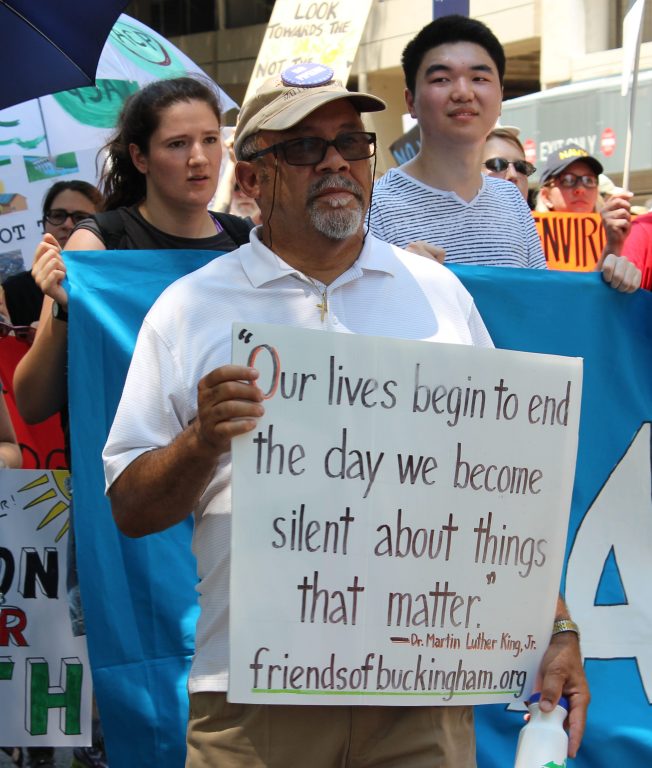
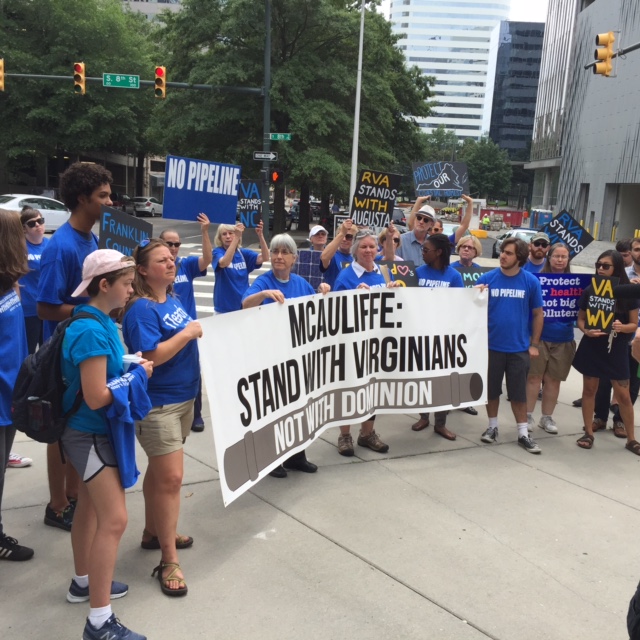
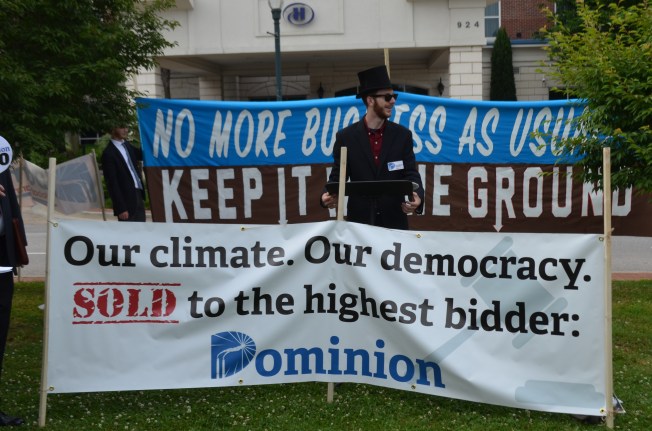
A sign at a protest against the Atlantic Coast Pipeline

A sign at a protest against the Atlantic Coast Pipeline

This post was co-written with Seth Heald, an attorney currently serving as Chair of the Virginia Chapter of the Sierra Club.

Donald Trump’s campaign for president upended the conventional wisdom that politicians must treat voters with honesty and respect. For Trump, no amount of lying, bullying, pettiness, crudeness and erratic behavior proved too much for an electorate hungry for change.

Indeed, some of his followers feel Trump succeeded because of his vices, not in spite of them. These trolls, bigots and bullies make up what historian Patty Limerick calls the Jerk Pride Movement, and they think they’re having their moment in the sun.

And lest anyone forget that corporations are people, the fossil fuel industry and its apologists have set out to prove that corporations can be jerks, too. Fossil fuel interests seized on the election as a mandate to gut the EPA, strip away clean air and water protections, open up public lands for exploitation, and renege on international climate commitments.

Since fake news and conspiracy theories served the Trump campaign so well, the anti-regulation crowd is stepping up its own use of half-truths, diversionary tactics and outright lies. Sure, they risk undermining the very foundations of American democracy, but fossil-fuel interests smell profit; nothing else matters.

Decent Americans should be outraged no matter who they voted for—and even more so when they see it happening in their own back yards, involving the people and institutions they deal with. We may not be able to staunch the flood of falsehood flowing across the internet, but we can hold our own leaders and institutions accountable when they add to it.

The corporate parent of Virginia’s own largest electric utility was already one of these corporate jerks, working with the American Legislative Exchange Council on state legislation undermining federal clean air and water protections. But recently Dominion Resources has gone further, adopting disinformation tactics in claiming its proposed fracked-gas pipeline will actually lower carbon emissions, and implicitly endorsing spurious reports and lies on a blog it sponsors. Dominion has gone from spinning facts to its own advantage, to actively misleading the people of Virginia.

Dominion is one of the partners in the Atlantic Coast Pipeline (ACP), which if built will bring massive amounts of fracked gas from West Virginia through Virginia and down to North Carolina. An analysis of the ACP’s climate change impact and that of the Mountain Valley Pipeline, conducted for the Sierra Club by physicist Richard Ball, showed that building these two pipelines would result in the emissions of twice the climate pollution of Virginia’s entire current greenhouse gas footprint.

Yet in a recent Facebook posting, Dominion claimed the Atlantic Coast Pipeline would “play an instrumental role in reducing carbon emissions in Virginia and North Carolina, which will allow both states to meet the requirements of the federal Clean Power Plan. In fact, the ACP alone could contribute as much as 25 to 50 percent of the carbon reductions necessary to meet interim goals in 2022.”

In the words of the Virginia Sierra Club’s former director, Glen Besa, “This is just not true and does not pass the sniff test. My personal rating is: Liar, Liar, Pants on Fire. Both of Dominion’s new gas plants in Virginia are fueled by existing pipelines. The ACP will bring in more fossil fuel for burning. At the same time Dominion has made NO new commitments to retire existing coal plants. Dominion can meet the Clean Power Plan without the ACP, but more importantly, the ACP will markedly increase carbon emissions, not decrease them.”

This bogus claim that a fracked-gas pipeline will help lower carbon pollution is in keeping with Dominion’s history of playing to both climate-concerned liberals and moderates on the one hand, and climate-denying conservatives on the other. Promising lower carbon emissions and Clean Power Plan compliance is intended to mollify the left, while Dominion courts the right through its work with ALEC, its lavish contributions to lawmakers, and its sponsorship of the libertarian Jim Bacon’s blog, Bacon’s Rebellion.

Even before Dominion signed on as his sponsor, Bacon exhibited an exasperating credulity when examining claims by Dominion and other fossil fuel companies. No doubt that endeared him to Dominion CEO Thomas Farrell, II and Company. If I were selling poison under the guise of medicine, I too would value a man who advertised my wares while proclaiming his independence.

But since joining the Dominion team and featuring its bright blue logo with every post, Bacon has adopted tactics familiar from the Trump campaign. These include promoting a sham “report” slamming a supposed new renewable electricity mandate that Virginia does not have and defending fake news about voter fraud. (Suppression of minority voting is a historic ALEC priority, along with opposition to wind and solar and promoting climate-science disinformation.)

Bacon’s post about supposed voter fraud is particularly instructive, as it adopts the “alt right’s” tactic of putting the onus on others to disprove absurd, baseless claims. Recall that Trump recently claimed, with no evidence, that he would have won the popular vote but for two million fraudulent votes supposedly cast against him. On the one hand Bacon (in perhaps the understatement of the year) acknowledged that Trump’s claim is a “huuuge stretch.” But then Bacon chastised “the news establishment” for not “distinguishing itself in debunking” Trump’s allegation. Indeed, Bacon posits, the national media’s reaction to Trump’s baseless allegation was “unhinged.” This, Bacon reasons, lends credence to Trump’s claim that the media is biased.

So now, according to a blog post with Dominion’s blue logo at the top, a president-elect’s lie about vote fraud is a stretch, but calling it a lie is unhinged. Welcome to the post-truth world.

Fossil fuel companies and their minions spreading disinformation is hardly a new tactic, of course. Read Naomi Oreskes and Erik Conway’s Merchants of Doubt for a compelling account of how the tobacco, chemical, and fossil fuel industries have used industry-funded “studies” and science-for-sale to stave off regulation for decades or longer.

If Americans aren’t in a panic about climate change, the reason isn’t a paucity of information about what is happening and why. It is due to a calculated disinformation campaign by the fossil fuel industry and a cadre of front groups like ALEC to make people believe the science is unsettled, exploiting the natural human tendency to do nothing in the face of uncertainty. As one internal tobacco company memo explained, “doubt is our product.”

Dominion Resources is a special case. Its Dominion Virginia Power subsidiary is a regulated public utility that is supposed to act in the public interest. Sham reports, fake news and false claims undermine the ability of regulators, legislators, and the public to understand and address the true nature of the energy choices facing us. Virginians should demand better.


Unknown's avatar

Why Trump won’t stop the clean energy revolution

A protest in Manhattan against the presidency of Donald Trump, held the day after the election. Photo credit Rhododendrites - Own work, CC BY-SA 4.0, https://commons.wikimedia.org/w/index.php?curid=53011447

A protest in Manhattan against the presidency of Donald Trump, held the day after the election. Photo credit Rhododendrites – Own work, CC BY-SA 4.0, https://commons.wikimedia.org/w/index.php?curid=53011447

It is not an overstatement to say that Donald Trump’s win over Hillary Clinton horrified everyone who is worried about climate change. Reading the news Wednesday morning was like waking up from a nightmare to discover that there really is a guy coming after you with a meat cleaver.

You might not be done for, though. You could just end up maimed and bloodied before you wrest the cleaver away. So with that comforting thought, let’s talk about what a Trump presidency means for energy policy over the next four years.

I’ve had a lot of time to think about this. As a career pessimist, I’ve been worried about the possibility of a Trump win since last spring. I can fairly say I was panicking before panic became mainstream. But even with the worst-case scenario starting to play out, I’m convinced we will continue making progress on clean energy.

There is no getting around how much harder a Trump presidency makes it for those of us who want the U.S. to meet its obligations under the Paris climate accord. It’s not clear that Trump can actually “cancel” the accord, as he has promised to do. On the other hand, a man who puts fossil fuel lobbyists and climate skeptics in charge of energy policy is hardly likely to ask Congress for a carbon tax.

Nothing good can come of it when the people in charge relish chaos and embrace ignorance. Destroying the EPA will not stop glaciers melting and sea levels rising.

But just as politicians can’t repeal the laws of physics driving global warming, so there are other forces largely beyond their control. Laws and regulations currently in place; state-level initiatives; market competition; technological innovation; and popular attitudes towards clean energy have all driven changes that will withstand a fair amount of monkeying with. It’s worth a quick review of these realities.

Coal is still dead

Donald Trump’s promise to bring back coal jobs is about as solid as his promise to force American companies to bring jobs back from China. Even if he’s sincere, he can’t actually do it.

The economic case for coal no longer exists, and that remains true even if Trump and anti-regulation forces in Congress gut EPA rules protecting air and water. Fracking technology did more than the Obama administration to drive coal use down by making shale gas cheap. A glut of natural gas pushed prices down to unsustainable levels and kept them there so long that utilities chose to close coal plants or convert them to gas rather than wait.

What gas started, renewables are finishing. Today, coal can’t compete on price with wind or solar, either. That leaves coal with no path back to profitability. Not many utilities want to pollute when not polluting is cheaper.

Nor will the export market recover. China doesn’t want our coal, and a president who pursues protectionist trade policies will find it hard to get other countries to take our products.

It’s also hard to find serious political support for coal outside of a handful of coal states. Politicians say they care about out-of-work coal miners, but they care more about attracting industry to their states with cheap energy. That is certainly the case in Virginia, where Governor McAuliffe didn’t even include coal mining or burning anywhere in his energy plan.

If there is a silver lining for coal miners, it’s that without an Obama bogeyman to blame for everything, coal-state Republicans will have to seek real solutions to unemployment in Appalachia.

Solar and wind are still going to beat out conventional fuels

Analysts predict renewable energy, especially solar, will become the dominant source of electricity worldwide in the coming decades. Already wind and solar out-compete coal and gas on price in many places across the U.S. As these technologies mature, prices will continue to fall, driving a virtuous cycle of escalating installations and further price reductions.

While federal policies helped make the clean energy revolution possible, changes in federal policy now won’t stop it. Today the main drivers of wind and solar are declining costs, improvements in technology, corporate sustainability goals, and state-level renewable energy targets.

As the revolution unfolds over the next decade, the folly of investing in new fossil fuel and nuclear infrastructure will become increasingly clear. Natural gas itself is cheap right now, but new gas infrastructure built today will become worthless before it can recover its costs and return a profit. Corporations like Dominion Resources and Duke Energy are investing in gas transmission pipelines and gas generating plants only because they think they can profit from them now, and force captive utility customers to bear the cost of paying off the worthless assets later.

Advocates fighting new gas infrastructure have mostly had to work at the state level, since they’ve received little help from the Feds. That much won’t change. The cavalry isn’t coming to save us? Well, we are no worse off than we were before. We just have to do the job ourselves.

Dominion’s gas build-out is still a bad idea

Dominion Power is enthusiastic about natural gas, but we’ve seen this movie before. Environmentalists and their allies tried, and failed, to stop Dominion’s newest coal plant in Wise County from being built. Regulators approved it in spite of Dominion’s cost projections showing a levelized cost of energy of 9.3 cents per kilowatt-hour. That’s about twice the wholesale price of energy today, and well above where wind and solar would be even without subsidies.

Approval to construct the plant came in the fall of 2008. A mere eight years later, that looks like a terrible decision. Dominion Virginia Power shows no further interest in building coal plants. Instead, it has since built two huge natural gas plants and received approval to build a third. Its sister company is building the Atlantic Coast Pipeline to lock ratepayers into even more gas.

Eight years from now, those will look like equally bad decisions.

Renewable energy is popular with everyone

One of the most remarkable pieces of legislation passed during the last few years was the extension of the Investment Tax Credit and the Production Tax Credit, subsidies that have underpinned the rapid spread of solar and wind power. It turns out that Republicans don’t actually hate subsidies; they only hate the ones that benefit other people.

Wind energy is one of the bright spots in the red states of the heartland. Farmers facing volatile markets for agricultural products appreciate the stable income they get from hosting wind turbines among the cornfields, and they aren’t going to give that up.

And everybody, it turns out, loves solar energy. There’s a simple, populist appeal to generating free, clean energy on your own roof. The failure on Tuesday of a utility-sponsored ballot measure in Florida is especially notable: the constitutional amendment would have ended net metering and led to steep declines in solar installations in the Sunshine State. Voters said no. The lesson will resonate across the South: people want solar.

Indeed, public polling for years has shown overwhelming support for wind and solar energy, across the political spectrum. Even people who don’t understand climate change think it’s a good idea to pollute less. And the energy security benefits of having wind and solar farms dotting the landscape are simple and intuitive. So while the fossil fuel industry may use a friendly Trump administration to launch attacks on renewable energy, no populist army will back them.

The Clean Power Plan was important, but not transformative

Congressional Republicans have talked smack about the EPA for years, and the Clean Power Plan raised the needle on the right wing’s outrage meter to new levels. Most EPA rules have a layer of insulation from Congressional meddling as long as Senate Democrats retain the ability to filibuster legislation that would repeal bedrock environmental laws like the Clean Air Act. And laws protecting the air and water have such broad public backing that it is hard to imagine even the Chaos Caucus going there.

The Clean Power Plan could be different. Trump’s choice of a new Supreme Court justice will produce a conservative majority that might well strike down Obama’s most important carbon rule. For a handful of states that rely heavily on electricity from aging coal plants and aren’t compelled to close them under other air pollution rules, this will buy them a few years. (But see “Coal is still dead,” above.)

For most states, though, the Clean Power Plan was never going to be a game-changer. Many states were given targets that are easy to meet, or that they have already met. As I’ve pointed out before, Virginia’s target is so modest that the state could meet it simply by adopting a few efficiency measures and supplying new demand with wind and solar. That’s if the state decided to include newly-built generating sources in its implementation plan, which it doesn’t have to do.

By its terms, the Clean Power Plan applies only to carbon pollution from power plants in existence as of 2012. Newer generating plants are regulated under a different section of the Clean Air Act, under standards that new combined-cycle gas plants can easily meet. That’s a gigantic loophole that Dominion Virginia Power, for one, intends to exploit to the fullest, and it’s the reason the company supported the Clean Power Plan in court.

Regardless of whether it is upheld in the courts, however, the Clean Power Plan has already had a significant effect nationwide by forcing utilities and state regulators to do better planning. It led to a raft of analyses by consulting firms showing how states could comply and actually save money for ratepayers by deploying cost-effective energy efficiency measures. If the Clean Power Plan doesn’t become law, states can ignore those reports, but their residents should be asking why.

For Virginia, nothing has changed at the state level. Or has it?

Virginia has off-year elections at the state level, so Trump’s election has no immediate effect on state law or policy. Most significantly, Terry McAuliffe is still governor of Virginia for another year, he still knows climate change is real, and his Executive Order 57, directing his senior staff to pursue a strategy for CO2 reductions, is still in effect. McAuliffe has disappointed activists who hoped he would become a climate champion, but Trump’s win could light a fire under his feet. He has an opportunity to put sound policies in place, if he chooses to do so.

Offshore drilling in Virginia probably isn’t back on the table

Trump has promised to re-open federal lands for private exploitation, reversing moves by the Obama administration. His website says that includes offshore federal waters. However, the decision by the Bureau of Ocean Energy Management to take Virginia out of consideration for offshore drilling isn’t scheduled to be revisited for five years. Trump’s people could change the process, perhaps, but there’s not much demand for him to do so. With oil prices low, companies aren’t clamoring for more places to drill.

Environmental protection begins at home . . . and the grassroots will just get stronger

I would hate for anyone to mistake this stock-taking for optimism. The mere fact that the clean energy revolution is underway does not mean it will proceed apace. Opportunities abound for Trump to do mischief, and nothing we have heard or seen from him during the campaign suggests he will rule wisely and with restraint.

But advancing environmental protection has always been the job of the people. Left by itself, government succumbs to moneyed interests, and regulators are taken captive by the industries they are supposed to regulate. Americans who want clean air and water and a climate that supports civilization as we know it have to demand it. It will not be given to us.

Sound economics, common sense, and technological innovation are on our side. Most important, though, is the groundswell of public support for clean energy and action on climate. That never depended on the election, and it won’t stop now.

Unknown's avatar

Virginia, meet Paris. Things will never be the same.

By Tristan Nitot - standblog.org, CC BY-SA 3.0, https://commons.wikimedia.org/w/index.php?curid=41689

By Tristan Nitot – standblog.org, CC BY-SA 3.0, https://commons.wikimedia.org/w/index.php?curid=41689

After Republicans in Virginia’s General Assembly shut down the McAuliffe administration’s work on implementing the EPA Clean Power Plan last winter, Governor McAuliffe decided on an end run. He issued Executive Order 57, directing administration officials to recommend ways to reduce carbon pollution from the state’s power plants. The workgroup led by Secretary of Natural Resources Molly Ward is holding meetings this fall to gather information and advice.

This puts Ward in something of a pickle. Meeting the climate challenge requires Virginia to commit to a future with less fossil fuel, while McAuliffe is championing Dominion Power’s plans to radically expand fossil fuel investments in the Commonwealth.

Last week the European Union joined the United States, China, India, Canada, Mexico and dozens of other countries in ratifying the Paris climate accord, putting it over the threshold needed for it to take effect. The goal of the accord is to limit the increase in world temperatures to “well below” 2 degrees Celsius, 3.6 degrees Fahrenheit, a level beyond which climate effects are projected to be catastrophic. Given mounting concerns that 2 degrees isn’t sufficiently protective, the 197 signatory nations also agreed to a stretch goal of 1.5 degrees Celsius.

The U.S. is the world’s second highest emitter of CO2 after China, and our average emissions per person are two-and-a-half times that of the Chinese. No other country has contributed more to the problem. American leadership was key to bringing other countries on board, and it will be key to implementing solutions.

A few niggling details remain, like how we are actually going to do this. The EPA’s Clean Power Plan is a first step, but its scope is narrow. It addresses only carbon emissions from electric generating plants in use as of 2012, not new sources (though states can choose to do that). It doesn’t address emissions outside the electric sector. It also doesn’t address methane emissions from natural gas infrastructure, a climate threat that seriously undercuts the climate benefit of utilities switching from coal to gas. Its goal of reducing electric-sector carbon pollution by 30% by 2030 is nowhere near what’s needed.

To meet its Paris commitment, the U.S. will have to dramatically reduce fossil fuel use in everything from electricity and heating to manufacturing and transportation. The good news is that the technologies to do this exist, and they are getting better and cheaper by the day. The bad news is that even an all-hands-on-deck approach would need time to work, and there are still way too many hands sitting idle in their bunks below deck.

Future federal regulation that goes well beyond the Clean Power Plan is inevitable. Through whatever means—a carbon tax, removal of fossil fuel subsidies, new incentives, or simple mandates—renewable energy has to take over the power sector, with fossil fuels limited to a supporting role before being phased out altogether. Building codes must be dramatically strengthened to minimize energy consumption, and transportation must be electrified so vehicles run on wind and solar, not gasoline or diesel. And all this has to happen starting now.

With the U.S. committed to this path, it makes no sense for any state to pursue a fossil fuel-heavy strategy simply because federal mandates aren’t in place yet. The ratification of the Paris accord means all new fossil fuel investments—drilling machinery, fracking wells, pipelines, generating plants—must be evaluated against the likelihood that they will have to be abandoned well before the end of their useful life.

In Virginia this includes proposed new fracked-gas transmission pipelines; a new natural gas generating station that Dominion Power just received approval to build; as much as 9,000 megawatts more of natural gas generating plants that Dominion wants to build; and at least two new natural gas generating plants proposed by other developers, who would use the new gas pipelines to supply them. Altogether, these projects represent tens of billions of dollars in investments in infrastructure that would have to be shut down and left to decay within a decade or two.

All this could happen without violating the Clean Power Plan, if Virginia takes advantage of a loophole allowing it to exclude new gas plants from its implementation plan. Dominion’s gas plants alone would increase carbon emissions from Virginia by as much as 83%. That won’t get us to Paris.

It seems obvious that these investments would be better channeled into carbon-free renewable energy and reducing energy use through efficiency and building improvements. These are the “no regrets” investments that make sense for human health and economic development reasons anyway. With the Paris accord, the decision has gone from no-regrets to no-brainer.

But Dominion clearly thinks a pipelines-and-gas-plants approach will make more money for its shareholders. Dominion is betting that regulators will allow it to bill customers for the costs of new fossil fuel infrastructure even if it turns out that using it means paying a high carbon tax, or not using it at all. Dominion counts on the prevalence of climate doubt and magical thinking within the Virginia legislature and the staff of the SCC to muffle the wake-up call from Paris.

This is a deeply irresponsible and immoral calculus.

To date, Governor McAuliffe has backed Dominion at every turn. With only a year and a half left in his term, the “jobs governor” wants to lure businesses to Virginia quickly with the promise of cheap natural gas. It’s a strategy that might backfire in the short run, as savvy businesses go to states better preparing for life after Paris. Surely, it will backfire in the long run, when Virginia is left paying off unwanted fossil fuel infrastructure. The Paris accord marks a good point for McAuliffe to change his allegiance.

Indeed, after Paris, nothing will ever be the same. The days of natural gas as a bridge fuel are rapidly ending, and the U.S. has committed itself to breaking from its fossil fuel past. Executive Order 57 offers Virginia an opportunity to map out a carbon-free strategy. Time is short. Allons-y!

Unknown's avatar

The “fuel” that’s helping America fight climate change isn’t natural gas

You’ve heard the good news on climate: after a century or more of continuous rise, U.S. CO2 emissions have finally begun to decline, due largely to changes in the energy sector. According to the Energy Information Agency (EIA), energy-related CO2 emissions in 2015 were 12% below their 2005 levels. The EIA says this is “because of the decreased use of coal and the increased use of natural gas for electricity generation.”

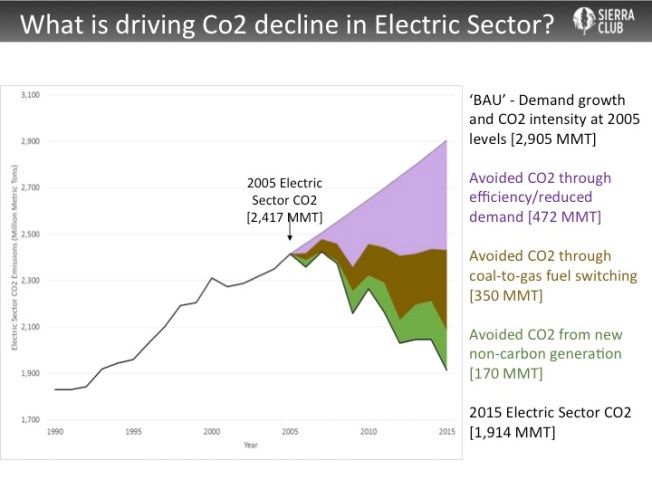
Is the EIA right in making natural gas the hero of the CO2 story? Hardly. Sure, coal-to-gas switching is real. But take a look at this graph showing the contributors to declining carbon emissions. Natural gas displacement of coal accounts for only about a third of the decrease in CO2 emissions.

Courtesy of the Sierra Club Beyond Coal Campaign, using data from the Energy Information Agency.

Courtesy of the Sierra Club Beyond Coal Campaign, using data from the Energy Information Agency.

By far the biggest driver of the declining emissions is energy efficiency. Americans are using less energy overall, even as our population grows and our economy expands

Energy efficiency is sometimes called the “first fuel” because cutting waste is a cheaper and faster way to meet energy demand than building new power plants. Improvements in energy performance cut across all sectors of the economy, from industrial machines to home electronics to innovations like LED bulbs replacing famously wasteful incandescent light bulbs.

Energy efficiency’s stunning success in lowering carbon emissions should get more attention, and not just because it is cheaper than building new natural gas-fired power plants. Efficiency has no downsides. Natural gas has plenty. Indeed, when methane leakage from drilling and infrastructure is factored in, natural gas doesn’t look much like a climate hero at all.

And that’s not the full story. A growing share of the credit for carbon reductions also goes to non-carbon-emitting sources, primarily wind, and solar. Both sources exhibit double-digit growth rates. Wind power in the U.S. has grown from a little over 9,000 megawatts (MW) in 2005 to more than 74,000 MW by the end of 2015. In 2005, the solar market scarcely existed. By early this year, we had 29,000 MW installed.

The solar trend is particularly exciting because we are just starting to see the big numbers that result from solar’s exponential growth. In the first quarter of 2016, more solar came online in the U.S. than all other power sources combined. Analysts like Bloomberg New Energy Finance see solar becoming the world’s dominant energy source over the next 25 years, driving out not just coal but also a lot of gas generation as solar becomes the cheapest way to make energy.

For an inspiring look at how this will happen, check out this presentation by author Tony Seba. As Seba argues, solar isn’t a commodity like fossil fuels; it is a technology like computers and cell phones. When technologies like these take off, they take over. Seba refers to solar technology, battery storage, electric vehicles and self-driving vehicles as “disruptive” technologies that are advancing together to upend our energy and transportation sectors.

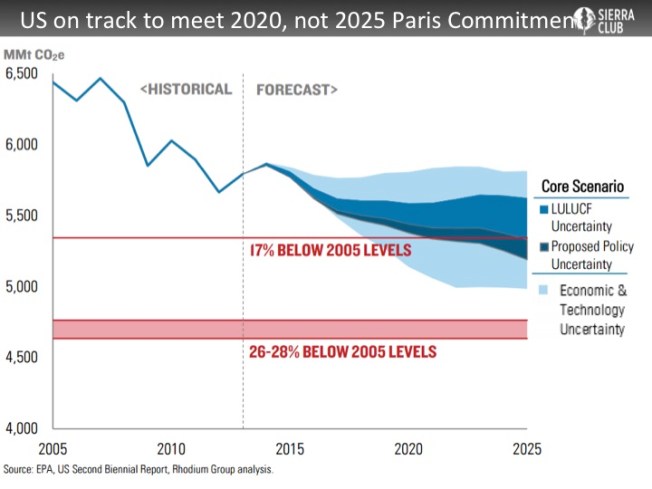
Another graph shows us how critical these advancements will be. The U.S. is on track to achieve President Obama’s goal announced last year of lowering carbon emissions 17% below 2005 levels by 2020, but we will need more aggressive measures to meet our Paris Agreement target of 26-28% below 2005 levels by 2025. After 2025, of course, we will have to cut greenhouse emissions even further and faster.

Slide4Given the urgency of the climate crisis, we don’t have the option of waiting around for the solar revolution to bankrupt the oil and gas industry and fossil-bound electric utilities. These companies will not go quietly; already they are maneuvering to lock customers into fossil fuels. Power producers are engaged in a mad rush to build natural gas plants, and wherever possible, to stick utility customers with the costs.

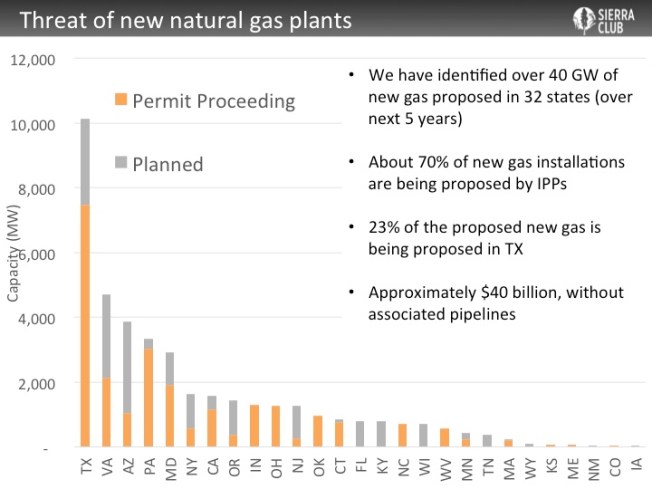
For Virginians who have felt especially under attack from fracked gas projects recently, this final graph shows it’s not your imagination: Virginia is second only to Texas in new gas plant development underway. And this graph captures only a fraction of the new gas that Virginia’s major utility, Dominion Virginia Power, wants to build. In presentations to state officials, it revealed plans for more than 9,000 megawatts of additional gas generating capacity.

Based on Energy Information Agency data. Chart excludes natural gas generating units already under construction as well as those scheduled to come online after 2020.

Based on Energy Information Agency data. Chart excludes natural gas generating units already under construction as well as those scheduled to come online after 2020.

Dominion and other gas-happy utilities are betting that once plants are built and consumers are on the hook, regulators won’t want to see them idled ten years from now just because renewable energy has made them obsolete.

Indeed, Dominion and other utilities, including Duke Energy, Southern Company, and NextEra in the Southeast and DTE Energy in the Midwest, even plan to use electricity customers to make money for the gas pipelines they are building, locking Americans further into gas.

This is madness. The only sound energy plan today is one that looks forward to an era of minimal fossil fuel use. It puts efficiency and renewables front and center, shifting natural gas and other fuels to supporting roles that will shrink over time.

The shift is inevitable. Delaying it means allowing the climate crisis to worsen, while sticking customers with higher bills for decades to come. That may suit some utilities just fine, but the cost is too high for the rest of us.


Unknown's avatar

Dominion executive speaks up on climate change. That turns out to be a bad thing.

Photo courtesy of Chesapeake Climate Action Network

Photo courtesy of Chesapeake Climate Action Network

In guest blogger Seth Heald’s last post here, he discussed the strange fact that top executives at Dominion Power don’t talk about climate disruption, even though it is a major driver of the tectonic shifts underway in the nation’s power sector. Many of us assumed the climate silence at Dominion means its executives want to avoid a subject that can be politically divisive.  Turns out some of them are talking–but not in a good way. Heald brings us the story.

As I’ve written elsewhere, senior Dominion executives and other electric utility officials tend to avoid mentioning climate change in their public discussions. Dominion Virginia Power president Bob Blue avoided that unpleasant topic in his keynote luncheon speech at a recent Virginia resiliency conference, a forum where one has to work to avoid mentioning climate change. That sort of climate silence at the corporate top leaves the public wondering what Dominion executives really think, or whether they think much at all, about climate change.

It may also leave other Dominion executives in doubt about where their company stands. Last month a curious letter to the editor appeared in the Richmond Times-Dispatch headlined “Actually scientists disagree about climate.” At first glance the letter seemed ordinary—reciting misguided climate-science denial arguments for not acting to reduce greenhouse-gas emissions. It complained about “alarmists” who (the letter claimed) refuse to acknowledge benefits of climate change. And it suggested that Americans devote “our limited dollars” to adapting to climate change rather than slowing it by reducing greenhouse-gas emissions.

Letters of this ilk appear with depressing regularity in the Times-Dispatch and many newspapers. They misrepresent the state of climate science, reciting talking points that can be found on any of a number of denialist websites, or heard at conferences sponsored by fossil-fuel funded groups such as the American Legislative Exchange Council (ALEC). That’s sad, but not unusual.

But this climate-science denial letter was different in one key respect—it was written by David Shuford, a vice president and deputy general counsel at Dominion Resources Inc., Virginia’s largest energy company and the commonwealth’s biggest emitter of climate-disrupting carbon dioxide. (Shuford’s letter did not note his Dominion connection).

Now that is noteworthy.

What’s more, the Times-Dispatch published a similar Shuford letter earlier this year in which he complained about climate change “warmists” who are “watermelons” (“green on the outside, red on the inside”).

As Dave Barry would say, I am not making this up—a senior Dominion executive really is making these arguments in the press.

A few years ago Shuford served as “Vice President – Policy and Business Evaluation, Alternative Energy Solutions” at Dominion. According to Dominion’s Citizenship & Sustainability Report, the company’s Alternative Energy group “drives innovation by researching and evaluating renewable and emerging energy technologies to assess their commercial viability and potential for building a more sustainable economy.” Virginia lags neighboring states in deploying clean energy such as solar and wind, in no small part because Dominion has opposed measures of the sort that have helped other states ramp up clean energy.

That makes Shuford’s letters all the more noteworthy.

I phoned Shuford at his Dominion office to be sure he had really written the recent letter. He confirmed he had, but was quick to emphasize that he wrote it on his own, that he did not purport to speak for Dominion, and that no one at Dominion had reviewed the letter before he sent it. The letter, he said, reflects his personal views.

In an odd sense, Shuford’s going public with his views is refreshing—we know where this Dominion executive stands on climate change. His views are ill-informed and dangerous for his industry, our commonwealth, our country, and our world, but at least we know what he thinks. Which Dominion executives disagree with Shuford? Are any of them willing to publicly refute his arguments and accurately inform the public about climate change?

Is Shuford an outlier at Dominion, or do his views perhaps align with what other company executives think? Dominion acknowledges on its website that climate change is a concern, but in the same paragraph notes its plans to use greenhouse-gas emitting coal and natural gas far into the future. The company’s website says it wants a national climate change policy to “be developed legislatively,” yet Dominion also financially supports ALEC, which has worked for years to misinform legislators about climate change and block efforts to reduce greenhouse-gas emissions. Many large corporations have left ALEC for that reason, including Virginia’s other big electric utility, AEP. But Dominion has stuck with ALEC.

What’s most offensive and cruel about Shuford’s recent letter is his suggestion that we focus solely on climate adaptation rather than reducing greenhouse-gas emissions. He seems unaware of the analyses showing that reducing emissions now is highly cost effective compared to the astronomical costs of adaptation without emission reductions. And I doubt that the adapting he’s thinking of includes helping poor people in the third world adapt to sea-level rise, floods, drought, disappearing glaciers, or extreme weather caused in large part by the developed world’s greenhouse-gas emissions. Nor does he seem aware that relying on adaptation alone essentially writes off the entire Hampton Roads region, where many Dominion customers live.

Dominion claims that ethics is one of its four core values. Top executives at an ethical company would feel compelled to respond promptly, forcefully, and publicly to a published letter from a company vice president suggesting that we ought not to reduce greenhouse-gas emissions because people can simply adapt to climate change.

Dominion’s board should require the company to conduct training for executives and board members on climate-change ethics, and for that matter on climate science too.

Seth Heald is chair of the Sierra Club Virginia Chapter. He is a student in the Master of Science in Energy Policy and Climate program at Johns Hopkins University.


For curious readers, reprinted below is Mr. Shuford’s letter, as published in the Times-Dispatch. That is followed by an annotated version that provides Seth Heald’s responses to Mr. Shuford’s points (in italics), with citations to sources with accurate information.

Actually, scientists disagree about climate

Editor, Times-Dispatch:

Can we please stop the nonsense about science-supported climate change believers and science-denying climate change skeptics?

We are constantly told that “the science” is settled, that 97 percent of scientists agree on “the science,” and that the benighted few who disagree must be shunned or even prosecuted. In truth, the debate is far more real — even in the scientific community — than these armchair experts apparently realize.

There has never been 97 percent scientific agreement on the questions that matter with climate change. Simply repeating it doesn’t make it true. No one disagrees with the fact that the climate is changing. And most everyone agrees with the so-called greenhouse theory — that carbon dioxide causes the atmosphere to warm and that man has contributed to its concentration in the atmosphere.

The real debate in and outside the scientific community is over questions that flow from that theory, including the following:

(1) How much of global warming is due to mankind and how much is natural?

(2) Are there forces that counteract the greenhouse effect that aren’t being considered in the climate alarmists’ computer models (which might explain how their computer models have proven so inaccurate)?

(3) Does the absence of warming over the past 15 years disprove the alarmists’ theories about catastrophic global warming and, if not, why not?

(4) Will warming in the next century really be catastrophic, or could it actually be beneficial in ways the alarmists won’t concede?

(5) Given that the celebrated Paris Climate Agreement will have negligible effect on global temperatures even if every country complied, would our limited dollars be better spent on adapting to a warmer climate than on trying to prevent it?

So enough with the trope about the 97 percent versus “deniers.” There simply is no scientific consensus on the questions that will drive public policy on this issue.

David Shuford.

Richmond.

Mr. Shuford’s letter, with annotated response 

Editor, Times-Dispatch: Can we please stop the nonsense about science-supported climate change believers and science-denying climate change skeptics?

We are constantly told that “the science” is settled, that 97 percent of scientists agree on “the science,” and that the benighted few who disagree must be shunned or even prosecuted. In truth, the debate is far more real — even in the scientific community — than these armchair experts apparently realize.

There has never been 97 percent scientific agreement on the questions that matter with climate change. Simply repeating it doesn’t make it true.

See this 2016 paper confirming that there is a high degree of consensus about human-caused climate change among climate-science experts. See also this 2004 paper by (now) Harvard Professor Naomi Oreskes, published in Science, the journal of the American Association for the Advancement of Science. Also well worth reading is Merchants of Doubt, by Oreskes and Erik Conway, which details efforts by corporations to mislead and create confusion about the science concerning cigarette smoking and climate change.

No one disagrees with the fact that the climate is changing.

In fact a large number of people have attempted to argue that climate change is a hoax, and many still do, including a number of the candidates in the recent Republican presidential primary contest, such as Ted Cruz and Donald Trump, to name just a couple. But it is true that some of the fossil-fuel funded groups that formerly argued that there is no global warming have reacted to criticism by changing their argument to “the climate is always changing,” as if that somehow disproves the scientific consensus that human greenhouse-gas emissions are causing dangerous warming. A good example of the changing arguments of fossil-fuel-supported climate misinformers is ALEC—the American Legislative Exchange Council, which Dominion Resources belongs to and supports financially.

And most everyone agrees with the so-called greenhouse theory — that carbon dioxide causes the atmosphere to warm and that man has contributed to its concentration in the atmosphere.

Not true. Those, like Donald Trump, who say global warming is a hoax certainly don’t agree with this. Nor does Ted Cruz, who last year agreed that his climate position is “full out denial.” Some climate change deniers make statements like “carbon dioxide is harmless, you’re breathing it now,” as if that somehow disproved the disturbing warming effects that scientists have found. And of course Senator James Inhofe famously brought a snowball into the senate in winter in an effort to show that global warming is a hoax.

The real debate in and outside the scientific community is over questions that flow from that theory, including the following:

  • How much of global warming is due to mankind and how much is natural?

False. There is no real debate in the peer-reviewed scientific literature over the fact that the unusual, accelerating global warming seen since the 19th Century is attributable to the increase of greenhouse gases, primarily carbon dioxide, in the atmosphere due to burning fossil fuels. An excellent book to read on this is The History of Global Warming, by Spencer Weart (2d ed. Harvard Univ. Press 2008). It’s a scholarly book that is clear and approachable for lay readers. See also the links below to reports by several prestigious scientific bodies.

  • Are there forces that counteract the greenhouse effect that aren’t being considered in the climate alarmists’ computer models (which might explain how their computer models have proven so inaccurate)?

What are these unnamed “forces”? Shuford doesn’t say. What is Shuford’s evidence that climate models have “proven so inaccurate”? In fact climate models have proven to be generally accurate in predicting the warming that has occurred. The fact that they are not perfect is hardly surprising. Moreover, our knowledge of global warming is informed not only by models, but studies of the Earth’s warming and cooling over millions of years, which have shown a direct link between high atmospheric concentrations of carbon dioxide and higher global temperatures.

  • Does the absence of warming over the past 15 years disprove the alarmists’ theories about catastrophic global warming and, if not, why not?

There hasn’t been an absence of global warming in the past 15 years. In fact 2014 and 2015 set new records for average global temperatures. Shuford’s claim, which is promoted by a number of fossil-fuel supported interests is demonstrably false. Scientific American published a good summary of the issue earlier this year.

  • Will warming in the next century really be catastrophic, or could it actually be beneficial in ways the alarmists won’t concede?

This claim is not only absurd, but unethical and cruel in its disregard for the world’s poorest people who are threatened in this century and next by sea-level rise, storm surges, disappearing glaciers, flooding, drought, and mass species extinctions. There may well be a small number of people who will benefit during their lifetimes from warmer temperatures and a changed climate, but that is dwarfed by the number of people who will suffer by losing their property, their livelihoods, their health, and their lives due to climate change. Our species evolved to live in the stable climate we’ve had for thousands of years, and people settled in places suitable for the climate we have. The Hampton Roads area, which is served by Dominion Virginia Power, is particularly susceptible to future inundation, which will affect rich and poor Virginians, with the poor harmed disproportionately and least able to recover quickly from their losses.

  • Given that the celebrated Paris Climate Agreement will have negligible effect on global temperatures even if every country complied,

Shuford’s boss at Dominion, Thomas Farrell, II, has refused to talk publicly about the Paris Climate Agreement, which will dramatically affect his and Shuford’s company. Perhaps this sort of silence at the corporate top leads to Shuford feeling comfortable to mock (and attempt to minimize the effect of) the Paris Agreement in Dominion’s hometown daily newspaper. Virtually every nation in the world worked to negotiate the Paris Agreement. What does Shuford mean by “have neglible effect”? In fact the Paris accord will help a great deal. Yes, the world still needs to do more, but that means we should be calling for faster and sharper greenhouse-gas reductions.

would our limited dollars be better spent on adapting to a warmer climate than on trying to prevent it?

This again is cruel, particularly to the world’s poor, who have done so little to cause global warming, and who are and will be suffering disproportionately from it. It is unlikely that Shuford is calling for our “limited dollars” to go to helping people in Bangladesh adapt to sea level rise, or people in Nepal, Pakistan or Bolivia adapt to a word where glaciers that they depend on for subsistence agriculture have disappeared. The type of adaptation Shuford is perhaps unwittingly calling for would involve mass migrations by tens of millions of poor people around the globe. Shuford also appears to be unaware of or ignores the strong economic arguments for reducing carbon emissions now, rather than later. These are set forth in detail in two recent books The Climate Casino (2013 Yale Univ. Press), by Yale economist William Nordberg, and Why Are We Waiting? (2015 MIT Press) by Nicholas Stern, a professor of economics and government at the London School of Economics. Both are scholarly books rather than page-turners, but they’re sufficiently clear and approachable to be readable by non-specialists. Do any executives or board members at Dominion read books like these, which provide key insights on the future of Dominion’s business? Perhaps if they did they’d be more likely to talk about climate change at work and in their public speeches.

So enough with the trope about the 97 percent versus “deniers.” There simply is no scientific consensus on the questions that will drive public policy on this issue.

Wrong again. Good explanations can be found in this publication from the American Academy for the Advancement of Science, and this one published jointly by the U.S. National Academy of Sciences and the British Royal Society. Also, Inside Climate News recently described a new study published in Science about how fossil-fuel funded climate-science deniers disingenuously shift their arguments and use normal scientific uncertainties to deflect attention from the overwhelming scientific consensus on climate change and argue for no action to reduce greenhouse-gas emissions. That’s what we see in Shuford’s letter. That’s not to say necessarily that Shuford personally is disingenuous. Perhaps he really doesn’t know better (although a man in his position certainly ought to know better), and has just repeated what he saw on a fossil-fuel funded denial group’s website, or heard at an ALEC conference.


Unknown's avatar

Sierra Club scorecard plumbs divisions among Virginia legislators

SC ScorecardBy and large, Virginia Republicans are still locked in a fossil fuel echo chamber, where “all of the above” and “war on coal” guide their votes. Virginia Democrats mostly acknowledge the damage climate change is doing to the commonwealth and around the planet and support a course correction. And regardless of ideology, large majorities from both parties vote for whatever Dominion Power wants.

These are the major takeaways from this year’s legislative session and the 2016 Climate and Energy Scorecard, just released by the Virginia Chapter of the Sierra Club. Constituents and clean energy advocates will want to look at not just the raw grades of individual legislators, but also the discussion provided in the report, to understand the dynamics of our General Assembly.

Twenty-eight Democrats earned perfect scores. All but a handful of Republicans earned failing grades. Sierra Club gave extra credit to legislators who introduced bills that advanced clean energy. This included several Republicans highlighted in the scorecard, but their bad votes on other bills dragged down their overall scores.

This is really a shame, since some Republicans have worked hard to advance clean energy legislation. Leesburg Delegate Randy Minchew comes to mind here for his dogged efforts on behalf of distributed solar energy, something you might not guess from his overall grade of D.

Often, it seems, reform-minded Republicans go along with their party’s more retrograde positions where they are pressured to do so by their party leaders, or where the votes are so lopsided that there is nothing to gain from breaking with the majority.

If party leaders have an outsize influence on voting, so too does Dominion Power. In fact, if you want to know who the true champions of the people are, don’t look at party affiliation. Look for the few legislators who will stand up to the most powerful political force in Richmond.

That assumes you can find votes to examine. In the introduction to the Sierra Club scorecard, Legislative Chair Susan Stillman noted with frustration this year’s paucity of recorded votes available to score:

The challenges of producing a fair and even scorecard are growing, as are the opportunities for Virginia citizens to have a clear and accurate picture of their elected representative’s voting record. Transparency in the General Assembly sunk to a new low this year: 95% of the bills defeated in the House of Delegates were done so on an unrecorded vote or no vote at all. This is not business-as-usual: just over a decade ago, nearly every bill that passed through the House received a recorded vote.

An ongoing problem, both for scorecard referees and for clean energy advocates, is that most bills that would advance the cause of renewable energy and energy efficiency never make it out of committee; in the House, the bills are heard in a tiny subcommittee. Not only do votes go unrecorded, but this approach deprives most of our elected representatives of the opportunity to vote on some of the most important energy policy issues facing Virginia.

And then there was this year, in which even the subcommittee members never got a chance to vote. A dozen or so of the most promising clean energy bills were never heard at all, but were sent to a newly-formed interim study subcommittee, ostensibly for the purpose of giving these bills the benefit of greater deliberation. The effect was to kill them quietly for the year.

As Stillman notes, all these unrecorded votes make it hard to know where the vast majority of legislators stand:

Without a recorded vote, the public is deprived of the full measure of his or her elected official’s voting history. And the problem of unrecorded votes is growing worse. This year’s unprecedented rate of unrecorded votes in the House is up from 76% in 2015—a 25% jump in one year. Virginia legislators are killing more bills than ever without accountability for their actions. This practice is wrong, and it’s dangerous for our democracy.

Stillman gives a shout-out to the founding members of the new, bipartisan Transparency Caucus for its efforts to make all votes public and ensure every bill gets a hearing.

These would be modest reforms, but welcome. If sunlight is the best disinfectant, there’s a big, dirty House (and Senate) in Richmond that need cleaning.

Unknown's avatar

Southeastern electric utilities find their way to higher profits through gas pipelines and captive consumers

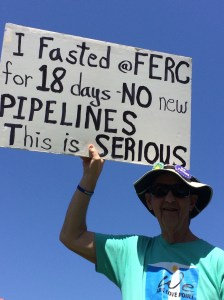
Charlie Strickler of Harrisonburg, Virginia, was one of a dozen activists who fasted last September in protest of FERC's role in approving natural gas pipelines, citing their contribution to climate change and harm to communities in their path. Photo by Ivy Main.

Charlie Strickler of Harrisonburg, Virginia, was one of a dozen activists who fasted last September in protest of FERC’s role in approving natural gas pipelines, citing their contribution to climate change and harm to communities in their path. Photo by Ivy Main.

Duke Energy, Southern Company, NextEra Energy and Dominion Resources—four of the largest investor-owned utilities in the U.S., all headquartered in the Southeast—have simultaneously adopted a growth strategy reliant on large volumes of fracked gas. With the nation’s energy sector turning decisively away from coal and nuclear energy, these companies are betting natural gas will be the dominant fuel for at least the next several decades. All four are investing billions of dollars in gas pipelines and other gas infrastructure to profit from the fracking boom.

Pipelines are attractive investments because they are typically allowed rates of return of around 14%, compared with the average regulated utility return allowed by public utility commissions of about 10%.

For the southeastern utilities, however, that rate of return is only part of the attraction. In a strategy that ought to concern regulators and electricity consumers, Duke, Dominion and NextEra all plan to use their regulated electric power subsidiaries to guarantee demand for the pipelines they’re building. The subsidiaries will build natural gas generating plants, paid for by electricity consumers, to be supplied with gas carried through the pipelines owned by their sister companies.

Southern is also investing in pipelines, but it currently doesn’t need new generation beyond the coal and nuclear plants it is struggling to complete—themselves object lessons in why coal and nuclear are kaput.

Southern just announced completion of its $12 billion acquisition of AGL Resources, a natural gas pipeline and distribution company. The move makes Southern Company “the nation’s second-largest combined gas and electric utility by customer base,” according to Utility Dive.

Dominion Resources was already heavily invested in the natural gas sector before it announced a $4.4 billion purchase of Questar Corp. News reports say the acquisition will bring Dominion an additional 27,500 miles of gas distribution pipelines, 3,400 miles of gas transmission pipeline and 56 billion cubic feet of working gas storage.

Duke Energy is making a $4.9 billion purchase of Piedmont Natural Gas, a natural gas transmission and distribution company. And NextEra recently spent $2.1 billion to acquire Texas-based NET Midstream through the limited partnership it formed, NextEra Partners, LLC.

Moody’s Investor Services issued a report in March criticizing Dominion, Southern and Duke for their natural gas transmission buys, saying the added financial risks offset the benefits of diversifying their businesses.

Moody’s may not have known how the utilities plan to use electricity customers as a hedge for at least two planned pipelines, the Atlantic Coast Pipeline (ACP) and Sabal Trail.

Using electricity customers to pay for pipelines

Companies owned by Duke, Southern and Dominion are partners in the 550-mile ACP, which will carry fracked gas from West Virginia through Virginia to the North Carolina coast. Duke and NextEra are partners in Sabal Trail, a 515-mile pipeline proposed to run from an existing pipeline in Alabama through Georgia to Florida, where Duke says it will fuel gas plants owned by Duke Energy Florida and Florida Power and Light, a subsidiary of NextEra.

ACP and Sabal Trail are only two of 15 new pipelines proposed on the East Coast competing to carry fracked gas flowing out of the Marcellus shale in Pennsylvania and West Virginia. So many pipelines are in development that analysts say there simply isn’t enough gas to fill them all. At the 2016 Marcellus-Utica Midstream Conference in February, attendees were warned that pipeline capacity “will be largely overbuilt by the 2016-2017 timeframe.”

But the ACP and Sabal Trail have an advantage most of the competition lacks. The utility partners all own electric power subsidiaries that use fracked gas to generate electricity. If the subsidiaries build new gas plants, these pipelines will be guaranteed a customer base. That means they can be profitable for their investors even when other pipelines struggle to find customers.

Indeed, Duke and Dominion’s electricity subsidiaries are making the kinds of investments you’d expect to see if the success of the pipelines were their top priority. Dominion Virginia Power is in the middle of a three-plant, 4,300 MW gas generation build-out. In the ACP’s application to the Federal Energy Regulatory Commission (FERC), Dominion Resources justifies the ACP in part by saying it will supply the newer of these plants. And the utility is just getting started with new gas generation; Dominion Virginia Power told Virginia officials last fall it expects to build another 9,000 MW of gas plants by 2040.

Meanwhile, Duke’s regulated subsidiaries, Duke Energy Carolinas and Duke Energy Progress, filed integrated resource plans in North and South Carolina that call for up to nine new natural gas generating units, totaling 8,300 MW. In February of this year, Duke received approval to build two 280 MW gas units in Asheville, NC, and sought approval for a third.

Bigger investments, greater risks

Linking pipelines to captive customers should prove a profitable arrangement for the utilities. For the customers who bear the costs and risks, it’s much more problematic. But state law gives them no say in the matter. In these southern states, the electric power subsidiaries hold legal monopolies in their designated territories. Once federal regulators approve the pipelines and state regulators approve the gas plants, the captive customers bear the loss if the bet turns sour.

Any one of several scenarios would make the gas investments a bad bet. The age of plentiful shale gas could end almost as quickly as it started, as some analysts predict, or gas prices could resume their historic volatility for other reasons. The U.S. could adopt newer, tighter carbon rules to meet international climate obligations, or enact a carbon tax that increases the cost of fossil fuels. Alternatives like wind, solar and energy storage seem likely to continue their astonishing march towards domination of the electric sector. As they become increasingly competitive, much new gas infrastructure is destined to become stranded investments.

And finally, the demand for natural gas, and for the pipelines themselves, may simply not be there; Americans are using less electricity, and generating more of it themselves through rooftop solar systems. The vertically-integrated, monopoly utility model that prevails in the Southeast relies on ever-increasing sales, which means it doesn’t require much of a change in consumer behavior to turn black ink red.

So while environmentalists are enraged by the recklessness of the southeastern utilities’ natural gas strategy in an age of climate change, customers who only care about the bottom line on their utility bills have reason to be just as upset. Capitalism is supposed to ensure that corporate shareholders bear the costs as well as receive the benefits of risky bets. With the risks of their gas gamble shifted onto captive customers, the utilities won’t be punished for not choosing clean energy instead.

Bucking the trend towards renewables and efficiency

It’s worth noting that the plans of Dominion, Duke and their fellow monopoly utilities run counter to the expressed desires of their customers. Natural gas companies work to brand their product as “clean,” but polls show Americans overwhelmingly believe the U.S. should emphasize wind and solar over oil and gas production, and oppose the use of fracking to extract oil and gas. Major corporations now threaten to vote with their feet, refusing to locate where they can’t access electricity from renewable sources.

It is not a coincidence that Duke and Dominion fall near the bottom of a just-released survey conducted by Ceres that ranks major utilities by their performance on energy efficiency and renewable energy. NextEra and Southern do no better. NextEra’s electricity subsidiary, Florida Power and Light, came in dead last for renewable energy sales. Ceres says it was unable to include Southern this year because it did not respond to requests for data, but in 2014 Southern ranked 31 out of 32 on renewable energy sales.

The southeastern utilities stand in marked contrast to utilities like Berkshire Hathaway’s Mid-American, which has announced a goal of meeting 85% of its customers’ needs with wind power. Even Dominion’s Virginia rival, Appalachian Power Company, filed an integrated resource plan last year with more new wind and solar generation projected than new natural gas. Perhaps that’s because neither Appalachian Power nor its parent company, American Electric Power, own any gas pipelines.

Effects on competition and consumers trigger an antitrust complaint

Customers may be the biggest losers when utilities use their electricity subsidiaries to guarantee the success of their gas subsidiaries, but the arrangement also harms other business interests. These include pipeline operators who don’t have the same self-dealing opportunity; non-utility electricity generators who can’t sell their product to utilities because the utilities now prefer to build their own gas generation; and companies that build wind and solar projects, who find themselves boxed out.

Already one non-utility generator is crying foul: Columbia Energy LLC, an operator of a 523 MW independent combined cycle gas generating plant that wants to sell electricity to Duke Power but finds itself left out in the cold. Columbia is challenging both Duke’s application for approval of a new gas plant in Ashville and the merger of Duke with Piedmont Natural Gas, another partner in the Atlantic Coast Pipeline.

The potential of the ACP to harm consumers and competition led to the filing in May of a complaint with the Federal Trade Commission (FTC). The complainant, retired Department of Justice antitrust lawyer Michael Hirrel, believes the utilities’ abuse of their legitimate monopoly power violates federal antitrust laws, and he is urging the FTC to investigate.

The Virginia Chapter of the Sierra Club, which opposes both the ACP and Dominion’s gas build-out, followed up with its own letter delving more deeply into the facts of Duke and Dominion’s self-dealing. (The letter and supporting documents, including Hirrel’s complaint, can be found at http://wp.vasierraclub.org/LetterInFull.pdf. Note that it’s a big file and may take time to load.) Hirrel has added both documents to the FERC file on the ACP application.

(Full disclosure: I led the team compiling the information for the Sierra Club submission. I’ve never met Mr. Hirrel and only learned about his complaint weeks after it was filed. However, I had been doing my own complaining—though evidently not to the proper authorities—about the utilities’ conflict of interest.)

But is anyone listening?

Aside from the FTC filing, opponents of the gas plants have pinned their hopes on state public utility commissions, while pipeline opponents are focused on the Federal Energy Regulatory Commission (FERC). Neither venue offers grounds for optimism. Virginia’s State Corporation Commission (SCC) has approved three of Dominion’s new gas plants in a row over the objections of environmental advocates, and North Carolina’s Utility Commission recently approved Duke’s new gas units in Asheville (though for now it has turned down a request for a third).

FERC poses its own challenge. Activists want FERC to review gas transmission proposals collectively instead of singly, to avoid overbuilding and the unnecessary damage to the environment and local communities that would result. This would be a departure for the agency, which traditionally reviews proposals individually, and has approved nearly every pipeline proposal that has come before it.

So far FERC has resisted arguments of this nature, as well as objections based on climate concerns. But in a possible sign that the agency recognizes times are changing, it has recently slowed the approval process for some proposed new pipelines, apparently to conduct more thorough environmental reviews.

There is no sign yet that the public utility commissions and FERC are communicating with each other or with the FTC. That leaves anti-pipeline groups and environmental activists in a difficult position. They can make a strong case the utilities are taking unfair advantage of captive ratepayers for a purpose that harms both the environment and the public. But is anyone listening?

Unknown's avatar

Does McAuliffe deserve that bad grade on climate and energy?

Protesters at an anti-pipeline rally aim their message at Governor McAuliffe

Protesters at an anti-pipeline rally aim their message at Governor McAuliffe

Clean energy advocates who scrutinize Virginia Governor Terry McAuliffe’s record see different things. Chesapeake Climate Action Network (CCAN), the Virginia Student Environmental Coalition (VSEC) and other groups recently released a mid-season “report card” that gave McAuliffe a D-plus on climate and energy. The bad grades primarily stem from his support of massive fracked-gas pipelines and offshore oil drilling, as well as Department of Environmental Quality’s (DEQ’s) approval of Dominion Virginia Power’s plans to “close” coal ash ponds by leaving toxic waste in unlined pits next to rivers.

Meanwhile, though, other environmental leaders are praising the governor for speaking out about the reality of climate change and promising to forge ahead with implementation of the EPA’s Clean Power Plan in spite of the current judicial stay. They also say McAuliffe should get more credit for his vetoes of bills attacking the Clean Power Plan and extending subsidies to coal companies.

It is possible to agree with both the criticism and the defense. McAuliffe’s enthusiastic support for Dominion’s Atlantic Coast Pipeline has been an enduring irritant to climate activists as well as to landowners along the planned routes of the ACP and other natural gas pipelines. A Sierra Club analysis concluded that the pipelines would increase the Commonwealth’s greenhouse gas footprint by more than twice the total emissions of all power plant generation in the state.

He is also rightly criticized for supporting off-shore drilling, which would increase climate pollution and sea level rise and threaten the Navy’s and tourism’s contributions to Hampton Roads’ economy—a potential double whammy for residents and businesses.

And the Virginia DEQ has begun to look a lot like its North Carolina counterpart, a captured agency incapable of defending our air and water from the corporate polluters it is supposed to regulate. Sure, the problem has festered through several administrations, but McAuliffe’s failure to intervene is impossible to reconcile with his pro-environment rhetoric.

The problem goes beyond DEQ. In response to a detailed petition to the Governor for an interagency review to modernize the state’s fracking regulations, McAuliffe’s Secretary of Commerce and Labor announced a plan to limit the issues and refer them to an industry-dominated organization funded by the American Petroleum Institute for decision. This is hardly a sign of a Governor committed to protecting the environment, safety and health.

Yet messaging matters, and McAuliffe is a vocal messenger on the topic of climate change. The governor points to the flooding that routinely shuts down streets in Norfolk as proof that human-caused sea level rise is already a problem right here in Virginia. And as a team player for the Democrats, he supports Obama’s Clean Power Plan even as he brags (superfluously and probably incorrectly) that he persuaded EPA to soften its Virginia targets to reduce our burden of compliance.

Besides which, if he’s no Jerry Brown or Jay Inslee leading his state towards a fossil-free future, McAuliffe is also not Ken Cuccinelli, hounding climate scientists out of state. Given a Republican majority in Virginia’s General Assembly that is dedicated to propping up the coal industry and blocking anything EPA does, it could have been so much worse.

So perhaps CCAN is letting the perfect be the enemy of the good—or in this case, letting the good be the enemy of the “meh.”

Regardless of how they feel about McAuliffe’s record, both the glass-half-full folks and the glass-half-empty folks agree there’s an “incomplete” on his report card that could make an enormous difference to his legacy. The ultimate test of the Governor’s climate credentials, they say, is whether he pushes DEQ to write a Clean Power Plan that puts a firm cap on total carbon emissions from the electric sector in Virginia. Though the General Assembly found a way to stop DEQ from completing work on the state implementation plan temporarily, nothing stops McAuliffe from taking a public stand on this most critical point.

That sounds like a no-brainer for a Democrat who is serious about reining in CO2. Unfortunately, it doesn’t meet with the approval of Tom Farrell, CEO of Dominion Resources, or Bob Blue, President of Dominion’s electric utility subsidiary, Dominion Virginia Power. They want DEQ to write a plan that leaves out new sources of emissions. That would let them continue building lots of big, new natural gas generating plants that, Blue assures us, will be capable of spewing carbon for at least another half century. All that burning of fracked gas would be lousy for the climate, but it would guarantee profits for Dominion’s utility and pipeline affiliate.

So on the one hand, the Governor can choose to be a climate hero, fighting sea level rise and deadly heat waves, creating tens of thousands of clean energy jobs and attracting forward-looking companies to the state, building his national reputation, doing what’s right for all our children and grandchildren, —

Or he can make Dominion happy.

It will be very interesting to see what becomes of that “incomplete” on his report card.

Unknown's avatar

Inside the minds of Dominion’s leaders, vacant space where climate thinking should be

Climate activists protest outside Dominion Resources' May shareholder meeting in Columbia, SC. Photo credit Ian Ware, Chesapeake Climate Action Network.

Climate activists protest outside Dominion Resources’ May shareholder meeting in Columbia, SC. Photo credit Ian Ware, Chesapeake Climate Action Network.

At Dominion Resources’ annual May meeting, shareholders presented five resolutions designed to improve the company’s assessment of its opportunities and vulnerabilities on climate, renewable energy and nuclear power. The company’s Board opposed the resolutions and fought vigorously to keep them off the shareholder ballot. (All five failed.) Guest blogger Seth Heald attended the meeting and sent this report back.

Two senior Dominion Resources executives—Bob Blue and Thomas F. Farrell, II—gave speeches on consecutive days earlier this month. I’ll report here on what they said, but even more telling is what they failed to say. Neither man mentioned a critical topic for their company and our world: climate change.

In Arthur Conan Doyle’s short story Silver Blaze, Sherlock Holmes solves the kidnapping of a racehorse by focusing on what didn’t happen. A dog didn’t bark in the night when the crime was committed, suggesting that the perpetrator was friendly with the dog. As The New Yorker’s Maria Konnikova, author of How to Think Like Sherlock Holmes, describes Holmes’s insight: “pay attention to what isn’t there, not just what is. Absence is just as important and just as telling as presence.”

Here’s the context of the two Dominion speeches. Bob Blue, president of Dominion Resources’ Dominion Virginia Power (DVP) subsidiary, was the luncheon speaker on May 10 before several hundred people in Richmond at the Virginia Chamber of Commerce conference on “Energy, Sustainability & Resiliency.” Tom Farrell, Dominion Resources’ board chairman, president, and CEO, spoke the following day in Columbia, SC, addressing a small audience—many of them Dominion employees and board members—at Dominion Resources’ 107th annual shareholders meeting. (Dominion always draws smaller audiences, and smaller climate protests, when it holds its shareholder meeting away from its Richmond headquarters.) As best I can tell, Bob Blue and I were the only two people present at both events. I took detailed notes.

DVP is Virginia’s largest electric utility. Thanks to its fossil-fuel-fired power plants it’s also the commonwealth’s number one emitter of climate-disrupting carbon dioxide. It’s hard for serious people to think about “energy, sustainability, and resiliency” these days without thinking about how climate change is and will be affecting us and our children. The past year has certainly been filled with near-constant reminders of climate change for anyone paying attention. These include Pope Francis’s encyclical, record warm global-average temperatures, the Paris international climate accord, severe droughts, and severe floods.

So it seems reasonable to expect Blue might have expressed some thoughts on how the climate crisis will be affecting his company and the electric-power industry in the coming decades. It was, after all, a conference on energy, sustainability, and resiliency.

Blue said at the outset that “natural gas is the new default fuel” for electric-power generation. He mentioned his company’s new gas-fired power plants and said, “We expect the big things we build to last 50 years or more.” He alluded to the hits Dominion has taken recently on its environmental record by saying the company had done a lot of things well, “but our weakness is our inability to communicate in simple terms about complex matters.” (Translation: We’re doing everything just right, but folks don’t realize it because they can’t understand complex matters.)

If climate change is a subject Blue has given any thought to lately, he neglected to mention it. To be fair, he did briefly mention the EPA Clean Power Plan, saying he thinks it would cost Virginia between $5 billion and $13 billion. But then he claimed it was too complex and boring to go into in detail. And he also talked a bit about solar and wind power, but there was no reference at all to the underlying climate problem that is the primary reason we need to transition from fossil fuels.

What’s more, Blue brought up solar and wind mostly to justify DVP’s go-slow approach in deploying them. Speaking a few days after the Kentucky Derby, in what he called “Triple Crown season,” Blue said that with solar and wind power, “The earliest horse out of the gate doesn’t always win.” That’s true in horse racing (although sometimes the first horse out does win), but it’s a poor analogy to use when addressing climate change, where greater CO2 emissions today necessitate much sharper reductions later. Thinking about climate change means recognizing the need for early action.

Come to think of it, the horse-out-of-the-gate analogy is more apt for building gas-fired power plants than it is for deploying clean energy. There’s no need to rush to build multiple fossil-fuel plants when we know we have to kick our fossil-fuel habit. In fact, there’s a high likelihood that a rush to build huge new fossil-fuel infrastructure now will leave ratepayers on the hook later, paying for power plants that have to be shut down early for us to reach our future carbon-emission targets. Yet Dominion has certainly been moving with great speed lately to get gas-fired power plants built. There is a sense of urgency at Dominion, but it’s about building more fossil-fuel infrastructure, not addressing climate change.

By not mentioning or acknowledging climate change Blue accomplished at least two objectives that he must think serve his company’s short-term interests. First, he avoided offending the many Republicans in the room, including some state legislators, whose party still cannot bring itself to acknowledge the climate threat. Blue’s climate silence is understandable in that regard, although it hardly reflects moral courage or true business leadership. Problems ignored as unpleasant or “controversial” tend to get worse, not better.

Second, by not mentioning climate change Blue could avoid having to explain how Dominion’s business plan will affect the climate, or Virginia’s ability to transition from fossil fuels to carbon-free energy in time to help our country avoid catastrophic climate impacts. Stated another way, ignoring climate change allowed Blue to ignore the need to compare his company’s greenhouse-gas-emissions trajectory with what the science tells us must be done to retain a recognizable climate.

Climate silence is a topic of considerable interest to scholars these days. In fact, on the day after Blue’s speech The Washington Post ran an article describing a recent study of climate silence by two Penn State researchers. In his new book Moral Disengagement, renowned Stanford psychologist Albert Bandura explains, “If one ignores … the evidence of the harmful results of one’s conduct, one has few reasons to activate self-censure or any need to change behavioral practices.”

This may help to explain Blue’s silence. When your business model doesn’t square with your conscience, you may prefer not to activate your conscience.

Bandura’s insights also illuminate the lacuna where climate thinking should be in the mind of the Dominion Resources CEO. Farrell’s speech to shareholders in Columbia a day after Blue’s talk was preceded by a short video intended to show Dominion’s good works in South Carolina. I’ve attended the last four Dominion shareholder meetings (two in Richmond, one in Cleveland, and this one in Columbia). The videos about the company’s local charitable and civic involvement are a staple at each meeting, and they’re always well-produced, moving, and interesting.

This year’s video highlighted contributions (financial, in-kind, and services) that Dominion and its employees made to the Red Cross and others in South Carolina last fall, when the state suffered from catastrophic flooding. A news clip in the video from the time of the floods showed an emotional Governor Nikki Haley saying, “This is the heaviest flooding we’ve ever seen.” Another person could be heard saying, “Eastover [SC] lost everything.” Columbia’s mayor said the floods “changed our lives.” A number of scenes of devastation were shown.

Dominion’s employees clearly did great work in helping a stricken region recover, and the company’s donations to the Red Cross are certainly admirable. But there was a sad irony in employing that tragic event to highlight Dominion’s many good works. Did any of the assembled Dominion executives or board members think about climate change as the video rolled? Did they think about the wisdom of their company’s plans to build massive new fossil-fuel infrastructure? Certainly Farrell did not mention climate in his prepared remarks following the video.

When company executives rarely talk publicly about climate change it’s easier for them and their audiences and employees not to think about it. Executives’ public silence on the issue also makes it easier for the legislators with whom executives regularly interact not to think about climate. And if you don’t think about a problem much, you’re unlikely to gain a sense of urgency about having to address it. That’s Albert Bandura’s moral-disengagement theory in a nutshell.

Dominion’s public silence on climate is complemented by its support for the American Legislative Exchange Council (ALEC), which promotes climate-change disinformation to state legislators. That further promotes inaction on climate. A corporation’s use of front groups to do the corporation’s dirty work behind the scenes is another example of moral disengagement, according to Bandura.

Farrell started his talk by listing what he said are Dominion’s four core values: “safety, ethics, excellence, and one Dominion.” There’s a large and growing body of scholarly research on climate-change ethics, including a number of recent excellent books on the topic suitable for lay readers. But Farrell’s discussion of ethics had no references to the climate. A shareholder resolution on the Dominion proxy ballot this year called on the company to have at least one board member with environmental expertise. Such expertise might include familiarity with the field of climate ethics. But Dominion’s board recommended a “no” vote on the resolution, and it was defeated.

Farrell claimed that Dominion is a leader in environmental stewardship. “We’re a leader, but people don’t recognize it.” He discussed the company’s major expansion in the natural-gas transmission business in recent years, and said the Marcellus shale-gas formation in the East “will provide gas for the balance of this century at least.” He noted the company’s pending acquisition of Utah-based gas company Questar, which will allow the company to expand its gas business across the West.

Farrell took questions from shareholders after his talk. I asked him for his thoughts about climate change, after noting that we’d been through a year of record global temperatures, floods, and the Paris climate accord. He said he didn’t want to talk about the Paris agreement. “I’ll leave that to President Obama and Secretary Kerry. That’s above my pay grade.” Farrell’s pay package last year topped $20 million.


Seth Heald is a student in the Johns Hopkins University Master of Science in Energy Policy and Climate program. His article on climate communication and moral disengagement is published in the May-June 2016 issue of the journal Environment, Science and Policy for Sustainable Development. He serves as volunteer chair of the Sierra Club’s Virginia Chapter.