Unknown's avatar

When a billion dollars is not enough: Dominion tries a hostile takeover of the SCC

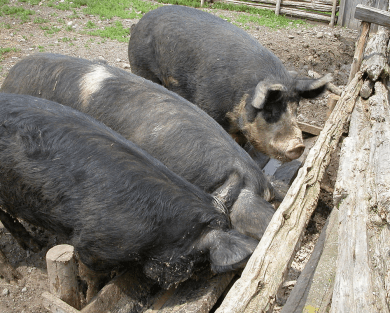
I’d call this a dog of a bill, but this is my dog, and she’s pretty darned cute.

For this bill, we really need a different animal altogether. Photo credit bmani/Creative Commons.


We have seen the future, and it looks suspiciously like the past.

I’m referring, of course, to the much-anticipated legislation Dominion Energy Virginia’s friends are peddling in the Virginia legislature to replace the infamous rate rip-off of 2015 with a brand new way for utilities to skip regulatory oversight and avoid giving refunds.

Personally, I have to hand it to Dominion on this one. Its lobbyists spent the fall trying to convince legislators not to reverse the brilliantly—though falsely—named “rate freeze.” Dominion hoped legislators would ignore estimates that the utility would keep northwards of a billion dollars in unearned profit from it, not to mention the barrage of newspaper articles connecting Dominion’s campaign contributions to the votes of legislators in support of the law. Apparently, a lot of legislators made it clear they were done being snookered, because by December, Dominion had publicly announced that it, too, believed it was time to change the law.

So Dominion had a PR disaster on its hands, and what did it do? Offer massive refunds and a return to regulatory oversight? Heck, no. The new bill allows Dominion to avoid regulatory oversight pretty much forever, while rebating just a fraction of the loot. Awesome head fake, guys!

Mind you, there are a lot of great buzzwords in the bill. If you didn’t know any better—if you happen to be one of this year’s snookerees, as the rank-and-file legislators are meant to be—you might think this bill is intended to transform the grid and add massive amounts of solar energy and energy efficiency. It could have been written to do that, but it wasn’t.

For a fuller explanation of this legislation and how it fits into the long pattern of Virginia legislators giving away the store to Dominion, see this terrific analysis from Dan Casey of the Roanoke Times. As he demonstrates, this is not legislation aimed at transforming the business of energy in Virginia. It’s aimed at ensuring Dominion gains unfettered control.

If legislative leaders are serious about transforming our energy economy, they could amend the bill now to give the State Corporation Commission back its role in protecting consumers from unwise spending and by ordering refunds and rate reductions when utilities collect more than permitted by law. The current draft of the bill throws a small fraction of past overearnings back to customers, ignores 2017 overearnings altogether, and allows utilities to game the system so rates can only go up hereafter.

Grid transformation is indeed important—so important that it shouldn’t be left to profit-seeking utilities to decide what grid investments are in the public interest. This issue needs an independent study with in-depth analysis and extensive public input– the sensible approach that has been taken by numerous states across the country. Letting Dominion decide what investments to make guarantees we’ll see only the ones that allow Dominion to tighten its control over Virginia’s power supply.

The bill also tries to buy off environmentalists with a promise of up to 4,000 MW of solar by 2028, a figure that was already in play (and appears in other bills this year) as a result of negotiations between utilities and the solar industry. To put that in context, recall that The Solar Foundation analysis showed Virginia needs 15,000 MW of solar to equal just 10% of our electricity supply. Do the math: 4,000 MW is well under 5% under the best of circumstances. When a bunch of other states are getting 20% of their electricity from wind and solar resources today, the promise of less than 5% over ten years is not only grossly inadequate, it’s insulting. Perhaps we environmentalists can be bought, but not that cheaply.

But will legislators wise up in time? Senate Minority Leader Dick Saslaw’s version of the legislation (there are several), SB 967, runs for 22 pages of mind-numbing detail that can’t be fully understood by anyone but a lawyer specializing in electric utility regulation. I’m not one, and I’m grateful for the help of people who are. Saslaw’s bill was introduced Friday—the last possible day to file legislation—and did not appear online until Tuesday. The Senate legislation may come before the Commerce and Labor committee as soon as Monday, and House versions may be in subcommittee on Tuesday.

Not everyone is being snookered, to be sure. Senator Chap Petersen has renewed his earlier effort for a more straightforward repeal of the “rate freeze,” and a bipartisan group of 11 senators have fired off a letter to the SCC asking for a report on what effect the various bills will have “on refunds owed to rate payers for past payments” and “the effects on future rates.” Six House members have done the same.

Finally, this afternoon Governor Northam weighed in, saying he has “significant concerns about the bill that is on the table.” An email from the Governor’s office laid out goals that echo what critics have been saying. First, more money should be refunded to ratepayers. Grid modernization should be defined, the focus on clean energy increased, and the SCC should be involved to make sure Virginians “are getting the best bang for the buck.” And perhaps most critically, the legislation should “restore the SCC’s authority to ensure that Virginia families and businesses do not pay more for power than they should under state law.”

Perhaps having the Governor weigh in will put a stop to the plan to turn electric utility regulation over to the monopolies themselves. Associated Press reporter Alan Suderman quotes Dominion spokesman David Botkins as saying by way of response that the legislation is a “work in progress.”

But why is this up for negotiation? Legislators should insist on a return to regular order, put an independent agency in charge of grid transformation, and set mandatory targets for decarbonizing our electricity supply. It’s time for the snookering to stop.

Unknown's avatar

Virginia legislators face a flood of new solar bills

Photo courtesy of Department of Energy, via Wikimedia Commons.

It’s true that Republicans remain in control of the General Assembly, and the way things run in Richmond, having only the narrowest of margins diminishes the majority’s power remarkably little. Yet the Blue Wave swept in a set of younger, more diverse, and more progressive delegates, many of whom are as interested in reforming energy policy as they are in social and economic issues.

As a result, I count more than 50 bills dealing with solar, energy efficiency, electric vehicles and battery storage; several more that affect clean energy by addressing carbon emissions; and still others that deal with utility regulation in ways that have implications for renewables and storage. And bills are still being filed.

In this post, I cover just the renewable energy bills of general interest filed to date, saving energy efficiency, storage, EVs and climate for later.

Most of these bills cover renewable energy generally. Bills submitted by the Rubin Group (the private negotiating group consisting mostly of utilities and solar industry members) are limited to solar.

One bill this year takes a new run at a mandatory renewable portfolio standard (RPS). This is Delegate Sullivan’s HB 436, which narrows the kind of resources eligible for the program (now mostly wind, solar and hydro) as well as making it mandatory. As currently drafted it is so ambitious that it would likely mean utilities would have to buy a lot of Renewable Energy Certificates from out of state to meet the early year targets, but changes to the bill may be in the works.

Delegate Sullivan has also proposed HB 54, which would provide a state tax credit of 35% of the cost of installing certain kinds of renewable energy property, up to a maximum credit of $15,000.

Several bills enable community solar programs, to provide options beyond the utility-controlled program passed last year that more closely resembles a green tariff. SB 313 (Edwards) SB 311 (Edwards) offer two different customer-controlled models. SB 586 (Gooditis) would authorize, but not require, utilities to set up utility-controlled programs; it differs from last year’s bill in that customers would have a direct connection with a specific renewable energy project. Since it would not be limited to solar, it could open a new option for community wind.

The Rubin Group drafted three pieces of legislation. The centerpiece bill, SB 284 (Saslaw) and HB 1215 (Hugo) raises from 500 megawatts (MW) to 4,000 MW (by 2024) the amount of large-scale solar utilities can build or buy that is deemed to be “in the public interest,” a designation that takes this determination away from the State Corporation Commission. The bill also makes it in the public interest for utilities to own or buy up to 500 MW of small-scale solar projects (under 1 MW each). These will be distributed projects, but utility-controlled, along the lines of Dominion’s not-very-successful Solar Partnership Program.

SB 284 and HB 1215 don’t actually require the utilities to do anything, but the legislation is widely seen as signaling their intent to move forward with additional solar development. While a very welcome signal, legislators should keep in mind that a Solar Foundation analysis earlier this year noted it would take as much as 15,000 MW of solar to provide just 10% of Virginia’s electricity supply.

Recognizing this reality, Delegate Mark Keam has introduced HB 392, which declares it in the public interest for the Commonwealth to get 10% of its electricity from solar, and raises to 15,000 MW the amount of utility solar in the public interest.

The two other Rubin Group bills deal with land use, putting language into the code giving people the right to put up solar panels on their own property for their own use, except where local ordinances specifically prohibit it, and subject to setback requirements, historic districts, etc. The bills are SB 429 (Stanley), its companion bill HB 508 (Hodges), SB 179 (Stanley) and companion bill HB 509 (Hodges).

The Rubin Group tried and failed to negotiate changes to Virginia’s net metering program, which affects most customer-sited solar projects, including residential rooftop solar. This is hardly a surprise; a group that works on consensus gives every member veto power. With utilities hostile to any perceived incursion on their monopoly power, and solar advocates pledged to protect the rights of residents, there aren’t a whole lot of opportunities for consensus here.

With the Rubin Group out of the net metering space, legislative champions have stepped into the vacuum to propose a host of bills that would support customers who install solar for their own use:

  • HB 393 (Keam) removes the 1% cap on net metered projects, and provides that when net metered projects reach 1% of a utility’s electric load, the SCC will conduct a study of the impact of net metering and make recommendations to the General Assembly about the future of the program. HB 1060 (Tran) simply removes the cap.
  • SB 191 (Favola) provides that Virginia customers who wish to self-generate electricity with renewable energy using the net metering provisions of the Code may install up to 125% of their previous 12 months’ electric demand, or in the case of new construction, of the electric demand of similar buildings. A 2015 law currently limits customers to 100% of previous demand.
  • HB 421 (Sullivan) allows owners of multifamily residential buildings to install renewable energy facilities and sell the output to occupants. This bill does not provide for the electricity to be net metered.
  • HB 930 (Lopez) requires the SCC to establish a net metering program for multifamily customer-generators, such as condominiums, apartment buildings, and homeowner associations.
  • HB 978 (Guzman) requires utilities to justify standby charges with a value of solar study. As currently written, the bill does not appear to have retroactive effect, so it might not repeal the existing, much-hated standby charges already approved by the SCC.
  • SB 82 (Edwards) expands the agricultural net metering program, increasing the project size limit from 500 kW to 1 MW, providing that the electricity can be attributed to meters on multiple parcels of land, and repealing the 2017 law ending agricultural net metering in coop territory.

Finally, several bills once again tackle third-party power purchase agreements (PPAs), which the Virginia Code appears to make legal, but which utilities have consistently maintained are a violation of their monopoly on the sale of electricity. HB 1155 (Simon) reaffirms the legality of PPAs. SB 83 (Edwards) replaces the existing PPA pilot program that dates from 2013 and directs the SCC to establish a broader program.

HB 1252 (Kilgore) replaces the existing pilot, which has different rules for Dominion and APCo, with a new program renamed “net metering power purchase agreements” that would be consistent for both utilities. It would open up APCo territory more than at present, by allowing any tax-exempt entity to participate rather than just the private colleges and universities that won inclusion last year. However, as currently drafted, it would narrow the program as it exists in Dominion territory by eliminating the eligibility of for-profit customers. Although it is the least customer-friendly option among the PPA bills, Kilgore’s position as chairman of House Commerce and Labor, which will hear the bill, gives it the strongest chance of passage.

Note that most of the renewable energy bills (other than those dealing with tax credits and land use) will go to the Commerce and Labor committees. In the House, a subcommittee usually meets once to hear all the bills (and typically to kill all but the ones anointed by chairman Terry Kilgore). While the schedule is not set, in the past the subcommittee meeting has been held in early February.


Important dates:

First Day of Session: Wednesday, January 10

Bill filing Deadline: Friday, January 19

Crossover (last day on which bills passed in one chamber can go to be heard in the other): Wednesday, February 14

Sine Die (end of Session): Saturday, March 10 

How to research a bill:

I’ve hot-linked the bills discussed here, but you can also find them all online pretty easily. On the home page of the General Assembly website, you will see options at the lower right that direct you to the Legislative Information Service, or LIS. If you know the number of a bill, you can type it into the first box (omitting spaces), and click “GO.” This will take you to a page with information about the bill, including a summary of the bill, the bill’s sponsor (called a “patron” in Virginia), the committee it has been assigned to, and its current status. Follow links to learn more about the committee, such as who is on it and when it meets. You will also see a link to the full text of a bill as a PDF.

Always read the full text of a bill rather than simply relying on the summary. Summaries sometimes contain errors or omit critical details, and bills can get amended in ways that make them very different from what the summary says. For the same reason, make sure you click on the latest version of the bill’s text.

If you don’t know a bill number, the General Assembly home page also lets you search “2018 Regular Session Tracking.” When you hit “GO,” this button brings you to a page with options for finding a bill, including by the name of the legislator (“member”), the committee hearing it, or the subject.

When you click on the name of a committee, you will see the list of bills referred to that committee, with short descriptions. It also tells you who is on the committee, when the committee meets and where. You can click on “Agendas” to see which bills are scheduled to be heard at the next committee meeting. Unfortunately the agendas are not set until a day or two before the meeting.


Unknown's avatar

Northern Virginia governments look at major renewable energy energy purchase

If the Northern Virginia Regional Commission has its way, local jurisdictions will buy power from a solar or wind farm in the near future. Photo credit Christoffer Reimer.

The Northern Virginia Regional Commission has selected a consultant to assist area localities in a joint procurement of renewable energy. Participating cities and counties will be able to aggregate their demand to get the kind of economies of scale that have allowed corporations like Amazon and Facebook to lower their energy cost by investing in large solar and wind farms.

On November 17, NVRC announced that Customer First Renewables, a national expert in matching large energy users with renewable energy projects, will serve as its technical advisor. Customer First Renewables and NVRC plan to issue a Request for Proposals (RFP) to identify one or more “shovel-ready,” large scale projects to present to NVRC’s thirteen member governments. Those local governments will individually decide whether to participate in the group purchase.

According to a Request for Qualifications that NVRC issued in its search for a consultant, the project(s) to be selected must be greater than 10 megawatts in size and result in new renewable energy capacity added to the grid. Preference will go to projects located in Virginia or in the regional grid that serves Virginia, known as PJM.

NVRC will act as a central contact and facilitator, but it will be up to the participating localities to negotiate a contract. NVRC Director Robert Lazaro said discussions with representatives of area localities indicate the interest is there for a major renewable energy buy like this. Arlington, Alexandria, Manassas Park, and Falls Church are among the jurisdictions most interested, with others possibly joining as they learn more.

“We see this as a way to green the grid, save money, and assist the solar industry in Virginia,” said Lazaro.

Niels Crone, Senior Vice President for Business Development at Customer First Renewables, said his company was excited to be involved in the procurement effort. “We are delighted to work with NVRC to help Northern Virginia jurisdictions get affordable, large-scale renewable energy,” he said.

NVRC is following an ambitious timeline. A project workshop for local government staff is scheduled for December 11, and a Request for Proposals (RFP) is due January 2, 2018.

How does a group purchase work?

Amazon and other large corporations have become major drivers of new wind and solar projects in PJM, including several large solar farms in Virginia. The steadily-tumbling costs of wind and solar make it possible for the companies to green their energy supply while lowering their overall energy costs using innovative financing approaches. Not all of these would work in Virginia, but one that does is the wholesale, or “virtual” power purchase agreement.

A virtual PPA allows a customer to buy and sell energy in the wholesale market, avoiding potential obstacles such as a utility’s monopoly on the retail sale of electricity.

Local governments in Virginia buy electricity from Dominion Energy Virginia at retail under a contract negotiated by the Virginia Energy Purchasing Governmental Association (VEPGA). That contract makes Dominion their only electricity supplier, and Dominion currently does not offer wind or solar as an option. A virtual PPA would not change this relationship; Dominion will continue to supply localities with electricity from its (decidedly un-green) power plants.

A virtual PPA would, however, let participating localities contract for the output of a renewable energy project, with the electricity sold into the wholesale market rather than delivered to the localities. Given the right project, the price for the electricity in the wholesale market could exceed the price paid to the project owner under the PPA, allowing the localities to pocket the difference—indirectly lowering their energy costs. The localities would also receive an additional benefit in the form of renewable energy certificates generated by the projects, demonstrating they have legally “greened” their energy supply.

There is some financial risk involved, since the PPA price is fixed, while wholesale prices fluctuate. Part of Customer First Renewables’ job will be to find the best project economics with the least risk. Corporate buyers, universities and large institutions around the country have used this approach successfully to lower their energy costs and meet their sustainability goals.

As members of the Metropolitan Washington Council of Governments (MWCOG), Northern Virginia localities are committed to reducing greenhouse gas emissions to 80 percent below 2005 levels by 2050, with an interim goal of 20 percent by 2020. MWCOG’s 2017-2020 Regional Climate and Energy Action Plan (available here) also sets a target of meeting 20 percent of the region’s electric consumption from renewable sources by 2020.

As the report notes, however, “There needs to be an immense undertaking to meet the 2020 and 2050 goals.” Here’s hoping Northern Virginia is ready to do its share.

Unknown's avatar

A 5-year plan for economic growth: 10% solar and 50,000 new jobs

Source: The Solar Foundation

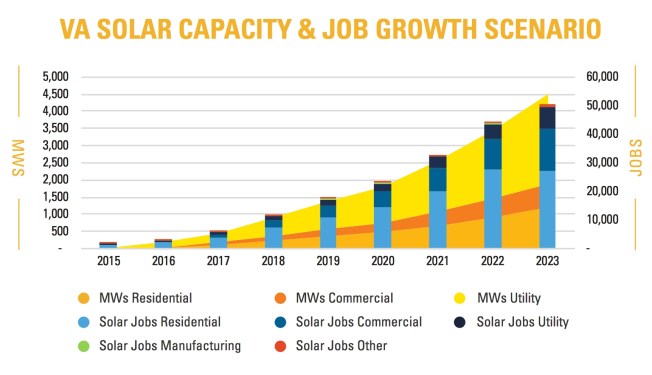
A new analysis from the non-profit Solar Foundation shows Virginia could create 50,400 jobs if it commits to building enough solar energy in the next five years to provide just 10% of our electricity supply.

The analysis takes the form of an “infographic” showing the implications of 10% solar. It would require building 15,000 megawatts of solar, divided among utility-scale solar farms, commercial installations, and the rooftops of houses. At the end of 2016, Virginia had a total of only 241 MW of solar installed, representing one-tenth of 1 percent of total electricity consumption. Getting to 10% by the end of 2023 would mean an annual growth rate of 61 percent. That would be impressive growth, but well below the 87 percent growth rate averaged by California and North Carolina over the past 6 years.

So 10% in five years should be doable. And indeed, viewed against the need to dramatically lower our carbon footprint, it seems like a very small step indeed. The McAuliffe administration wants to significantly cut statewide carbon emissions, and it is hard to see how we can do that without replacing the dirtiest fossil fuels with solar (and wind, and energy efficiency).

The good news is that the market is in our favor. Dominion Energy’s 2017 Integrated Resource Plan (IRP) identified utility-scale solar as the least-cost energy resource available in Virginia today. And participants in local cooperative buying programs for homeowners and businesses, known as “Solarize” programs, report payback times of under 10 years for rooftop solar, after which they will have nearly free electricity for 20 or 30 years.

Recent solar deals involving Amazon, Microsoft, and now Facebook show just how strong the demand is from customers. The very companies that our political leaders want so desperately to attract to Virginia are insisting on renewable electricity.

These deals demonstrate the direction of the market, and they will give an initial boost to solar employment, especially in the rural communities that are the best locations for solar farms. But restricting solar to a handful of new companies just coming into Virginia won’t get us to 15,000 MW and 10% solar. It’s also fundamentally unfair to the rest of us who are stuck with a dirty grid. Why should existing customers get left with polluting sources, while big tech companies get solar?

For us, Dominion’s IRP caps its solar plans at 240 MW per year, an amount it admits is arbitrary. In other words, Amazon got 260 MW, Facebook is getting 130 MW, but all the rest of Dominion’s customers put together will get just 240 MW per year.

As for customers who are determined to take matters into their own hands with rooftop solar, a host of unnecessary restrictions continue to limit growth. Virginia needs to put policies in place to push utilities to do more, to support local governments and schools that want solar, and to remove the barriers that limit private investment.

Solar companies around the state say if we can do that, they will do their part by hiring more Virginians. Here’s what some of them had to say about the 10% solar goal, and how to achieve it:

“We believe, as Virginians, that we can solve our energy challenges. Ours is a Virginia company founded and based in Charlottesville, and we are committed to building Virginia-based energy production facilities that benefit all Virginians. But the fact is that over the past few years our growth has come from business in other states. We have 26 employees in Virginia now, and we could increase that dramatically if Virginia promotes solar through policy changes that incentivize business owners to invest, allows competition, and supports the environmental message.” –Paul Risberg, President of Altenergy, Charlottesville

“The economics have never been better for solar in Virginia than they are right now. Prospect Solar has grown from two employees in 2010 to 16 full time employees today. Roles such as electricians, skilled labor, engineers, project managers, and sales people are integral to the success of each project. We hope Virginia will commit to a rapid, sustained buildout of all sectors of the solar industry, allowing us to continue adding local jobs.” –Andrew Skinner, Project Manager at Prospect Solar, Sterling

“Nationwide, the solar market was a 23 billion dollar industry in 2016. One out of every 50 new jobs in America was created by the solar industry last year. Sigora has been part of that. We have doubled in size in the past year and now employ 80 people in the Commonwealth.” –Karla Loeb, Vice President of Policy and Development for Sigora Solar, Charlottesville

“Local energy, local jobs, local investment. Our workforce is made up of local people—three of us went to Virginia Tech, one went to New River Community College, which has an Alternative Energy Program. An increase in demand of this scale would mean we’d hire more local people.” –Patrick Feucht, Manager of Baseline Solar, Blacksburg

“Residential and commercial rooftop solar has created most of the solar jobs in Virginia to date, and it has to be a part of the push to 10 percent. As we know, rooftop solar creates more jobs than utility solar, and these are good-paying, local jobs for local people. That’s one reason Virginia should lift the outdated 1 percent cap on net-metered solar, and leave the market open to anyone who wants to invest in their own home-grown energy supply.” –Sue Kanz, President of Solar Services, Virginia Beach

“Ten percent solar is a modest goal to shoot for given the strong economics of solar and the demand we are seeing from customers. Virginia has been held back by restrictive policies that have made it a ‘dark state.’ Reforming our policies would lead to a lot more economic development around solar.” –Tony Smith, President of Secure Futures LLC, Staunton


Unknown's avatar

Hearing examiner rules Appalachian Power’s renewable energy tariff isn’t good enough

Appalachian Power’s plan to repackage power from existing renewable energy projects in its portfolio into a new, higher-priced green option hit a bump this week when a hearing examiner for the Virginia State Corporation Commission recommended rejection of the tariff, saying it wasn’t a good deal for consumers.

Approval of the tariff would have allowed APCo to block competition from other renewable energy suppliers. Virginia law provides that if a customer’s own utility doesn’t offer a tariff for 100% renewable energy, the customer has the right to buy from any other provider.

APCo had argued its tariff met the letter of the law, and that should be the end of the SCC’s inquiry. Since it was a voluntary tariff, customers could take it or leave it. Hearing Examiner A. Ann Berkobile disagreed. Because approval of the tariff would adversely affect competition and restrict the rights of customers, she found, the tariff could only be approved if APCo proved it was “in the public interest and its rate is just, reasonable and unlikely to prejudice customers.”

In this case, she concluded, APCo failed to do so, having “made no effort to establish the reasonableness of its proposed Rider REO rate.”

She went on: “Stated somewhat differently, Rider REO has the potential to suppress or even curtail customer access to 100 percent renewable energy by precluding sales by [Competitive Service Providers] while at the same time offering an incumbent utility alternative that is simply too costly for customers to bear. The overall price of Rider REO (and associated rate) should, therefore, be considered when deciding whether to grant approval.”

Testimony in the case had established that the existing wind farms APCo proposed to use were providing power at a higher price than could be obtained from new sources, which the Hearing Examiner suggested made the proposed tariff rate unreasonable. In addition, using old sources rather than new ones would not “promote the development of renewable energy in accordance with the objectives of the Commonwealth Energy Policy set forth in §§ 67-101 and 67-102 of the Code.”

The Hearing Examiner’s report is only a recommendation to the SCC, which will have the final say. The case is PUE-2016-00051.

Ruling could affect Dominion tariff

If the SCC adopts the Hearing Examiner’s recommendation, that could also affect the SCC’s evaluation of Dominion’s proposed 100% renewable commercial tariff. Dominion’s tariff will likely use biomass as a source because of Dominion’s insistence that a 100% renewable product must use sources that together produce renewable energy 100% of the time. But while Virginia’s overbroad definition of renewable energy includes “biomass, sustainable or otherwise,” biomass often doesn’t satisfy corporate sustainability goals. As the Hearing Examiner’s opinion suggests, it’s not enough for a tariff to meet the requirement of providing 100% renewable energy if it isn’t also good enough to attract customers.

The Hearing Examiner’s emphasis on the cost to consumers is also a relevant consideration. If the SCC affirms the APCo decision, Dominion would have to justify using higher-cost biomass over much cheaper wind and solar.


Update: On September 13, 2017, the SCC rejected APCo’s proposed tariff, focusing especially on its high cost.

Unknown's avatar

Moving to block competition, Dominion files its own sort-of-green energy tariff

Just a couple of the great things that count as “renewable energy” in the Virginia Code.

Dominion Virginia Power has filed for permission from the State Corporation Commission (SCC) to offer a 100% renewable energy tariff to commercial and industrial customers with peak loads of over 1,000 kilowatts. In a footnote, Dominion states that it intends to propose a similar tariff for residential customers in the future. The case is PUR-2017-0060.

Customers who want only carbon-free energy like wind and solar will likely be disappointed. Dominion intends to use a “portfolio of resources” that will include “dispatchable resources”—i.e., hydropower and stuff that can be burned. Dominion promises the sources it uses will meet Virginia’s definition of renewable. That’s not reassuring. Under Virginia law, renewable energy can include sources like landfill gas and municipal solid waste, as well as “biomass, sustainable or otherwise (the definitions of which shall be liberally construed).”

Dominion’s filing comes scarcely one month after an SCC decision confirmed the right of independent renewable energy provider Direct Energy to offer its products to Dominion customers, but only so long as Dominion lacks its own green tariff for those customers. The SCC order (explained here) made clear that under Virginia law, a competitor like Direct Energy would be blocked from taking on new customers once Dominion has an approved tariff.

Dominion’s filing looks suspiciously like an effort to cut Direct Energy off at the knees. If the upstart competitor follows through with its plans to offer Virginia residents a renewable energy option, Dominion will surely propose a residential renewable energy tariff. SCC approval of Dominion’s tariff would shut out Direct Energy, which is targeting only residential consumers for its product. Under the language of the Code, it does not appear to matter whether a competitor can offer a better product, or a better price.

For the moment, Direct Energy is not backing down. The company has set up a web page to gauge the interest of residential consumers while it deliberates its next move. Ron Cerniglia, Director of Corporate and Regulatory Affairs for the Mid-Atlantic Region, told me he thinks the timing of Dominion’s filing is “curious,” given that “Dominion has had ten years to file a renewable energy tariff and hasn’t. We’re concerned about the implications of limiting choice for consumers. We don’t know if the move will actually offer a choice consumers want, or if it is just closing doors on others.”

Indeed, ten years have passed since Virginia enacted its current utility law, which includes the right of a customer to “purchase electric energy provided 100 percent from renewable energy” from another supplier if its own utility isn’t offering it. During most of that time, Dominion has sold Renewable Energy Certificates to customers under its “Green Power Program,” but it has never offered residential customers an opportunity to buy actual renewable energy. (See “Is a Green Power program worth your money?”)

This is slated to change as the utility works with the solar industry on implementing a new solar option under legislation passed this year. However, the new law specifies that the solar option will not count as a tariff for “electric energy provided 100 percent from renewable energy,” so it does not block competitive offerings like Direct Energy’s.

Dominion was agreeable to excluding the solar program because it interprets the Code’s reference to “electric energy provided 100% from renewable electricity” to mean the electricity must come from renewables 100% of the time, an interpretation almost no one else shares.

This seems to be the reason Dominion intends to include carbon-emitting sources into its renewable energy offering, even though it’s safe to say there are no customers clamoring to get their electricity from garbage or the clear-cutting of forests. It also means the new tariff will likely be priced higher than one that included only solar, because electricity from biomass is more expensive today than harvesting the sun. (No word from Dominion on why it doesn’t just assign a portion of its pumped storage capacity to serve an all-wind-and-solar product.)

But if customers want only wind and solar, they are also likely to be disappointed in Direct Energy’s product. Cerniglia says his company includes baseload sources like “cleaner biomass” in its renewable energy product to provide 24/7 power. He estimated that the initial mixture would consist of “50% to 60% municipal waste biomass (Pennsylvania and Virginia sourced) and 40% to 50% wind (Pennsylvania sourced) . . . We are also committing to not utilize virgin wood / clear cut wood biomass in our product mix at any time.”

Direct Energy also has not determined the pricing of its product yet, but Cerniglia said it would be “equal to or lower than what Dominion Virginia Power residential customers pay for ‘brown’ power.”

Perhaps most importantly, he noted, “The benefit of a competitive market is that customers can leave us at any time. They’re not captive.”


Update: On June 21, a Hearing Examiner for the SCC recommended rejection of a similar application for a renewable energy tariff filed last year by Appalachian Power. See my discussion here for how this may affect Dominion’s application. 

Unknown's avatar

Dominion Power promises huge solar investments and a lower carbon footprint—or does it?

Dominion Virginia Power says energy from solar farms is now a low-cost option. Photo credit Kanadaurlauber.

Dominion Virginia Power released its updated Integrated Resource Plan (IRP) this week with a press release that promised thousands of megawatts (MW) of new solar power and a dramatically lower carbon footprint. In a remarkable turnabout, the Executive Summary declares, “The Company must now prepare for a future in which solar PV generation can become a major contributor to the Company’s overall energy mix.”

Alas, a closer look reveals Dominion will actually increase its carbon emissions over the period studied. Meanwhile, the solar would be built at a rate of only 240 MW per year over the 15-year period covered by the IRP, about the same amount being installed in Virginia this year. (Over 25 years, Dominion says its solar could reach 5,200 MW, which means the pace of installation would actually drop in the out years.) That should elicit yawns, not excitement.

The solar numbers pale in comparison to the more than 4,600 MW of new natural gas combined-cycle plants Dominion has been building just in this decade. (Remember that solar farms generate electricity at about 20-25% of “nameplate” capacity on average, while combined-cycle gas plants nationally average 50-60%, and can achieve 70% or higher.*) And even come 2032, the new solar will make up only a tiny fraction of a generation portfolio that consists almost entirely of coal, gas and nuclear.

I’ll be interested to see the numbers analyzed, but my guess is that all the renewable energy Dominion proposes to build over the next 15 years represents no more than 5-10% of its total electric generation. That’s too little, too late, in a state that can do so much better.

So the more things change, the more Dominion stays the same. Behind the hype being offered to the press stands a utility that is still committed to fossil fuels and nuclear power.

Virginia utilities file IRPs with the State Corporation Commission (SCC) every year. The plans are supposed to reflect the utilities’ best sense of how they will meet consumers’ needs for electricity while complying with state and federal laws and policies. This involves some guesswork about the direction of future regulations, including regulations of CO2 emissions.

In spite of President Trump’s determination to roll back climate protections while he is in office, Dominion’s IRP assumes an eventual price on carbon. Most utilities nationwide are doing the same thing. But given the uncertainties, Dominion has chosen (as it did last year) to model different scenarios instead of committing to a single plan.

Even the low-cost plan that wouldn’t comply with the EPA Clean Power Plan contains just as much solar as the other plans, reflecting the company’s assessment (on page 3) that solar is now “cost-competitive with other more traditional forms of generation, such as combined-cycle natural gas.”

Yet the carbon reductions Dominion promises in its press release appear to be something of a sleight-of-hand. For one thing, Dominion has chosen to compare its CO2 output in 2032 to its output in 2007, not 2017. CO2 emissions were markedly higher in 2007 than now, with the shale gas boom and the rise of renewables leading to massive coal retirements in the interim.

Moreover, a careful reading of the press release reveals the reductions Dominion promises are per-capita, not overall. A chart on page 115 of Dominion’s IRP shows every one of the scenarios Dominion studied will actually increase the company’s total CO2 emissions between now and 2042.

That reality exasperates climate activists. Glen Besa, former Director of the Virginia Chapter of the Sierra Club, comments, “The only impression you could have reading Dominion’s release was that it was making dramatic reductions in carbon pollution, which obviously is not the case.”

CO2 emissions would not increase if Dominion were simply shutting down coal and building more solar. But all of the alternative scenarios Dominion models for its IRP contain more gas plants: at least another 1,374 MW of gas combustion turbines in all plans, and 1,591 MW of combined cycle gas in some scenarios. Combustion turbines are more flexible than combined-cycle plants and so are better for meeting spikes in demand and integrating renewable energy like solar, but while they run less often, they are typically higher-polluting. Many utilities are using demand response or installing battery storage instead; Dominion appears to prefer gas.

All this gas means higher CO2 output. Not incidentally, burning more gas also means more business for Dominion’s parent corporation, Dominion Resources (soon to be known as Dominion Energy), which is heavily invested in gas transmission. And crucially, Dominion Energy needs more gas power plants to justify building the Atlantic Coast Pipeline. So building more gas plants serves the interests of Dominion’s affiliates, not its customers.

The problem with building new gas plants is that it lowers carbon only so far compared to coal, and then you’re stuck at that level for the life of the gas plants, unless you’re willing to abandon them early. That’s why any utility that’s serious about protecting ratepayers from stranded costs has to invest in wind, solar, energy efficiency and storage, not natural gas.

Speaking of wind, the IRP includes the 12 MW pilot project known as VOWTAP in all of the plans, even though Dominion lost millions of dollars in federal funding when it would not commit to building the two test turbines by 2020, three years past the original deadline. But none of the scenarios studied include any land-based wind, and none include a build-out of the federal offshore wind energy area Dominion bought the rights to, which could support at least 2,000 MW of offshore wind power. This is a strange omission given that Dominion continues to include a scenario in which it would build the world’s most expensive nuclear reactor, known as North Anna 3.

Polls consistently show overwhelming public support for renewable energy. Yet right now, ordinary Virginia ratepayers have no access to renewable energy unless they put solar on their own rooftop. Corporations like Amazon Web Services and Microsoft account for the bulk of the solar energy being installed in Virginia, with most of the remaining going to the military, state government, universities, and schools.

So 3,200 MW over 15 years won’t even begin to satisfy consumer demand. North Carolina installed almost 1,000 MW last year; I’d like to see Dominion set that as an annual target, bringing it up to the 15,000 MW over 15 years it modeled for last year’s IRP (before hiding the encouraging results from pubic view). Round out the solar with other cost-effective clean energy options, and we will see the kind of carbon reductions that don’t have to be fudged in a press release.


*On page 88 of the IRP, Dominion provides it own capacity factor forecasts: solar 25%, combined cycle gas 70%, gas combustion turbines 10%, nuclear 96%, onshore wind 42%, offshore wind 42%. The chart does not include a number for coal.

Unknown's avatar

Virginia legislative session wraps up with action on solar, coal ash, and pumped storage

Next year I'm bringing him to lobby with me. Photo credit: Sierra Club

Next year I’m bringing him to lobby with me. Photo credit: Sierra Club

The Virginia General Assembly wraps up its 2017 session on Saturday, February 25. As usual, the results are a mixed bag for energy. On the plus side is the promise of a new solar purchase option for customers. On the downside, utility opposition to energy efficiency and distributed generation meant a lot of worthwhile initiatives never made it out of subcommittee.

Putting it into perspective, it could have been worse. For clean energy advocates in Virginia, that’s what we call a success!

Governor Terry McAuliffe has already acted on some of the bills that passed and will have until March 27 to act on the remaining bills. Under Virginia law, the governor can sign, veto, or amend the bills for legislators’ consideration.

“Rubin Group” bills move renewable energy forward—and back.

Negotiations between utilities, the solar industry trade association MDV-SEIA, and the group Powered by Facts produced three pieces of legislation that appear likely to become law (and all of which I’ve discussed previously). The most significant of these “Rubin Group” bills (named for facilitator Mark Rubin) is SB 1393 (Wagner), the so-called “community solar” bill, which is designed to launch a utility-controlled and administered solar option for customers. The utilities will contract for the output of solar facilities to be built in Virginia and will sell the electricity to subscribers under programs to be approved by the State Corporation Commission. Critical details such as the price of the offering will be determined during a proceeding before the State Corporation Commission.

This was the only one of the Rubin Group bills that had participation from members of the environmental community (Southern Environmental Law Center and Virginia League of Conservation Voters), and it received widespread (though not unanimous) support from advocates.

Broader legislation that would have enabled true community solar programs did not move forward. SB 1208 (Wexton) and HB 2112 (Keam and Villanueva), modeled on programs in other states, had the backing of the Distributed Solar Collaborative, a stakeholder group composed of everyone but utilities. In the Senate, Wexton’s bill was “rolled into” Wagner’s bill, but only her name, not the provisions of her bill, carried over.

SB 1395 (Wagner), a second Rubin Group bill, increases from 100 MW to 150 MW the size of solar or wind projects eligible to use the state’s Permit by Rule process, which is overseen by the Department of Environmental Quality. The legislation also allows utilities to use the PBR process for their projects instead of seeking a permit from the SCC, if the projects are not being built to serve their regulated ratepayers.

The third Rubin Group bill establishes a buy-all, sell-all program for agricultural generators of renewable energy. Although supported by MDV-SEIA as part of the package deal, passage of SB 1394 (Wagner) and HB 2303 (Minchew) should be considered a loss for solar. The program replaces existing agricultural net metering rules for members of rural cooperatives and could lead these coops to reach their 1% net metering cap prematurely, blocking other customers from being able to use net metering. And while negotiators say the program should be economically beneficial to participants, it appears to offer generators no options they don’t already have under existing federal PURPA law.

The governor has until March 27 to act on these bills.

Appalachian Power PPAs for private colleges only

Under HB 2390 (Kilgore), the existing pilot program that allows some third-party power purchase agreements (PPAs) in Dominion Power territory will be extended to Appalachian Power territory, but only for the private colleges and universities who could afford to hire a lobbyist to negotiate the special favor, and only up to a 7 MW program cap. APCo is expected to use passage of the bill to assert that PPAs for all other customers are now illegal. The governor has not indicated whether he will sign the bill.

Intellectual property

SB 1226 (Edwards, D-Roanoke) allows solar developers to keep confidential certain proprietary information that would otherwise be subject to disclosure under the state’s Freedom of Information Act (FOIA). It resolves a problem that has held up a solar project on the Berglund Center, a public building in Roanoke.

Storage, pumped or otherwise

HB 1760 (Kilgore) and SB 1418 (Chafin) allow Dominion Power to seek rate recovery for a scheme to use abandoned coal mines for pumped storage facilities. If you think this sounds weird and possibly dangerous, you are not alone. Usually the idea is to keep water out of coal mines to avoid the leaching of toxic chemicals into groundwater. Apparently no one has ever used coal mines for pumped storage before, and neither the company that would construct the project, nor the sites under consideration, nor the technology to be used, have been revealed.

SB 1258 (Ebbin) adds storage to the mandate of the Virginia Solar Energy Development Authority.

Dominion’s nuclear costs, and the politics of the “rate freeze”

HB 2291 (Kilgore) allows Dominion to charge ratepayers for the costs of upgrading its nuclear facilities. Because the charges will appear as a rider on top of base rates, consumers would not be protected by the “rate freeze” Dominion pushed through in 2015’s SB 1349.

That 2015 legislation, of course, was supposedly designed to shield customers from the impact of the EPA’s Clean Power Plan, a ruse that has been since laid bare. Instead, it will allow Dominion to keep an estimated billion dollars of customers’ money it would otherwise have had to refund or forego. This year, with the CPP on death row under Trump, Senator Chap Petersen introduced SB 1095, which would repeal the rate freeze. His bill was promptly killed in committee, but continues to gain support everywhere outside the General Assembly. Governor McAuliffe belatedly announced his support for Petersen’s bill, but did not use his authority to resurrect it.

Petersen is encouraging the Governor to offer an amendment to Kilgore’s HB 2291 that would repeal the rate freeze, an option allowed by Virginia’s legislative procedure since both provisions affect the same provision of the Code.

Dominion, of course, says the CPP isn’t actually dead and buried just yet, and Republicans seem to fear its resurrection. HB 1974 (O’Quinn) requires the Department of Environmental Quality to submit any Clean Power Plan implementation plan to the General Assembly for approval, so they can stab it with their steely knives.  The governor is expected to veto the bill.

State’s failures on energy efficiency will now be tracked

SB 990 (Dance) requires the Department of Mines, Minerals and Energy to track and report on the state’s progress towards meeting its energy efficiency goals. Or in Virginia’s case, its lack of progress.

HB 1712 (Minchew) expands the provisions of state law that allow public entities to use energy performance-based contracting.

That’s it for energy efficiency legislation this year. Several good bills were offered but killed off in the House Energy Subcommittee, notably HB 1703 (Sullivan), which would have required electric utilities to meet efficiency goals, and HB 1636 (Sullivan again), which would have changed how the SCC evaluates energy efficiency programs. Delegate Sullivan, by the way, introduced a companion bill to SB 990, but his was killed in that same House subcommittee, all on the same day.

Coal ash legislation watered down but passes

SB1398 (Surovell) will require Dominion Power to monitor pollution and study options for the closure of its coal ash impoundments, including removal of the ash to secure, lined landfills. Unfortunately amendments in the House will allow Dominion to proceed with capping the waste in unlined pits while it completes the study. As one editorial put it, “Why not do it right the first time?” The editorial—along with a lot of people who have to live near the coal ash dumps—would like to see the governor offer amendments to the bill, but we’ve heard nothing from the governor’s office on that yet.

Republicans keep trying to throw taxpayer money down a rathole; Governor vetoes

Governor McAuliffe has already vetoed HB 2198 (Kilgore), which would reinstate the coal employment and production incentive tax credit and extend the allowance of the coalfield employment enhancement tax credit. SB 1470 (Chafin) is identical to HB 2198 and so likely faces a veto as well.

Unknown's avatar

While U.S. leaders were worrying about coal jobs, clean energy snatched the lead: even Virginia now has more people working in solar than coal.


va-electric-sector-jobs

Jobs in electric generation do not include fuel jobs, so for example, the coal jobs in the two charts have to be added together to get total employment. Wind and solar, of course, have no fuel costs. Charts come from DOE.

Jobs in electric generation do not include fuel jobs, so for example, the coal jobs in the two charts have to be added together to get total employment. Wind and solar, of course, don’t need employees to produce their “fuel.” Charts come from DOE.

A new report from the U.S. Department of Energy takes stock of energy employment in the U.S. and comes up with fresh evidence of the rapid transformation of our nation’s electricity supply: more people today work in the solar and wind industries than in natural gas extraction and coal mining.

According to the January 2017 U.S. Energy and Employment Report, 373,807 Americans now work in solar electric power generation, while 101,738 people work in wind. By comparison, a total of 362,118 people work in the natural gas sector, including both fuel supply and generating plants.

Total coal employment stands at 160,119. And while renewable power employment grew by double digits last year—25% for solar, 32% for wind—total job numbers actually declined across the fossil fuel sectors, where machines now do most of the work.

If generating electricity employs a lot of people, not generating it employs even more. The number of Americans working in energy efficiency rose to almost 2.2 million, an increase of 133,000 jobs over the year before.

Those are nationwide figures, but the report helpfully breaks down the numbers by state. For Virginia, 2016 was a watershed year. In spite of the fact that our solar industry is still in its infancy and we have no operating wind farms yet, more Virginians now work in renewable energy than in the state’s storied coal industry. A mere 2,647 Virginians continue to work in coal mining, compared to 4,338 in solar energy and 1,260 in wind.

Dwarfing all of these numbers is the statistic for employment in energy efficiency in Virginia: 75,552.

Unknown's avatar

McAuliffe’s bright new energy plan still has that rotten-egg smell

Students protesting the new state motto.

Students protesting the new state motto.

Earlier this week, Virginia Secretary of Commerce and Trade Todd Haymore published an op-ed in the Roanoke Times boasting of the Commonwealth’s achievements on energy. It was a sad reminder that Virginia has trouble moving beyond “all of the above,” a phrase that seems to have become the state motto. But then on Wednesday, the McAuliffe Administration released a cheerful new version of the Virginia Energy Plan that reads like an extended love poem to solar power.

Haymore’s column more accurately reflects this Administration’s approach to energy: a lot of fracked gas, tricked out with bright snippets of solar. But I much prefer the Energy Plan. The entire first third of it is given over to trumpeting Virginia’s progress on developing solar energy. Though the amount of solar installed to date is still tiny, Virginia solar has terrific momentum, and McAuliffe can rightly claim a share of the credit.

The Plan also touches briefly on onshore wind (thanks to a single project from Apex Clean Energy), offshore wind power (nothing to see here, folks, move along), and an array of modest-yet-promising energy efficiency initiatives.

But the Energy Plan has its darker moments, too. If McAuliffe is in love with solar, he is still married to fossil fuels. The Plan continues to promote fracked gas infrastructure like Dominion’s Atlantic Coast pipeline, and insists that flooding the Commonwealth with natural gas is the key to economic prosperity.

Natural gas sneaks into other parts of the Energy Plan as well. The section on alternative fuel vehicles shows a preference for natural gas-fueled vehicles over electric vehicles, bucking the nationwide trend toward EVs. It’s another discouraging indication of just how powerful utility giant Dominion Resources has become in Virginia. Though we think of it as an electric utility, Dominion is a much bigger player in the gas world. You can run an EV on solar, but a natural gas vehicle commits you to fracking.

Locking us into natural gas in all parts of our lives serves Dominion’s purposes very well. But for Virginia, it means considerable pain down the road. With the world finally committed to tackling global warming, our failure to cut carbon now will mean deeper cuts forced on us later.

The Energy Plan does contain a short discussion of the need to fight climate change, but it fails to acknowledge the tension between embracing gas and cutting carbon. The Plan assures us that “Regardless of the outcome of litigation involving the [EPA’s Clean Power Plan], the Governor will work to identify a path toward further reducing Virginia’s carbon emissions and shifting to greater utilization of clean energy to power the Commonwealth economy.” But no hints follow as to how McAuliffe expects to accomplish this while expanding the use of a carbon-emitting resource like natural gas.

We’ve already seen that McAuliffe is capable of holding two contradictory thoughts in his head at the same time. The Governor frequently asserts that climate change is an urgent problem, then in the same breath brags that he persuaded EPA to soften Virginia’s targets under the Clean Power Plan to make compliance easier. He repeats this claim in the Energy Plan, and seems to expect applause.

Knowledgeable observers say EPA softened some initial state targets and tightened others to make the final Clean Power Plan more legally defensible. Regardless, for a man who believes in climate change, McAuliffe’s boast is exasperating. It’s like announcing you pulled off a bank heist when the evidence points to an inside job. Well-wishers can only cringe.

McAuliffe has a little more than a year left in the single term Virginia allows its governors. Here’s hoping he uses it to commit the Commonwealth more firmly to the solar energy he so loves, along with the other essentials of the 21st century energy economy: wind power, battery storage, and energy efficiency. That should make it easier to break with natural gas. Sure, fracked gas looks cheap today, but cheap is not the stuff of legacies.


*On a purely tangential note, Haymore’s column isn’t helped by the editing habits of the Roanoke Times. Like many newspapers these days, the Roanoke Times seems to believe its readers can’t handle full paragraphs. It presents almost all of the Secretary’s short sentences as separate paragraphs, as though insisting that each one should be mulled over individually. The result puts me in mind of the slips of paper inside Chinese fortune cookies, if the fortunes had been written by guys working for energy companies. (That is not, frankly, something I would like to see.)