Unknown's avatar

Your 2016 guide to Virginia wind and solar policy

[NOTE: The 2017 Guide is now available. You can find it here.]

I could make short work of this year’s update by saying that not much has changed in the way of Virginia renewable energy policy in the past year. The General Assembly punted on almost all of the relevant bills that were presented this winter, and a subcommittee that was formed to review those bills has taken no action to date.

But if the policies haven’t changed, the landscape has. While our legislators sat on their hands, everyone else embarked on what, for Virginia, amounts to a solar binge. Dominion Virginia Power began making good on a pledge to install 400 megawatts (MW) of solar in state by the end of the decade. The Governor has taken the first steps to fulfill a pledge to have state agencies meet 8% of their electric demand with solar. Large corporations suddenly want to take advantage of low solar prices and favorable tax policies to do deals in Virginia. Residents are flocking to bulk purchasing cooperatives for rooftop solar. A few universities and schools are using third-party power purchase agreements (PPAs) to install solar under the limited provisions of Dominion Power’s pilot program.

Very little of this is reflected in the statistics—yet. According to the Solar Energy Industries Association, Virginia increased its total renewable energy capacity from 14 MW at the end of 2014 to 22 MW at the end of 2015. A few years ago, an increase of more than 50% would have been amazing. Today we just have to point out that 22 MW is how much solar capacity North Carolina installs on average every single week.

  1. The further we go, the behinder we get
Maryland North Carolina W. Virginia Tennessee Virginia
Solar* 465 2,294 3.4 132 22
Wind** 190 0 583 29 0
Total 655 2,294 586 161 22

Installed capacity measured in megawatts (MW) at the end of 2015. One megawatt is equal to 1,000 kilowatts (kW).

*Source: Solar Energy Industries Association **Source: American Wind Energy Association 

This year we will show real progress. Based on the projects announced to date, Virginia will likely have more than 200 MW of solar online by the end of 2016, with more projects in the queue for 2017. So we are headed in the right direction, but these numbers still represent only a tiny fraction of what we could see if we removed the barriers currently holding back private investment in the solar industry and pushed our utilities to make renewables central to their planning.

Moreover, we still have no wind farms in the state, and neither of our investor-owned utilities included Virginia wind in their latest Integrated Resource Plans (with the exception of Dominion Power’s two pilot offshore wind turbines, which probably won’t get built). The one bright spot on wind energy is that Apex Clean Energy continues to move forward with its Rocky Forge wind farm, scheduled for completion next year.

We also have to view Virginia’s progress on solar in the broader context of energy development. Dominion Virginia Power will have built 4,300 MW of new natural gas generation by the end of the decade and has indicated its interest in building far more. The company will add this to a portfolio that’s already 96% fossil fuel and nuclear. This summer two more companies announced plans to build natural gas plants in Virginia, aiming to burn some of the fracked gas that Dominion plans to bring through the Atlantic Coast Pipeline. When the state’s dominant utility is all-in on natural gas, it’s hard for a different energy model to find elbow room.

But we do have good solar and wind resources, and plenty of demand. What we need are policies that welcome participants to the market.

  1. Virginia utilities won’t sell wind or solar to customers*

(*except those with billions of dollars and famous CEOs—see section 14)

Currently, the average Virginia resident can’t pick up the phone and call their utility to buy electricity generated by wind and solar farms. Worse, they can’t buy renewable energy elsewhere, either.

This wasn’t supposed to happen. Section 56-577(A)(6) of the Virginia code allows utilities to offer “green power” tariffs, and if they don’t, customers are supposed to be able to go elsewhere for it. Ideally, a utility would use money from voluntary green power programs to build or buy renewable energy for these customers. However, Virginia utilities have not done this, except in very tiny amounts. Instead, utilities pay brokers to buy renewable energy certificates (RECs) on behalf of the participants. Participation by consumers is voluntary. Participants sign up and agree to be billed extra on their power bills for the service. Meanwhile, they still run their homes and businesses on regular “brown” power, which is not what they want.

In Dominion’s case, these RECs meet a recognized national standard, and some of them originate with wind turbines, but they primarily represent power produced and consumed out of state, and thus have no effect on the power mix in Virginia. For a fuller discussion of the Dominion Green Power Program, see What’s wrong with Dominion’s Green Power Program.

Appalachian Power’s “green pricing” program is even worse, offering RECs from an 80 MW hydroelectric dam in West Virginia. No wind, and no solar.

Other REC programs are available to Virginia consumers. If you’re considering this route, read this post first.

The State Corporation Commission has ruled that REC-based programs do not qualify as selling renewable energy, so under the terms of §56-577(A)(6), customers are currently permitted to turn to other licensed suppliers of electric energy “to purchase electric energy provided 100 percent from renewable energy.”

So you should be able to go elsewhere to buy wind and solar—say, from a solar facility on someone else’s land, or even from a facility on your own rooftop that someone else owns and operates for you. (For more on that, see section 10 on third-party power purchase agreements.) But Virginia utilities claim that the statute’s words mean that not only must another licensed supplier provide 100% renewable energy, it must also supply 100% of the customer’s demand, all the time. Obviously, the owner of a wind farm or solar facility cannot do that. Ergo, say the utilities, a customer cannot go elsewhere.

On August 31, however, a hearing examiner for the SCC rejected this reading. If the SCC agrees, Virginia residents might have new options.

Anticipating the possibility of an adverse ruling from the SCC, this spring APCo filed a proposal with the SCC for a new tariff under of §56-577(A)(6). Instead of RECs, APCo now proposes to offer real green power, combining wind, solar and hydro. None of the power will come from new projects; partly as a result, the tariff will cost more. The SCC will hold a hearing on the proposal this fall. If approved, APCo customers would finally be able to order renewable energy from their utility. But it would also likely close off customers’ ability under the statute to turn to other suppliers of renewable energy.

Dominion has not yet followed APCo’s lead on this one. If the SCC rules that the statute means what it says, we would expect Dominion to offer a green power program consisting of true renewable energy. Indeed, Dominion seems to be working on a green tariff this fall that it is calling “community solar” (see next session). Its real interest may well be the same as APCo’s.

We hope the SCC will require both APCo and Dominion to follow best practices recommended by groups like Advanced Energy Economy Institute: “Utility renewable energy tariff programs must require that utilities build, purchase or contract for a portfolio of renewable energy through a competitive process, and charge customers according to the actual cost of the portfolio, whether that be a net premium or net savings for customers.”

  1. Community solar? Not hardly

Last year Dominion received SCC approval for a program it billed as an offer to sell electricity from solar panels. Notwithstanding its name, however, the “Dominion Community Solar” program is not an offer to sell electricity generated from solar energy, and reading the details, one can only conclude it would attract customers only to the extent they were deceived about it. Perhaps someone within Dominion pointed out to the brass how close this looks to consumer fraud; at any rate, a year has passed and the company still hasn’t launched it.

As for true community solar, only one Virginia utility offers it: a member-owned rural electric cooperative in southwestern Virginia called BARC. The rest of you are out of luck at the moment. Every year for the past several years, legislation has been introduced to support community solar, and every year it has died in the face of utility opposition.

A few bills this year would have enabled community solar, but they were “carried over to 2017”—i.e., killed. A small working group put together by the solar industry association and the utilities is currently trying to come up with a program that utilities will find acceptable. The group has issued a “Request for Information,” available online, and is holding public meetings this fall to get input on a proposal that looks much more like a green tariff than like community solar. (Clearly Dominion likes the name “community solar”–just not, you know, actual community solar.) Another group, the Distributed Solar Collaborative, which includes all stakeholders except utilities, is also evaluating models from other states and plans to put forward a true community solar alternative.

  1. Virginia’s Renewable Portfolio Standard (RPS) is a miserable sham

Many advocates focus on an RPS as a vehicle for inducing demand. In Virginia, that’s a mistake. Virginia has only a voluntary RPS, which means utilities have the option of participating but don’t have to. Any costs they incur in meeting the goals can be charged to ratepayers. Until a few years ago, utilities even got to collect bonus money as a reward for virtue, until it became clear that there was nothing very virtuous going on.

Making our RPS mandatory rather than voluntary would do nothing for wind and solar in Virginia without a complete overhaul. The statute takes a kitchen-sink approach to what counts as renewable energy, so meeting it requires no new investment and no wind or solar.

The targets are also modest to a fault. Although nominally promising 15% renewables by 2025, the statute sets a 2007 baseline and contains a sleight-of-hand in the definitions section by which the target is applied only to the amount of energy not produced by nuclear plants. The combined result is an effective 2025 target of about 7%.

The RPS is as impotent in practice as it is in theory. In the case of Dominion Virginia Power, the RPS has been met largely with old hydro projects built prior to World War II, trash incinerators, and wood burning, plus a small amount of landfill gas and—a Virginia peculiarity—RECs representing R&D rather than electric generation.

There appears to be no appetite in the General Assembly for making the RPS mandatory, and efforts to improve the voluntary goals have repeatedly failed in the face of utility or industry opposition. The utilities have offered no arguments why the goals should not be limited to new, high-value, in-state renewable projects, other than that it would cost more to meet them than to buy junk RECs.

But with the GA hostile to a mandatory RPS and too many parties with vested interests in keeping the kitchen-sink approach going, it is hard to imagine our RPS becoming transformed into a useful tool to incentivize wind and solar.

That doesn’t mean there is no role for legislatively-mandated wind and solar. But it would be easier to pass a bill with a simple, straightforward mandate for buying or building a certain number of megawatts than it would be to repair a hopelessly broken RPS.

  1. Customer-owned generation: for most, the only game in town

Given the lack of wind or solar options from utilities, people who want renewable energy generally have to build it themselves. A federal 30% tax credit makes it cost-effective for those with cash or access to low-cost financing, and bulk purchasing through nonprofits VA-SUN and LEAP makes the process easier and reduces costs.

Last year the GA passed legislation enabling Property Assessed Clean Energy (PACE) loans for commercial customers. Localities now have an option to offer low-cost financing for energy efficiency and renewable energy projects at the commercial level. A bill to extend PACE authorization to residential customers did not get out of committee this year.

Virginia offers no cash incentives or tax credits for wind or solar. The Virginia legislature passed a bill in 2014 that would offer an incentive, initially as a tax credit and then as a grant program, but it did not receive funding. The same bill, reintroduced in 2015, died in a subcommittee.

The lack of a true RPS in Virginia means Virginia utilities generally will not buy solar renewable energy certificates (SRECs) from customers. SRECs generated here can sometimes be sold to utilities in other states (as of now only Pennsylvania) or to brokers who sell to voluntary purchasers.

  1. Limits to net metering hamper growth

Section 56-594 of the Virginia code allows utility customers with wind and solar projects to net energy meter. System owners get credit from their utility for surplus electricity that’s fed into the grid at times of high output. That offsets the grid power they draw on when their systems are producing less than they need. Their monthly bills reflect only the net energy they draw from the grid.

If a system produces more than the customer uses in a month, the credits roll over to the next month. However, at the end of the year, the customer will be paid for any excess credits only by entering a power purchase agreement with the utility. This will likely be for a price that represents the utility’s “avoided cost” of about 4.5 cents, rather than the retail rate, which for homeowners is closer to 12 cents. This effectively stops most people from installing larger systems than they can use themselves.

Legislation passed in 2015 makes it less likely that new solar owners will have any surplus. At Dominion’s insistence, the definition of “eligible customer-generator” was amended to limit system sizes to no larger than needed to meet the customers demand, based on the previous 12 months of billing history. The SCC wrote implementing regulations (see 20VAC5-315-10 et seq.) but failed to address what happens with new construction. The solar trade association MDV-SEIA continues to work towards a solution to that problem.

The new limitation is a problem for other reasons as well. Some solar customers want to install larger systems than they previously needed because their business is expanding or they plan to buy an electric car. But the limitation is also stupid. If customers want to install more clean, renewable energy than they need and are willing to sell the surplus electricity into the grid at the wholesale power price, why would you stop them from performing this service to society? I can understand that the paperwork isn’t worth the hassle for very small amounts of excess electricity, but if there isn’t an app for that yet, I bet some Virginia Tech students could make one.

  1. Aggregated net metering allowed for farms only

Under a bill introduced by Delegate Randy Minchew (R-Leesburg) and passed in 2013, owners of Virginia farms with more than one electric meter are permitted to attribute the electricity produced by a system that serves one meter (say, on a barn) to other meters on the property (the farmhouse and other outbuildings). This is referred to as “agricultural net metering.” Efforts to expand aggregated net metering beyond farms have not succeeded.

  1. Standby charges hobble the market for larger home systems and electric cars

Dominion Power and Appalachian Power are at the forefront of a national pushback against policies like net metering that facilitate customer-owned generation.

The current system capacity limit for net-metered solar installations is 1 MW for commercial, 20 kW for residential. However, for residential systems between 10 kW and 20 kW, a utility is allowed to apply to the State Corporation Commission to impose a “standby” charge on those customers.

Seizing the opportunity, Dominion won the right to impose a standby charge of up to about $60 per month on these larger systems, eviscerating the market for them just as electric cars were increasing interest in larger systems. (SCC case PUE- 2011-00088.) Legislative efforts to roll back the standby charges were unsuccessful, and more recently, Appalachian Power instituted even more extreme standby charges. (PUE-2014-00026.)

The standby charges supposedly represent the extra costs to the grid for transmission and distribution, though there is a great deal of disagreement on that score, and a lot of suspicion that utilities’ real concern is that they will make less money as demand for their dirty energy product falls.

In the summer of 2013, in a filing with the SCC (PUE-2012-00064, Virginia Electric and Power Company’s Net Metering Generation Impacts Report), Dominion claimed it could also justify standby charges for its generation costs, and indicated it expected to seek them after a year of operating its Solar Purchase Program (see discussion below). As far as I can tell, it hasn’t carried out this threat yet, and it would likely need legislation to do so.

  1. Good news for residential solar: homeowner association bans are largely a thing of the past

Homeowner association (HOA) bans and restrictions on solar systems have been a problem for residential solar. In the 2014 session, the legislature nullified bans as contrary to public policy. The law contains an exception for bans that are recorded in the land deeds, but this is said to be highly unusual; most bans are simply written into HOA covenants. In April of 2015 the Virginia Attorney issued an opinion letter confirming that unrecorded HOA bans on solar are no longer legal.

Even where HOAs cannot ban solar installations, they can impose “reasonable restrictions concerning the size, place and manner of placement.” This language is undefined. The Maryland-DC-Virginia Solar Energy Industries Association has published a guide for HOAs on this topic.

  1. Virginia utilities continue their fight against PPAs; now a losing battle?

One of the primary drivers of solar installations in other states has been third-party ownership of the systems, including third-party power purchase agreements (PPAs), under which the customer pays only for the power produced by the system. For customers that pay no taxes, including non-profit entities like churches and colleges, this is especially important because they can’t use the 30% federal tax credit to reduce the cost of the system if they purchase it directly. Under a PPA, the system owner can take the tax credit (as well as accelerated depreciation) and pass along the savings in the form of a lower electricity price.

The Virginia Code seems to sanction this approach to financing solar facilities in its net metering provisions, specifically §56-594, which authorizes a “customer generator” to net meter, and defines an eligible customer generator as “a customer that owns and operates, or contracts with other persons to own or operate, or both, an electrical generating facility that . . . uses as its total source of fuel renewable energy. . . “

Notwithstanding this provision, in 2011, when Washington & Lee University attempted to use a PPA to finance a solar array on its campus, Dominion Virginia Power issued cease and desist letters to the university and its Staunton-based solar provider, Secure Futures LLC. Dominion claimed the arrangement violated its monopoly on power sales within its territory. Secure Futures and the university thought that even if what was really just a financing arrangement somehow fell afoul of Dominion’s monopoly, surely they were covered by the exception in §56-577(A)(6) available to customers whose own utilities do not offer 100% renewable energy. (See Section 2, above.)

Yet the threat of prolonged and costly litigation was too much. The parties turned the PPA contract into a lease, allowing the solar installation to proceed but without the advantages of a PPA.

After a long and very public fight in the legislature and the press, in 2013 Dominion and the solar industry negotiated a compromise that specifically allows customers in Dominion territory to use third-party PPAs to install solar or wind projects under a pilot program capped at 50 MW. Projects must have a minimum size of 50 kW, unless the customer is a tax-exempt entity, in which case there is no minimum. Projects can be as large as 1 MW. The SCC is supposed to review the program every two years beginning in 2015 and has authority to make changes to it. I’m not aware the SCC has reviewed the program to date.

Appalachian Power and the electric cooperatives declined to participate in the PPA deal-making, so the legal uncertainty about PPAs continues in their territories. In June of 2015, Appalachian Power proposed an alternative to PPAs. An evidentiary hearing was held September 29, 2015. A veritable parade of witnesses testified that APCo”s program was expensive, unworkable and unnecessary, given the plain language of the statute allowing PPAs.

Almost a year later, on August 31, 2016, the hearing examiner finally issued her report, recommending that APCo’s application be rejected, both because it is a lousy program and because she, too, reads the Code to allow PPAs currently, making a utility alternative unnecessary. If the commissioners agree with her, this would be a victory for the solar industry and customers. How useful it will be depends on the scope of the final order, however, and on how they view APCo’s effort to close off the opening afforded by §56-577(A)(6) by offering its own renewable energy product.

The problem cries out for a legislative fix. Advocates pushed hard for legislation this year that would open the Virginia market to private investment through third-party PPAs; but as previously noted, the Commerce and Labor committees ducked their responsibilities and failed to act on the bills.

Meanwhile, Secure Futures has developed a third-party-ownership business model that it says works like a PPA for tax purposes but does not include the sale of electricity, and therefore should not trigger a challenge from Appalachian Power or other utilities. Currently Secure Futures is the only solar provider offering this option, which it calls a Customer Self-Generation Agreement.

  1. Tax exemption for third-party owned solar proves a market driver

In 2014 the General Assembly passed a law exempting solar generating equipment “owned or operated by a business” from state and local taxation for installations up to 20 MW. It did this by classifying solar equipment as “pollution abatement equipment.” Note that this applies only to the equipment, not to the buildings or land underlying the installation, so real estate taxes aren’t affected.

The law was a response to a problem that local “machinery and tools” taxes were mostly so high as to make third-party PPAs uneconomic in Virginia. In a state where solar was already on the margin, the tax could be a deal-breaker.

The 20 MW cap was included at the request of the Virginia Municipal League and the Virginia Association of Counties, and it seemed at the time like such a high cap as to be irrelevant. However, with solar increasingly attractive economically, Virginia’s tax exemption rapidly became a draw for solar developers, including Virginia utilities.

In 2016 Dominion proposed changing the exemption to benefit its own projects at the expense of those of independent developers. In the end, the statute was amended in a way that benefits utility-scale projects without unduly harming smaller projects. Many new projects will now be only 80% exempt, rather than entirely exempt. However, the details are complex, with different timelines and different size classes, and anyone looking to use this provision should study it carefully.

  1. Dominion “Solar Partnership” Program encounters limited success

In 2011, the General Assembly passed a law allowing Dominion to build up to 30 MW of solar energy on leased property, such as roof space on a college or commercial establishment. The SCC approved $80 million of spending, to be partially offset by selling the RECs (meaning the solar energy would not be used to meet Virginia’s RPS goals). The program has resulted in several commercial-scale projects on university campuses and corporate buildings. Unfortunately, it has also been plagued by delays and over-spending.

The program was supposed to proceed in two phases, with 10 MW in place by the end of 2013, and another 20 MW by December 31, 2015. However, the program got off to a very slow start. In August of 2014 the company acknowledged it was behind schedule and would likely not achieve more than 13 or 14 MW of the 30 MW authorized before it ran out of money. On May 7, 2015 Dominion filed a notice with the SCC that it needed to extend the phase 2 end date to December 31, 2016, and confirmed that it would install less than 20 MW altogether.

Although Dominion’s web page suggests that it is still taking applications, I’m doubtful.

  1. Dominion’s Solar Purchase Program: bad for sellers, bad for buyers, and not popular with anyone

The same legislation that enabled the “Solar Partnership” initiative also authorized Dominion to establish “an alternative to net metering” as part of the demonstration program. The alternative turned out to be a buy-all, sell-all deal for up to 3 MW of customer-owned solar. As approved by the SCC, the program allows owners of small solar systems on homes and businesses to sell the power and the associated RECs to Dominion at 15 cents/kWh, while buying regular grid power at retail for their own use. Dominion then sells the power to the Green Power Program at an enormous markup.

I ripped this program from the perspective of the Green Power Program buyers, but the program is also a bad deal for most sellers. Some installers who have looked at it say it’s not worth the hassle given the costs involved and the likelihood that the payments represent taxable income to the homeowner. There is also a possibility that selling the electricity may make homeowners ineligible for the 30% federal tax credit on the purchase of their system. Sellers beware.

And then there’s the problem that selling the solar power means you aren’t powering your home or business with solar—which is the whole point of installing it, right?

  1. Dominion’s Renewable Generation tariff for large users of energy finds no takers; Amazon forces a change, with a new tariff in the works that will be available to others

Currently non-utility renewable energy facilities are subject to a size limit of 1 MW for net-metered projects. These limitations constrain universities, corporations, data centers, and other large users of energy that might want to run on wind or solar. On top of this, the utilities’ interpretation of Virginia law prohibits a developer from building a wind farm or a solar array and selling the power directly to users under a power purchase agreement.

In 2013, Dominion Power rolled out a Renewable Generation Tariff (PUE-2012-00142) to allow customers to buy larger amounts of renewable power from providers, with the utility acting as a go-between and collecting a monthly administrative fee.

From the start the program appeared cumbersome and bureaucratic, and Dominion confirmed to me this summer that they have never had any takers. Then suddenly last year, Amazon Web Services made Dominion’s tariff irrelevant. Amazon contracted directly with a developer for an 80 MW solar farm, avoiding Dominion’s monopoly restrictions with a plan to sell the electricity directly into the PJM (wholesale) market. Dominion Energy (an affiliate of Dominion Virginia Power) then bought the project, and Dominion Virginia Power negotiated a special rate with Amazon for the power. This contract became the basis for an “experimental” tariff that Dominion proposes to offer to customers with a peak demand of 5 MW or more, with a program cap of 200 MW. A hearing examiner at the SCC has recommended approval of the special rate.

Dominion used a different model for its deal this year with Microsoft. After the SCC turned down Dominion’s application to charge ratepayers for a 20-MW solar farm in Remington, Virginia, Dominion reached an agreement with Microsoft and the Commonwealth of Virginia under which the state will buy the output of the project, while Microsoft buys the RECs.

Dominion has a strong incentive to make deals with large corporations that want a lot of renewable energy: if they don’t like what Dominion is offering, they can do an end run around the utility. Amazon has shown other companies how to use PJM rules that let anyone develop projects for the wholesale market regardless of utility monopolies, and then “attribute” the solar or wind energy to their operations in any state. With the tax exemption discussed in section 11, Virginia projects apparently now pencil out pretty well.

  1. Dominion moves into utility-scale solar

Well before Amazon and Microsoft showed an interest in large-scale solar projects here, Dominion had announced it wanted to develop 400 MW of solar in Virginia. In 2015, at the utility’s behest, two bills promoted the construction of utility-scale solar by declaring it in the public interest for utilities to build solar energy projects of at least 1 MW, and up to an aggregate of 500 MW. The bill was amended at the solar industry’s behest to allow utilities the alternative of entering into PPAs for solar power prior to purchasing the generation facilities at a later date, an option with significant tax advantages.

Dominion’s first solar project will be a 20 MW solar farm in Remington, Virginia; however, the SCC rejected the company’s plan to charge ratepayers for the project because the company had not considered cheaper third-party alternatives. Governor McAuliffe helped save the project by working out a deal with Microsoft, as discussed above. Meanwhile, Dominion had also solicited bids for additional projects. To date, three have been announced, totaling 56 MW.

Although Dominion will be able to charge ratepayers for these projects, the SCC insists that the RECs be sold—whether to utilities in other states that have RPS obligations, or to customers who want them for their own sustainability goals, or perhaps even to voluntary green power customers. The result is that Dominion still won’t have any solar in its fuel mix. That’s the weird world of RECs for you.

  1. Governor McAuliffe promises the state will purchase 110 MW of solar

Following a recommendation by the Governor’s Climate Change and Resiliency Commission, on December 21, 2015, Governor McAuliffe announced that the Commonwealth would commit to procuring 8% of its electricity from solar, with 75% of that built by Dominion and 25% by private developers.

The first deal that will count towards this goal is an 18 MW project at Naval Station Oceana, announced on August 2, 2016. The Commonwealth will buy the power and the RECs. (The Remington Project did not count, because as the buyer of the RECs, only Microsoft can claim the right to be buying solar power.)

  1. Will a Solar Development Authority help?

One of the MacAuliffe Administration’s initiatives last year was a bill to establish the Virginia Solar Development Authority. The Authority is explicitly tasked with helping utilities find financing for solar projects; there is no similar language about supporting customer-owned solar. So far, nothing seems to have come of it.

  1. Any wind energy yet? Nope, still waiting

No Virginia utility is actively moving forward with a wind farm on land. Dominion Power’s website used to list 248 MW of land-based wind in Virginia as “under development,” without any noticeable progress. Now it just says 247 MW are “being evaluated.” That’s closer to reality, but they probably should put it in the past tense. There has been a lot of press about the standoff in Tazewell County, where supervisors blocked Dominion’s proposed wind farm. Today, Dominion’s advocacy for its project feels perfunctory. The company has signaled it prefers solar, and its 2016 IRP dismisses wind as too costly.

On the other hand, Appalachian Power’s IRP suggests an interest in wind as a low-cost renewable resource. The bad news is that it isn’t proposing to build any new wind in Virginia.

With no utility buyers, Virginia has not been a friendly place for independent wind developers. In previous years a few wind farm proposals made it to the permitting stage before being abandoned, including in Highland County and on Poor Mountain near Roanoke.

Nonetheless, Apex Clean Energy is in the development stages for the 75-MW Rocky Forge wind farm in Botetourt County. No customer has been announced, but the company believes the project can produce electricity at a competitive price, given its good location and improved turbine technology. Construction is planned for 2017.

As for Virginia’s great offshore wind resource, little progress has been made towards harnessing it, even as the nation’s first offshore wind project will begin generating electricity this fall in the waters off Rhode Island. In 2013 Dominion won the federal auction for the right to develop about 2,000 MW of wind power off Virginia Beach, and the company completed a Site Assessment Plan (SAP) this spring.

We had originally been told the federal government’s timeline would lead to wind turbines being built off Virginia Beach around 2020. Now, however, the Bureau of Ocean Energy Management says Dominion has five years from approval of the SAP to submit its construction and operations plan, after which we’ll have to wait for review and approval. Presumably the project will also require an environmental impact statement. So the whole process would be quite slow even if Dominion were committed to moving forward expeditiously. But in fact, it seems increasingly clear that Dominion is just going through the motions and has no interest in seeing the project through. Its 2016 Integrated Resource Plan (IRP) does not even include offshore wind in any of its scenarios for the next 15 years, except for the 12 MW that would be produced by the two test turbines of its VOWTAP project.

Yes, so what about VOWTAP? Dominion had been part of a Department of Energy-funded team to try out new technology, with the pilot turbines due to be installed in 2017. After a second round of bids to build the project still came in higher than expected, Dominion told DOE this spring it could not commit to construction even by 2020, upon which DOE pulled funding. Dominion executives swear the project isn’t necessarily dead, but that puts me in mind of the “ex-parrot” in the Monty Python skit, still on its perch only because it’s been nailed there.

  1. The Clean Power Plan tries to make it better to switch than fight

On August 3, 2015, EPA issued the final rule known as the Clean Power Plan. Under the rule, states with existing fossil-fuel generating plants must develop plans to reduce total carbon pollution from power plants, which could include using renewable energy as an offset to fossil fuel. In Virginia, the task of developing a state implementation plan (SIP) falls to the Department of Environmental Quality. Earlier this year the Supreme Court stayed implementation of the EPA rule while a Circuit Court considers a challenge, following which Virginia Republicans pushed through a budget provision prohibiting DEQ from developing a SIP while the federal rule is stayed.

Assuming the Clean Power Plan survives challenge, it could help incentivize construction of wind and solar facilities. While Virginia’s goals under the plan are modest, the rule means the state, utilities and the SCC must for the first time take carbon emissions into account in their planning. The EPA has signaled a strong interest in seeing wind and solar deployed as solutions.

Unknown's avatar

Virginia hearing examiner says renewable energy PPAs are legal, but will the ruling stick?

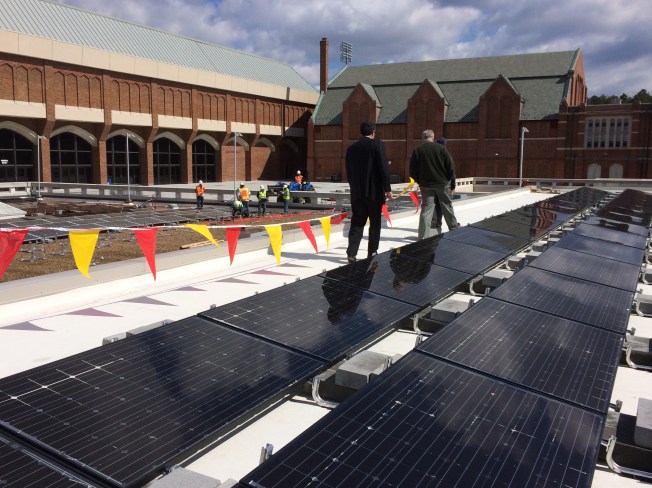
A third-party PPA made it possible to build this solar facility at the University of Richmond. Appalachian Power Company contends that a project like this would be illegal in its territory.

A third-party PPA made it possible to build this solar facility at the University of Richmond. Appalachian Power Company contends that a project like this would be illegal in its territory.

A hearing examiner for the Virginia State Corporation Commission recommended on August 31 that the SCC reject Appalachian Power Company’s proposed alternative to third-party power purchase agreements (PPAs) for renewable energy, concluding the program is not in the public interest. The parties will have three weeks to comment before the recommendation goes to the Commissioners for a final decision. The case is PUE-2015-00040.

The ruling against APCo’s proposed Rider RGP is less important to customers than the reasoning behind it. In addition to finding a myriad of faults with the proposal, the Hearing Examiner concluded it isn’t needed because PPAs are already legal under the Virginia Code. This is an outcome long sought by the solar industry and environmental groups, and one supported by the Attorney General’s Office of Consumer Counsel.

However, the Hearing Examiner’s report is merely a recommendation. Nothing is final until the Commissioners rule, and they could make a decision about Rider RGP without addressing the current legality of PPAs. Moreover, earlier this year, APCo proposed another program that it clearly hopes will nip in the bud any surge of PPA activity that might result from a decision in the present case. (I’ll get to that in a moment.)

The rejection of Rider RGP won’t disappoint any would-be customers. A long line of witnesses testified at the hearing on September 29, 2015 that APCo’s expensive and convoluted program would find no takers. As the Solar Research Institute summarized it, the proposed Rider RGP “would require a customer interested in a solar PPA to first pay for 100% of their service under the standard tariff, pay for 100% of the solar energy generated, pay a $30 program fee, and receive excess payments back through a Renewable Output Credit.” Oh, and they still wouldn’t be using renewable energy. (Note that although solar energy was the focus of the discussion for participants, the decision applies to other forms of renewable energy as well.)

The SCC staff made some suggestions to improve the program, but the hearing examiner, Deborah Ellenberg, concluded it was really beyond saving. Not only that, but the plain language of the Virginia Code makes third-party PPAs legal in the state already. Thus, there is no need for a utility-sponsored alternative.

Ellenberg pointed to two statutory provisions that support the legality of third-party PPAs. First, Virginia Code §56-577 A 5 provides that customers may purchase renewable energy from third-party sellers if their own utility does not offer a tariff for renewable energy. Specifically, customers may:

[P]urchase electric energy provided 100 percent from renewable energy from any supplier of electric energy licensed to sell retail electric energy within the Commonwealth . . . if the incumbent electric utility serving the exclusive service territory does not offer an approved tariff for electric energy provided 100 percent from renewable energy. . . .

Until now, APCo has offered only a green power program that sells RECs, which the SCC says doesn’t count.

The language of §56-577 sounds clear enough, but APCo and Dominion Power have maintained that this section only allows customers to go elsewhere if the other supplier can provide 100% of their electricity from renewable energy, something that can’t be done with a solar facility or a wind turbine.

This flimsy reading of the statute was the basis on which Dominion challenged a PPA at Washington and Lee University back in 2011. The issue was temporarily resolved two years later when Dominion and the solar industry agreed to a pilot program that now allows a limited number of PPAs in Dominion territory, under tight parameters that exclude residential customers. The program never applied in APCo territory, however—a sore point to customers there. APCo has clung to its reading of §56-577, regardless of the growing clamor for renewable energy in southwestern Virginia.

Ellenberg’s report flatly rejects the utility interpretation. If the SCC adopts her reading, any customer in APCo territory would be free to buy renewable energy from third-party suppliers, until APCo offers a qualifying program.

Ellenberg also cited Virginia’s net metering statute. Virginia Code §56-594 authorizes “customer generators” to enter into behind-the-meter PPAs with third parties that own and operate a renewable facility for the customer. Code §56-594 B defines an eligible customer generator for net metering purposes as “a customer that owns and operates, or contracts with other persons to own or operate, or both, an electrical generating facility that . . . uses as its total source of fuel renewable energy . . .” (emphasis added).

Interpreting this provision takes no special legal talent, surely. It would seem to cover residential and commercial facilities installed and owned by third-party developers, including the familiar no-money-down contract offered to residential customers by Solar City. But again, APCo and Dominion Virginia Power claim the Code doesn’t mean what it says. For more than five years they’ve backed up their position with threats of lawsuits, creating the kind of uncertainty that is toxic to development deals.

If the SCC’s final order endorses the hearing examiner’s finding that PPAs are currently legal, the result could be to open up the Virginia solar (and wind) market to large amounts of private investment statewide.

However, Ellenberg’s finding that PPAs are currently legal appears in her discussion but not in her recommendations to the commissioners; her recommendations are limited to the actions she proposes (rejecting or modifying the tariff). The SCC does not have to rule on the question of PPA legality in order to decide this case. Surely, though, it would be strange if it were to duck the opportunity now that the issue has been fully briefed. With solar a hot commodity across the state, the current legal limbo has become a significant economic drag that the SCC ought not to ignore.

As I mentioned, though, APCo still has one card up its sleeve. This spring it proposed a new tariff to offer its customers 100% renewable energy derived from existing wind, solar and hydro projects. The product appears to meet the condition of §56-577. If approved, it would slam shut the door that the Hearing Examiner just opened (or rather, that she said was open all along, if you had dared to go through it into the toxic miasma where gray-suited lawyers lay in wait). APCo’s request for approval of the tariff (PUE-2016-00051) is scheduled to be heard by the SCC on November 15, with comments due by November 8.

Solar advocates take a dim view of APCo’s move. The new tariff won’t build any new facilities; it simply shifts the burden of paying for existing renewable energy projects onto volunteers, at a significant premium. In today’s market, third-party developers can offer electricity generated by new solar projects at competitive prices. So APCo’s tariff looks less like an accommodation to its eco-conscious customers, and more like a maneuver to prevent anyone from building solar on its turf.

It’s high time the SCC put a stop to this anti-competitive behavior and let Virginians build solar projects with their own money. The Commissioners can follow the Hearing Examiner’s advice, or they can take a pragmatic approach and recognize that PPAs are really just a way to finance projects. They don’t turn solar developers into utilities, and APCo should stop wasting everyone’s time and money blocking private investment in a part of the Commonwealth that desperately needs it.

Unknown's avatar

The “fuel” that’s helping America fight climate change isn’t natural gas

You’ve heard the good news on climate: after a century or more of continuous rise, U.S. CO2 emissions have finally begun to decline, due largely to changes in the energy sector. According to the Energy Information Agency (EIA), energy-related CO2 emissions in 2015 were 12% below their 2005 levels. The EIA says this is “because of the decreased use of coal and the increased use of natural gas for electricity generation.”

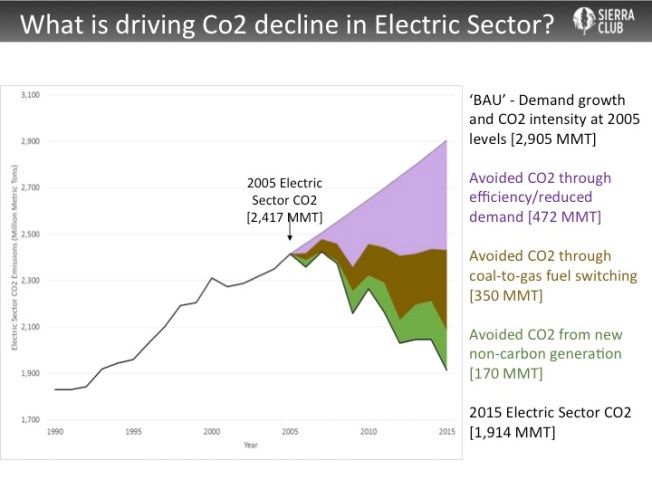
Is the EIA right in making natural gas the hero of the CO2 story? Hardly. Sure, coal-to-gas switching is real. But take a look at this graph showing the contributors to declining carbon emissions. Natural gas displacement of coal accounts for only about a third of the decrease in CO2 emissions.

Courtesy of the Sierra Club Beyond Coal Campaign, using data from the Energy Information Agency.

Courtesy of the Sierra Club Beyond Coal Campaign, using data from the Energy Information Agency.

By far the biggest driver of the declining emissions is energy efficiency. Americans are using less energy overall, even as our population grows and our economy expands

Energy efficiency is sometimes called the “first fuel” because cutting waste is a cheaper and faster way to meet energy demand than building new power plants. Improvements in energy performance cut across all sectors of the economy, from industrial machines to home electronics to innovations like LED bulbs replacing famously wasteful incandescent light bulbs.

Energy efficiency’s stunning success in lowering carbon emissions should get more attention, and not just because it is cheaper than building new natural gas-fired power plants. Efficiency has no downsides. Natural gas has plenty. Indeed, when methane leakage from drilling and infrastructure is factored in, natural gas doesn’t look much like a climate hero at all.

And that’s not the full story. A growing share of the credit for carbon reductions also goes to non-carbon-emitting sources, primarily wind, and solar. Both sources exhibit double-digit growth rates. Wind power in the U.S. has grown from a little over 9,000 megawatts (MW) in 2005 to more than 74,000 MW by the end of 2015. In 2005, the solar market scarcely existed. By early this year, we had 29,000 MW installed.

The solar trend is particularly exciting because we are just starting to see the big numbers that result from solar’s exponential growth. In the first quarter of 2016, more solar came online in the U.S. than all other power sources combined. Analysts like Bloomberg New Energy Finance see solar becoming the world’s dominant energy source over the next 25 years, driving out not just coal but also a lot of gas generation as solar becomes the cheapest way to make energy.

For an inspiring look at how this will happen, check out this presentation by author Tony Seba. As Seba argues, solar isn’t a commodity like fossil fuels; it is a technology like computers and cell phones. When technologies like these take off, they take over. Seba refers to solar technology, battery storage, electric vehicles and self-driving vehicles as “disruptive” technologies that are advancing together to upend our energy and transportation sectors.

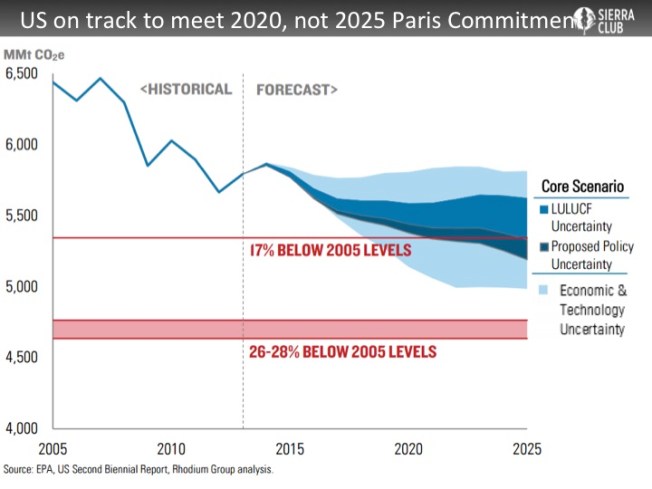
Another graph shows us how critical these advancements will be. The U.S. is on track to achieve President Obama’s goal announced last year of lowering carbon emissions 17% below 2005 levels by 2020, but we will need more aggressive measures to meet our Paris Agreement target of 26-28% below 2005 levels by 2025. After 2025, of course, we will have to cut greenhouse emissions even further and faster.

Slide4Given the urgency of the climate crisis, we don’t have the option of waiting around for the solar revolution to bankrupt the oil and gas industry and fossil-bound electric utilities. These companies will not go quietly; already they are maneuvering to lock customers into fossil fuels. Power producers are engaged in a mad rush to build natural gas plants, and wherever possible, to stick utility customers with the costs.

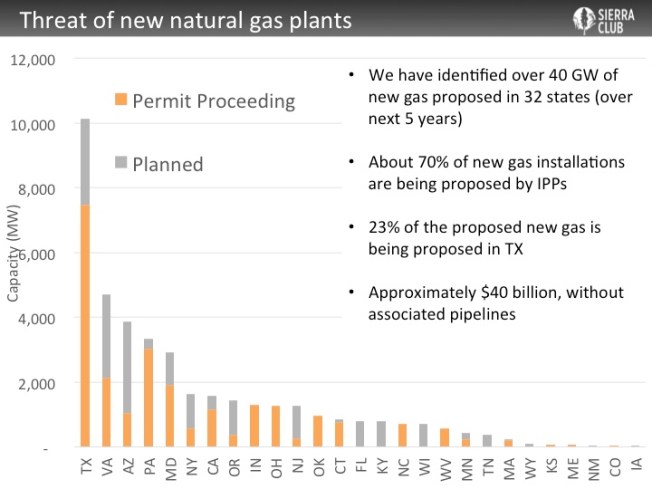
For Virginians who have felt especially under attack from fracked gas projects recently, this final graph shows it’s not your imagination: Virginia is second only to Texas in new gas plant development underway. And this graph captures only a fraction of the new gas that Virginia’s major utility, Dominion Virginia Power, wants to build. In presentations to state officials, it revealed plans for more than 9,000 megawatts of additional gas generating capacity.

Based on Energy Information Agency data. Chart excludes natural gas generating units already under construction as well as those scheduled to come online after 2020.

Based on Energy Information Agency data. Chart excludes natural gas generating units already under construction as well as those scheduled to come online after 2020.

Dominion and other gas-happy utilities are betting that once plants are built and consumers are on the hook, regulators won’t want to see them idled ten years from now just because renewable energy has made them obsolete.

Indeed, Dominion and other utilities, including Duke Energy, Southern Company, and NextEra in the Southeast and DTE Energy in the Midwest, even plan to use electricity customers to make money for the gas pipelines they are building, locking Americans further into gas.

This is madness. The only sound energy plan today is one that looks forward to an era of minimal fossil fuel use. It puts efficiency and renewables front and center, shifting natural gas and other fuels to supporting roles that will shrink over time.

The shift is inevitable. Delaying it means allowing the climate crisis to worsen, while sticking customers with higher bills for decades to come. That may suit some utilities just fine, but the cost is too high for the rest of us.


Unknown's avatar

Sierra Club scorecard plumbs divisions among Virginia legislators

SC ScorecardBy and large, Virginia Republicans are still locked in a fossil fuel echo chamber, where “all of the above” and “war on coal” guide their votes. Virginia Democrats mostly acknowledge the damage climate change is doing to the commonwealth and around the planet and support a course correction. And regardless of ideology, large majorities from both parties vote for whatever Dominion Power wants.

These are the major takeaways from this year’s legislative session and the 2016 Climate and Energy Scorecard, just released by the Virginia Chapter of the Sierra Club. Constituents and clean energy advocates will want to look at not just the raw grades of individual legislators, but also the discussion provided in the report, to understand the dynamics of our General Assembly.

Twenty-eight Democrats earned perfect scores. All but a handful of Republicans earned failing grades. Sierra Club gave extra credit to legislators who introduced bills that advanced clean energy. This included several Republicans highlighted in the scorecard, but their bad votes on other bills dragged down their overall scores.

This is really a shame, since some Republicans have worked hard to advance clean energy legislation. Leesburg Delegate Randy Minchew comes to mind here for his dogged efforts on behalf of distributed solar energy, something you might not guess from his overall grade of D.

Often, it seems, reform-minded Republicans go along with their party’s more retrograde positions where they are pressured to do so by their party leaders, or where the votes are so lopsided that there is nothing to gain from breaking with the majority.

If party leaders have an outsize influence on voting, so too does Dominion Power. In fact, if you want to know who the true champions of the people are, don’t look at party affiliation. Look for the few legislators who will stand up to the most powerful political force in Richmond.

That assumes you can find votes to examine. In the introduction to the Sierra Club scorecard, Legislative Chair Susan Stillman noted with frustration this year’s paucity of recorded votes available to score:

The challenges of producing a fair and even scorecard are growing, as are the opportunities for Virginia citizens to have a clear and accurate picture of their elected representative’s voting record. Transparency in the General Assembly sunk to a new low this year: 95% of the bills defeated in the House of Delegates were done so on an unrecorded vote or no vote at all. This is not business-as-usual: just over a decade ago, nearly every bill that passed through the House received a recorded vote.

An ongoing problem, both for scorecard referees and for clean energy advocates, is that most bills that would advance the cause of renewable energy and energy efficiency never make it out of committee; in the House, the bills are heard in a tiny subcommittee. Not only do votes go unrecorded, but this approach deprives most of our elected representatives of the opportunity to vote on some of the most important energy policy issues facing Virginia.

And then there was this year, in which even the subcommittee members never got a chance to vote. A dozen or so of the most promising clean energy bills were never heard at all, but were sent to a newly-formed interim study subcommittee, ostensibly for the purpose of giving these bills the benefit of greater deliberation. The effect was to kill them quietly for the year.

As Stillman notes, all these unrecorded votes make it hard to know where the vast majority of legislators stand:

Without a recorded vote, the public is deprived of the full measure of his or her elected official’s voting history. And the problem of unrecorded votes is growing worse. This year’s unprecedented rate of unrecorded votes in the House is up from 76% in 2015—a 25% jump in one year. Virginia legislators are killing more bills than ever without accountability for their actions. This practice is wrong, and it’s dangerous for our democracy.

Stillman gives a shout-out to the founding members of the new, bipartisan Transparency Caucus for its efforts to make all votes public and ensure every bill gets a hearing.

These would be modest reforms, but welcome. If sunlight is the best disinfectant, there’s a big, dirty House (and Senate) in Richmond that need cleaning.

Unknown's avatar

Virginia legislators named to review clean energy bills

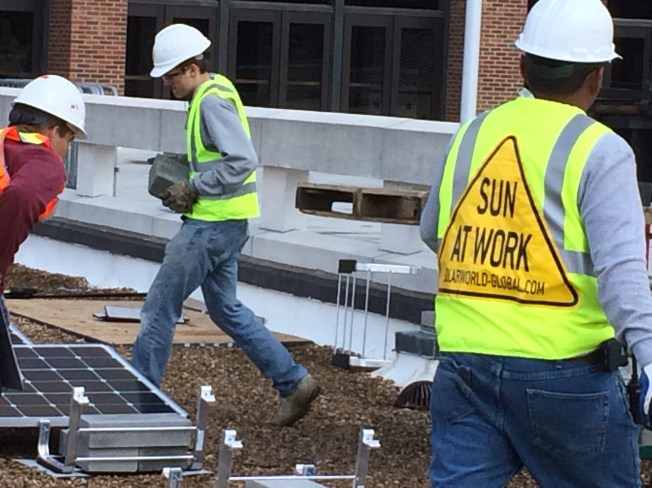
Workers install solar panels at the University of Richmond.

Workers install solar panels at the University of Richmond.

Virginia’s 2016 legislative session began with a host of worthy bills promoting energy efficiency, wind and solar, but ended with almost none of the legislation even having been considered in committee. The Republican chairmen of the Senate and House Commerce and Labor committees instead “carried over” the bulk of the bills, announcing plans for a new subcommittee to study them and make recommendations for 2017.

Members of the subcommittee have now been named. Senator Frank Wagner has tapped Senators Black, Cosgrove, Stuart and Dance to serve. This information is now on the General Assembly website. Delegate Terry Kilgore has named Delegates Ware, Hugo, Ransome, Miller and Keam.

No meeting schedule has been announced, but lobbyists for the utilities and the solar industry trade association, MDV-SEIA, have begun meeting in private to discuss potential compromises. This can’t be called a stakeholder process; the meetings are not open to the public, and they have not invited participation by environmentalists or, with one exception, anyone on the consumer side representing the interests of local government, colleges and universities, churches, eco-friendly businesses or residential customers.

(The exception is a lobbyist for Loudoun County landowner Karen Schaufeld, a newcomer to energy issues who formed a group called Powered by Facts and hired lobbyists to advocate for expanded agricultural net metering and other pro-solar reforms.)

Anything that emerges from these meetings will likely have a significant impact on the subcommittee. Yet, given the importance of this issue to the commonwealth, the subcommittee should ensure it hears from all solar stakeholders. More importantly, committee members should explicitly adopt as their measure of progress a simple test: whether the language of a bill will lead to greater private investment in solar in Virginia. Wagner and Kilgore have said they want to see the growth of solar here, and all of the legislators publicly subscribe to the values of free market competition and consumer choice. But without a guidepost, we are likely to see the utilities bully the solar industry into a “compromise” that shifts the ground a bit but continues to strangle the private market–and leaves us further than ever behind other states.

Who’s who on the committee

All of the legislators named to the study committee are Commerce and Labor committee members, but beyond that, many of these appointments are surprising, as they don’t necessarily reflect demonstrated interest in the subject. It is also disturbing that only one Democrat was named from each side. (Dance is the Senate Democrat, Keam the House Democrat. They are also the only minorities represented.) There is no reason energy efficiency and renewable energy should be partisan issues, but in the past, party affiliation has been the single most powerful predictor of votes on clean energy.

To gage how these legislators approach the issues, I took a look at the Sierra Club’s Climate and Energy Scorecard for 2014 and 2015. Scores for 2016 are not yet available. It is important to note that in the House, most renewable energy legislation has been killed by unrecorded voice votes in the Commerce and Labor subcommittee, preventing the votes from being scored. So the scorecard is only a starting point.

The Senators

Frank Wagner himself earned a D in 2015, with a voting percentage of 60%. This was up from an F in 2014. The Virginia Beach Republican is the only member on this subcommittee to have exhibited a serious interest in energy issues, having shaped many of Virginia’s current policies. Unfortunately, he is closely allied with Dominion Power, voted for tax subsidies for the coal industry, tends to doubt the reality of climate change, and has been sharply critical of the EPA Clean Power Plan. On the plus side, he believes renewable energy should play an important role and was instrumental in launching the state’s bid for offshore wind. He also genuinely welcomes input from the public at meetings he runs.

That makes his committee choices all the more peculiar. Dick Black is better known as a social crusader who lines up with the far right wing of his party, most notably in opposition to abortion, gay rights and gun limits. Most recently, he made headlines by meeting with Syrian president Bashar Assad and urging the U.S. to lift economics sanctions against the Assad regime.

Black is a climate denier of the delusional variety, insisting at an event last August that global temperatures have not risen in 17 years and that no major hurricanes have hit the American mainland in 9 years. (2014 was the hottest year on record until 2015 seized the trophy. Superstorm Sandy, the largest Atlantic hurricane on record, struck in 2012.)

The forum was an “American for Prosperity grassroots event” (sic). The “crowd of about 18 people” included former Senator Ken Cuccinelli, no slouch himself in the climate denial department. Black compared EPA employees to “Bolshevik communists.” He and Cuccinelli used the event to criticize the Clean Power Plan as “part of a government scheme to send billions in taxpayer funds to ‘wind and solar scams’ and ‘billionaire liberals.’”

He received a grade of F from the Sierra Club in both 2014 and 2015. With a voting percentage of just 14% last year, he had the worst record in the Senate on climate and energy bills. In sum, the appointment of Dick Black to this committee can’t be called an effort to seek out thoughtful voices on the issues.

John Cosgrove is a solid conservative on name-brand issues like guns and abortion, though decidedly lacking Black’s flair for headlines. With a 67% score, he received a grade of D from the Sierra Club in 2015, up from an F in 2014. A review of the bills he has introduced in the last two years showed none related to climate or energy, again raising the question of why he was chosen for this particular subcommittee.

Richard Stuart’s voting record of 50% earned him an F in 2015, down from a C in 2014. However, he earned an award from the Sierra Club in 2014 for introducing a bill to regulate fracking; the bill did not pass. Senator Stuart also received “extra credit” on the 2015 scorecard for introducing the bill that established the Virginia Solar Energy Development Authority. In 2016, he also introduced one of the more ambitious renewable energy bills, working with Schaufeld’s Powered by Facts.

Roslyn Dance is the lone Democrat and only woman selected from the Senate. She has consistently voted on the side of clean energy, and was the patron of 2015 legislation raising the size limit on net-metered projects from 500 kW to 1 megawatt. This work earned her an award from the Sierra Club that year.

Dance scored 100% on both the 2014 scorecard (when she was a delegate) and the 2015 scorecard, for a grade of A+ each year. However, she came in for intense criticism in the 2016 session for abstaining on Senator Surovell’s coal ash bill, knowing it would fail in committee without her vote. The bill would have required Dominion Virginia Power to move stored coal ash out of unlined ponds along rivers for disposal in lined facilities away from water sources. Dance’s abstention was widely thought to be a favor to Dominion Power, saving the company from what might have been a nasty fight on the Senate floor.

The Delegates

Terry Kilgore, Chairman of House Commerce and Labor, represents part of rural southwest Virginia, and has close ties to Appalachian Power Company and the coal industry, both of which contribute generously to his campaigns. Bills opposed by utilities have little chance in his committee. In 2015, he earned an F on the energy and climate scorecard, with a 50% score, down from a D (63%) in 2014.

Lee Ware represents a suburban and rural area west of Richmond, stretching from the western side of Chesterfield County. He earned a C (75%) in 2014 and an F (50%) in 2015. In spite of these scores, he has shown an independent, thoughtful approach to energy legislation, and has demonstrated a serious interest in promoting energy efficiency. His bill to change how the State Corporation Commission evaluates utility efficiency programs is one of the pieces of legislation to be considered this summer.

Tim Hugo represents a suburban Northern Virginia district. He earned a D (67%) in 2014, with extra credit for introducing a bill that reclassified solar equipment as “pollution control equipment,” earning it a critical exemption from a local business property tax known as a “machinery and tools” tax. In 2015 his score dropped to an F (56%), in spite of an extra credit bump from introducing the House version of the Solar Development Authority bill.

As Majority Caucus Chair, Hugo’s poor scores reflect the leadership’s pro-coal, anti-regulation platform. He is nonetheless keenly interested in promoting solar energy, at least where he can do so without running into utility opposition. His close ties to Dominion have often meant he led the opposition to pro-solar net metering reforms, keeping them from moving out of the committee.

Margaret Ransone is the only woman named to the House subcommittee. She received an F (57%) in 2015, down from a C (71%) in 2014. She represents counties along the Northern Neck, near Richmond. She is not on the Commerce and Labor energy subcommittee, and has shown no particular interest in the subject. Her website suggests a mix of the ideological (pro-gun, anti-abortion) and the practical (high speed internet for rural areas).

Jackson Miller received an F (44%) in 2015, down from a D (63%) in 2014. His district is close to Hugo’s, covering the City of Manassas and part of Prince William County in the outer suburbs of Northern Virginia. Miller is Majority Whip for the House. He has consistently voted against expanding net metering options.

Mark Keam is the only Democrat on the House subcommittee as well as the only ethnic minority (he is Korean). He received an A+ (100%) in 2015, up from an A (88%) in 2014. He has generally supported expanded opportunities for renewable energy.

Unknown's avatar

McAuliffe’s stark choice on the Clean Power Plan: serve Virginia, or Dominion Power

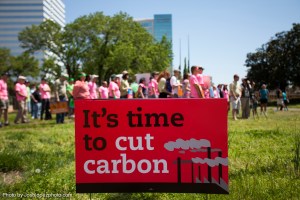
Photo by Josh Lopez, courtesy of the Sierra Club.

Photo by Josh Lopez, courtesy of the Sierra Club.

After the Supreme Court issued a stay of the EPA’s Clean Power Plan pending its review by the D.C. Circuit, many Republican governors halted compliance efforts in their states, while most Democratic governors opted to continue. Among these was Virginia Governor Terry McAuliffe, who plans to unveil a draft state implementation plan this fall.

Deciding to move forward on President Obama’s signature climate effort was an easy call. Polls show strong support for reducing carbon pollution, and the Governor wants to prove himself a team player who supports his president and his party. McAuliffe often reiterates his conviction that climate change is already producing extreme weather and increasingly severe coastal flooding in Virginia, making government action urgent.

Governor McAuliffe has another choice before him now: he can craft a compliance plan that moves Virginia firmly in the direction of clean energy and lower carbon emissions, or he can adopt one that allows unbridled growth in new power generation from natural gas. The latter could still meet the letter of the law, but it would hugely increase greenhouse gas emissions from Virginia power plants.

McAuliffe has this choice because EPA’s rules come in two parts: the Clean Power Plan addresses existing power plants under one section of the Clean Air Act, while new power plants are addressed under another section of that law. As a result of the statutory structure and EPA’s rules, states can choose to cover both under one set of rules with a total cap on utilities’ CO2 emissions, or they can address new and existing sources separately.

If a state chooses to cover both under a single cap, new generation can be added up to the cap or go beyond if the utility buys emission allowances from another utility. But if a state treats new and existing sources separately, then new sources can grow without limit as long as each new unit meets a unit-specific standard. Of course, building more fossil-fueled power plants of any type will increase carbon emissions, at a time when the U.S. desperately needs to cut back.

The carbon reduction target EPA set for Virginia under the Clean Power Plan is extremely modest. EPA’s numbers show Virginia can meet the target for existing sources simply by not increasing emissions. If the state also includes new power plants under the cap, however, it creates a real incentive to invest in clean energy.

But there’s a problem. Dominion Resources, the Richmond-based parent company of Dominion Virginia Power, is heavily invested in the natural gas sector, primarily transmission and storage. That has led Dominion to lobby for an implementation plan that covers only existing power plants.

Excluding new sources would leave the company free to build as many new natural gas-burning power plants in the state as it wants, locking in years of increased carbon pollution, and further boosting demand for fracked gas and pipeline capacity. Dominion’s plans call for more than 9,500 megawatts of new gas generation in Virginia, equivalent in carbon impact to building eight average-sized coal plants in the state.

McAuliffe can do what Dominion wants, or he can do the right thing for the climate. He can’t do both.

The stakes are high on both sides. McAuliffe has made job creation his number one priority, and he lures new industry to the state with the promise of lower-than-average electricity rates. Dominion says supporting its natural gas plans is the way to deliver on that promise. Whether that is true or not doesn’t count in this calculus; with state law limiting governors to a single term, McAuliffe is focused on the present.

But adopting a plan that allows unlimited increases in greenhouse gas emissions would run contrary to Virginia’s long-term interests. Not only is the state on the front lines of sea level rise, it needs predictable, affordable electricity prices for decades to come. And nothing can provide that better than renewable power and increased energy efficiency.

Neither Dominion nor anyone else can guarantee the price of natural gas over the life of a new power plant. Questions of price and supply bedevil even the best analysts and make forecasting risky. Moreover, the growing awareness of the climate impacts of methane from leaking wells and pipelines is already producing calls for tighter regulation of natural gas. A carbon tax or cap-and-trade legislation would also make all fossil fuels more expensive relative to carbon-free renewables.

While the cost of using natural gas can only go up, the costs of wind, solar and battery storage are expected to continue their astonishing declines. Advances in energy efficiency promise huge savings for states that pursue programs to help customers cut their energy use.

From a bill-payer’s perspective, then, investments in clean energy make more sense than building gas plants, even without taking federal regulations into consideration. Recent analyses show Virginia can cap carbon pollution from new power plants and still save money for electricity customers.

Environmental groups say their number one energy priority this year is to ensure Virginia adopts a Clean Power Plan that includes both existing and new sources, and they are counting on Governor McAuliffe to deliver. Their message is simple: if McAuliffe wants to be on the climate team, Virginia’s compliance plan must reduce CO2 emissions, not let them grow.

Unknown's avatar

Only the good die young: A mid-way review of Virginia climate and energy bills

Photo credit: Corrina Beall

Photo credit: Corrina Beall

Virginia’s 2016 legislative session is only half over, but it’s already clear that the General Assembly is no more capable of dealing with climate change and a rapidly-evolving energy sector than it ever was. Republicans are stuck in denial, Democrats are divided between those who get it and those who don’t, and for most legislators in both parties, the default vote is whatever Dominion Power wants.

Republican attacks on EPA climate regulations sail through both houses, while popular RGGI legislation dies in committee.

Practically the first bills filed this session call for Virginia’s Department of Environmental Quality to submit for legislative approval any plan to comply with the EPA’s Clean Power Plan. Anxious to safeguard Virginia’s heritage of carbon pollution against the twin threats of clean energy and a more stable climate, the Republican leadership rammed through HB 2 and SB 21 on party-line votes. Governor McAuliffe has promised vetoes.

Eager as it was to defeat Obama’s approach to climate disruption, the Party of No supported no solutions of its own, even when proposed by one of its own. Virginia Beach Republican Ron Villanueva couldn’t even get a vote in subcommittee for his Virginia Alternative Energy and Coastal Protection Act, which would have had Virginia join the Regional Greenhouse Gas Initiative (RGGI). It was the only legislation introduced this year that would have lowered greenhouse gas emissions and raised money to deal with climate change. The Democratic-led Senate version also failed to move out of committee, on a party-line vote.

Republicans scoff at climate change, but they are beginning to worry about its effects. Bills have moved forward to work on coastal “resiliency” efforts and to continue studying sea level rise (referred to as “recurrent flooding,” as though it were a phenomenon unto itself and suggesting no particular reason it might get worse). The Senate passed SB 282, creating the Virginia Shoreline Resiliency Fund, and SJ 58, extending the work of the Joint Subcommittee to study recurrent flooding. The House passed HJ 84, a companion to SJ 58, and HB 903, establishing a Commonwealth Center for Recurrent Flooding Resiliency.

Bold energy efficiency measures die. Not-so-bold measures don’t do well either.

Virginia appears set to continue its woeful record on energy efficiency. Between the opposition of electric utilities and their regulators at the State Corporation Commission, bills that would have set the stage for cost-effective reductions in energy use got killed off early or watered down to nothing.

Among the latter were the fairly modest bills pushed by the Governor. They passed only when reduced to a provision for the SCC to evaluate how to measure the subject. Weirdly, even that found opposition from conservative members of the Senate and House.

The only bill to move forward more or less intact was Delegate Sullivan’s HB 1174, which requires state agencies to report on how badly the state is doing in meeting its efficiency goal. So we may not make progress, but at least we’ll have to acknowledge our failures. (Roughly the same group of conservatives didn’t think we should even go that far.)

Renewable energy bills won’t move forward this year, except the one Dominion wants.

As previously reported, the Republican chairmen of the House and Senate Commerce and Labor committees decided not to decide when it came to much-needed renewable energy reforms. Every bill to create new market opportunities for wind and solar was “carried over to 2017,” i.e., referred to a not-yet-existent subcommittee composed of unnamed people tasked with meeting at a not-yet-scheduled time, in order to do “something.”

“We do need to get moving on these solar bills faster than we have been going,” said House C&L Chairman Terry Kilgore, in explaining why his committee was not getting moving on any solar bills.

On the other hand, over in House Finance, Dominion Virginia Power’s bill to lower the taxes it pays for renewable energy property fared better. In exchange for an 80% tax exclusion for its own utility projects, Dominion offered up reductions in the tax savings currently afforded to the smaller projects being developed by independent solar companies. In an amusing sideshow, Republican leaders tried to use their support for this legislation to strong-arm liberal Democrats into supporting a bill extending coal subsidies, on the theory that passing one bill that benefits Dominion warrants passing another bill that benefits Dominion.

Given the lack of progress in opening the wind and solar markets, there is more than a little irony in the fact that legislation moved forward in both the House and Senate requiring utilities to direct customers to an SCC website with information about options for purchasing renewable energy. (Which leads to the question: if visitors to such a site encounter an error message, is it still an error?)

Coal subsidies remain everyone’s favorite waste of money.

Once again, the House and Senate passed bills extending corporate welfare for companies whose business model involves blowing up mountains and poisoning streams. Over the years legislators have spent more than half a billion dollars of taxpayer money on these giveaways, knowing full well it was money down a rat-hole. Community activists have pleaded with lawmakers to put the cash towards diversifying the coalfields economy instead, but there has never been a serious effort to redirect the subsidies to help mine workers instead of corporate executives and the utilities that buy coal.

This year the corporate handout went forward in the face of reports that one of the biggest recipients plans to pay multi-million-dollar bonuses to its executives while laying off miners and looking for ways to dodge its obligations to workers. Add to this the news that the same company owes two coalfields counties $2.4 million in unpaid taxes for last year, and you have to wonder what fairy tales legislators are hearing from lobbyists that makes them put aside common sense.

It’s not just Republicans who voted for these subsidies (though there is no excuse for them, either). Some Democrats did so, too. Governor McAuliffe has said he would veto these bills, which means senators like David Marsden, Jennifer Wexton, John Edwards and Chap Petersen will have a chance to redeem themselves by voting against an override.

Many thanks to Senators Howell, Ebbin, Favola, Locke, McEachin, McPike and Surovell for seeing through the propaganda of the coal lobby and voting no.

Dominion defeats legislation protecting the public from coal ash contamination

Senator Scott Surovell’s SB 537 would have required toxic coal ash to be disposed of in lined landfills rather than left in leaking, unlined pits and simply covered over. The bill failed in committee in spite of support from one Republican (Stanley), after Democratic Senator Roslyn Dance caved to pressure from Dominion and abstained. One might have expected more backbone from a legislator with coal ash contamination in her own district. (Nothing excuses the Republicans who voted against the public health on this, either. Last I heard, Republican babies are as vulnerable to water pollution as Democratic babies.)


Unknown's avatar

Facing utility opposition, Virginia legislators punt on renewable energy bills

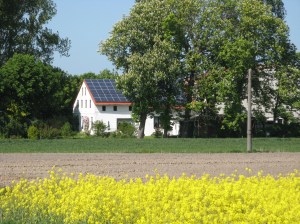
Expanding solar financing to include third-party ownership would allow more houses and farms to host solar arrays. Photo credit Dirk Franke via Wikimedia Commons.

Expanding solar financing to include third-party ownership would allow more houses and farms to host solar arrays. Photo credit Dirk Franke via Wikimedia Commons.

Most Virginia legislators say they want more renewable energy. They listen to their constituents, they understand the economic opportunities, they support consumer choice, and they think it’s important to diversify our energy supply, even if they aren’t against fossil fuels. But when it comes to voting, only one voice counts with them, and that’s Dominion’s.

And so Dominion Virginia Power once again succeeded in blocking legislation that would have opened the market for wind and solar to greater private investment through third-party power purchase agreements (PPAs), community solar programs, removal of standby charges and the lifting of size caps. (I described most of these bills in a previous post.)

Rather than capitulate publicly, however, the chairs of the Senate and House Commerce and Labor Committees, Senator Frank Wagner and Delegate Terry Kilgore, determined to “carry over” to next year the bulk of the renewable energy bills, assigning them to a new subcommittee to be named later, and which will consider the bills sometime later in the year.

If you are a pessimist, you will notice this means that none of the bills even got a hearing in committee, and all are effectively dead for the year, with no legislators you can hold accountable. You will also have doubts about the likelihood of this subcommittee delivering results favorable to solar and wind advocates, given that Mssrs. Wagner and Kilgore are not known for standing tall against utility interests.

If you are an optimist, however (and what choice do you have?), you will respond with hope that this subcommittee will browbeat the utilities into accepting at least some legislative reforms in the service of the public good. You will point out that legislators’ unwillingness to simply kill bills at the utilities’ behest is progress in itself, driven by an outpouring of constituent support for renewable energy and backed by new lobbying firepower.

In past years, Dominion never gave more than it got, and routinely killed off legislation. And this year, Dominion’s approach to the most important piece of legislation—Delegate Randy Minchew’s HB 1286—followed the utility’s standard operating procedure. Over many weeks Dominion lobbyists met with members of the industry coalition and persuaded them to strip away parts of the legislation—first one provision, then another, all in the name of “compromise.” Eventually the bill was reduced to a single paragraph recognizing the legality of third-party PPAs, with all sides in agreement.

Then two days before the subcommittee hearing on the bill, Dominion reneged and produced substitute language that eliminated authority for all but a narrow subset of PPAs, while suddenly slapping new standby charges on small commercial customers who install renewable energy systems, a provision entirely separate from the PPA issue.

The standby charges were a known poison pill. In 2012 Dominion convinced the solar industry to accept the idea of standby charges in exchange for raising the size limit on residential solar systems from 10 to 20 kW. The industry assumed the charges would be modest at worst, given the value of distributed solar to the grid. But Dominion then persuaded the State Corporation Commission to approve charges so high as to kill the market for the larger systems. Appalachian Power followed suit.

Dominion would dearly love to institute standby charges on more customers, so this year the company is ransacking renewable energy bills looking for opportunities. I’m told that after Delegate Minchew elected to have HB 1286 carried over rather than accede to the standby charge language, Dominion lobbyists went to Senator Richard Stuart and tried to use another pro-renewables bill as the vehicle for standby charges.*

This obnoxious tactic smacks of desperation, and must be as irritating to legislators as it is to renewable energy advocates. We should not be surprised to see it a point of contention later this year when the subcommittee meets. Standby charges may be bogus, but utilities see them as their best tool to prevent the spread of customer-owned generation that threatens utility profits.


*That bill is SB 779, a latecomer filed at the request of Loudoun County farmer and philanthropist Karen Schaufeld. Her new group, Powered by Facts, initiated several pro-solar bills separate from those of the solar industry. Although Stuart’s bill as written includes sweeping reforms for farmers who want to sell excess renewable energy, we hear it was suffering the same death-by-a-thousand-amendments even before the standby charge issue came up. For now, however, the legislative information website continues to show the bill with its original language. It will likely be heard on Monday if it is heard at all; we expect to see it bounced to the new subcommittee.


Unknown's avatar

Virginia legislators look to tax breaks and barrier-busting to boost renewable energy

Let's get these projects moo-ving. Photo credit NREL

Let’s get these projects moo-ving. Photo credit NREL

The orchestrated mayhem of the Virginia General Assembly session is well underway. Thirteen days are gone and only twenty-one days remain until what’s known as “Crossover,” after which any bill that hasn’t passed its own chamber is effectively dead. This year Crossover falls on February 16. After that, each chamber considers only bills already passed by the other.

By that measure, yours truly is one lazy blogger, because I’m only just getting to the renewable energy bills. On the other hand, bills were still being filed until Friday, and some bills are undergoing revisions before they are heard in committee. These are moving targets; advocates beware.

Removing barriers to investment 

Readers of this blog know that Virginia law is riddled with barriers that restrain the market for wind and solar in Virginia. This year several bills take aim at the policies holding us back.

HB 1286 (Randy Minchew, R-Leesburg, in Commerce and Labor) is barrier-busting legislation developed by the solar industry in consultation with the wind industry and solar advocates. It clarifies that renewable energy companies that sell to retail customers under power purchase agreements (PPAs) are not public utilities and don’t have to meet the statutory requirements for public utilities and suppliers. Customers can use third-party PPAs to purchase renewable energy electricity generated by facilities located on the customer’s property, everywhere in the state. The bill also lifts the one percent cap on net metering programs relative to total utility sales, and authorizes community net metering programs. It also expands the concept of “agricultural net metering” to cover other customers who want to attribute electricity from one facility to multiple meters on the customer’s property.

In addition, the bill amends the Commonwealth’s energy policy by adding the goals of encouraging private sector distributed renewable energy, increasing security of the electricity grid by supporting distributed renewable energy projects, and augmenting the exercise of private property rights by landowners desiring to generate their own energy from renewable energy sources on their lands. None of this language by itself forces action, but the State Corporation Commission takes note of energy policy in its decision-making.

SB 140 (John Edwards, D-Roanoke, in Commerce and Labor) attacks the standby charges that have been so controversial. It increases the size of electrical generating facilities operated by residential or agricultural net energy metering customers that are subject to a monthly standby charge from those with a capacity of 10 kilowatts to those with a capacity of 20 kilowatts. Since residential solar facilities that are net-metered are already limited to 20 kW, this would effectively repeal standby charges for residential net metering.

SB 139 (John Edwards, D-Roanoke, in Commerce and Labor) makes a small change to the existing agricultural net metering option.

SB 148 (John Edwards, D-Roanoke, in Commerce and Labor) replaces the pilot program enacted in 2013 that authorized a limited pilot program for third-party PPAs. generation facilities. The bill requires the State Corporation Commission to establish third-party power purchase agreement programs for each electric utility. The existing pilot program applies only to Dominion Virginia Power and sets the maximum size of a renewable generation facility at one megawatt; the programs authorized by SB 148 apply to all electric utilities and do not set limits on the size of facilities.

Although SB 148 is similar to HB 1286 in attempting to ensure the legality of third-party PPAs, solar advocates prefer HB 1286. Giving the State Corporation Commission authority here should not be necessary and might lead to higher costs and more regulations.

Community energy/solar gardens

It’s darned hard to buy renewable energy in Virginia if you are among the approximately 75% of residents who can’t put solar panels on your own roof or build a wind turbine out on the back forty. That’s an enormous untapped market.

SB 1286, above, contains a provision authorizing community energy programs In addition, HB 1285 (Randy Minchew, R-Leesburg, in Commerce and Labor) is a stand-alone bill that authorizes (but does not require) investor-owned utilities and coops to establish community energy programs.

HB 618 (Paul Krizek, D-Alexandria, referred to Commerce and Labor) would require the State Corporation Commission to adopt rules for “community solar gardens” that would let customers subscribe to a portion of the output of a solar facility located elsewhere in their area. The solar electricity and the renewable energy credits (RECs) would be sold to the local utility, which would then credit the subscribers on their utility bills.

But whereas customers who have solar panels one their own roof get credited at full retail value and own the associated renewable energy credits, HB 618 allows the SCC to devise rules that could result in a much worse deal for solar garden subscribers, including allowing the utility to impose a “reasonable charge” to cover ill-defined costs.

That’s an unfortunate invitation to the utilities to pile on fees. Unless the utilities involved really want to make the program work for their customers, it’s hard to imagine this turning out well. We would not expect to see viable programs in Dominion or APCo territory if this passes. On the other hand, some municipal utilities have been more responsive to the interests of their customers, so it could work for them.

Tax credits and exemptions

An important tax bill to watch this year is HB 1305 (Jackson Miller, R-Manassas, referred to Finance), which changes the state and local tax treatment of solar and wind energy facilities. It exempts utility solar and wind from taxation, but lowers from 20 MW to 1 MW the size of other solar projects that are exempt from local machinery and tools tax (a kind of personal property tax; securing that exemption was a major win for the solar industry in 2014). The bill replaces the hard-won 100% exemption with an 80% exemption. The change is very nice for utilities (Virginia is always very nice to utilities), but it makes the economics worse for third-party owned facilities in the 1 MW to 20 MW range—exactly the ones the state should be trying to attract.

SB 743 (Frank Wagner, R-Virginia Beach, referred to Agriculture, Conservation and Natural Resources) helps solar projects below 5 MW qualify for the above-mentioned tax exemption passed in 2014. The bill makes the Department of Mines, Minerals and Energy the agency that certifies solar projects as “pollution control equipment and facilities,” eligible for exemption from state and local taxation. This exemption from state sales tax and local machinery and tools taxes is one of the few perks Virginia can offer commercial-scale solar developers here, where margins on projects are very thin compared with projects in North Carolina or Maryland with stronger incentives.

Tax credits are also on the agenda this year. Tax credits fell into disfavor in Virginia following an audit that revealed that many tax credits aren’t achieving their objectives (see: tax subsidies for coal mining). Senate Finance Committee members resolved to end them just about the same time the solar industry came asking for one themselves two years ago, with unhappy results for solar. But tax credits are legislative candy, and there’s no telling how long the diet will last. Hopeful persons may as well put out their own plate of chocolates. If the diet is off, then the main problem with this year’s bills, from the point of view of the Republicans who make up the majority of our legislature, is simply that they come from Democrats.

HB 480 (Rip Sullivan, D-Arlington, referred to Finance) establishes a 35% tax credit for renewable energy property, to be claimed over 5 years, with a $5 million program cap. The credit would apply not just to wind and solar but also some biomass, combined heat and power, geothermal and hydro systems.

SB 142 (John Edwards, D-Roanoke, referred to Finance) and HB 1050 (Sam Rasoul, D-Roanoke, referred to Finance) establish a tax credit of up to 30% for solar thermal systems used for water heating or space heating and cooling. Solar PV systems are not included in the bill.

State funding through carbon cap and trade

SB 571 (Donald McEachin, D-Richmond, referred to Agriculture, Conservation and Natuaral Resources) and HB 351 (Villanueva, R-Virginia Beach, referred to Commerce and Labor) would require the Governor to join the Regional Greenhouse Gas Initiative (RGGI), the cap-and-trade program that has successfully ratcheted down carbon emissions in the northeastern states. Funds generated by auction allowances would fund sea level rise adaptation in coastal areas, economic transition efforts for southwest Virginia, energy efficiency for low-income families, and distributed renewable energy programs.

Financing

HB 941 (David Toscano, D-Charlottesville, referred to Counties, Cities and Towns) expands the authorization for Property Assessed Clean Energy (PACE) programs to include residential and condominium projects. This would allow localities to offer low-interest financing to homeowners for both energy efficiency and renewable energy investments.

Utility cost recovery

HB 1220 (David Yancey, R-Newport News, referred to Commerce and Labor) is billed as a technical fix for language added to the Code last year that encourages utilities to invest in solar. The bill clarifies that a utility that purchases a solar facility is allowed cost recovery on the same favorable terms it would get by building the facility itself.

Energy storage

Energy storage is emerging as the hot new energy technology area, about where solar was five years ago. Interest in it has been driven by recent price declines as well as the success of wind and solar and the growing awareness that these carbon-free sources are likely to make up a significant portion of our electricity supply in coming years. So while the use of storage is by no means limited to renewable energy applications, I include it here because it will interest those who follow wind and solar policy.

HB 452 (Patrick Hope, D-Arlington, in Commerce and Labor) and SB 403 (Ebbin, D-Alexandria, in Commerce and Labor) create the Virginia Energy Storage Consortium to promote research, development, commercialization, manufacturing and deployment of energy storage. It’s a great idea.

HB 1137 (David Toscano, D-Charlottesville, in Commerce and Labor) directs the State Corporation Commission to develop a program to enable commercial and industrial customers to sell battery storage services to the grid. If you’ve heard of the concept known as “vehicle-to-grid” (using electric cars to put power back on the grid as well as drawing from it), you’ll understand what this is about. It would allow these and other “energy balancing devices” to provide value to the grid in the form of spinning reserves, frequency regulation, distribution system support, reactive power, demand response, or other electric grid services. It’s an idea whose time has come.

Biomass

Wind and solar have several less popular relatives with more tenuous claims on the renewable energy family name. Virginia’s definition of “renewable” embraces them all, regardless of merit. It treats biomass to a special place of honor, including even the burning of trees that haven’t been harvested sustainably, and regardless of how much pollution gets spewed into the atmosphere.

SB 647 (Barbara Favola, D-Arlington, in Commerce and Labor) and HB 973 (Alfonso Lopez, D-Arlington, in Commerce and Labor) would change that to require that electricity from new biomass plants, to qualify as renewable energy, would have to meet a minimum efficiency level. Burning wood from trees would generally meet that standard only when it produces both electricity and heat (or, through the magic of science, cooling).

Consumer choice

HB 444 (Manoli Loupassi, R-Richmond, in Commerce and Labor) and SB 745 (Frank Wagner, R-Virginia Beach, in Commerce and Labor) would expand the current requirement that utilities inform ratepayers about their options for purchasing renewable energy.

Which might lead you to ask, “what options?” since for most of us here in Virginia they are sadly lacking. But maybe this year’s session will start to change that.

A note about House Commerce and Labor: Bills noted above that have been assigned to the House Committee on Commerce and Labor have all been assigned to its Subcommittee on Energy. This powerful subcommittee typically meets only once or twice before Crossover. I’m told it will meet on the afternoon of Tuesday, February 9, likely continuing well into the evening due to the number of bills assigned.

February 9 is also Clean Energy Lobby Day, when members of the renewable energy and energy efficiency industries descend on Richmond to educate legislators about the need for sound reforms. This year the solar industry trade association MDV-SEIA is organizing the lobby day, which is free to participants. The organization has also created a petition to support third-party financing of solar in Virginia.


UPDATE:

Senator McEachin files bill for mandatory RPS. SB 761 Donald McEachin (D-Richmond) would make Virginia’s pathetic, voluntary RPS into a mandatory RPS that would rank as one of the best in the country. It would require utilities to meet an increasing percentage of electricity sales from solar, onshore wind, offshore wind, and energy efficiency, reaching 25% of base year sales by 2025 (and deleting the current, obnoxious slight-of-hand that leaves nuclear out of the equation, but keeping a base year of 2007). By 2017, half of it would have to come from sources located within Virginia.

Unknown's avatar

Getting the policy right could mean massive investments in solar for Virginia


As_solar_firmengebaude.Christoffer.Reimer

There’s more where this came from–but will it come to Virginia? Photo credit Christoffer Reimer/Wikimedia

Virginia is poised to see hundreds of megawatts of new solar built in 2016, an enormous acceleration from today’s 20-or-so. Some of this is the result of recent utility commitments, but the rest represents demand from the private market. And there’s a catch: many of these projects could be tripped up or squelched altogether by unnecessary policy barriers.

The list of projects shows just how broad the appeal of solar has become, and how all parts of the Commonwealth will benefit. On the utility side, Dominion Virginia Power’s solar plans include the 20 MW Remington project, another 56 MW from three projects it plans to buy from developers, and 47 MW worth of power purchase agreements with third-party developers.* Old Dominion Electric Cooperative is building two projects totaling 30 MW to serve its member cooperatives, and Appalachian Power has put out a request for proposals for 10 MW of solar.

Projects not initiated by utilities include Amazon’s 80 MW solar farm in Accomack County, which has now been purchased by Dominion’s parent company, Dominion Resources, along with with the contract for the sale of the power. (Dominion Resources will own the project through its “merchant” arm, so it will not come under the banner of Dominion Virginia Power.)

More recently, the Council of Independent Colleges of Virginia (CICV) issued a request for proposals for up to 38 MW of solar spread among its fourteen members statewide.

Beyond these projects, grid operator PJM Interconnection lists hundreds of MW of Virginia solar in its “queue”—projects mostly still on the drawing board, but reflecting the desire of developers to build and sell solar in Virginia.

The new-found popularity of Virginia solar is not limited to multi-megawatt projects like these. Residential solar is also growing rapidly, in part due to the discount “solarize” programs popping up all across the state. In addition, projects on low-income housing and on schools in Albermarle, Lexington, Arlington and elsewhere have turned civic leaders into proponents.

While customers like the social and environmental benefits of solar, virtue isn’t bankable; the real driving force here is economics. The price of solar panels has declined so much that Dominion Power touted savings on electric bills as the reason residents should support its plans for a Louisa County solar farm.

Yet what’s holding back the market is a list of policies in place because Virginia utilities opposed the growth of solar for so long. At first utilities said they wanted to protect the grid from the unknown effects of intermittent generation. Now, having gotten into the act themselves, they are more concerned with protecting their monopolies from the known effects of competition. The result is years of projects going to other states, and a very damaging level of market uncertainty today.

For example, some of the CICV members won’t be able to proceed unless the State Corporation Commission rejects the utilities’ contention that third party power purchase agreements (PPAs) violate Virginia law outside the narrow confines of a pilot project Dominion negotiated in 2013, or the General Assembly acts to bring clarity to the law. And all of the colleges are constrained by legal limits on the size of the projects they can install.

In addition, Virginia limits the size of net-metered renewable energy projects to 1 megawatt (up from 500 kilowatts last year, but still below the 2 MW limit that the industry sought), and places an overall cap on these projects of 1% of a utility’s overall sales. Residential projects are limited to 20 kilowatts, with systems sized between 10 and 20 kW subject to punitive standby charges. Commercial and residential projects are limited to just the size required to meet a customer’s demand based on the previous year’s electricity usage, unfairly constraining customers who plan to expand or buy electric vehicles.

With so much interest in the Virginia solar market, these barriers only hurt the state in its efforts to attract new businesses and development. Even two years ago, more than 60% of Fortune 100 companies had adopted renewable energy procurement and greenhouse gas reduction goals. Household names like Walmart, Johnson & Johnson, Proctor & Gamble and Goldman Sachs have pledged to source 100% of their electricity from renewable energy. More companies are expected to join them, creating opportunities in states that want to accommodate them.

Yet the only reason Amazon could proceed with its Virginia project was because the developer arranged to sell the power into the grid in Maryland, beyond Dominion’s reach. The fact that Dominion’s parent corporation then bought the project and the PPA for its own investment portfolio underscores the hypocrisy of our utilities in opposing other companies’ right to enter PPAs.

Writing last week, energy consultant and developer Francis Hodsoll argues that Dominion Virginia Power actually needs a thriving private market to help it establish the market price of solar, which it can use to justify its own projects to regulators.

Utility-owned solar and private investments are not an either/or proposition. Virginia is at the bare beginning of the clean energy transition, and there are plenty of opportunities for all—if our leaders will take down the walls.

__________________

*The State Corporation Commission’s rejection of Dominion’s plan to build and own the Remington plant means a cloud still hangs over plans for that project as well as the three projects making up the 56 MW package. But apparently the clever legal minds at Dominion have a plan. The gist of it is that they will use pricing from the 47 MW of PPA solar to demonstrate the company isn’t overspending, which will meet the requirement that the company consider market alternatives. Now all that remains is to get the blessing of the IRS to allow them to use the federal tax credits as effectively as a third-party developer could.

I seem to be the only one to regard that last detail as a hitch. Other than that, though, I’m impressed. Dominion ratepayers can be proud that their money pays the salaries of people so skilled in manipulating energy laws and tax codes. Just imagine what could be achieved if all that talent were put to work improving Dominion’s abysmal record on energy efficiency and renewable energy.