Unknown's avatar

APCo tries to quell criticism on solar policies, and just makes matters worse

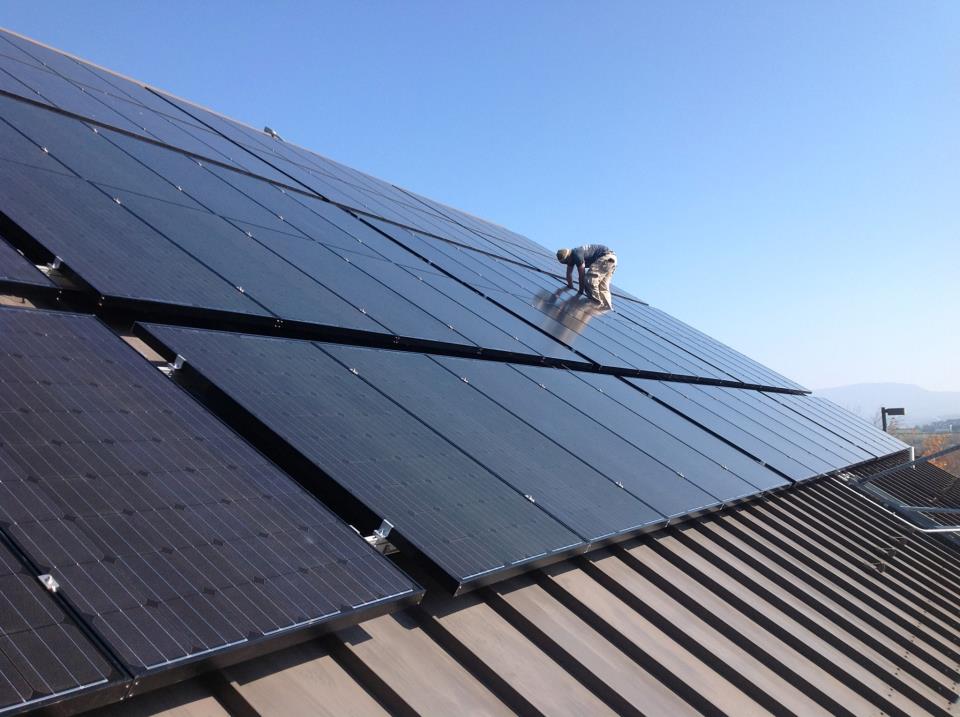
Photo credit Matt Ruscio, Secure Futures LLC

Photo credit Matt Ruscio, Secure Futures LLC

Appalachian Power Company (APCo) has spent the past two years ducking its Virginia customers who want the ability to buy solar power from third-party providers. This spring it finally unveiled what it claims will be the answer to their prayers: a bizarre, convoluted “Experimental Rider R.G.P.,” available only to certain larger customers like colleges and universities.

Under this proposal, a customer can arrange to have solar panels installed and owned by a third party developer but won’t be allowed to use the electricity or take advantage of net metering, as it would if it owned the system itself. The customer will have to continue buying dirty electricity from APCo, while the solar electricity the customer is also paying for is sold onto the grid, and the customer credited for its value according to a complicated and unfriendly formula. Instead of breaking even or saving money on electricity bills by going solar, the customer will pay substantially more.

By contrast, normally a customer who installs solar uses the solar electricity “behind the meter,” reducing the use of dirty electricity from the grid and saving money, especially if it had been paying high demand charges to its utility, as many institutions do.*

The limitations and poor economics of APCo’s proposal has would-be customers and solar advocates crying foul. According to an analysis by Professor Mark “Buzz” Belleville of the Appalachian School of Law in Grundy, VA, the program is so expensive that it’s not likely to get any takers. Worse, he concludes, “The [State Corporation Commission’s] approval of the proposal would actually be counterproductive to solar deployment in Virginia.”

That’s because “APCo will be able to claim that they made a [Power Purchase Agreement] program available, and the fact no one signed up shows that there is simply not a demand for PPAs in SW Virginia. Moreover, the SCC’s approval may strengthen APCo’s argument that PPAs are not legally permissible in APCo territory unless they are entered into pursuant to its SCC-approved program, and it will lay the groundwork for utilities to argue that a customer who has a PPA is not eligible for net metering under Va. Code §56-594.”

Understanding what’s at stake here requires a short history lesson. Back in 2011, a solar developer out of Staunton, Virginia, called Secure Futures LLC installed a solar array on a rooftop at Washington & Lee University. The parties used a popular financing approach known as a third-party power purchase agreement (PPA), which can let a customer go solar with no money down by having the developer keep ownership of the solar panels and sell the electricity they produce to the customer.

Federal tax rules make PPAs especially important for tax-exempt entities like colleges that can’t use the 30% federal tax credit for renewable energy facilities. When a for-profit solar developer owns a facility, however, it can take the tax credit and pass on the savings to the customer.

PPAs appeared to be explicitly authorized under Virginia law, but when Dominion Virginia Power got wind of the arrangement at Washington & Lee it moved quickly to block it, claiming a violation of its monopoly on the sale of electricity within its territory. Dominion’s weak legal position didn’t matter; the mere threat that the utility giant would unleash its army of lawyers was enough to stop the PPA in its tracks. The university completed its solar installation using an alternative, non-PPA approach.

Dominion had won the skirmish, but at a price. The utility took such a drubbing in the court of public opinion that it eventually acceded to legislation in 2013 establishing a limited “pilot program” under which not-for-profit entities and some commercial businesses can use PPAs, at least through the end of 2015. Secure Futures has gone on to develop additional solar projects in Virginia under the legislation, including at the University of Richmond and, under a just-announced deal, at six Albermarle County schools.

APCo, however, didn’t participate in the pilot program, and it has steadfastly resisted efforts to bring it into the fold, even in the face of mounting criticism. As Belleville pointed out in a Roanoke Times op-ed in March of 2014, the failure to extend the PPA law to residents of APCo territory put southwest Virginia at an economic disadvantage, closing it off to business opportunities that are available elsewhere in the state. Yet utility lobbying successfully defeated legislation this year that would have made PPAs explicitly legal statewide.

So southwest Virginia’s state of limbo persists, with many legal experts advising that PPAs are legal there under Virginia law, but most developers and customers unwilling to expose themselves to prolonged and expensive litigation to find out for sure. This state of affairs suits APCo very well. No doubt it calculates that the worst that can happen now is that the SCC rejects its rider and prolongs the state of limbo. Then the utility’s lobbyists will tell legislators it did its best to help customers but was prevented from doing so by that darned SCC.

APCo’s actions are those of a rational monopolist facing the threat of competition; it is easier to keep a competitor out of your market than it is to improve your product. But its efforts to throw roadblocks in the way of solar also reflect the suspicion, shared by many American utilities, that distributed solar generation benefits only the customer who installs it, at the expense of the utility and other customers. They believe this justifies them in making solar more expensive, even if it means preventing projects from being developed altogether.

This is a textbook example of cutting off your nose to spite your face, given the need for a rapid build-out of distributed solar generation to fight climate change and strengthen grid security. These are not considerations that hold much sway with Virginia’s SCC, however, so let’s confine ourselves to the cost argument.

The problem for APCo is that the notion that distributed solar increases costs for other ratepayers is mere conjecture, and neither APCo nor Dominion has offered any hard data to support it. Indeed, the only evidence from Virginia points the other way, according to Secure Futures CEO Tony Smith.

Since his company’s skirmish with Dominion, Smith has worked with a municipal utility, Harrisonburg Electric Commission (HEC), to study the financial impacts to the utility of Secure Futures’ first Virginia PPA project, a 104-kilowatt array installed in 2010 at Eastern Mennonite University in Harrisonburg (outside of Dominion territory).

The case study measured only the energy and capacity-related impacts of the solar array on the utility, ignoring the wide range of other benefits often considered in “value of solar” analyses. Analyzing three years’ worth of data, Smith found that the EMU array provided an average net benefit to the utility of $22.78 per kilowatt per year. The full technical analysis is available here. In an article soon to be published in the May/June issue of Solar Today, Smith writes:

Using a net benefit model developed in consultation with HEC management, we find that in the case of the EMU solar installation, the benefits to HEC outweigh the costs . . . Our net benefit results suggest that within HEC territory, solar installed for a commercial customer with demand exceeding 1,000 kW benefits all municipal utility stakeholders, including non-participants.

Certainly it would be interesting to repeat the analysis with data from more Virginia projects, including ones in APCo’s territory. But first, those projects have to get built. Right now that isn’t happening due to the PPA limbo. If APCo’s Experimental Rider gets approved—well, the projects still won’t get built, because no one will sign up.

Flip a coin: heads APCo wins, tails customers lose.

The SCC case is No. PUE-2015-00040. An evidentiary hearing is scheduled for September 29 at the SCC offices in Richmond, Virginia.

___________________________________

*Residential customers don’t pay demand charges, making this an unfamiliar concept to many people. Demand charges (KW) are fees over and above the cost of energy usage (kWh) that are assessed according to a customer’s peak power requirements, measured as the highest peak demand in a given 30-minute period during the month. For many institutions, demand charges can exceed the cost of energy usage, and using solar electricity to reduce peak demand is often a compelling reason to look at solar in the first place.

Unknown's avatar

Governor McAuliffe considers changes to Virginia fracking regulations, currently among worst in nation

Over the past year, guest blogger John Bloom has been studying Virginia’s regulations governing hydraulic fracturing with horizontal drilling–fracking–and assessing the commonwealth’s readiness to welcome natural gas drilling companies into communities where they have never operated before. With the McAuliffe Administration preparing to address the issue for the first time with new regulations, I asked Bloom to take over the blog this week and tell us how things look. –I.M.

IMG_0634Proposed changes to Virginia’s gas drilling regulations are on their way to Virginia Governor Terry McAuliffe for review. If he approves, the revisions will go out for public comment. Public safety and environmental advocates generally welcome the changes, as far as they go. There’s just one problem: the changes fail to address many of the serious risks posed by fracking.

The dismal state of Virginia’s regulatory regime has become a pressing issue because, if the fossil fuel industry has its way, unconventional shale gas drilling – fracking[1] — will soon be a part of Virginia’s landscape. The gas industry sees opportunities to drill into the Marcellus Shale in western Virginia and the Taylorsville Basin in Tidewater Virginia, where 80,000 acres are under lease already.

Is Virginia ready for this kind of fracking? The fracking industry seems to think so, and Virginia’s Division of Mines, Minerals and Energy (DMME), the agency in charge of regulating gas drilling, seems to think its regulations just need a few tweaks to make fracking safe in Virginia.

Before deciding whether or not a few tweaks is all we need, let’s consider the views of a drilling industry insider. According to Louis Allstadt, Mobil Oil Corporation’s former head of oil and gas drilling in the Western Hemisphere, “making fracking safe is simply not possible, not with the current technology, or with the inadequate regulations being proposed.”[2] He warns that “the industry will tell you that fracking has been around a long time. While that is true, the magnitude of the modern technique is very new.” Fracking now requires 50 to 100 times more chemicals and water than older wells, according to Allstadt. “This requires thousands of trucks coming and going. It is much more a heavy industrial activity.” Further, he warns that methane, which is 86 times more potent as a greenhouse gas than carbon dioxide over a 20-year period, “is leaking from wells at far greater rates than were previously estimated.”

The health and environmental risks of fracking include a litany of short-term and long-term threats to air, water, land, and human and animal health. The risks come from many directions, including the drilling process, the fracking process, the chemicals used, which typically include potent carcinogens and endocrine disruptors, the handling and disposal of large quantities of toxic wastewater, potential earthquakes, the pipelines and compressor stations needed to transport the gas, and disruption of local communities with lights, noise, heavy truck traffic, and the constant prospect of disastrous explosions and other industrial accidents. For an excellent review of recent findings, check out A Compendium of Scientific, Medical, and Media Findings Demonstrating Risks and Harms of Fracking (Unconventional Gas and Oil Extraction), published by Concerned Health Professionals of New York in December 2014.

After carefully studying the risks, Maryland and New York recently declared statewide moratoriums on fracking. Like Allstadt, they found that the risks outweighed the benefits. Other states, such as Pennsylvania, Ohio and West Virginia, have embraced drilling and are learning the hard way that modern fracking – if it’s going to happen at all – requires much more careful regulatory oversight than traditional drilling.

Proposed Revisions to Virginia’s Drilling Regulations Are Grossly Inadequate

Virginia’s regulations start off in an embarrassing place. According to a 2013 survey of shale gas regulations across the country, using two different methodologies, Virginia had the least stringent regulations of all 31 states with actual or potential shale gas production.[3] Given that, and given the rapid pace at which other states are learning from mistakes and tightening regulations, you might expect Virginia to study the potential risks of modern fracking techniques carefully, as Maryland and New York did, before deciding whether to allow them. At the very least, you might expect Virginia to conduct a rigorous review and update of its regulations. Unfortunately, you would be wrong.

Instead of a thorough review, Virginia’s DMME conducted a controlled review intended to update only a few aspects of the regulations. A driving force behind the review seemed to be a request by the drilling industry for Virginia to join an industry-endorsed approach to disclosing fracking fluid ingredients while continuing to protect alleged trade secrets.

DMME convened a review panel that notably lacked anyone from the Virginia Department of Health (VDH) or anyone else with public health expertise, despite the major public health issues involved in fracking. DMME staff led the panel through a handful of issues. The panel came up with exactly what was intended: piecemeal updates when a broader effort was badly needed. When environmental groups proposed a more thorough regulatory review, they were told their proposals were simply beyond the scope of what DMME would consider.

So what are the shortcomings of the proposed revisions? There are many, and the devil is in the details. Here are just a few examples:

  • The regulations would continue to allow drilling wastewater to be disposed of by spreading it on roadways, agricultural and forest land. Other states have correctly concluded that this is simply not a safe way to dispose of fracking waste.
  • The regulations would continue to allow the industry to use open pits to store toxic wastewater, while other states such as Pennsylvania now require closed tanks to avoid leaks, spills, and harm to wildlife.
  • The regulations authorize disposing of wastewater at an “offsite facility,” yet water treatment plants in Virginia cannot effectively process fracking waste. This would result in toxins passing through untreated, damaging Virginia’s waterways. How toxic wastewater will be tracked and disposed of needs to be more clearly spelled out and regulated, as it is in other states.
  • In western Virginia, drilling companies would still be allowed to bury drilling muds and cuttings (drilling waste products) at the well-site instead of hauling them offsite for safe disposal. This practice can result in heavy metals, radioactive materials, and other toxins leaching into the groundwater and contaminating soils. That practice is now forbidden in Tidewater Virginia, reflecting a growing double-standard between protections offered to eastern versus western parts of the state. Is western Virginia somehow less worthy of protection?
  • Virginia’s regulations contain no testing requirements or limits on hazardous air pollution and methane emissions from gas drilling operations, despite the recognition of methane as a potent greenhouse gas. Federal regulations may provide a floor in this area, but Virginia should enact higher standards.
  • Virginia regulations contain only a single setback requirement that wells be at least 200 feet from an occupied building – literally a stone’s throw. Other states have developed much more protective siting requirements taking into account floodplains, public water supply watersheds, fisheries, special lands, schools, hospitals and other important considerations. Virginians should have similar protections spelled out in regulations.

Correcting these deficiencies, and many other suggestions made by the Sierra Club and other environmental groups, were rejected as beyond the scope of DMME’s review.

Now It’s Up to Governor McAuliffe

Three actions are needed at this point, and all of them fall squarely within the authority of Governor McAuliffe. The Governor should:

  1. Direct his Administration to conduct a broad study of the health, environmental, economic and other risks and benefits of unconventional shale fracking in Virginia, so that a considered decision can be made about whether these new forms of fracking should be allowed, and if so, what regulations are needed.
  2. Direct DMME to conduct a thorough regulatory review that takes into account the findings of the Administration’s study and the extensive lessons learned from other states.
  3. Direct that no permits for unconventional shale drilling be approved until the first two steps have been completed.

As long as he takes the steps outlined above, it doesn’t matter much what the Governor does with the weak piecemeal regulatory revisions currently under his review. They could be folded into the broader regulatory review or enacted separately. The important thing is that the Governor isn’t fooled into thinking that these revisions are an adequate response to the threat fracking poses to Virginia’s health, safety and environment.

Taking these three steps should not be difficult for Governor McAuliffe. It would put into practice precisely the position on fracking that he took as a candidate in 2011:

“We should not do any of these techniques here in Virginia until everyone is 100 percent – 100 percent – sure of safety as it relates not only to the watershed but everything that comes off of that, as it relates to uranium, natural gas fracking… Let’s look at all the alternatives. Wind is clean, wind is safe. Solar is clean, solar is safe. So let’s get everything moving forward (while) studying these other things.”[4]

*  *  *  *

John Bloom, a public interest consultant, is chair of public health issues for the Virginia Chapter of the Sierra Club and serves on the Executive Committee of the Sierra Club’s Mount Vernon Group.

_____________________________________________________________________

[1] As used here, “fracking” and “unconventional drilling” refer to newer forms of high volume hydraulic fracturing, or similar forms of well stimulation using liquid nitrogen or other materials, combined with horizontal drilling.

[2] Allstadt was referring to draft regulations in New York, which were much more stringent than Virginia’s. See Brian Neering, Albany Times-Union, April 22, 2014, “Former Mobil Oil exec urges brakes on gas fracking,” available online at http://www.timesunion.com/business/article/Former-Mobil-Oil-exec-urges-brakes-on-gas-fracking-5422292.php.

[3] Nathan Richardson et al, The State of State Shale Gas Regulation, at pages 18, 20 (June 2013), available at http://www.rff.org/rff/documents/RFF-Rpt-StateofStateRegs_Report.pdf.

[4] Terry McAuliffe, in an interview with Jan Paynter, Host, Politics Matters, September 2011. Available online at https://www.youtube.com/watch?v=EFvDrh92xpM.


Unknown's avatar

Virginia schools taking giant steps into solar, and saving money for taxpayers

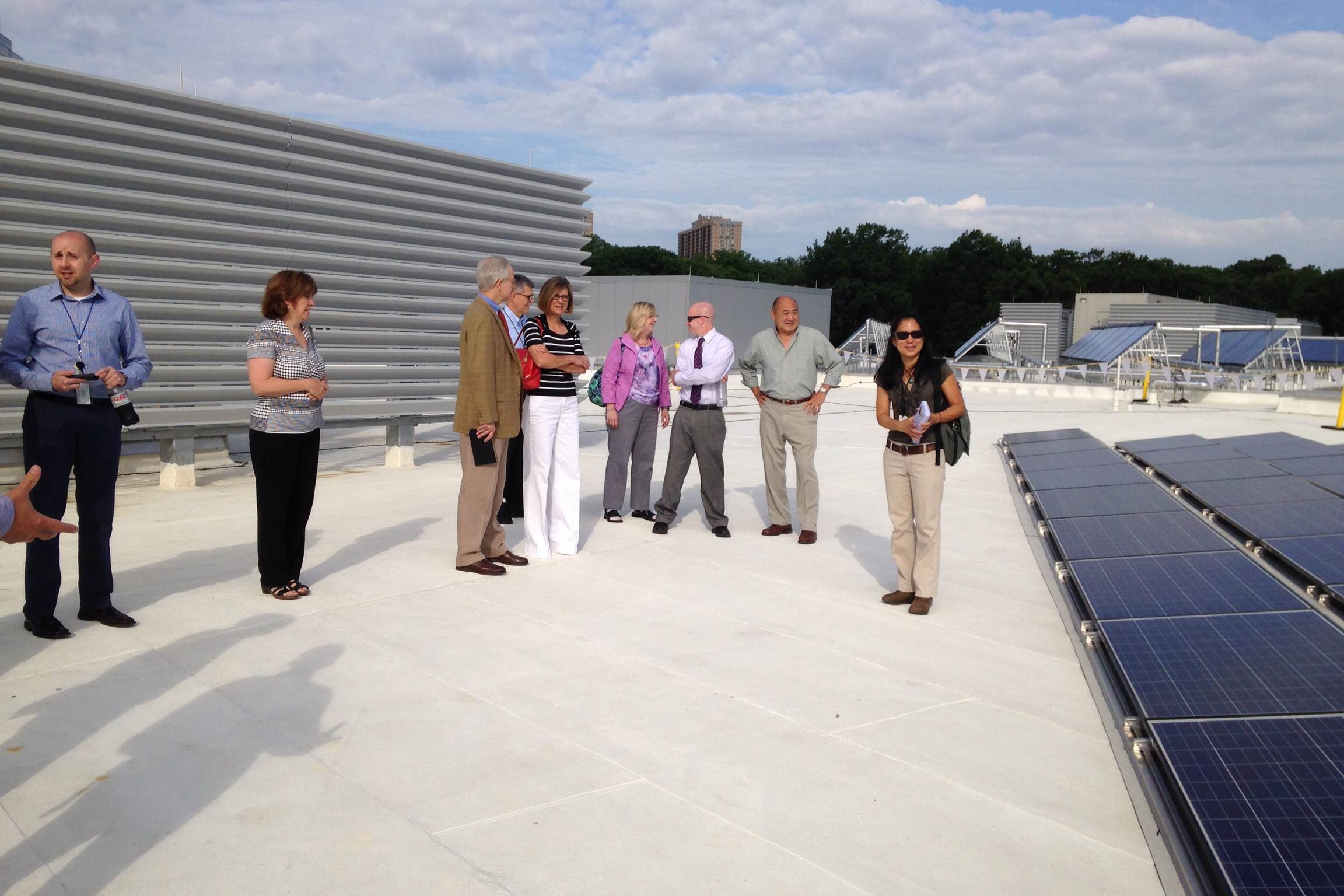
Visitors tour the solar installation on the roof of Wakefield HS in Arlington. Photo credit Phil Duncan

Visitors tour the solar installation on the roof of Wakefield HS in Arlington. Photo credit Phil Duncan

Amory Fischer was a high school sophomore in Albermarle County in central Virginia four years ago when he got interested in the idea of using solar panels to provide some of the power used by the local schools. He found a lot of people shared his enthusiasm, but economic and policy hurdles stood in the way.

In 2012, a local middle school used federal stimulus money to install solar PV and solar hot water. Unfortunately, schools without grant funding couldn’t afford to follow suit. Although the cost of solar panels had fallen to record low levels, buying and installing them still required a significant upfront capital investment. And as tax-exempt entities, public schools couldn’t take advantage of the 30% federal tax credit available to residents and businesses.

Then, in 2013, the Virginia General Assembly passed a law allowing nonprofits and local governments, among others, to buy solar power using a tax-advantaged financing method known as a third party power purchase agreement (PPA).* PPAs can be structured to require no upfront capital from the customer, just payment for the electricity the solar panels produce. Suddenly, for the first time, the economics favored solar for Virginia schools.

Amory and fellow students collaborated with Lindsay Snoddy, the school division’s Environmental Compliance Manager, and spent the next year educating teachers, staff, parents and the community about the benefits of solar and the opportunities presented by the new law. Partnering with environmental groups 350 Central Virginia and the Piedmont Group of the Sierra Club, they formed the Solar Schools Initiative and circulated a petition that garnered nearly a thousand signatures in support of putting solar on Albermarle schools.

It worked. Once school board members understood that a PPA would let the schools install solar panels at no additional cost premium over regular “brown” power—and indeed, would even save them money—their support was unanimous. The school board issued a Request for Proposals and chose Staunton-based solar developer Secure Futures, LLC to develop the projects.

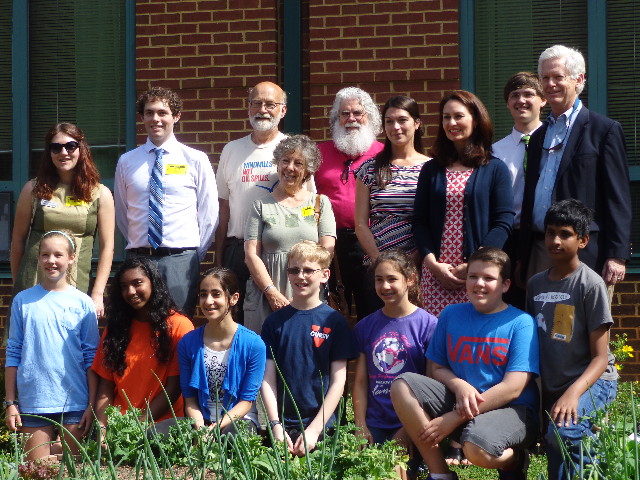
Students and community members gather at Sutherland Middle School in Albemarle County on May 28 to celebrate the student engagement that led to the signing of a contract to put solar on Sutherland and five other schools.

Students and community members gather at Sutherland Middle School in Albemarle County on May 28 to celebrate the student engagement that led to the signing of a contract to put solar on Sutherland and five other schools.

Six area schools will have solar panels installed by the end of this year: two high schools, a middle school, and three elementary schools. Together, the installations will total 3,000 solar panels for a combined 1 megawatt (1,000 kW) of capacity, producing about 14% of the electricity used by the schools.

Amory Fischer is now a junior at Virginia Tech, where he studies Environmental Policy and Planning. This summer he will be working for Secure Futures and trying to encourage more schools across the Commonwealth to go solar.

He will find a promising market, so far largely untapped. A small number of schools elsewhere in Virginia already boast solar panels, but most of them are small systems designed more for their educational value than to make a significant contribution to the school’s power demand. One significant exception is the Center for Energy Efficient Design, an educationally-focused building in Franklin County that “enables students and community members to explore various energy devices and techniques to make intelligent decisions about energy and housing.” It was completed in 2010 and designed to PassivHaus and LEED Platinum standards. In addition to solar panels, two wind turbines help meet the electric demand, and the building includes other energy and water-saving features like a geothermal system, solar hot water and a green roof. The project reflects an impressive commitment from the Franklin County School Board going back to 2004.

More recently, Arlington County has made a commitment to sustainable design in its schools as well as other county-owned buildings. Its LEED Gold-certified Wakefield High School, completed in 2013, includes a 90-kW solar PV installation. The county’s next school building will be even more ambitious. Discovery Elementary School, under construction on the grounds of Williamsburg Middle School, will include 496 kW of solar to allow the super-efficient building to produce as much electricity as it consumes. Buildings that achieve that feat are referred to as “net zero energy.”

Net zero is also the goal of advocates in Harrisonburg, who are pushing the city to include solar and other green features on a school building that is currently in the design phase. Bishop Dansby, a member of the Harrisonburg-Rockingham Green Network, says residents collected more than 800 signatures in support of a net zero energy school, but the school board has not told them yet whether it will adopt the recommendation. One encouraging sign: the board has hired Charlottesville-based VMDO Architects, the firm behind Arlington’s Discovery school.

Other Virginia localities are decidedly lagging, including ones you’d expect to see in the lead. Affluent, tech-savvy Fairfax County is missing in action on solar schools; advocates point to an insular and uninterested school bureaucracy as the primary barrier. A group of students at Thomas Jefferson High School for Science and Technology hopes to change that with a petition drive aimed at getting the county to act.

_____________________

*Unfortunately, the 2013 PPA law applies only to customers of Dominion Virginia Power as part of a two year “pilot program.” The legality of PPAs elsewhere in Virginia is unclear. However, Secure Futures offers a PPA alternative called a Customer Self-Generation Agreement that offers similar benefits. The company believes is legal in all parts of Virginia.

Unknown's avatar

Sierra Club’s 2015 Legislative Scorecard Reflects Partisan Divide on Climate Change

Photo credit: Corrina Beall

Photo credit: Corrina Beall

The Virginia Chapter of the Sierra Club just published its second annual Virginia General Assembly Climate and Energy Scorecard. The Scorecard grades Virginia’s state elected officials on the votes they took during the 2015 General Assembly Session on legislation that will have a direct impact on Virginia’s energy policy and strategy to mitigate and adapt to climate change.

This was the General Assembly’s first opportunity to weigh in on the Environmental Protection Agency’s Clean Power Plan, the nation’s first effort to deal with carbon pollution. The plan gives new momentum to the transition underway in the electric sector away from dirty coal and towards clean energy like efficiency, wind and solar. The plan won’t be finalized this summer, but a lot of Republicans have already decided they’d rather fight than switch.

So although two-thirds of Virginians support government action to reduce climate pollution, Republican legislators in the Commonwealth mostly toed the party line when it came to voting on climate bills. This brought down their GPAs on the Scorecard.

Another problem—affecting members of both parties—was a tendency to toe the Dominion Virginia Power line. As we have seen, bills Dominion liked got passed, and ones it didn’t like were killed. Virginia Sierra Club Director Glen Besa put it this way: “Too many legislators from both parties defer to Dominion Virginia Power on energy policy matters, and that is why Virginia continues to lag in energy efficiency, and solar and wind investments compared to our neighboring states.”

Yet a number of legislators received perfect scores, and some received extra credit for introducing important bills, even when they did not pass or even make it out of small-but-hostile subcommittees.

Looking at the scorecard, you might wonder about all the clean energy bills we tracked this year, but which don’t show up as scorecard votes. The reason is that most of those good bills were killed in House subcommittees, where votes aren’t recorded. If the House leadership would kindly change that practice and ensure that all bills get recorded votes, we would have a lot more to work with.

Even with these limitations, people who have lobbied in the General Assembly will find the Scorecard a reasonably accurate reflection of members’ positions on energy and climate. Yes, we would have expected better scores for a handful of Republicans who have been real leaders on clean energy; it is unfortunate that their climate votes dragged down their grades.

But that’s what happens when climate change is treated as a political zero-sum game and party members are forced to choose whose side they’re on. Perhaps next year, with the Clean Power Plan finalized, legislators will find themselves able to move past the political posturing and turn their attention to the pressing need for solutions. Certainly, we’d like to see more “A” students.

Thirteen Senators scored a perfect 100%, including Sen. Barker (D-39), Sen. Colgan (D-29), Sen. Dance (D-16), Sen. Ebbin (D-30), Sen. Favola (D-31), Sen. Howell (D-32), Sen. Lewis (D-6), Sen. Lucas (D-18), Sen. Marsden (D-37), Sen. McEachin (D-9), Sen. Miller (D-1), Sen. Petersen (D-34) and Sen. Wexton (D-33).

Twenty-five Delegates scored a perfect 100%, including Del. Bulova (D-37), Del. Carr (D-69), Del. Filler-Corn (D-41), Del. Futrell (D-2), Del. Herring (D-46), Del. Hester (D-89), Del. Hope (D-47), Del. Keam (D-35), Del. Krupicka (D-45), Del. Lopez (D-49), Del. Mason (D-93), Del. McClellan (D-71), Del. McQuinn (D-70), Del. Morrissey (I-74), Del. Murphy (D-34), Del. Plum (D-36), Del. Preston (D-63), Del. Sickles (D-43), Del. Simon (D-53), Del. Spruill (D-77), Del. Sullivan (D-48), Del. Surovell (D-44), Del. Toscano (D-57), Del. Ward (D-92) and Del. Watts (D-39).

To view the Scorecard online, visit the Virginia Sierra Club’s website at vasierraclub.org or on Facebook.

Unknown's avatar

In reversal, Virginia AG says localities may ban fracking

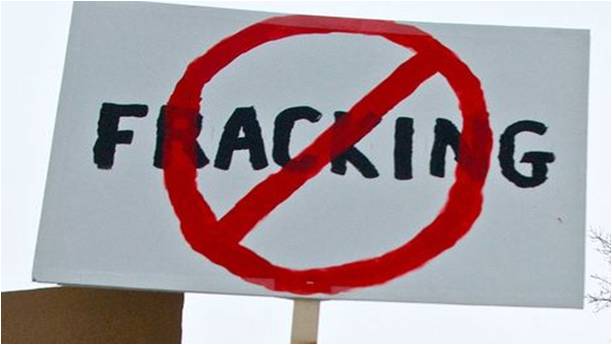
fracking signVirginia Attorney General Mark Herring issued an official advisory opinion on May 5 holding that Virginia localities have the right to prohibit hydraulic fracturing (or “fracking”) as part of their power to regulate land use within their boundaries. The letter reverses a two-year-old opinion by former Attorney General Ken Cuccinelli.

Herring’s opinion cites §15.2-2280 of the Virginia Code, which grants broad zoning powers to localities. These include the power to “regulate, restrict, permit, prohibit, and determine” land uses, such as “the excavation or mining of soil or other natural resources.” Thus, writes Herring, “I conclude that the General Assembly has authorized localities to pass zoning ordinances prohibiting fracking. The plain language of the stature also authorizes localities to regulate fracking in instances where it is permitted.”

Herring’s opinion comes in a letter to Senator Richard Stuart, who had asked whether Virginia law allows localities to prohibit “unconventional gas and oil drilling,” commonly known as fracking, and whether they may use their zoning authority “to regulate aspects of fracking, such as the timing of drilling operations, traffic, or noise.”

The letter overrules a January 11, 2013 opinion by then-Attorney General Ken Cuccinelli, which held that the General Assembly had preempted localities’ right to regulate or ban drilling when it passed the Virginia Gas and Oil Act. Under §45.1-361.5, localities may not “impose any condition, or require any other local license, permit, fee, or bond to perform any gas, oil or geophysical operations which varies from or is in addition to the requirements of this chapter.”

But, Herring notes, the statute “also includes a savings clause stating that the Act does not ‘limit or supersede the jurisdiction and requirements of . . . local land-use ordinances.’” Thus, it explicitly preserves local zoning authority to prohibit or limit fracking.

Herring concludes, “To the extent that the 2013 Opinion conflicts with this conclusion, it is overruled.”

Interestingly, if localities choose to restrict fracking but not prohibit it, they may actually leave themselves more open to challenge. Herring’s opinion reaffirms that portion of Cuccinelli’s opinion that upheld the right of localities to impose some restrictions on fracking, short of outright prohibition. However, the restriction must be “reasonable in scope” and “not inconsistent with the Act or regulations properly enacted pursuant to the Act.” As a result, a fracking company might have a better shot at challenging a restriction than it would an outright ban.

Herring adds, “Determining the extent to which particular zoning restrictions on fracking may possibly be preempted by state law will be governed by the particular facts, restrictions, and regulations at issue. Consequently, I can express no opinion on whether any particular zoning restriction has been preempted.”

Unknown's avatar

As sea level rise accelerates, buying shorefront property becomes a game of musical chairs

Sea level rise graphThank God for climate change deniers. They may eventually be the only buyers for shorefront real estate.

Sea level rise may not cause widespread flooding until later in this century or into the next one, but real estate deals involve long timelines: the useful life of a new house or a commercial building can be at least fifty years, while an infrastructure project might last a hundred years or more.

And of course, it’s one thing to lose your house, and another to lose the ground beneath it. Sea level rise means low-lying real estate now comes with an expiration date.

So smart buyers—and landowners—have to consider not just today’s flood maps, but also ones that haven’t been drawn yet. If a rising sea will threaten property some decades from now, it will depreciate over time, like a car. At some point only chumps and climate deniers will buy.

Head-in-the-sand posturing still dominates the headlines, like Florida Governor Rick Scott’s alleged ban on the use of the term “climate change,” or the North Carolina legislature’s silly (and costly) attempt to legislate sea level rise out of existence. Now the Federal Emergency Management Agency (FEMA) hopes to force states to get serious about climate change by requiring states to do a better job planning for natural disasters caused in part by global warming. FEMA’s goal is to save money through better planning, but conservatives have attacked the requirement as politically motivated.

Meanwhile, however, many states and localities have already begun using sea level rise forecasting in their planning. The projections will help land use planners determine not just where to allow growth, but also where to defend existing development against the incursion of the sea, and where the wiser course is to retreat. And of course, the studies should inform the decisions of anyone thinking of buying property on the coast.

Two recent studies provide a picture of sea level rise in Virginia. The Virginia Institute of Marine Science (VIMS) issued its report in January 2013, titled Recurrent Flooding Study for Tidewater Virginia. Building on that study and others, on March 10 of this year the Sierra Club released Sea Level Rise: What Should Virginia Plan For?

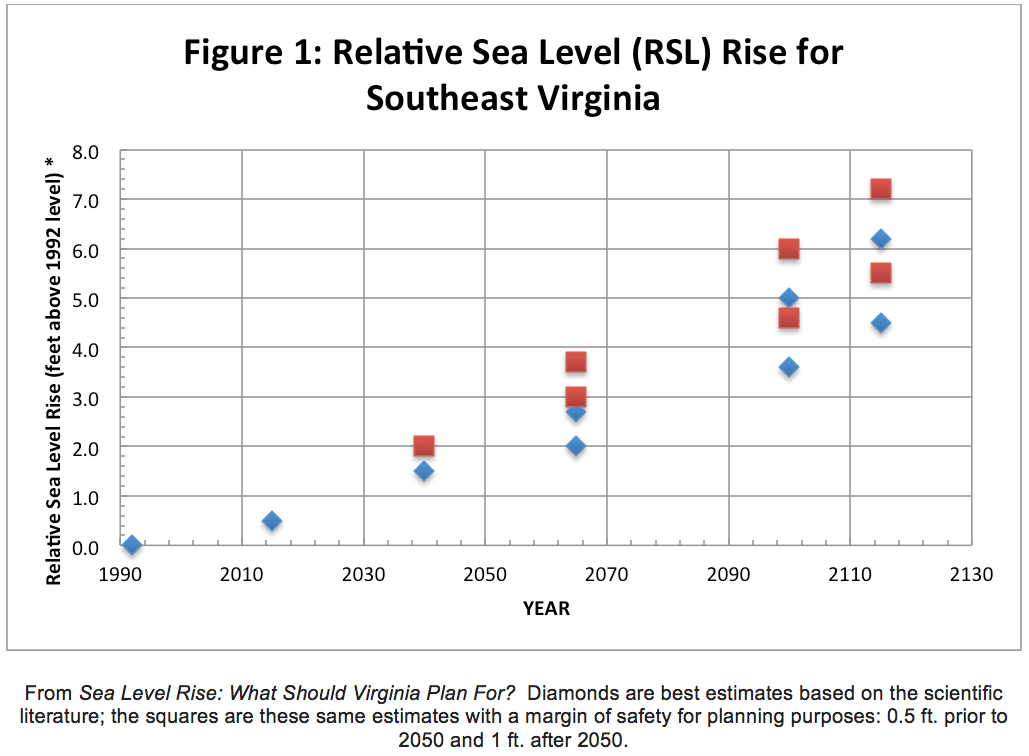
Both studies agree on some pretty sobering numbers. By the end of this century, the sea level in Norfolk, Virginia, is projected to be 3.6-5 feet above the level in 1992. By that point, the sea will be rising more than half a foot per decade. The numbers are higher for Virginia than for many states, in part because the land around Hampton Roads is also sinking at a rate of about one foot per century.

Although Hampton Roads gets most of the media attention, sea level rise threatens the entire Virginia coastline and the tidal portions of rivers, including the Potomac River all the way up to Alexandria and Washington, D.C. A whole lot of people should be consulting topographic maps before they make their next real estate decision.

The Sierra Club report focuses in on specific timeframes that matter in real estate decisions: twenty-five years for short-term projects, fifty years for new homes, and a hundred years for infrastructure projects. With a one-foot margin of safety added in, the report recommends that anyone considering a new project or building today with a 50-year expected life should plan for as much as 3.7 feet of sea level rise over the 1992 baseline. That number becomes 5.5-7.2 feet when the planning horizon is extended out a hundred years, to 2115.

(The “good” news is that the sea rose half a foot between 1992 and today, so you get to subtract six inches from these projections if you are starting now.)

Results are stated as a range rather than a precise number because the actual level will depend on many factors. Researchers agree that a certain amount of sea level rise is “baked in” as a result of greenhouse gas emissions to date, but future emissions will play a big role in determining how much the seas rise in the long run. Providing a range allows users to decide how much risk they are willing to take. Even at the high end, there are caveats; new information about melting ice in Eastern Antarctica could make today’s projections too conservative.

Right now many shore communities are hosting a game of musical chairs. Developers continue to build and sell new housing, figuring they can earn a good return on their investment and get out before the market collapses. Buyers aren’t told about the risks. Sea level rise is bad for business, so business would rather not talk about it. And some local governments soft-peddle the news, afraid of setting off a panic that will make the collapse of the real estate market a self-fulfilling prophecy.

The Virginia General Assembly took action this year to require localities in the Hampton Roads Planning District Commission to include measures addressing sea level rise in their comprehensive plans. The District includes 16 local governments in southeast Virginia, but that’s only a fraction of the counties and cities vulnerable to sea level rise.

Another bill requires that the disclaimer form provided to home buyers across the state include language warning that the seller makes no representations about whether the property is located in a “special flood hazard area” or may require flood insurance, putting the onus on buyers to inquire. While prudent buyers will follow through (and mortgage lenders will make sure they do), today’s flood maps don’t reflect tomorrow’s reality.

So these bills are a good start, but Virginia needs to do more. Local governments outside of Hampton Roads need specific guidance for planning, and the public needs better education about the floods to come. By the time the sea claims low-lying neighborhoods from Virginia Beach up to Alexandria, there may not be enough climate deniers left to buy everyone out.

Unknown's avatar

Virginia’s General Assembly likes solar energy. Will that be enough?

Emojione_1F31E.svgVirginia’s General Assembly broke new ground in February when it passed legislation declaring up to 500 megawatts of utility solar power “in the public interest.” The language will help projects gain regulatory approval from the State Corporation Commission, which has been hostile to renewable energy. Dominion Virginia Power wants to build up to 400 MW of solar by 2020.* If the utility follows through, Virginia will finally join the solar revolution underway across the U.S.

Emojione_umbrella.svgIt’s important to acknowledge the limitations of the legislation, though. It was written by and for Dominion, not for the solar industry or Virginia residents. The utility does not want its customers installing solar power for themselves or buying it from anyone else, hence the limitation to utility-owned projects of at least 1 MW. So people who want to see more distributed generation, especially customer-owned, rooftop solar, found little to cheer about in this legislation.

Twemoji_exclamation question.svgOthers took a glass-half-full view. For climate activists, all solar is good solar, and big projects produce more than little projects. It would take 4,000 houses, each with an average 5-kW system, to produce as much power as a single 20-MW project like the one Dominion plans for Remington, Virginia. (The Remington facility is the only solar project Dominion has identified so far in the commonwealth.)

But of course, if you can get 4,000 houses with solar in addition to a 20-MW solar farm, then you’ve got twice as much solar altogether. Glass totally full: insert your happy emoji here.

The optimists hope that success with utility-scale solar will demonstrate the value of the resource and lead to better policies for distributed solar as well. A look at the experience of other states shows that is not inevitable. States with policies that promote residential and commercial solar, like New York and New Jersey, see a lot of those projects. States that mainly incentivize utility ownership, like North Carolina and Nevada, haven’t seen much else.

Dominion unquestionably won this round in the General Assembly, getting a seal of approval for its own projects while locking out most of the competition. Only two bills passed this year lowering hurdles to customer-owned renewables, and neither of them help homeowners. One bill raises the project size limit on net-metered facilities from 500 kW to 1 MW, a change sought by Virginia’s universities and by the solar developer Secure Futures LLC, whose business model focuses on large nonprofit institutions. The other enables localities to help finance energy efficiency and renewable energy projects on commercial properties using what are known as property-assessed clean energy, or PACE, loans.

Many more bills sought by renewable energy advocates went down to defeat in the face of utility opposition, including things like a grant program and a community net-metering bill that could have had a transformational impact on the industry.

That leaves just one initiative that advocates will be watching closely to see if it produces any opportunities for customer-owned solar. Legislation establishing the Virginia Solar Development Authority, HB 2267 and others, says it will “support the development of the solar industry and solar energy projects

by developing programs that increase the availability of financing for solar energy projects, facilitate the increase of solar energy generation systems on public and private sector facilities in the Commonwealth, promote the growth of the Virginia solar industry, and provide a hub for collaboration between entities, both public and private, to partner on solar energy projects.”

The bill is a little vague as to just how all this will happen. The Authority has no regulatory power and no budget. Many of its duties involve finding money, as in the paragraph empowering it to help utilities deploy 400 MW of solar projects by “providing for the financing or assisting in the financing of the construction or purchase of such solar energy projects.”

Another provision, however, empowers the Authority to “identify and take steps to mitigate existing state and regulatory or administrative barriers to the development of the solar energy industry.” Of course, one of those barriers is the anti-competitive maneuvering of our utilities to protect their monopoly positions.

The Authority should perhaps take a lesson from the DEQ-facilitated Small Solar Working Group, which I helped form in 2013 with a goal of developing pro-solar legislative proposals. The problem we ran into was that utilities were determined to ensure we did not put forth any legislative proposals, and we had made the mistake of letting them into the group. If utility executives get appointed to the Solar Authority, it could be déjà vu all over again.

Delegate Tim Hugo, for one, thinks the Authority will lead to more distributed generation as well as utility solar. “The intent of the legislation is to create an opportunity to develop a broad range of projects including distributed customer owned generation and to help facilitate a solar industry in Virginia,” he told me.

Hugo, one of the sponsors of the Authority bill, is one of the Commerce and Labor committee members who helped defeat other bills sought by the solar industry. But if distributed solar is to thrive in Virginia, it will require legislators like Hugo to become its champions.

Hugo, a Republican, considers himself a staunch solar advocate, going back many years. “In 2007,” he reminded me, “I sponsored HB2708 dealing with net metering, which would require utilities to purchase excess electricity produced by a customer-generator.” Last year he sponsored bi-partisan legislation exempting from real and personal property taxes solar equipment that generates 20 megawatts or less, a change critical to the economics of commercial solar projects.

But relatively few legislators from either party are willing to oppose Dominion, and therein lies the rub. The company considers monopoly control its right, and it doesn’t yield an inch without getting something for it. On the other hand, this was a bad year in the press for Dominion. Editorial boards across the state lambasted the company over legislation that will let it shield excess profits for the next several years. The public, too, is irritated with the slow pace of solar, and it knows whom to blame. That provides an opening for pro-solar legislators. We’ll see if they take it.


*Dominion was the moving force behind this legislation, but it applies as well to Appalachian Power Company. When I asked an APCo lobbyist whether its passage means more solar in APCo’s future, he merely referred me to the company’s 2014 Integrated Resource Plan, written a year ago. It lays out plans for small additions of utility solar beginning in 2019, scaling up gradually to a cumulative total of 500 MW in 2028—or about half as much as North Carolina already has today.

Unknown's avatar

Virginia’s legislative session ends. How did we do?

Photo credit: Corrina Beall

The General Assembly made a mad dash to the end of the 2015 legislative session last week. House Republicans were in a hurry to finish up a day early, even if bills suffered as a result, in the peculiar belief that prioritizing speed over quality would demonstrate their competence.

Apparently they thought that would play to the anti-government crowd. And I guess it does; if you weren’t anti-government before they pulled a stunt like that, you probably are now.

Being in a rush had to be their excuse for that ethics bill they pushed through in the final hours. I can finally understand why Senator Dick Saslaw says, “You can’t legislate ethics.” What he means is that the Virginia General Assembly can’t legislate ethics. Most of the rest of us would have no problem doing it. Our legislators, however, are just too fond of living well on the tab of corporate lobbyists.

So the new bill drops the gift limit from $250 to $100—but then removes the aggregate cap, allowing for an unlimited number of $99 gifts. Gifts that go over the limit but that are donated to charity now don’t count, providing a nice way for a legislator to buy popularity at no expense to himself.

A report from the group ProgressVA analyzes the bill’s effect and concludes that some 70% of lobbyists’ 2014 giving would still be legal under the new law, while opening up some brand-new loopholes. Among the most egregious is that lobbyists and their clients will now be able to pay for legislators to fly around the state for official meetings without the travel having to be disclosed, much less reimbursed. This means legislators from southwest Virginia can expect even more face time with coal lobbyists, but now on corporate jets—and their constituents will never know about it.

Addressing (or not) the issue of extravagant vacations paid for by companies with business before the legislature, the bill imposes a requirement that there be “a reasonable relationship between the purpose of the travel and the official duties of the requester.” That means junkets to France paid for by Virginia Uranium are still okay. So is letting corporate America pay for you to attend meetings of the American Legislative Exchange Council (ALEC), where lobbyists can teach you how to hobble environmental regulators and suppress voting.

If you can’t figure out a way to meet the reasonable relationship test (and I’m embarrassed for you if you have so little imagination), you can still accept a fun travel adventure as long as Virginia’s toothless ethics council approves it—or simply doesn’t act within five days of your request.

And of course, this so-called ethics reform makes no attempt to address the biggest obstacles to honest government in Virginia: the flood of corporate money into campaign chests and the ability of legislators to use campaign money for personal expenses. Even if Governor McAuliffe fixes the serious flaws in the ethics bill, nothing in it will stop companies like Dominion Resources from continuing to use cash to corrupt the democratic process.

Which brings us to energy legislation. The Associated Press summed up the situation very nicely: “Virginia’s 2015 legislative session was a good one for energy giant Dominion Resources Inc., the state’s most politically influential company. Legislation it wanted passed, passed. Bills it didn’t like did not.”

Chief among the legislation Dominion wanted was Senator Wagner’s SB 1349, which spares Dominion from having to refund excess profits for the next five years. Pretty much every newspaper in the state editorialized against it, so I’ll spare you a rehash of its failings.

Sadly, Governor McAuliffe signed the bill without amendments. He told reporters, “It was clear to Dominion that at the end of the day a veto would have been devastating for them.” If so, that’s a lot of leverage the Administration squandered.

And really, Governor, “devastating”? But since you fell for that, can I interest you in a bridge in Brooklyn?

SB 1349 does contain some welcome language calling solar energy projects of at least 1 MW in size, and up to an aggregate of 500 MW, “in the public interest,” a phrase that will help utilities when they seek approval for these projects at the State Corporation Commission. But nothing actually requires the utilities to build these projects, and the 1 MW size minimum has been carefully crafted to be above the limit for net-metered solar projects. Dominion wrote the bill for itself, not for ordinary people who want to go solar on their own.

The solar language was not originally part of SB 1349; it was imported from another Dominion bill, Delegate Yancey’s HB 2237, as a way to get buy-in from the solar industry and Democrats.

As for customer-owned solar, this was another bad year. The only concession won from Dominion was an increase in the size cap for net-metered projects from 500 kW to 1 MW, a compromise from the initial proposal of 2 MW.

Wherever else solar advocates faced utility opposition, they lost. That includes bills on community net metering, solar gardens, RPS improvements, expanded 3d party PPA availability, and a higher hurdle for standby charges. Also going down to early defeat was the renewable energy grant program that had been celebrated last year as a near-triumph (it only lacked passage again this year, plus—oh yeah—funding).

The GA did pass one of the Governor’s solar priorities, establishing the Virginia Solar Energy Development Authority (HB 2267 and others). The Authority is explicitly tasked with helping utilities find financing for solar projects; there is no similar language about supporting customer-owned solar. The Authority is supposed to identify barriers to solar, but isn’t given any tools to remove them. So we shall see.

Bills that did not require Dominion’s approval did better. Chief among these was legislation enabling Property Assessed Clean Energy (PACE) loans for commercial customers. This should help bring low-cost financing to energy efficiency and renewable energy projects at the commercial level.

And while Dominion’s sole concession to energy efficiency this year was agreeing to a “pilot program” of unspecified size as part of the SB1349 deal, natural gas utilities sought and won legislation (SB 1331) that makes it easier to win regulatory approval for energy efficiency programs that could benefit lots of customers. The difference is that natural gas companies have “decoupled” profits from sales, so it’s in their interest to help customers use energy more wisely. Dominion and Appalachian Power, by contrast, have a profit model that requires ever-increasing sales, making efficiency bad for business.

While legislators repeatedly shot down any solar bills that might be characterized as subsidies, they dropped their free market principles when it came to subsidies for coal mining. Unless the governor vetoes HB 1879, Virginia taxpayers will continue to pay tens of millions of dollars annually to prop up an uncompetitive industry with a long legacy of poisoning our air, land and water. Anyone who is ever tempted to believe a Virginia Republican’s claim to legislate based on his conservative principles and not merely on politics should check how they voted on this bill. (Here are the House votes, and here are the Senate votes.)

The limited progress made this year towards greening our energy supply does not bode well for compliance with the EPA’s Clean Power Plan. The only legislation that would have moved Virginia decisively towards compliance, by having us join the Regional Greenhouse Gas Initiative, died in committee. On the other hand, a number of bills that would have hindered compliance also died. True, SB 1349 makes the process harder by adding a hurdle to the closure of coal plants. Republicans also pushed through a bill that requires the Department of Environmental Quality to waste time and money studying whether the federal carbon reduction rules have health benefits beyond those gained by regulating conventional pollutants.

But overall, the session ended in a draw on climate issues. On the one hand, that’s bad, given that 2014 was the hottest year on record globally.* On the other hand, this is Virginia. Merely not regressing counts as progress here.

———————–

*I know, 2014 was not hot in eastern North America, and 2015 has started out with one of those winters that make people say they could use a little global warming. Nature has a keen sense of irony. But while you were shivering, the rising sea ate a little more of our shoreline.


Unknown's avatar

Surprise endings to a week of bad news on energy and climate bills

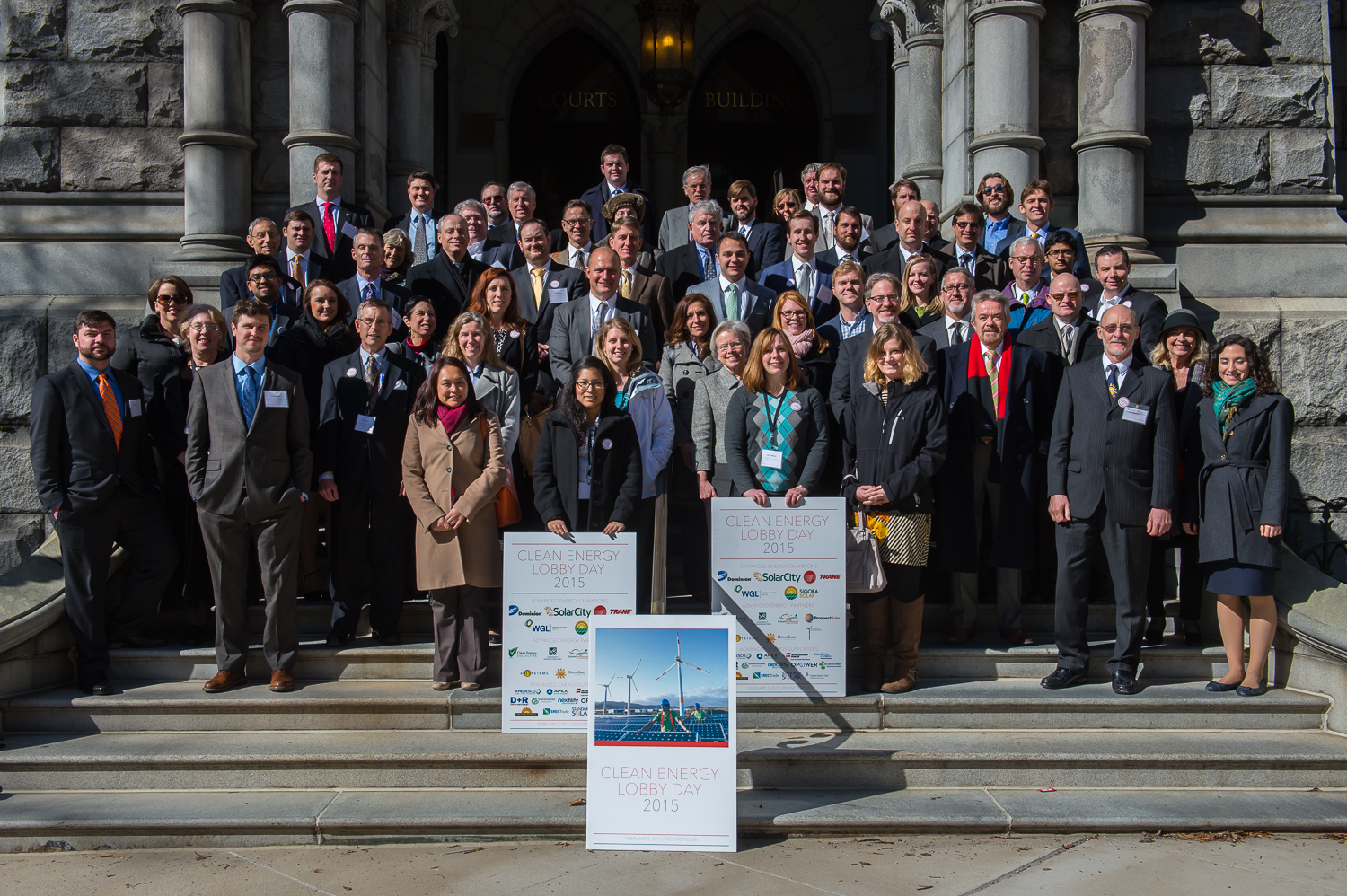
The fourth annual Clean Energy Lobby Day on February 3d brought representatives from businesses across the state to Richmond. Photo courtesy of MDV-SEIA.

The fourth annual Clean Energy Lobby Day on February 3d brought representatives from businesses across the state to Richmond. Photo courtesy of MDV-SEIA.

More than a hundred representatives of energy efficiency and renewable energy businesses descended on Richmond Tuesday for Clean Energy Lobby Day. After meetings with legislators, many of them stayed to attend a critical subcommittee meeting where most of this year’s clean energy bills came up for votes. And they came away with one overpowering impression: the only bills that can make it out of committee are the ones supported by the state’s utilities, especially Dominion Power.

But that wasn’t quite the end of the story. Because by the end of the week, they also found that the groundwork they had laid with their lobbing, and their tenaciousness before the subcommittee, created an opening they would not otherwise have had.

First, the bad news, and plenty of it

Things started bleakly. The House Commerce and Labor Subcommittee on Energy turned back multiple proposals that would have benefited Virginia’s small renewable energy and energy efficiency businesses, as well as their customers. Going down to defeat were bills to improve the renewable portfolio standard (HB 1913), create an energy efficiency resource standard (HB 1730), require a more rigorous study before utilities can impose standby charges (HB 1911), make third-party PPAs legal across the state (HB 1925), and enable an innovative vehicle-to-grid (V2G) project (HB 2073).

Left in limbo for the day was Delegate Minchew’s community solar bill, HB 1636. Minchew wasn’t ready to give up on it, but he had not found a way to get the utilities to back off their opposition. It went without saying that, without Dominion’s buy-in, the subcommittee members wanted nothing to do with it. Out of respect for a fellow Republican, however, they were willing to give him a couple of days’ grace. (On Thursday they killed the bill off.)

One small success was the raising of the cap for individual commercial renewable energy projects from the current 500 kilowatts to 1 megawatt (MW) (HB 1950). Bills to increase it to 2 MW were discarded. The bill was also passed out of the full committee on Thursday.

Also reported out was HB 2267, creating the Virginia Solar Development Authority. It passed in the full committee on Thursday but was then referred to the Committee on Appropriations.

With a few exceptions, the good bills lost on party-line voice votes following testimony from utilities in opposition to the measures. Republican committee members repeatedly expressed their concern about the potential impact on other ratepayers of bills that would make it easier for utility customers to generate their own power, or that would require utilities to buy a smidgeon more renewable energy.

Indeed, anyone who thinks Republicans don’t care about poor people should have been in that room. The outpouring of concern for struggling families was tremendously affecting. These brave souls made it abundantly clear that nothing that could be construed as a subsidy would sneak by on their watch.

Those of us who had seen some of the same delegates vote just last week to continue giving tens of millions of dollars annually in subsidies to coal companies, could not help noting the inconsistency.

Then a funny thing happened on the way to rubber-stamping Dominion’s solar bill

The anti-subsidy rhetoric was further undercut when, a few minutes later, the subcommittee unanimously approved Delegate Yancey’s bill (HB 2237) declaring it in the public interest for the state’s largest utility to install up to 500 MW of solar and offshore wind projects. Chairman Terry Kilgore did ask Dominion Power’s lobbyist if it would raise rates, but he was easily satisfied with the assurance that it would not—even though solar was “marginally more expensive.”

This was all the committee wanted to hear, and a motion had already been made to report the bill when the members were suddenly treated to an earful from the solar industry—not in support of the bill, but in opposition. Francis Hodsoll of Virginia Advances Energy Industries and Jon Hillis of MDV-SIEA, the solar industry trade association, praised the goal but urged that the bill be amended to open up competition for building the solar projects. Utilities might prefer to build the projects themselves to earn their guaranteed return on investment, said Hodsoll, but ratepayers would benefit from lower costs and in-state jobs if independent companies were eligible to bid.

Tony Smith of Secure Futures, LLC, further explained that federal tax incentives strongly favor independent companies developing projects instead of the utilities doing it themselves. He said an independent firm that develops a 20 MW project can sell solar for 5 cents per kilowatt-hour, a far better price than a utility can achieve building the same project itself.

Andy Bidea of Sigora Solar put the case most simply. “This is America. Let’s give capitalism a chance, right?”

Catchy idea. The committee proceeded to report the bill without changes, but Kilgore encouraged the patron to work with the solar industry on possible amendments prior to the full committee meeting on Thursday.

The industry’s stand had an effect. When the bill was taken up on Thursday, it included an amendment allowing utilities to buy power from a third-party developer before purchasing the project itself. This should be significant because the SCC would presumably insist on the lowest-cost approach. In an email, Francis Hodsoll told me the industry now supports the bill, which passed the full committee.

With Dominion’s recent announcements of its plans to move forward with as much as 400 MW of large-scale solar projects in Virginia, this is a hopeful sign for utility solar in the state. Only one project has actually been announced, a 20 MW project in Remington, Virginia. It should also make it easier for Dominion to move forward on offshore wind, a major plus.

Admittedly, the struggle for distributed solar continues. The happy ending on the Yancey bill means little to members of the industry struggling to make a living doing residential and small commercial projects. They had pinned a lot of hope on the grant program that passed with such fanfare a year ago, only to sink like a stone in a House subcommittee this session.

On the other hand, those who take the long view believe that once Virginians get familiar with the benefits of solar, it will become an unstoppable force. The indicators point to success in coming years whether utilities like it or not.

Climate? What climate?

In addition to the clean energy bills, the subcommittee also took action on two climate bills Tuesday. It rejected Delegate Villanueva’s HB 2205, which would have had Virginia join the Regional Greenhouse Gas Initiative as a vehicle to reduce carbon emissions. (The Senate companion bill died on a party-line vote last week.) It was the only legislation this year that would have taken positive action to address climate change and raise some of the enormous sums of money that will be needed to address the consequences of sea level rise.

Instead, it passed HB 2291 (O’Quinn), a bill that would require the Department of Environmental Quality (DEQ) to get approval from the General Assembly before submitting to the U.S. EPA a plan to implement the Clean Power Plan. Since the Republican majority has made its hostility to the Clean Power Plan clear, this is widely seen as a way to keep the state from acting at all. The bill also passed the full committee Thursday on a straight party-line vote, a clear indication that it is about party politics and anti-Obama Administration sentiment, not climate change.

Over in the Senate, however, saner heads prevailed. Senator Watkins amended his companion bill, SB 1365, simply to give DEQ direction on what to consider in developing the plan, and to require it to consult with the SCC and to meet with General Assembly members. The substitute bill passed Senate Agriculture unanimously.

Dominion’s Ratepayer Rip-off Act hits a bump in the road

Meanwhile, Senator Wagner’s bill to protect utility profits and shield Dominion (and now APCo too) from SCC scrutiny through the end of the decade sailed through Senate Commerce and Labor in spite of sparking the kind of outrage and condemnation in the press usually reserved for bills on guns and abortion. Editorial boards excoriated the legislation; Wagner was forced to sell his Dominion stock. Environmental groups, which had first sounded the alarm, staged a protest outside the General Assembly on Thursday morning and spurred thousands of constituents to write letters opposing the ratepayer rip-off.

As a consequence, SB 1349 ran into trouble on the Senate floor Thursday afternoon, and a substitute was introduced consisting of two pages of such dense regulatory detail that I cannot possibly tell you what it means. Anyone with the gumption to try to understand it may be wasting their time anyway, because I hear it remains in flux, with negotiations underway right now. Senator Donald McEachin reportedly is working to make it less objectionable. One thing seems certain: the senators who will be asked to vote on this will have no chance to review the language and reach their own conclusions.

It’s a lousy way to make sausage, but it’s ours.


Unknown's avatar

Virginia’s amazing year in energy: gas rises, coal falls, and solar shines (but it’s still not okay to say “climate change”)

Virginians rally in front of U.S. EPA Headquarters in Washington, DC in support of the Clean Power Plan

Virginians rally in front of U.S. EPA Headquarters in Washington, DC in support of the Clean Power Plan

Nobody laughed a few years ago when former governor Bob McDonnell dubbed Virginia the “Energy Capital of the East Coast”; we were all too astounded by the hyperbole. And today, even “Energy Suburb” still seems like a stretch. Yet, if you measure achievement by the sheer level of activity, Virginia is making a play for importance. The year’s top energy stories show us fully engaged in the worldwide battle between fossil fuels and renewable energy. Of course, while the smart money says renewables will dominate by mid-century, Virginia seems determined to drown rather than give up its fossil fuel addiction.

Coal falls hard; observers disagree on whether it bounces or goes splat. Nationwide, 2014 was a bad year for the coal industry. Coal stocks fell precipitously; mining jobs continued to decline; and the one thing electric utilities and the public found to agree on is that no one likes coal. Even in Virginia, with its long history of mining, coal had to play defense for what may have been the first time ever. So when Governor McAuliffe released the state’s latest energy plan in October, what was otherwise a paean to “All of the Above” omitted the stanza on coal. And this month, the governor proposed a rollback of the subsidies coal companies pocket by mining Virginia coal.

Of course, coal is not going quietly; Senator Charles Carrico (himself heavily subsidized by Alpha Natural Resources) has already responded with a bill to extend the subsidies to 2022.

EPA opens a door to a cleaner future, and Republicans try to brick it up. Speaking of hard times for coal, in June the EPA unveiled its proposal to lower carbon emissions from existing power plants 30% nationwide by 2030. Instead of targeting plants one-by-one, EPA proposed a systemic approach, offering a suite of options for states to reach their individualized targets.

The proposal drew widespread support from the public, but Virginia’s 38% reduction target set off howls of protest from defenders of the status quo. The staff of the State Corporation Commission claimed the rule was illegal and would cost ratepayers $6 billion. Republicans convened a special meeting of the House and Senate Energy and Commerce Committees, where they tried out a number of arguments, not all of which proved ready for prime time. The rule, they said, threatens Virginia with a loss of business to more favored states like—and I am not making this up—West Virginia. Also, Virginia should have received more credit for lowering its carbon emissions by building nuclear plants back in the 1970s when no one was thinking about carbon emissions.

Meanwhile, the Southern Environmental Law Center analyzed the rule and concluded that actually, compliance will not be hard. Virginia is already 80% of the way there, and achieving the rest will produce a burst of clean-energy jobs coupled with savings for consumers through energy efficiency.

Undaunted, Republicans have already introduced a thumb-your-nose-at-EPA bill developed by the fossil fuel champions at the American Legislative Exchange Council.

The “solarize” movement takes Virginia by storm. For the last few years, solar energy has been exploding in popularity across the U.S., but Virginia always seemed to be missing the party. So it surprised even advocates this year when pent-up consumer demand manifested itself in the blossoming of local solar buying cooperatives and other bulk-purchase arrangements. “Solarize Blacksburg” made its debut in March, going on to sign up hundreds of homeowners for solar installations. It was followed in quick succession by the launch of similar programs in Richmond, Charlottesville, Harrisonburg, Northern Virginia, Halifax, Floyd, and Hampton Roads.

The main reason for the solarize programs’ success was the steep decline in the cost of solar energy. 2014 saw the cost of residential installations in Virginia fall to record low prices, making the investment worthwhile to a broad swath of homeowners for the first time.

Utilities say maybe to solar, but only for themselves. Virginia still boasts no utility-scale solar, but utilities elsewhere signed long-term power purchase contracts for solar energy at prices that were sometimes below that of natural gas: under 6.5 cents/kilowatt-hour in Georgia, and under 5 cents in Texas. Compare that to the estimated 9.3 cents/kWh cost of power from Dominion Virginia Power’s newest and most up-to-date coal plant, the Virginia City Hybrid Energy Plant, and you’ll understand why Dominion has suddenly taken an interest in solar projects. Sadly, it’s own foray into rooftop solar so far stands as an example of what not to do, and a testament to why the private market should be allowed to compete.

Yet Virginia utilities continued their hostility to customer-owned solar. Dominion put the kibosh on a bill that would have expanded access to solar energy through community net-metering, while Appalachian Power matched Dominion’s earlier success in imposing punitive standby charges on owners of larger residential systems.

Fracking, pipelines, and gas plants, oh my! Renewable energy may be the future, but the present belongs to cheap natural gas. Yes, the fracking process is dirty, noisy and polluting, and yes, methane leakage around gas wells is exacerbating climate change. But did we mention gas is cheap?

2014 saw proposals to drill gas wells east of I-95, while the Virginia government began updating its regulations to govern fracking. Dominion Power started construction on a second new gas power plant, and talked up its plans for a third. The utility giant, a major player in the gas transmission business, also got approval to turn its liquefied natural gas import terminal in Cove Point, Maryland, into an export terminal. With visions of customers dancing in its head, it also announced plans for a major new pipeline to bring fracked gas from West Virginia through Virginia and into North Carolina—one of three proposed pipelines that would cut through the Virginia countryside and across natural treasures like the Appalachian Trail. The pipeline created an instant protest movement but gained the wholehearted approval of Governor McAuliffe.

Flooding in Hampton Roads becomes the new normal; it’s still not okay to ask what’s causing it. A cooler-than-normal year for the eastern United States gulled many landlubbers into believing that global warming was taking a breather, but meanwhile the ocean continued its inexorable rise along Virginia’s vulnerable coastline. It’s one thing to shrug off the occasional storm, said residents; it’s harder to ignore seawater that cuts off your parking lot at every high tide. 2014 will go down as the year everyone finally agreed we have a problem—even in the General Assembly, which passed legislation to develop a response to the “recurrent flooding.” But while the bill recognized that the problem will just get worse, it avoided noting why.

The public gets it, though. The Richmond Times-Dispatch reports that climate change was the number one topic of interest to writers of letters to the editor in 2014. And loud cheers greeted Governor McAuliffe’s announcement that he would reestablish the state’s commission on climate change, which Bob McDonnell had disbanded. As one environmental leader quipped, “People in Tidewater are tired of driving through tidal water.”

Public corruption: in Virginia, it’s not just for politicians. Everyone can agree that it was a really bad year for the Virginia Way, that gentlemanly notion that persons of good character don’t need no stinkin’ ethics laws. But we also saw plenty to prove the adage that the real scandal is what’s legal. As we learned, Virginia law allows unlimited corporate contributions to campaigns, and puts no limits on what campaigns can spend money on. So if some legislators act more like corporate employees than servants of the public, well, that’s how the system was set up to work.

But the system only works when corporations get their money’s worth from the politicians, and that quid pro quo usually comes at the public’s expense. For example, take Dominion Power’s North Anna 3 shenanigans (please). In an exceptionally bold exploitation of the Virginia Way, Dominion Power secured passage of legislation allowing it to bill customers for hundreds of millions of dollars it had spent towards a new nuclear plant that it is unlikely to build. (And the irony is that ratepayers will still be better off throwing the money down that rathole than they will be if Dominion does manage to build it.)

So as we look ahead to 2015’s energy battles, anyone wondering who the winners and losers will be needs only one piece of guidance: in Virginia, just follow the money.