[NOTE: The 2017 Guide is now available. You can find it here.]
I could make short work of this year’s update by saying that not much has changed in the way of Virginia renewable energy policy in the past year. The General Assembly punted on almost all of the relevant bills that were presented this winter, and a subcommittee that was formed to review those bills has taken no action to date.
But if the policies haven’t changed, the landscape has. While our legislators sat on their hands, everyone else embarked on what, for Virginia, amounts to a solar binge. Dominion Virginia Power began making good on a pledge to install 400 megawatts (MW) of solar in state by the end of the decade. The Governor has taken the first steps to fulfill a pledge to have state agencies meet 8% of their electric demand with solar. Large corporations suddenly want to take advantage of low solar prices and favorable tax policies to do deals in Virginia. Residents are flocking to bulk purchasing cooperatives for rooftop solar. A few universities and schools are using third-party power purchase agreements (PPAs) to install solar under the limited provisions of Dominion Power’s pilot program.
Very little of this is reflected in the statistics—yet. According to the Solar Energy Industries Association, Virginia increased its total renewable energy capacity from 14 MW at the end of 2014 to 22 MW at the end of 2015. A few years ago, an increase of more than 50% would have been amazing. Today we just have to point out that 22 MW is how much solar capacity North Carolina installs on average every single week.
- The further we go, the behinder we get
|
Maryland |
North Carolina |
W. Virginia |
Tennessee |
Virginia |
| Solar* |
465 |
2,294 |
3.4 |
132 |
22 |
| Wind** |
190 |
0 |
583 |
29 |
0 |
| Total |
655 |
2,294 |
586 |
161 |
22 |
Installed capacity measured in megawatts (MW) at the end of 2015. One megawatt is equal to 1,000 kilowatts (kW).
*Source: Solar Energy Industries Association **Source: American Wind Energy Association
This year we will show real progress. Based on the projects announced to date, Virginia will likely have more than 200 MW of solar online by the end of 2016, with more projects in the queue for 2017. So we are headed in the right direction, but these numbers still represent only a tiny fraction of what we could see if we removed the barriers currently holding back private investment in the solar industry and pushed our utilities to make renewables central to their planning.
Moreover, we still have no wind farms in the state, and neither of our investor-owned utilities included Virginia wind in their latest Integrated Resource Plans (with the exception of Dominion Power’s two pilot offshore wind turbines, which probably won’t get built). The one bright spot on wind energy is that Apex Clean Energy continues to move forward with its Rocky Forge wind farm, scheduled for completion next year.
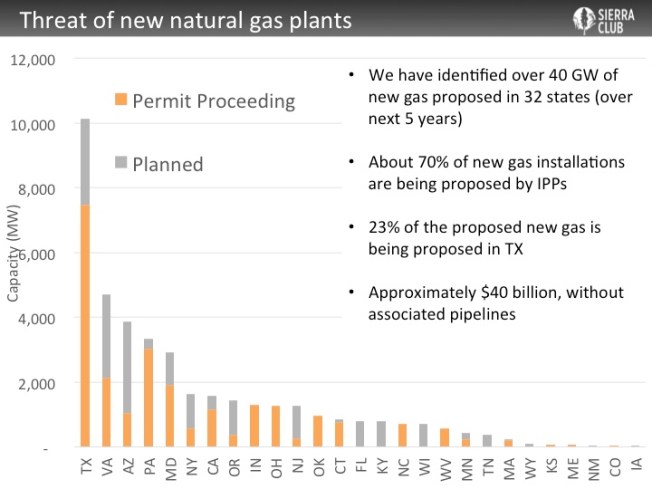
We also have to view Virginia’s progress on solar in the broader context of energy development. Dominion Virginia Power will have built 4,300 MW of new natural gas generation by the end of the decade and has indicated its interest in building far more. The company will add this to a portfolio that’s already 96% fossil fuel and nuclear. This summer two more companies announced plans to build natural gas plants in Virginia, aiming to burn some of the fracked gas that Dominion plans to bring through the Atlantic Coast Pipeline. When the state’s dominant utility is all-in on natural gas, it’s hard for a different energy model to find elbow room.
But we do have good solar and wind resources, and plenty of demand. What we need are policies that welcome participants to the market.
- Virginia utilities won’t sell wind or solar to customers*
(*except those with billions of dollars and famous CEOs—see section 14)
Currently, the average Virginia resident can’t pick up the phone and call their utility to buy electricity generated by wind and solar farms. Worse, they can’t buy renewable energy elsewhere, either.
This wasn’t supposed to happen. Section 56-577(A)(6) of the Virginia code allows utilities to offer “green power” tariffs, and if they don’t, customers are supposed to be able to go elsewhere for it. Ideally, a utility would use money from voluntary green power programs to build or buy renewable energy for these customers. However, Virginia utilities have not done this, except in very tiny amounts. Instead, utilities pay brokers to buy renewable energy certificates (RECs) on behalf of the participants. Participation by consumers is voluntary. Participants sign up and agree to be billed extra on their power bills for the service. Meanwhile, they still run their homes and businesses on regular “brown” power, which is not what they want.
In Dominion’s case, these RECs meet a recognized national standard, and some of them originate with wind turbines, but they primarily represent power produced and consumed out of state, and thus have no effect on the power mix in Virginia. For a fuller discussion of the Dominion Green Power Program, see What’s wrong with Dominion’s Green Power Program.
Appalachian Power’s “green pricing” program is even worse, offering RECs from an 80 MW hydroelectric dam in West Virginia. No wind, and no solar.
Other REC programs are available to Virginia consumers. If you’re considering this route, read this post first.
The State Corporation Commission has ruled that REC-based programs do not qualify as selling renewable energy, so under the terms of §56-577(A)(6), customers are currently permitted to turn to other licensed suppliers of electric energy “to purchase electric energy provided 100 percent from renewable energy.”
So you should be able to go elsewhere to buy wind and solar—say, from a solar facility on someone else’s land, or even from a facility on your own rooftop that someone else owns and operates for you. (For more on that, see section 10 on third-party power purchase agreements.) But Virginia utilities claim that the statute’s words mean that not only must another licensed supplier provide 100% renewable energy, it must also supply 100% of the customer’s demand, all the time. Obviously, the owner of a wind farm or solar facility cannot do that. Ergo, say the utilities, a customer cannot go elsewhere.
On August 31, however, a hearing examiner for the SCC rejected this reading. If the SCC agrees, Virginia residents might have new options.
Anticipating the possibility of an adverse ruling from the SCC, this spring APCo filed a proposal with the SCC for a new tariff under of §56-577(A)(6). Instead of RECs, APCo now proposes to offer real green power, combining wind, solar and hydro. None of the power will come from new projects; partly as a result, the tariff will cost more. The SCC will hold a hearing on the proposal this fall. If approved, APCo customers would finally be able to order renewable energy from their utility. But it would also likely close off customers’ ability under the statute to turn to other suppliers of renewable energy.
Dominion has not yet followed APCo’s lead on this one. If the SCC rules that the statute means what it says, we would expect Dominion to offer a green power program consisting of true renewable energy. Indeed, Dominion seems to be working on a green tariff this fall that it is calling “community solar” (see next session). Its real interest may well be the same as APCo’s.
We hope the SCC will require both APCo and Dominion to follow best practices recommended by groups like Advanced Energy Economy Institute: “Utility renewable energy tariff programs must require that utilities build, purchase or contract for a portfolio of renewable energy through a competitive process, and charge customers according to the actual cost of the portfolio, whether that be a net premium or net savings for customers.”
- Community solar? Not hardly
Last year Dominion received SCC approval for a program it billed as an offer to sell electricity from solar panels. Notwithstanding its name, however, the “Dominion Community Solar” program is not an offer to sell electricity generated from solar energy, and reading the details, one can only conclude it would attract customers only to the extent they were deceived about it. Perhaps someone within Dominion pointed out to the brass how close this looks to consumer fraud; at any rate, a year has passed and the company still hasn’t launched it.
As for true community solar, only one Virginia utility offers it: a member-owned rural electric cooperative in southwestern Virginia called BARC. The rest of you are out of luck at the moment. Every year for the past several years, legislation has been introduced to support community solar, and every year it has died in the face of utility opposition.
A few bills this year would have enabled community solar, but they were “carried over to 2017”—i.e., killed. A small working group put together by the solar industry association and the utilities is currently trying to come up with a program that utilities will find acceptable. The group has issued a “Request for Information,” available online, and is holding public meetings this fall to get input on a proposal that looks much more like a green tariff than like community solar. (Clearly Dominion likes the name “community solar”–just not, you know, actual community solar.) Another group, the Distributed Solar Collaborative, which includes all stakeholders except utilities, is also evaluating models from other states and plans to put forward a true community solar alternative.
- Virginia’s Renewable Portfolio Standard (RPS) is a miserable sham
Many advocates focus on an RPS as a vehicle for inducing demand. In Virginia, that’s a mistake. Virginia has only a voluntary RPS, which means utilities have the option of participating but don’t have to. Any costs they incur in meeting the goals can be charged to ratepayers. Until a few years ago, utilities even got to collect bonus money as a reward for virtue, until it became clear that there was nothing very virtuous going on.
Making our RPS mandatory rather than voluntary would do nothing for wind and solar in Virginia without a complete overhaul. The statute takes a kitchen-sink approach to what counts as renewable energy, so meeting it requires no new investment and no wind or solar.
The targets are also modest to a fault. Although nominally promising 15% renewables by 2025, the statute sets a 2007 baseline and contains a sleight-of-hand in the definitions section by which the target is applied only to the amount of energy not produced by nuclear plants. The combined result is an effective 2025 target of about 7%.
The RPS is as impotent in practice as it is in theory. In the case of Dominion Virginia Power, the RPS has been met largely with old hydro projects built prior to World War II, trash incinerators, and wood burning, plus a small amount of landfill gas and—a Virginia peculiarity—RECs representing R&D rather than electric generation.
There appears to be no appetite in the General Assembly for making the RPS mandatory, and efforts to improve the voluntary goals have repeatedly failed in the face of utility or industry opposition. The utilities have offered no arguments why the goals should not be limited to new, high-value, in-state renewable projects, other than that it would cost more to meet them than to buy junk RECs.
But with the GA hostile to a mandatory RPS and too many parties with vested interests in keeping the kitchen-sink approach going, it is hard to imagine our RPS becoming transformed into a useful tool to incentivize wind and solar.
That doesn’t mean there is no role for legislatively-mandated wind and solar. But it would be easier to pass a bill with a simple, straightforward mandate for buying or building a certain number of megawatts than it would be to repair a hopelessly broken RPS.
- Customer-owned generation: for most, the only game in town
Given the lack of wind or solar options from utilities, people who want renewable energy generally have to build it themselves. A federal 30% tax credit makes it cost-effective for those with cash or access to low-cost financing, and bulk purchasing through nonprofits VA-SUN and LEAP makes the process easier and reduces costs.
Last year the GA passed legislation enabling Property Assessed Clean Energy (PACE) loans for commercial customers. Localities now have an option to offer low-cost financing for energy efficiency and renewable energy projects at the commercial level. A bill to extend PACE authorization to residential customers did not get out of committee this year.
Virginia offers no cash incentives or tax credits for wind or solar. The Virginia legislature passed a bill in 2014 that would offer an incentive, initially as a tax credit and then as a grant program, but it did not receive funding. The same bill, reintroduced in 2015, died in a subcommittee.
The lack of a true RPS in Virginia means Virginia utilities generally will not buy solar renewable energy certificates (SRECs) from customers. SRECs generated here can sometimes be sold to utilities in other states (as of now only Pennsylvania) or to brokers who sell to voluntary purchasers.
- Limits to net metering hamper growth
Section 56-594 of the Virginia code allows utility customers with wind and solar projects to net energy meter. System owners get credit from their utility for surplus electricity that’s fed into the grid at times of high output. That offsets the grid power they draw on when their systems are producing less than they need. Their monthly bills reflect only the net energy they draw from the grid.
If a system produces more than the customer uses in a month, the credits roll over to the next month. However, at the end of the year, the customer will be paid for any excess credits only by entering a power purchase agreement with the utility. This will likely be for a price that represents the utility’s “avoided cost” of about 4.5 cents, rather than the retail rate, which for homeowners is closer to 12 cents. This effectively stops most people from installing larger systems than they can use themselves.
Legislation passed in 2015 makes it less likely that new solar owners will have any surplus. At Dominion’s insistence, the definition of “eligible customer-generator” was amended to limit system sizes to no larger than needed to meet the customers demand, based on the previous 12 months of billing history. The SCC wrote implementing regulations (see 20VAC5-315-10 et seq.) but failed to address what happens with new construction. The solar trade association MDV-SEIA continues to work towards a solution to that problem.
The new limitation is a problem for other reasons as well. Some solar customers want to install larger systems than they previously needed because their business is expanding or they plan to buy an electric car. But the limitation is also stupid. If customers want to install more clean, renewable energy than they need and are willing to sell the surplus electricity into the grid at the wholesale power price, why would you stop them from performing this service to society? I can understand that the paperwork isn’t worth the hassle for very small amounts of excess electricity, but if there isn’t an app for that yet, I bet some Virginia Tech students could make one.
- Aggregated net metering allowed for farms only
Under a bill introduced by Delegate Randy Minchew (R-Leesburg) and passed in 2013, owners of Virginia farms with more than one electric meter are permitted to attribute the electricity produced by a system that serves one meter (say, on a barn) to other meters on the property (the farmhouse and other outbuildings). This is referred to as “agricultural net metering.” Efforts to expand aggregated net metering beyond farms have not succeeded.
- Standby charges hobble the market for larger home systems and electric cars
Dominion Power and Appalachian Power are at the forefront of a national pushback against policies like net metering that facilitate customer-owned generation.
The current system capacity limit for net-metered solar installations is 1 MW for commercial, 20 kW for residential. However, for residential systems between 10 kW and 20 kW, a utility is allowed to apply to the State Corporation Commission to impose a “standby” charge on those customers.
Seizing the opportunity, Dominion won the right to impose a standby charge of up to about $60 per month on these larger systems, eviscerating the market for them just as electric cars were increasing interest in larger systems. (SCC case PUE- 2011-00088.) Legislative efforts to roll back the standby charges were unsuccessful, and more recently, Appalachian Power instituted even more extreme standby charges. (PUE-2014-00026.)
The standby charges supposedly represent the extra costs to the grid for transmission and distribution, though there is a great deal of disagreement on that score, and a lot of suspicion that utilities’ real concern is that they will make less money as demand for their dirty energy product falls.
In the summer of 2013, in a filing with the SCC (PUE-2012-00064, Virginia Electric and Power Company’s Net Metering Generation Impacts Report), Dominion claimed it could also justify standby charges for its generation costs, and indicated it expected to seek them after a year of operating its Solar Purchase Program (see discussion below). As far as I can tell, it hasn’t carried out this threat yet, and it would likely need legislation to do so.
- Good news for residential solar: homeowner association bans are largely a thing of the past
Homeowner association (HOA) bans and restrictions on solar systems have been a problem for residential solar. In the 2014 session, the legislature nullified bans as contrary to public policy. The law contains an exception for bans that are recorded in the land deeds, but this is said to be highly unusual; most bans are simply written into HOA covenants. In April of 2015 the Virginia Attorney issued an opinion letter confirming that unrecorded HOA bans on solar are no longer legal.
Even where HOAs cannot ban solar installations, they can impose “reasonable restrictions concerning the size, place and manner of placement.” This language is undefined. The Maryland-DC-Virginia Solar Energy Industries Association has published a guide for HOAs on this topic.
- Virginia utilities continue their fight against PPAs; now a losing battle?
One of the primary drivers of solar installations in other states has been third-party ownership of the systems, including third-party power purchase agreements (PPAs), under which the customer pays only for the power produced by the system. For customers that pay no taxes, including non-profit entities like churches and colleges, this is especially important because they can’t use the 30% federal tax credit to reduce the cost of the system if they purchase it directly. Under a PPA, the system owner can take the tax credit (as well as accelerated depreciation) and pass along the savings in the form of a lower electricity price.
The Virginia Code seems to sanction this approach to financing solar facilities in its net metering provisions, specifically §56-594, which authorizes a “customer generator” to net meter, and defines an eligible customer generator as “a customer that owns and operates, or contracts with other persons to own or operate, or both, an electrical generating facility that . . . uses as its total source of fuel renewable energy. . . “
Notwithstanding this provision, in 2011, when Washington & Lee University attempted to use a PPA to finance a solar array on its campus, Dominion Virginia Power issued cease and desist letters to the university and its Staunton-based solar provider, Secure Futures LLC. Dominion claimed the arrangement violated its monopoly on power sales within its territory. Secure Futures and the university thought that even if what was really just a financing arrangement somehow fell afoul of Dominion’s monopoly, surely they were covered by the exception in §56-577(A)(6) available to customers whose own utilities do not offer 100% renewable energy. (See Section 2, above.)
Yet the threat of prolonged and costly litigation was too much. The parties turned the PPA contract into a lease, allowing the solar installation to proceed but without the advantages of a PPA.
After a long and very public fight in the legislature and the press, in 2013 Dominion and the solar industry negotiated a compromise that specifically allows customers in Dominion territory to use third-party PPAs to install solar or wind projects under a pilot program capped at 50 MW. Projects must have a minimum size of 50 kW, unless the customer is a tax-exempt entity, in which case there is no minimum. Projects can be as large as 1 MW. The SCC is supposed to review the program every two years beginning in 2015 and has authority to make changes to it. I’m not aware the SCC has reviewed the program to date.
Appalachian Power and the electric cooperatives declined to participate in the PPA deal-making, so the legal uncertainty about PPAs continues in their territories. In June of 2015, Appalachian Power proposed an alternative to PPAs. An evidentiary hearing was held September 29, 2015. A veritable parade of witnesses testified that APCo”s program was expensive, unworkable and unnecessary, given the plain language of the statute allowing PPAs.
Almost a year later, on August 31, 2016, the hearing examiner finally issued her report, recommending that APCo’s application be rejected, both because it is a lousy program and because she, too, reads the Code to allow PPAs currently, making a utility alternative unnecessary. If the commissioners agree with her, this would be a victory for the solar industry and customers. How useful it will be depends on the scope of the final order, however, and on how they view APCo’s effort to close off the opening afforded by §56-577(A)(6) by offering its own renewable energy product.
The problem cries out for a legislative fix. Advocates pushed hard for legislation this year that would open the Virginia market to private investment through third-party PPAs; but as previously noted, the Commerce and Labor committees ducked their responsibilities and failed to act on the bills.
Meanwhile, Secure Futures has developed a third-party-ownership business model that it says works like a PPA for tax purposes but does not include the sale of electricity, and therefore should not trigger a challenge from Appalachian Power or other utilities. Currently Secure Futures is the only solar provider offering this option, which it calls a Customer Self-Generation Agreement.
- Tax exemption for third-party owned solar proves a market driver
In 2014 the General Assembly passed a law exempting solar generating equipment “owned or operated by a business” from state and local taxation for installations up to 20 MW. It did this by classifying solar equipment as “pollution abatement equipment.” Note that this applies only to the equipment, not to the buildings or land underlying the installation, so real estate taxes aren’t affected.
The law was a response to a problem that local “machinery and tools” taxes were mostly so high as to make third-party PPAs uneconomic in Virginia. In a state where solar was already on the margin, the tax could be a deal-breaker.
The 20 MW cap was included at the request of the Virginia Municipal League and the Virginia Association of Counties, and it seemed at the time like such a high cap as to be irrelevant. However, with solar increasingly attractive economically, Virginia’s tax exemption rapidly became a draw for solar developers, including Virginia utilities.
In 2016 Dominion proposed changing the exemption to benefit its own projects at the expense of those of independent developers. In the end, the statute was amended in a way that benefits utility-scale projects without unduly harming smaller projects. Many new projects will now be only 80% exempt, rather than entirely exempt. However, the details are complex, with different timelines and different size classes, and anyone looking to use this provision should study it carefully.
- Dominion “Solar Partnership” Program encounters limited success
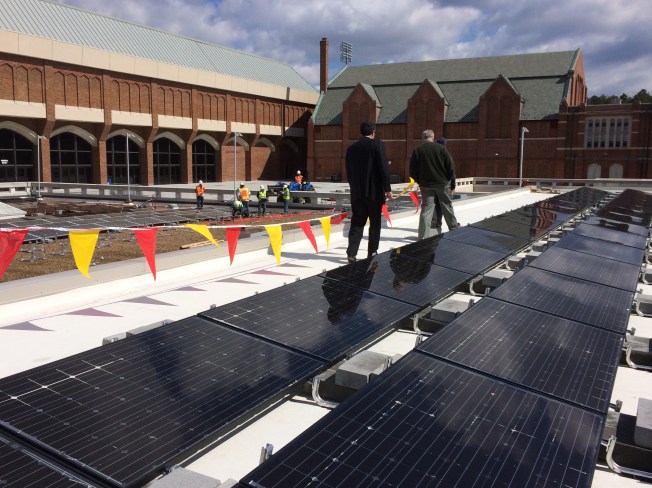
In 2011, the General Assembly passed a law allowing Dominion to build up to 30 MW of solar energy on leased property, such as roof space on a college or commercial establishment. The SCC approved $80 million of spending, to be partially offset by selling the RECs (meaning the solar energy would not be used to meet Virginia’s RPS goals). The program has resulted in several commercial-scale projects on university campuses and corporate buildings. Unfortunately, it has also been plagued by delays and over-spending.
The program was supposed to proceed in two phases, with 10 MW in place by the end of 2013, and another 20 MW by December 31, 2015. However, the program got off to a very slow start. In August of 2014 the company acknowledged it was behind schedule and would likely not achieve more than 13 or 14 MW of the 30 MW authorized before it ran out of money. On May 7, 2015 Dominion filed a notice with the SCC that it needed to extend the phase 2 end date to December 31, 2016, and confirmed that it would install less than 20 MW altogether.
Although Dominion’s web page suggests that it is still taking applications, I’m doubtful.
- Dominion’s Solar Purchase Program: bad for sellers, bad for buyers, and not popular with anyone
The same legislation that enabled the “Solar Partnership” initiative also authorized Dominion to establish “an alternative to net metering” as part of the demonstration program. The alternative turned out to be a buy-all, sell-all deal for up to 3 MW of customer-owned solar. As approved by the SCC, the program allows owners of small solar systems on homes and businesses to sell the power and the associated RECs to Dominion at 15 cents/kWh, while buying regular grid power at retail for their own use. Dominion then sells the power to the Green Power Program at an enormous markup.
I ripped this program from the perspective of the Green Power Program buyers, but the program is also a bad deal for most sellers. Some installers who have looked at it say it’s not worth the hassle given the costs involved and the likelihood that the payments represent taxable income to the homeowner. There is also a possibility that selling the electricity may make homeowners ineligible for the 30% federal tax credit on the purchase of their system. Sellers beware.
And then there’s the problem that selling the solar power means you aren’t powering your home or business with solar—which is the whole point of installing it, right?
- Dominion’s Renewable Generation tariff for large users of energy finds no takers; Amazon forces a change, with a new tariff in the works that will be available to others
Currently non-utility renewable energy facilities are subject to a size limit of 1 MW for net-metered projects. These limitations constrain universities, corporations, data centers, and other large users of energy that might want to run on wind or solar. On top of this, the utilities’ interpretation of Virginia law prohibits a developer from building a wind farm or a solar array and selling the power directly to users under a power purchase agreement.
In 2013, Dominion Power rolled out a Renewable Generation Tariff (PUE-2012-00142) to allow customers to buy larger amounts of renewable power from providers, with the utility acting as a go-between and collecting a monthly administrative fee.
From the start the program appeared cumbersome and bureaucratic, and Dominion confirmed to me this summer that they have never had any takers. Then suddenly last year, Amazon Web Services made Dominion’s tariff irrelevant. Amazon contracted directly with a developer for an 80 MW solar farm, avoiding Dominion’s monopoly restrictions with a plan to sell the electricity directly into the PJM (wholesale) market. Dominion Energy (an affiliate of Dominion Virginia Power) then bought the project, and Dominion Virginia Power negotiated a special rate with Amazon for the power. This contract became the basis for an “experimental” tariff that Dominion proposes to offer to customers with a peak demand of 5 MW or more, with a program cap of 200 MW. A hearing examiner at the SCC has recommended approval of the special rate.
Dominion used a different model for its deal this year with Microsoft. After the SCC turned down Dominion’s application to charge ratepayers for a 20-MW solar farm in Remington, Virginia, Dominion reached an agreement with Microsoft and the Commonwealth of Virginia under which the state will buy the output of the project, while Microsoft buys the RECs.
Dominion has a strong incentive to make deals with large corporations that want a lot of renewable energy: if they don’t like what Dominion is offering, they can do an end run around the utility. Amazon has shown other companies how to use PJM rules that let anyone develop projects for the wholesale market regardless of utility monopolies, and then “attribute” the solar or wind energy to their operations in any state. With the tax exemption discussed in section 11, Virginia projects apparently now pencil out pretty well.
- Dominion moves into utility-scale solar
Well before Amazon and Microsoft showed an interest in large-scale solar projects here, Dominion had announced it wanted to develop 400 MW of solar in Virginia. In 2015, at the utility’s behest, two bills promoted the construction of utility-scale solar by declaring it in the public interest for utilities to build solar energy projects of at least 1 MW, and up to an aggregate of 500 MW. The bill was amended at the solar industry’s behest to allow utilities the alternative of entering into PPAs for solar power prior to purchasing the generation facilities at a later date, an option with significant tax advantages.
Dominion’s first solar project will be a 20 MW solar farm in Remington, Virginia; however, the SCC rejected the company’s plan to charge ratepayers for the project because the company had not considered cheaper third-party alternatives. Governor McAuliffe helped save the project by working out a deal with Microsoft, as discussed above. Meanwhile, Dominion had also solicited bids for additional projects. To date, three have been announced, totaling 56 MW.
Although Dominion will be able to charge ratepayers for these projects, the SCC insists that the RECs be sold—whether to utilities in other states that have RPS obligations, or to customers who want them for their own sustainability goals, or perhaps even to voluntary green power customers. The result is that Dominion still won’t have any solar in its fuel mix. That’s the weird world of RECs for you.
- Governor McAuliffe promises the state will purchase 110 MW of solar
Following a recommendation by the Governor’s Climate Change and Resiliency Commission, on December 21, 2015, Governor McAuliffe announced that the Commonwealth would commit to procuring 8% of its electricity from solar, with 75% of that built by Dominion and 25% by private developers.
The first deal that will count towards this goal is an 18 MW project at Naval Station Oceana, announced on August 2, 2016. The Commonwealth will buy the power and the RECs. (The Remington Project did not count, because as the buyer of the RECs, only Microsoft can claim the right to be buying solar power.)
- Will a Solar Development Authority help?
One of the MacAuliffe Administration’s initiatives last year was a bill to establish the Virginia Solar Development Authority. The Authority is explicitly tasked with helping utilities find financing for solar projects; there is no similar language about supporting customer-owned solar. So far, nothing seems to have come of it.
- Any wind energy yet? Nope, still waiting
No Virginia utility is actively moving forward with a wind farm on land. Dominion Power’s website used to list 248 MW of land-based wind in Virginia as “under development,” without any noticeable progress. Now it just says 247 MW are “being evaluated.” That’s closer to reality, but they probably should put it in the past tense. There has been a lot of press about the standoff in Tazewell County, where supervisors blocked Dominion’s proposed wind farm. Today, Dominion’s advocacy for its project feels perfunctory. The company has signaled it prefers solar, and its 2016 IRP dismisses wind as too costly.
On the other hand, Appalachian Power’s IRP suggests an interest in wind as a low-cost renewable resource. The bad news is that it isn’t proposing to build any new wind in Virginia.
With no utility buyers, Virginia has not been a friendly place for independent wind developers. In previous years a few wind farm proposals made it to the permitting stage before being abandoned, including in Highland County and on Poor Mountain near Roanoke.
Nonetheless, Apex Clean Energy is in the development stages for the 75-MW Rocky Forge wind farm in Botetourt County. No customer has been announced, but the company believes the project can produce electricity at a competitive price, given its good location and improved turbine technology. Construction is planned for 2017.
As for Virginia’s great offshore wind resource, little progress has been made towards harnessing it, even as the nation’s first offshore wind project will begin generating electricity this fall in the waters off Rhode Island. In 2013 Dominion won the federal auction for the right to develop about 2,000 MW of wind power off Virginia Beach, and the company completed a Site Assessment Plan (SAP) this spring.
We had originally been told the federal government’s timeline would lead to wind turbines being built off Virginia Beach around 2020. Now, however, the Bureau of Ocean Energy Management says Dominion has five years from approval of the SAP to submit its construction and operations plan, after which we’ll have to wait for review and approval. Presumably the project will also require an environmental impact statement. So the whole process would be quite slow even if Dominion were committed to moving forward expeditiously. But in fact, it seems increasingly clear that Dominion is just going through the motions and has no interest in seeing the project through. Its 2016 Integrated Resource Plan (IRP) does not even include offshore wind in any of its scenarios for the next 15 years, except for the 12 MW that would be produced by the two test turbines of its VOWTAP project.
Yes, so what about VOWTAP? Dominion had been part of a Department of Energy-funded team to try out new technology, with the pilot turbines due to be installed in 2017. After a second round of bids to build the project still came in higher than expected, Dominion told DOE this spring it could not commit to construction even by 2020, upon which DOE pulled funding. Dominion executives swear the project isn’t necessarily dead, but that puts me in mind of the “ex-parrot” in the Monty Python skit, still on its perch only because it’s been nailed there.
- The Clean Power Plan tries to make it better to switch than fight
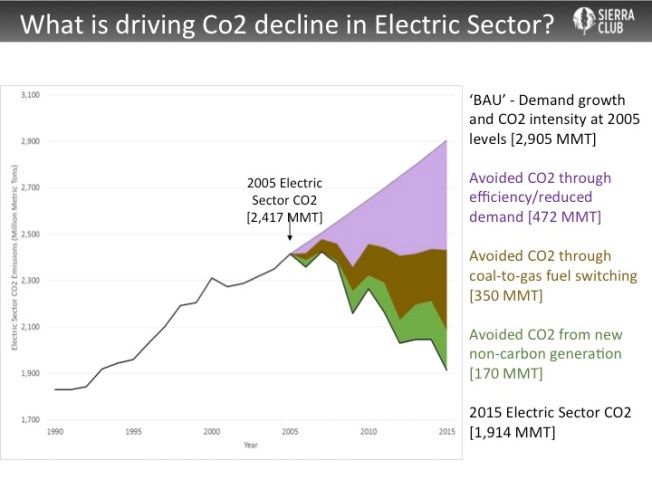
On August 3, 2015, EPA issued the final rule known as the Clean Power Plan. Under the rule, states with existing fossil-fuel generating plants must develop plans to reduce total carbon pollution from power plants, which could include using renewable energy as an offset to fossil fuel. In Virginia, the task of developing a state implementation plan (SIP) falls to the Department of Environmental Quality. Earlier this year the Supreme Court stayed implementation of the EPA rule while a Circuit Court considers a challenge, following which Virginia Republicans pushed through a budget provision prohibiting DEQ from developing a SIP while the federal rule is stayed.
Assuming the Clean Power Plan survives challenge, it could help incentivize construction of wind and solar facilities. While Virginia’s goals under the plan are modest, the rule means the state, utilities and the SCC must for the first time take carbon emissions into account in their planning. The EPA has signaled a strong interest in seeing wind and solar deployed as solutions.


 Power for the People VA
