Unknown's avatar

Northern Virginia governments look at major renewable energy energy purchase

If the Northern Virginia Regional Commission has its way, local jurisdictions will buy power from a solar or wind farm in the near future. Photo credit Christoffer Reimer.

The Northern Virginia Regional Commission has selected a consultant to assist area localities in a joint procurement of renewable energy. Participating cities and counties will be able to aggregate their demand to get the kind of economies of scale that have allowed corporations like Amazon and Facebook to lower their energy cost by investing in large solar and wind farms.

On November 17, NVRC announced that Customer First Renewables, a national expert in matching large energy users with renewable energy projects, will serve as its technical advisor. Customer First Renewables and NVRC plan to issue a Request for Proposals (RFP) to identify one or more “shovel-ready,” large scale projects to present to NVRC’s thirteen member governments. Those local governments will individually decide whether to participate in the group purchase.

According to a Request for Qualifications that NVRC issued in its search for a consultant, the project(s) to be selected must be greater than 10 megawatts in size and result in new renewable energy capacity added to the grid. Preference will go to projects located in Virginia or in the regional grid that serves Virginia, known as PJM.

NVRC will act as a central contact and facilitator, but it will be up to the participating localities to negotiate a contract. NVRC Director Robert Lazaro said discussions with representatives of area localities indicate the interest is there for a major renewable energy buy like this. Arlington, Alexandria, Manassas Park, and Falls Church are among the jurisdictions most interested, with others possibly joining as they learn more.

“We see this as a way to green the grid, save money, and assist the solar industry in Virginia,” said Lazaro.

Niels Crone, Senior Vice President for Business Development at Customer First Renewables, said his company was excited to be involved in the procurement effort. “We are delighted to work with NVRC to help Northern Virginia jurisdictions get affordable, large-scale renewable energy,” he said.

NVRC is following an ambitious timeline. A project workshop for local government staff is scheduled for December 11, and a Request for Proposals (RFP) is due January 2, 2018.

How does a group purchase work?

Amazon and other large corporations have become major drivers of new wind and solar projects in PJM, including several large solar farms in Virginia. The steadily-tumbling costs of wind and solar make it possible for the companies to green their energy supply while lowering their overall energy costs using innovative financing approaches. Not all of these would work in Virginia, but one that does is the wholesale, or “virtual” power purchase agreement.

A virtual PPA allows a customer to buy and sell energy in the wholesale market, avoiding potential obstacles such as a utility’s monopoly on the retail sale of electricity.

Local governments in Virginia buy electricity from Dominion Energy Virginia at retail under a contract negotiated by the Virginia Energy Purchasing Governmental Association (VEPGA). That contract makes Dominion their only electricity supplier, and Dominion currently does not offer wind or solar as an option. A virtual PPA would not change this relationship; Dominion will continue to supply localities with electricity from its (decidedly un-green) power plants.

A virtual PPA would, however, let participating localities contract for the output of a renewable energy project, with the electricity sold into the wholesale market rather than delivered to the localities. Given the right project, the price for the electricity in the wholesale market could exceed the price paid to the project owner under the PPA, allowing the localities to pocket the difference—indirectly lowering their energy costs. The localities would also receive an additional benefit in the form of renewable energy certificates generated by the projects, demonstrating they have legally “greened” their energy supply.

There is some financial risk involved, since the PPA price is fixed, while wholesale prices fluctuate. Part of Customer First Renewables’ job will be to find the best project economics with the least risk. Corporate buyers, universities and large institutions around the country have used this approach successfully to lower their energy costs and meet their sustainability goals.

As members of the Metropolitan Washington Council of Governments (MWCOG), Northern Virginia localities are committed to reducing greenhouse gas emissions to 80 percent below 2005 levels by 2050, with an interim goal of 20 percent by 2020. MWCOG’s 2017-2020 Regional Climate and Energy Action Plan (available here) also sets a target of meeting 20 percent of the region’s electric consumption from renewable sources by 2020.

As the report notes, however, “There needs to be an immense undertaking to meet the 2020 and 2050 goals.” Here’s hoping Northern Virginia is ready to do its share.

Unknown's avatar

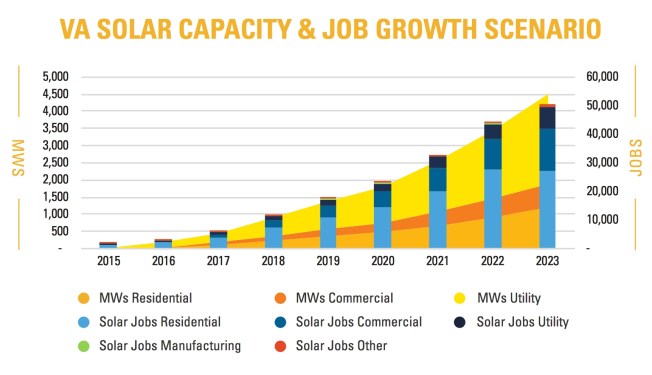
A 5-year plan for economic growth: 10% solar and 50,000 new jobs

Source: The Solar Foundation

A new analysis from the non-profit Solar Foundation shows Virginia could create 50,400 jobs if it commits to building enough solar energy in the next five years to provide just 10% of our electricity supply.

The analysis takes the form of an “infographic” showing the implications of 10% solar. It would require building 15,000 megawatts of solar, divided among utility-scale solar farms, commercial installations, and the rooftops of houses. At the end of 2016, Virginia had a total of only 241 MW of solar installed, representing one-tenth of 1 percent of total electricity consumption. Getting to 10% by the end of 2023 would mean an annual growth rate of 61 percent. That would be impressive growth, but well below the 87 percent growth rate averaged by California and North Carolina over the past 6 years.

So 10% in five years should be doable. And indeed, viewed against the need to dramatically lower our carbon footprint, it seems like a very small step indeed. The McAuliffe administration wants to significantly cut statewide carbon emissions, and it is hard to see how we can do that without replacing the dirtiest fossil fuels with solar (and wind, and energy efficiency).

The good news is that the market is in our favor. Dominion Energy’s 2017 Integrated Resource Plan (IRP) identified utility-scale solar as the least-cost energy resource available in Virginia today. And participants in local cooperative buying programs for homeowners and businesses, known as “Solarize” programs, report payback times of under 10 years for rooftop solar, after which they will have nearly free electricity for 20 or 30 years.

Recent solar deals involving Amazon, Microsoft, and now Facebook show just how strong the demand is from customers. The very companies that our political leaders want so desperately to attract to Virginia are insisting on renewable electricity.

These deals demonstrate the direction of the market, and they will give an initial boost to solar employment, especially in the rural communities that are the best locations for solar farms. But restricting solar to a handful of new companies just coming into Virginia won’t get us to 15,000 MW and 10% solar. It’s also fundamentally unfair to the rest of us who are stuck with a dirty grid. Why should existing customers get left with polluting sources, while big tech companies get solar?

For us, Dominion’s IRP caps its solar plans at 240 MW per year, an amount it admits is arbitrary. In other words, Amazon got 260 MW, Facebook is getting 130 MW, but all the rest of Dominion’s customers put together will get just 240 MW per year.

As for customers who are determined to take matters into their own hands with rooftop solar, a host of unnecessary restrictions continue to limit growth. Virginia needs to put policies in place to push utilities to do more, to support local governments and schools that want solar, and to remove the barriers that limit private investment.

Solar companies around the state say if we can do that, they will do their part by hiring more Virginians. Here’s what some of them had to say about the 10% solar goal, and how to achieve it:

“We believe, as Virginians, that we can solve our energy challenges. Ours is a Virginia company founded and based in Charlottesville, and we are committed to building Virginia-based energy production facilities that benefit all Virginians. But the fact is that over the past few years our growth has come from business in other states. We have 26 employees in Virginia now, and we could increase that dramatically if Virginia promotes solar through policy changes that incentivize business owners to invest, allows competition, and supports the environmental message.” –Paul Risberg, President of Altenergy, Charlottesville

“The economics have never been better for solar in Virginia than they are right now. Prospect Solar has grown from two employees in 2010 to 16 full time employees today. Roles such as electricians, skilled labor, engineers, project managers, and sales people are integral to the success of each project. We hope Virginia will commit to a rapid, sustained buildout of all sectors of the solar industry, allowing us to continue adding local jobs.” –Andrew Skinner, Project Manager at Prospect Solar, Sterling

“Nationwide, the solar market was a 23 billion dollar industry in 2016. One out of every 50 new jobs in America was created by the solar industry last year. Sigora has been part of that. We have doubled in size in the past year and now employ 80 people in the Commonwealth.” –Karla Loeb, Vice President of Policy and Development for Sigora Solar, Charlottesville

“Local energy, local jobs, local investment. Our workforce is made up of local people—three of us went to Virginia Tech, one went to New River Community College, which has an Alternative Energy Program. An increase in demand of this scale would mean we’d hire more local people.” –Patrick Feucht, Manager of Baseline Solar, Blacksburg

“Residential and commercial rooftop solar has created most of the solar jobs in Virginia to date, and it has to be a part of the push to 10 percent. As we know, rooftop solar creates more jobs than utility solar, and these are good-paying, local jobs for local people. That’s one reason Virginia should lift the outdated 1 percent cap on net-metered solar, and leave the market open to anyone who wants to invest in their own home-grown energy supply.” –Sue Kanz, President of Solar Services, Virginia Beach

“Ten percent solar is a modest goal to shoot for given the strong economics of solar and the demand we are seeing from customers. Virginia has been held back by restrictive policies that have made it a ‘dark state.’ Reforming our policies would lead to a lot more economic development around solar.” –Tony Smith, President of Secure Futures LLC, Staunton


Unknown's avatar

Hearing examiner rules Appalachian Power’s renewable energy tariff isn’t good enough

Appalachian Power’s plan to repackage power from existing renewable energy projects in its portfolio into a new, higher-priced green option hit a bump this week when a hearing examiner for the Virginia State Corporation Commission recommended rejection of the tariff, saying it wasn’t a good deal for consumers.

Approval of the tariff would have allowed APCo to block competition from other renewable energy suppliers. Virginia law provides that if a customer’s own utility doesn’t offer a tariff for 100% renewable energy, the customer has the right to buy from any other provider.

APCo had argued its tariff met the letter of the law, and that should be the end of the SCC’s inquiry. Since it was a voluntary tariff, customers could take it or leave it. Hearing Examiner A. Ann Berkobile disagreed. Because approval of the tariff would adversely affect competition and restrict the rights of customers, she found, the tariff could only be approved if APCo proved it was “in the public interest and its rate is just, reasonable and unlikely to prejudice customers.”

In this case, she concluded, APCo failed to do so, having “made no effort to establish the reasonableness of its proposed Rider REO rate.”

She went on: “Stated somewhat differently, Rider REO has the potential to suppress or even curtail customer access to 100 percent renewable energy by precluding sales by [Competitive Service Providers] while at the same time offering an incumbent utility alternative that is simply too costly for customers to bear. The overall price of Rider REO (and associated rate) should, therefore, be considered when deciding whether to grant approval.”

Testimony in the case had established that the existing wind farms APCo proposed to use were providing power at a higher price than could be obtained from new sources, which the Hearing Examiner suggested made the proposed tariff rate unreasonable. In addition, using old sources rather than new ones would not “promote the development of renewable energy in accordance with the objectives of the Commonwealth Energy Policy set forth in §§ 67-101 and 67-102 of the Code.”

The Hearing Examiner’s report is only a recommendation to the SCC, which will have the final say. The case is PUE-2016-00051.

Ruling could affect Dominion tariff

If the SCC adopts the Hearing Examiner’s recommendation, that could also affect the SCC’s evaluation of Dominion’s proposed 100% renewable commercial tariff. Dominion’s tariff will likely use biomass as a source because of Dominion’s insistence that a 100% renewable product must use sources that together produce renewable energy 100% of the time. But while Virginia’s overbroad definition of renewable energy includes “biomass, sustainable or otherwise,” biomass often doesn’t satisfy corporate sustainability goals. As the Hearing Examiner’s opinion suggests, it’s not enough for a tariff to meet the requirement of providing 100% renewable energy if it isn’t also good enough to attract customers.

The Hearing Examiner’s emphasis on the cost to consumers is also a relevant consideration. If the SCC affirms the APCo decision, Dominion would have to justify using higher-cost biomass over much cheaper wind and solar.


Update: On September 13, 2017, the SCC rejected APCo’s proposed tariff, focusing especially on its high cost.

Unknown's avatar

Moving to block competition, Dominion files its own sort-of-green energy tariff

Just a couple of the great things that count as “renewable energy” in the Virginia Code.

Dominion Virginia Power has filed for permission from the State Corporation Commission (SCC) to offer a 100% renewable energy tariff to commercial and industrial customers with peak loads of over 1,000 kilowatts. In a footnote, Dominion states that it intends to propose a similar tariff for residential customers in the future. The case is PUR-2017-0060.

Customers who want only carbon-free energy like wind and solar will likely be disappointed. Dominion intends to use a “portfolio of resources” that will include “dispatchable resources”—i.e., hydropower and stuff that can be burned. Dominion promises the sources it uses will meet Virginia’s definition of renewable. That’s not reassuring. Under Virginia law, renewable energy can include sources like landfill gas and municipal solid waste, as well as “biomass, sustainable or otherwise (the definitions of which shall be liberally construed).”

Dominion’s filing comes scarcely one month after an SCC decision confirmed the right of independent renewable energy provider Direct Energy to offer its products to Dominion customers, but only so long as Dominion lacks its own green tariff for those customers. The SCC order (explained here) made clear that under Virginia law, a competitor like Direct Energy would be blocked from taking on new customers once Dominion has an approved tariff.

Dominion’s filing looks suspiciously like an effort to cut Direct Energy off at the knees. If the upstart competitor follows through with its plans to offer Virginia residents a renewable energy option, Dominion will surely propose a residential renewable energy tariff. SCC approval of Dominion’s tariff would shut out Direct Energy, which is targeting only residential consumers for its product. Under the language of the Code, it does not appear to matter whether a competitor can offer a better product, or a better price.

For the moment, Direct Energy is not backing down. The company has set up a web page to gauge the interest of residential consumers while it deliberates its next move. Ron Cerniglia, Director of Corporate and Regulatory Affairs for the Mid-Atlantic Region, told me he thinks the timing of Dominion’s filing is “curious,” given that “Dominion has had ten years to file a renewable energy tariff and hasn’t. We’re concerned about the implications of limiting choice for consumers. We don’t know if the move will actually offer a choice consumers want, or if it is just closing doors on others.”

Indeed, ten years have passed since Virginia enacted its current utility law, which includes the right of a customer to “purchase electric energy provided 100 percent from renewable energy” from another supplier if its own utility isn’t offering it. During most of that time, Dominion has sold Renewable Energy Certificates to customers under its “Green Power Program,” but it has never offered residential customers an opportunity to buy actual renewable energy. (See “Is a Green Power program worth your money?”)

This is slated to change as the utility works with the solar industry on implementing a new solar option under legislation passed this year. However, the new law specifies that the solar option will not count as a tariff for “electric energy provided 100 percent from renewable energy,” so it does not block competitive offerings like Direct Energy’s.

Dominion was agreeable to excluding the solar program because it interprets the Code’s reference to “electric energy provided 100% from renewable electricity” to mean the electricity must come from renewables 100% of the time, an interpretation almost no one else shares.

This seems to be the reason Dominion intends to include carbon-emitting sources into its renewable energy offering, even though it’s safe to say there are no customers clamoring to get their electricity from garbage or the clear-cutting of forests. It also means the new tariff will likely be priced higher than one that included only solar, because electricity from biomass is more expensive today than harvesting the sun. (No word from Dominion on why it doesn’t just assign a portion of its pumped storage capacity to serve an all-wind-and-solar product.)

But if customers want only wind and solar, they are also likely to be disappointed in Direct Energy’s product. Cerniglia says his company includes baseload sources like “cleaner biomass” in its renewable energy product to provide 24/7 power. He estimated that the initial mixture would consist of “50% to 60% municipal waste biomass (Pennsylvania and Virginia sourced) and 40% to 50% wind (Pennsylvania sourced) . . . We are also committing to not utilize virgin wood / clear cut wood biomass in our product mix at any time.”

Direct Energy also has not determined the pricing of its product yet, but Cerniglia said it would be “equal to or lower than what Dominion Virginia Power residential customers pay for ‘brown’ power.”

Perhaps most importantly, he noted, “The benefit of a competitive market is that customers can leave us at any time. They’re not captive.”


Update: On June 21, a Hearing Examiner for the SCC recommended rejection of a similar application for a renewable energy tariff filed last year by Appalachian Power. See my discussion here for how this may affect Dominion’s application. 

Unknown's avatar

Dominion Power promises huge solar investments and a lower carbon footprint—or does it?

Dominion Virginia Power says energy from solar farms is now a low-cost option. Photo credit Kanadaurlauber.

Dominion Virginia Power released its updated Integrated Resource Plan (IRP) this week with a press release that promised thousands of megawatts (MW) of new solar power and a dramatically lower carbon footprint. In a remarkable turnabout, the Executive Summary declares, “The Company must now prepare for a future in which solar PV generation can become a major contributor to the Company’s overall energy mix.”

Alas, a closer look reveals Dominion will actually increase its carbon emissions over the period studied. Meanwhile, the solar would be built at a rate of only 240 MW per year over the 15-year period covered by the IRP, about the same amount being installed in Virginia this year. (Over 25 years, Dominion says its solar could reach 5,200 MW, which means the pace of installation would actually drop in the out years.) That should elicit yawns, not excitement.

The solar numbers pale in comparison to the more than 4,600 MW of new natural gas combined-cycle plants Dominion has been building just in this decade. (Remember that solar farms generate electricity at about 20-25% of “nameplate” capacity on average, while combined-cycle gas plants nationally average 50-60%, and can achieve 70% or higher.*) And even come 2032, the new solar will make up only a tiny fraction of a generation portfolio that consists almost entirely of coal, gas and nuclear.

I’ll be interested to see the numbers analyzed, but my guess is that all the renewable energy Dominion proposes to build over the next 15 years represents no more than 5-10% of its total electric generation. That’s too little, too late, in a state that can do so much better.

So the more things change, the more Dominion stays the same. Behind the hype being offered to the press stands a utility that is still committed to fossil fuels and nuclear power.

Virginia utilities file IRPs with the State Corporation Commission (SCC) every year. The plans are supposed to reflect the utilities’ best sense of how they will meet consumers’ needs for electricity while complying with state and federal laws and policies. This involves some guesswork about the direction of future regulations, including regulations of CO2 emissions.

In spite of President Trump’s determination to roll back climate protections while he is in office, Dominion’s IRP assumes an eventual price on carbon. Most utilities nationwide are doing the same thing. But given the uncertainties, Dominion has chosen (as it did last year) to model different scenarios instead of committing to a single plan.

Even the low-cost plan that wouldn’t comply with the EPA Clean Power Plan contains just as much solar as the other plans, reflecting the company’s assessment (on page 3) that solar is now “cost-competitive with other more traditional forms of generation, such as combined-cycle natural gas.”

Yet the carbon reductions Dominion promises in its press release appear to be something of a sleight-of-hand. For one thing, Dominion has chosen to compare its CO2 output in 2032 to its output in 2007, not 2017. CO2 emissions were markedly higher in 2007 than now, with the shale gas boom and the rise of renewables leading to massive coal retirements in the interim.

Moreover, a careful reading of the press release reveals the reductions Dominion promises are per-capita, not overall. A chart on page 115 of Dominion’s IRP shows every one of the scenarios Dominion studied will actually increase the company’s total CO2 emissions between now and 2042.

That reality exasperates climate activists. Glen Besa, former Director of the Virginia Chapter of the Sierra Club, comments, “The only impression you could have reading Dominion’s release was that it was making dramatic reductions in carbon pollution, which obviously is not the case.”

CO2 emissions would not increase if Dominion were simply shutting down coal and building more solar. But all of the alternative scenarios Dominion models for its IRP contain more gas plants: at least another 1,374 MW of gas combustion turbines in all plans, and 1,591 MW of combined cycle gas in some scenarios. Combustion turbines are more flexible than combined-cycle plants and so are better for meeting spikes in demand and integrating renewable energy like solar, but while they run less often, they are typically higher-polluting. Many utilities are using demand response or installing battery storage instead; Dominion appears to prefer gas.

All this gas means higher CO2 output. Not incidentally, burning more gas also means more business for Dominion’s parent corporation, Dominion Resources (soon to be known as Dominion Energy), which is heavily invested in gas transmission. And crucially, Dominion Energy needs more gas power plants to justify building the Atlantic Coast Pipeline. So building more gas plants serves the interests of Dominion’s affiliates, not its customers.

The problem with building new gas plants is that it lowers carbon only so far compared to coal, and then you’re stuck at that level for the life of the gas plants, unless you’re willing to abandon them early. That’s why any utility that’s serious about protecting ratepayers from stranded costs has to invest in wind, solar, energy efficiency and storage, not natural gas.

Speaking of wind, the IRP includes the 12 MW pilot project known as VOWTAP in all of the plans, even though Dominion lost millions of dollars in federal funding when it would not commit to building the two test turbines by 2020, three years past the original deadline. But none of the scenarios studied include any land-based wind, and none include a build-out of the federal offshore wind energy area Dominion bought the rights to, which could support at least 2,000 MW of offshore wind power. This is a strange omission given that Dominion continues to include a scenario in which it would build the world’s most expensive nuclear reactor, known as North Anna 3.

Polls consistently show overwhelming public support for renewable energy. Yet right now, ordinary Virginia ratepayers have no access to renewable energy unless they put solar on their own rooftop. Corporations like Amazon Web Services and Microsoft account for the bulk of the solar energy being installed in Virginia, with most of the remaining going to the military, state government, universities, and schools.

So 3,200 MW over 15 years won’t even begin to satisfy consumer demand. North Carolina installed almost 1,000 MW last year; I’d like to see Dominion set that as an annual target, bringing it up to the 15,000 MW over 15 years it modeled for last year’s IRP (before hiding the encouraging results from pubic view). Round out the solar with other cost-effective clean energy options, and we will see the kind of carbon reductions that don’t have to be fudged in a press release.


*On page 88 of the IRP, Dominion provides it own capacity factor forecasts: solar 25%, combined cycle gas 70%, gas combustion turbines 10%, nuclear 96%, onshore wind 42%, offshore wind 42%. The chart does not include a number for coal.

Unknown's avatar

Virginia legislative session wraps up with action on solar, coal ash, and pumped storage

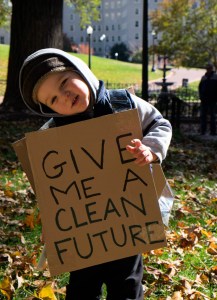
Next year I'm bringing him to lobby with me. Photo credit: Sierra Club

Next year I’m bringing him to lobby with me. Photo credit: Sierra Club

The Virginia General Assembly wraps up its 2017 session on Saturday, February 25. As usual, the results are a mixed bag for energy. On the plus side is the promise of a new solar purchase option for customers. On the downside, utility opposition to energy efficiency and distributed generation meant a lot of worthwhile initiatives never made it out of subcommittee.

Putting it into perspective, it could have been worse. For clean energy advocates in Virginia, that’s what we call a success!

Governor Terry McAuliffe has already acted on some of the bills that passed and will have until March 27 to act on the remaining bills. Under Virginia law, the governor can sign, veto, or amend the bills for legislators’ consideration.

“Rubin Group” bills move renewable energy forward—and back.

Negotiations between utilities, the solar industry trade association MDV-SEIA, and the group Powered by Facts produced three pieces of legislation that appear likely to become law (and all of which I’ve discussed previously). The most significant of these “Rubin Group” bills (named for facilitator Mark Rubin) is SB 1393 (Wagner), the so-called “community solar” bill, which is designed to launch a utility-controlled and administered solar option for customers. The utilities will contract for the output of solar facilities to be built in Virginia and will sell the electricity to subscribers under programs to be approved by the State Corporation Commission. Critical details such as the price of the offering will be determined during a proceeding before the State Corporation Commission.

This was the only one of the Rubin Group bills that had participation from members of the environmental community (Southern Environmental Law Center and Virginia League of Conservation Voters), and it received widespread (though not unanimous) support from advocates.

Broader legislation that would have enabled true community solar programs did not move forward. SB 1208 (Wexton) and HB 2112 (Keam and Villanueva), modeled on programs in other states, had the backing of the Distributed Solar Collaborative, a stakeholder group composed of everyone but utilities. In the Senate, Wexton’s bill was “rolled into” Wagner’s bill, but only her name, not the provisions of her bill, carried over.

SB 1395 (Wagner), a second Rubin Group bill, increases from 100 MW to 150 MW the size of solar or wind projects eligible to use the state’s Permit by Rule process, which is overseen by the Department of Environmental Quality. The legislation also allows utilities to use the PBR process for their projects instead of seeking a permit from the SCC, if the projects are not being built to serve their regulated ratepayers.

The third Rubin Group bill establishes a buy-all, sell-all program for agricultural generators of renewable energy. Although supported by MDV-SEIA as part of the package deal, passage of SB 1394 (Wagner) and HB 2303 (Minchew) should be considered a loss for solar. The program replaces existing agricultural net metering rules for members of rural cooperatives and could lead these coops to reach their 1% net metering cap prematurely, blocking other customers from being able to use net metering. And while negotiators say the program should be economically beneficial to participants, it appears to offer generators no options they don’t already have under existing federal PURPA law.

The governor has until March 27 to act on these bills.

Appalachian Power PPAs for private colleges only

Under HB 2390 (Kilgore), the existing pilot program that allows some third-party power purchase agreements (PPAs) in Dominion Power territory will be extended to Appalachian Power territory, but only for the private colleges and universities who could afford to hire a lobbyist to negotiate the special favor, and only up to a 7 MW program cap. APCo is expected to use passage of the bill to assert that PPAs for all other customers are now illegal. The governor has not indicated whether he will sign the bill.

Intellectual property

SB 1226 (Edwards, D-Roanoke) allows solar developers to keep confidential certain proprietary information that would otherwise be subject to disclosure under the state’s Freedom of Information Act (FOIA). It resolves a problem that has held up a solar project on the Berglund Center, a public building in Roanoke.

Storage, pumped or otherwise

HB 1760 (Kilgore) and SB 1418 (Chafin) allow Dominion Power to seek rate recovery for a scheme to use abandoned coal mines for pumped storage facilities. If you think this sounds weird and possibly dangerous, you are not alone. Usually the idea is to keep water out of coal mines to avoid the leaching of toxic chemicals into groundwater. Apparently no one has ever used coal mines for pumped storage before, and neither the company that would construct the project, nor the sites under consideration, nor the technology to be used, have been revealed.

SB 1258 (Ebbin) adds storage to the mandate of the Virginia Solar Energy Development Authority.

Dominion’s nuclear costs, and the politics of the “rate freeze”

HB 2291 (Kilgore) allows Dominion to charge ratepayers for the costs of upgrading its nuclear facilities. Because the charges will appear as a rider on top of base rates, consumers would not be protected by the “rate freeze” Dominion pushed through in 2015’s SB 1349.

That 2015 legislation, of course, was supposedly designed to shield customers from the impact of the EPA’s Clean Power Plan, a ruse that has been since laid bare. Instead, it will allow Dominion to keep an estimated billion dollars of customers’ money it would otherwise have had to refund or forego. This year, with the CPP on death row under Trump, Senator Chap Petersen introduced SB 1095, which would repeal the rate freeze. His bill was promptly killed in committee, but continues to gain support everywhere outside the General Assembly. Governor McAuliffe belatedly announced his support for Petersen’s bill, but did not use his authority to resurrect it.

Petersen is encouraging the Governor to offer an amendment to Kilgore’s HB 2291 that would repeal the rate freeze, an option allowed by Virginia’s legislative procedure since both provisions affect the same provision of the Code.

Dominion, of course, says the CPP isn’t actually dead and buried just yet, and Republicans seem to fear its resurrection. HB 1974 (O’Quinn) requires the Department of Environmental Quality to submit any Clean Power Plan implementation plan to the General Assembly for approval, so they can stab it with their steely knives.  The governor is expected to veto the bill.

State’s failures on energy efficiency will now be tracked

SB 990 (Dance) requires the Department of Mines, Minerals and Energy to track and report on the state’s progress towards meeting its energy efficiency goals. Or in Virginia’s case, its lack of progress.

HB 1712 (Minchew) expands the provisions of state law that allow public entities to use energy performance-based contracting.

That’s it for energy efficiency legislation this year. Several good bills were offered but killed off in the House Energy Subcommittee, notably HB 1703 (Sullivan), which would have required electric utilities to meet efficiency goals, and HB 1636 (Sullivan again), which would have changed how the SCC evaluates energy efficiency programs. Delegate Sullivan, by the way, introduced a companion bill to SB 990, but his was killed in that same House subcommittee, all on the same day.

Coal ash legislation watered down but passes

SB1398 (Surovell) will require Dominion Power to monitor pollution and study options for the closure of its coal ash impoundments, including removal of the ash to secure, lined landfills. Unfortunately amendments in the House will allow Dominion to proceed with capping the waste in unlined pits while it completes the study. As one editorial put it, “Why not do it right the first time?” The editorial—along with a lot of people who have to live near the coal ash dumps—would like to see the governor offer amendments to the bill, but we’ve heard nothing from the governor’s office on that yet.

Republicans keep trying to throw taxpayer money down a rathole; Governor vetoes

Governor McAuliffe has already vetoed HB 2198 (Kilgore), which would reinstate the coal employment and production incentive tax credit and extend the allowance of the coalfield employment enhancement tax credit. SB 1470 (Chafin) is identical to HB 2198 and so likely faces a veto as well.

Unknown's avatar

While U.S. leaders were worrying about coal jobs, clean energy snatched the lead: even Virginia now has more people working in solar than coal.


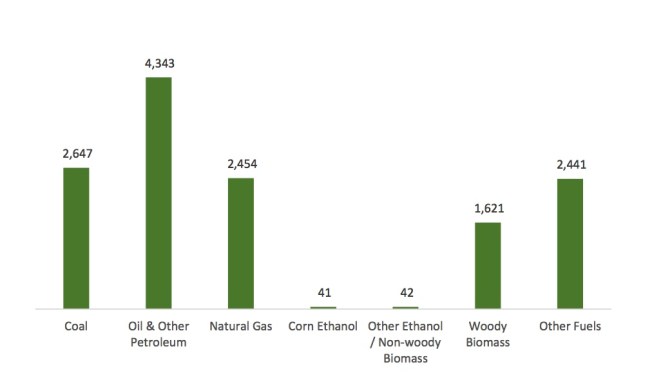
va-electric-sector-jobs

Jobs in electric generation do not include fuel jobs, so for example, the coal jobs in the two charts have to be added together to get total employment. Wind and solar, of course, have no fuel costs. Charts come from DOE.

Jobs in electric generation do not include fuel jobs, so for example, the coal jobs in the two charts have to be added together to get total employment. Wind and solar, of course, don’t need employees to produce their “fuel.” Charts come from DOE.

A new report from the U.S. Department of Energy takes stock of energy employment in the U.S. and comes up with fresh evidence of the rapid transformation of our nation’s electricity supply: more people today work in the solar and wind industries than in natural gas extraction and coal mining.

According to the January 2017 U.S. Energy and Employment Report, 373,807 Americans now work in solar electric power generation, while 101,738 people work in wind. By comparison, a total of 362,118 people work in the natural gas sector, including both fuel supply and generating plants.

Total coal employment stands at 160,119. And while renewable power employment grew by double digits last year—25% for solar, 32% for wind—total job numbers actually declined across the fossil fuel sectors, where machines now do most of the work.

If generating electricity employs a lot of people, not generating it employs even more. The number of Americans working in energy efficiency rose to almost 2.2 million, an increase of 133,000 jobs over the year before.

Those are nationwide figures, but the report helpfully breaks down the numbers by state. For Virginia, 2016 was a watershed year. In spite of the fact that our solar industry is still in its infancy and we have no operating wind farms yet, more Virginians now work in renewable energy than in the state’s storied coal industry. A mere 2,647 Virginians continue to work in coal mining, compared to 4,338 in solar energy and 1,260 in wind.

Dwarfing all of these numbers is the statistic for employment in energy efficiency in Virginia: 75,552.

Unknown's avatar

McAuliffe’s bright new energy plan still has that rotten-egg smell

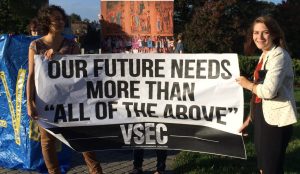
Students protesting the new state motto.

Students protesting the new state motto.

Earlier this week, Virginia Secretary of Commerce and Trade Todd Haymore published an op-ed in the Roanoke Times boasting of the Commonwealth’s achievements on energy. It was a sad reminder that Virginia has trouble moving beyond “all of the above,” a phrase that seems to have become the state motto. But then on Wednesday, the McAuliffe Administration released a cheerful new version of the Virginia Energy Plan that reads like an extended love poem to solar power.

Haymore’s column more accurately reflects this Administration’s approach to energy: a lot of fracked gas, tricked out with bright snippets of solar. But I much prefer the Energy Plan. The entire first third of it is given over to trumpeting Virginia’s progress on developing solar energy. Though the amount of solar installed to date is still tiny, Virginia solar has terrific momentum, and McAuliffe can rightly claim a share of the credit.

The Plan also touches briefly on onshore wind (thanks to a single project from Apex Clean Energy), offshore wind power (nothing to see here, folks, move along), and an array of modest-yet-promising energy efficiency initiatives.

But the Energy Plan has its darker moments, too. If McAuliffe is in love with solar, he is still married to fossil fuels. The Plan continues to promote fracked gas infrastructure like Dominion’s Atlantic Coast pipeline, and insists that flooding the Commonwealth with natural gas is the key to economic prosperity.

Natural gas sneaks into other parts of the Energy Plan as well. The section on alternative fuel vehicles shows a preference for natural gas-fueled vehicles over electric vehicles, bucking the nationwide trend toward EVs. It’s another discouraging indication of just how powerful utility giant Dominion Resources has become in Virginia. Though we think of it as an electric utility, Dominion is a much bigger player in the gas world. You can run an EV on solar, but a natural gas vehicle commits you to fracking.

Locking us into natural gas in all parts of our lives serves Dominion’s purposes very well. But for Virginia, it means considerable pain down the road. With the world finally committed to tackling global warming, our failure to cut carbon now will mean deeper cuts forced on us later.

The Energy Plan does contain a short discussion of the need to fight climate change, but it fails to acknowledge the tension between embracing gas and cutting carbon. The Plan assures us that “Regardless of the outcome of litigation involving the [EPA’s Clean Power Plan], the Governor will work to identify a path toward further reducing Virginia’s carbon emissions and shifting to greater utilization of clean energy to power the Commonwealth economy.” But no hints follow as to how McAuliffe expects to accomplish this while expanding the use of a carbon-emitting resource like natural gas.

We’ve already seen that McAuliffe is capable of holding two contradictory thoughts in his head at the same time. The Governor frequently asserts that climate change is an urgent problem, then in the same breath brags that he persuaded EPA to soften Virginia’s targets under the Clean Power Plan to make compliance easier. He repeats this claim in the Energy Plan, and seems to expect applause.

Knowledgeable observers say EPA softened some initial state targets and tightened others to make the final Clean Power Plan more legally defensible. Regardless, for a man who believes in climate change, McAuliffe’s boast is exasperating. It’s like announcing you pulled off a bank heist when the evidence points to an inside job. Well-wishers can only cringe.

McAuliffe has a little more than a year left in the single term Virginia allows its governors. Here’s hoping he uses it to commit the Commonwealth more firmly to the solar energy he so loves, along with the other essentials of the 21st century energy economy: wind power, battery storage, and energy efficiency. That should make it easier to break with natural gas. Sure, fracked gas looks cheap today, but cheap is not the stuff of legacies.


*On a purely tangential note, Haymore’s column isn’t helped by the editing habits of the Roanoke Times. Like many newspapers these days, the Roanoke Times seems to believe its readers can’t handle full paragraphs. It presents almost all of the Secretary’s short sentences as separate paragraphs, as though insisting that each one should be mulled over individually. The result puts me in mind of the slips of paper inside Chinese fortune cookies, if the fortunes had been written by guys working for energy companies. (That is not, frankly, something I would like to see.)

Unknown's avatar

Your 2016 guide to Virginia wind and solar policy

[NOTE: The 2017 Guide is now available. You can find it here.]

I could make short work of this year’s update by saying that not much has changed in the way of Virginia renewable energy policy in the past year. The General Assembly punted on almost all of the relevant bills that were presented this winter, and a subcommittee that was formed to review those bills has taken no action to date.

But if the policies haven’t changed, the landscape has. While our legislators sat on their hands, everyone else embarked on what, for Virginia, amounts to a solar binge. Dominion Virginia Power began making good on a pledge to install 400 megawatts (MW) of solar in state by the end of the decade. The Governor has taken the first steps to fulfill a pledge to have state agencies meet 8% of their electric demand with solar. Large corporations suddenly want to take advantage of low solar prices and favorable tax policies to do deals in Virginia. Residents are flocking to bulk purchasing cooperatives for rooftop solar. A few universities and schools are using third-party power purchase agreements (PPAs) to install solar under the limited provisions of Dominion Power’s pilot program.

Very little of this is reflected in the statistics—yet. According to the Solar Energy Industries Association, Virginia increased its total renewable energy capacity from 14 MW at the end of 2014 to 22 MW at the end of 2015. A few years ago, an increase of more than 50% would have been amazing. Today we just have to point out that 22 MW is how much solar capacity North Carolina installs on average every single week.

  1. The further we go, the behinder we get
Maryland North Carolina W. Virginia Tennessee Virginia
Solar* 465 2,294 3.4 132 22
Wind** 190 0 583 29 0
Total 655 2,294 586 161 22

Installed capacity measured in megawatts (MW) at the end of 2015. One megawatt is equal to 1,000 kilowatts (kW).

*Source: Solar Energy Industries Association **Source: American Wind Energy Association 

This year we will show real progress. Based on the projects announced to date, Virginia will likely have more than 200 MW of solar online by the end of 2016, with more projects in the queue for 2017. So we are headed in the right direction, but these numbers still represent only a tiny fraction of what we could see if we removed the barriers currently holding back private investment in the solar industry and pushed our utilities to make renewables central to their planning.

Moreover, we still have no wind farms in the state, and neither of our investor-owned utilities included Virginia wind in their latest Integrated Resource Plans (with the exception of Dominion Power’s two pilot offshore wind turbines, which probably won’t get built). The one bright spot on wind energy is that Apex Clean Energy continues to move forward with its Rocky Forge wind farm, scheduled for completion next year.

We also have to view Virginia’s progress on solar in the broader context of energy development. Dominion Virginia Power will have built 4,300 MW of new natural gas generation by the end of the decade and has indicated its interest in building far more. The company will add this to a portfolio that’s already 96% fossil fuel and nuclear. This summer two more companies announced plans to build natural gas plants in Virginia, aiming to burn some of the fracked gas that Dominion plans to bring through the Atlantic Coast Pipeline. When the state’s dominant utility is all-in on natural gas, it’s hard for a different energy model to find elbow room.

But we do have good solar and wind resources, and plenty of demand. What we need are policies that welcome participants to the market.

  1. Virginia utilities won’t sell wind or solar to customers*

(*except those with billions of dollars and famous CEOs—see section 14)

Currently, the average Virginia resident can’t pick up the phone and call their utility to buy electricity generated by wind and solar farms. Worse, they can’t buy renewable energy elsewhere, either.

This wasn’t supposed to happen. Section 56-577(A)(6) of the Virginia code allows utilities to offer “green power” tariffs, and if they don’t, customers are supposed to be able to go elsewhere for it. Ideally, a utility would use money from voluntary green power programs to build or buy renewable energy for these customers. However, Virginia utilities have not done this, except in very tiny amounts. Instead, utilities pay brokers to buy renewable energy certificates (RECs) on behalf of the participants. Participation by consumers is voluntary. Participants sign up and agree to be billed extra on their power bills for the service. Meanwhile, they still run their homes and businesses on regular “brown” power, which is not what they want.

In Dominion’s case, these RECs meet a recognized national standard, and some of them originate with wind turbines, but they primarily represent power produced and consumed out of state, and thus have no effect on the power mix in Virginia. For a fuller discussion of the Dominion Green Power Program, see What’s wrong with Dominion’s Green Power Program.

Appalachian Power’s “green pricing” program is even worse, offering RECs from an 80 MW hydroelectric dam in West Virginia. No wind, and no solar.

Other REC programs are available to Virginia consumers. If you’re considering this route, read this post first.

The State Corporation Commission has ruled that REC-based programs do not qualify as selling renewable energy, so under the terms of §56-577(A)(6), customers are currently permitted to turn to other licensed suppliers of electric energy “to purchase electric energy provided 100 percent from renewable energy.”

So you should be able to go elsewhere to buy wind and solar—say, from a solar facility on someone else’s land, or even from a facility on your own rooftop that someone else owns and operates for you. (For more on that, see section 10 on third-party power purchase agreements.) But Virginia utilities claim that the statute’s words mean that not only must another licensed supplier provide 100% renewable energy, it must also supply 100% of the customer’s demand, all the time. Obviously, the owner of a wind farm or solar facility cannot do that. Ergo, say the utilities, a customer cannot go elsewhere.

On August 31, however, a hearing examiner for the SCC rejected this reading. If the SCC agrees, Virginia residents might have new options.

Anticipating the possibility of an adverse ruling from the SCC, this spring APCo filed a proposal with the SCC for a new tariff under of §56-577(A)(6). Instead of RECs, APCo now proposes to offer real green power, combining wind, solar and hydro. None of the power will come from new projects; partly as a result, the tariff will cost more. The SCC will hold a hearing on the proposal this fall. If approved, APCo customers would finally be able to order renewable energy from their utility. But it would also likely close off customers’ ability under the statute to turn to other suppliers of renewable energy.

Dominion has not yet followed APCo’s lead on this one. If the SCC rules that the statute means what it says, we would expect Dominion to offer a green power program consisting of true renewable energy. Indeed, Dominion seems to be working on a green tariff this fall that it is calling “community solar” (see next session). Its real interest may well be the same as APCo’s.

We hope the SCC will require both APCo and Dominion to follow best practices recommended by groups like Advanced Energy Economy Institute: “Utility renewable energy tariff programs must require that utilities build, purchase or contract for a portfolio of renewable energy through a competitive process, and charge customers according to the actual cost of the portfolio, whether that be a net premium or net savings for customers.”

  1. Community solar? Not hardly

Last year Dominion received SCC approval for a program it billed as an offer to sell electricity from solar panels. Notwithstanding its name, however, the “Dominion Community Solar” program is not an offer to sell electricity generated from solar energy, and reading the details, one can only conclude it would attract customers only to the extent they were deceived about it. Perhaps someone within Dominion pointed out to the brass how close this looks to consumer fraud; at any rate, a year has passed and the company still hasn’t launched it.

As for true community solar, only one Virginia utility offers it: a member-owned rural electric cooperative in southwestern Virginia called BARC. The rest of you are out of luck at the moment. Every year for the past several years, legislation has been introduced to support community solar, and every year it has died in the face of utility opposition.

A few bills this year would have enabled community solar, but they were “carried over to 2017”—i.e., killed. A small working group put together by the solar industry association and the utilities is currently trying to come up with a program that utilities will find acceptable. The group has issued a “Request for Information,” available online, and is holding public meetings this fall to get input on a proposal that looks much more like a green tariff than like community solar. (Clearly Dominion likes the name “community solar”–just not, you know, actual community solar.) Another group, the Distributed Solar Collaborative, which includes all stakeholders except utilities, is also evaluating models from other states and plans to put forward a true community solar alternative.

  1. Virginia’s Renewable Portfolio Standard (RPS) is a miserable sham

Many advocates focus on an RPS as a vehicle for inducing demand. In Virginia, that’s a mistake. Virginia has only a voluntary RPS, which means utilities have the option of participating but don’t have to. Any costs they incur in meeting the goals can be charged to ratepayers. Until a few years ago, utilities even got to collect bonus money as a reward for virtue, until it became clear that there was nothing very virtuous going on.

Making our RPS mandatory rather than voluntary would do nothing for wind and solar in Virginia without a complete overhaul. The statute takes a kitchen-sink approach to what counts as renewable energy, so meeting it requires no new investment and no wind or solar.

The targets are also modest to a fault. Although nominally promising 15% renewables by 2025, the statute sets a 2007 baseline and contains a sleight-of-hand in the definitions section by which the target is applied only to the amount of energy not produced by nuclear plants. The combined result is an effective 2025 target of about 7%.

The RPS is as impotent in practice as it is in theory. In the case of Dominion Virginia Power, the RPS has been met largely with old hydro projects built prior to World War II, trash incinerators, and wood burning, plus a small amount of landfill gas and—a Virginia peculiarity—RECs representing R&D rather than electric generation.

There appears to be no appetite in the General Assembly for making the RPS mandatory, and efforts to improve the voluntary goals have repeatedly failed in the face of utility or industry opposition. The utilities have offered no arguments why the goals should not be limited to new, high-value, in-state renewable projects, other than that it would cost more to meet them than to buy junk RECs.

But with the GA hostile to a mandatory RPS and too many parties with vested interests in keeping the kitchen-sink approach going, it is hard to imagine our RPS becoming transformed into a useful tool to incentivize wind and solar.

That doesn’t mean there is no role for legislatively-mandated wind and solar. But it would be easier to pass a bill with a simple, straightforward mandate for buying or building a certain number of megawatts than it would be to repair a hopelessly broken RPS.

  1. Customer-owned generation: for most, the only game in town

Given the lack of wind or solar options from utilities, people who want renewable energy generally have to build it themselves. A federal 30% tax credit makes it cost-effective for those with cash or access to low-cost financing, and bulk purchasing through nonprofits VA-SUN and LEAP makes the process easier and reduces costs.

Last year the GA passed legislation enabling Property Assessed Clean Energy (PACE) loans for commercial customers. Localities now have an option to offer low-cost financing for energy efficiency and renewable energy projects at the commercial level. A bill to extend PACE authorization to residential customers did not get out of committee this year.

Virginia offers no cash incentives or tax credits for wind or solar. The Virginia legislature passed a bill in 2014 that would offer an incentive, initially as a tax credit and then as a grant program, but it did not receive funding. The same bill, reintroduced in 2015, died in a subcommittee.

The lack of a true RPS in Virginia means Virginia utilities generally will not buy solar renewable energy certificates (SRECs) from customers. SRECs generated here can sometimes be sold to utilities in other states (as of now only Pennsylvania) or to brokers who sell to voluntary purchasers.

  1. Limits to net metering hamper growth

Section 56-594 of the Virginia code allows utility customers with wind and solar projects to net energy meter. System owners get credit from their utility for surplus electricity that’s fed into the grid at times of high output. That offsets the grid power they draw on when their systems are producing less than they need. Their monthly bills reflect only the net energy they draw from the grid.

If a system produces more than the customer uses in a month, the credits roll over to the next month. However, at the end of the year, the customer will be paid for any excess credits only by entering a power purchase agreement with the utility. This will likely be for a price that represents the utility’s “avoided cost” of about 4.5 cents, rather than the retail rate, which for homeowners is closer to 12 cents. This effectively stops most people from installing larger systems than they can use themselves.

Legislation passed in 2015 makes it less likely that new solar owners will have any surplus. At Dominion’s insistence, the definition of “eligible customer-generator” was amended to limit system sizes to no larger than needed to meet the customers demand, based on the previous 12 months of billing history. The SCC wrote implementing regulations (see 20VAC5-315-10 et seq.) but failed to address what happens with new construction. The solar trade association MDV-SEIA continues to work towards a solution to that problem.

The new limitation is a problem for other reasons as well. Some solar customers want to install larger systems than they previously needed because their business is expanding or they plan to buy an electric car. But the limitation is also stupid. If customers want to install more clean, renewable energy than they need and are willing to sell the surplus electricity into the grid at the wholesale power price, why would you stop them from performing this service to society? I can understand that the paperwork isn’t worth the hassle for very small amounts of excess electricity, but if there isn’t an app for that yet, I bet some Virginia Tech students could make one.

  1. Aggregated net metering allowed for farms only

Under a bill introduced by Delegate Randy Minchew (R-Leesburg) and passed in 2013, owners of Virginia farms with more than one electric meter are permitted to attribute the electricity produced by a system that serves one meter (say, on a barn) to other meters on the property (the farmhouse and other outbuildings). This is referred to as “agricultural net metering.” Efforts to expand aggregated net metering beyond farms have not succeeded.

  1. Standby charges hobble the market for larger home systems and electric cars

Dominion Power and Appalachian Power are at the forefront of a national pushback against policies like net metering that facilitate customer-owned generation.

The current system capacity limit for net-metered solar installations is 1 MW for commercial, 20 kW for residential. However, for residential systems between 10 kW and 20 kW, a utility is allowed to apply to the State Corporation Commission to impose a “standby” charge on those customers.

Seizing the opportunity, Dominion won the right to impose a standby charge of up to about $60 per month on these larger systems, eviscerating the market for them just as electric cars were increasing interest in larger systems. (SCC case PUE- 2011-00088.) Legislative efforts to roll back the standby charges were unsuccessful, and more recently, Appalachian Power instituted even more extreme standby charges. (PUE-2014-00026.)

The standby charges supposedly represent the extra costs to the grid for transmission and distribution, though there is a great deal of disagreement on that score, and a lot of suspicion that utilities’ real concern is that they will make less money as demand for their dirty energy product falls.

In the summer of 2013, in a filing with the SCC (PUE-2012-00064, Virginia Electric and Power Company’s Net Metering Generation Impacts Report), Dominion claimed it could also justify standby charges for its generation costs, and indicated it expected to seek them after a year of operating its Solar Purchase Program (see discussion below). As far as I can tell, it hasn’t carried out this threat yet, and it would likely need legislation to do so.

  1. Good news for residential solar: homeowner association bans are largely a thing of the past

Homeowner association (HOA) bans and restrictions on solar systems have been a problem for residential solar. In the 2014 session, the legislature nullified bans as contrary to public policy. The law contains an exception for bans that are recorded in the land deeds, but this is said to be highly unusual; most bans are simply written into HOA covenants. In April of 2015 the Virginia Attorney issued an opinion letter confirming that unrecorded HOA bans on solar are no longer legal.

Even where HOAs cannot ban solar installations, they can impose “reasonable restrictions concerning the size, place and manner of placement.” This language is undefined. The Maryland-DC-Virginia Solar Energy Industries Association has published a guide for HOAs on this topic.

  1. Virginia utilities continue their fight against PPAs; now a losing battle?

One of the primary drivers of solar installations in other states has been third-party ownership of the systems, including third-party power purchase agreements (PPAs), under which the customer pays only for the power produced by the system. For customers that pay no taxes, including non-profit entities like churches and colleges, this is especially important because they can’t use the 30% federal tax credit to reduce the cost of the system if they purchase it directly. Under a PPA, the system owner can take the tax credit (as well as accelerated depreciation) and pass along the savings in the form of a lower electricity price.

The Virginia Code seems to sanction this approach to financing solar facilities in its net metering provisions, specifically §56-594, which authorizes a “customer generator” to net meter, and defines an eligible customer generator as “a customer that owns and operates, or contracts with other persons to own or operate, or both, an electrical generating facility that . . . uses as its total source of fuel renewable energy. . . “

Notwithstanding this provision, in 2011, when Washington & Lee University attempted to use a PPA to finance a solar array on its campus, Dominion Virginia Power issued cease and desist letters to the university and its Staunton-based solar provider, Secure Futures LLC. Dominion claimed the arrangement violated its monopoly on power sales within its territory. Secure Futures and the university thought that even if what was really just a financing arrangement somehow fell afoul of Dominion’s monopoly, surely they were covered by the exception in §56-577(A)(6) available to customers whose own utilities do not offer 100% renewable energy. (See Section 2, above.)

Yet the threat of prolonged and costly litigation was too much. The parties turned the PPA contract into a lease, allowing the solar installation to proceed but without the advantages of a PPA.

After a long and very public fight in the legislature and the press, in 2013 Dominion and the solar industry negotiated a compromise that specifically allows customers in Dominion territory to use third-party PPAs to install solar or wind projects under a pilot program capped at 50 MW. Projects must have a minimum size of 50 kW, unless the customer is a tax-exempt entity, in which case there is no minimum. Projects can be as large as 1 MW. The SCC is supposed to review the program every two years beginning in 2015 and has authority to make changes to it. I’m not aware the SCC has reviewed the program to date.

Appalachian Power and the electric cooperatives declined to participate in the PPA deal-making, so the legal uncertainty about PPAs continues in their territories. In June of 2015, Appalachian Power proposed an alternative to PPAs. An evidentiary hearing was held September 29, 2015. A veritable parade of witnesses testified that APCo”s program was expensive, unworkable and unnecessary, given the plain language of the statute allowing PPAs.

Almost a year later, on August 31, 2016, the hearing examiner finally issued her report, recommending that APCo’s application be rejected, both because it is a lousy program and because she, too, reads the Code to allow PPAs currently, making a utility alternative unnecessary. If the commissioners agree with her, this would be a victory for the solar industry and customers. How useful it will be depends on the scope of the final order, however, and on how they view APCo’s effort to close off the opening afforded by §56-577(A)(6) by offering its own renewable energy product.

The problem cries out for a legislative fix. Advocates pushed hard for legislation this year that would open the Virginia market to private investment through third-party PPAs; but as previously noted, the Commerce and Labor committees ducked their responsibilities and failed to act on the bills.

Meanwhile, Secure Futures has developed a third-party-ownership business model that it says works like a PPA for tax purposes but does not include the sale of electricity, and therefore should not trigger a challenge from Appalachian Power or other utilities. Currently Secure Futures is the only solar provider offering this option, which it calls a Customer Self-Generation Agreement.

  1. Tax exemption for third-party owned solar proves a market driver

In 2014 the General Assembly passed a law exempting solar generating equipment “owned or operated by a business” from state and local taxation for installations up to 20 MW. It did this by classifying solar equipment as “pollution abatement equipment.” Note that this applies only to the equipment, not to the buildings or land underlying the installation, so real estate taxes aren’t affected.

The law was a response to a problem that local “machinery and tools” taxes were mostly so high as to make third-party PPAs uneconomic in Virginia. In a state where solar was already on the margin, the tax could be a deal-breaker.

The 20 MW cap was included at the request of the Virginia Municipal League and the Virginia Association of Counties, and it seemed at the time like such a high cap as to be irrelevant. However, with solar increasingly attractive economically, Virginia’s tax exemption rapidly became a draw for solar developers, including Virginia utilities.

In 2016 Dominion proposed changing the exemption to benefit its own projects at the expense of those of independent developers. In the end, the statute was amended in a way that benefits utility-scale projects without unduly harming smaller projects. Many new projects will now be only 80% exempt, rather than entirely exempt. However, the details are complex, with different timelines and different size classes, and anyone looking to use this provision should study it carefully.

  1. Dominion “Solar Partnership” Program encounters limited success

In 2011, the General Assembly passed a law allowing Dominion to build up to 30 MW of solar energy on leased property, such as roof space on a college or commercial establishment. The SCC approved $80 million of spending, to be partially offset by selling the RECs (meaning the solar energy would not be used to meet Virginia’s RPS goals). The program has resulted in several commercial-scale projects on university campuses and corporate buildings. Unfortunately, it has also been plagued by delays and over-spending.

The program was supposed to proceed in two phases, with 10 MW in place by the end of 2013, and another 20 MW by December 31, 2015. However, the program got off to a very slow start. In August of 2014 the company acknowledged it was behind schedule and would likely not achieve more than 13 or 14 MW of the 30 MW authorized before it ran out of money. On May 7, 2015 Dominion filed a notice with the SCC that it needed to extend the phase 2 end date to December 31, 2016, and confirmed that it would install less than 20 MW altogether.

Although Dominion’s web page suggests that it is still taking applications, I’m doubtful.

  1. Dominion’s Solar Purchase Program: bad for sellers, bad for buyers, and not popular with anyone

The same legislation that enabled the “Solar Partnership” initiative also authorized Dominion to establish “an alternative to net metering” as part of the demonstration program. The alternative turned out to be a buy-all, sell-all deal for up to 3 MW of customer-owned solar. As approved by the SCC, the program allows owners of small solar systems on homes and businesses to sell the power and the associated RECs to Dominion at 15 cents/kWh, while buying regular grid power at retail for their own use. Dominion then sells the power to the Green Power Program at an enormous markup.

I ripped this program from the perspective of the Green Power Program buyers, but the program is also a bad deal for most sellers. Some installers who have looked at it say it’s not worth the hassle given the costs involved and the likelihood that the payments represent taxable income to the homeowner. There is also a possibility that selling the electricity may make homeowners ineligible for the 30% federal tax credit on the purchase of their system. Sellers beware.

And then there’s the problem that selling the solar power means you aren’t powering your home or business with solar—which is the whole point of installing it, right?

  1. Dominion’s Renewable Generation tariff for large users of energy finds no takers; Amazon forces a change, with a new tariff in the works that will be available to others

Currently non-utility renewable energy facilities are subject to a size limit of 1 MW for net-metered projects. These limitations constrain universities, corporations, data centers, and other large users of energy that might want to run on wind or solar. On top of this, the utilities’ interpretation of Virginia law prohibits a developer from building a wind farm or a solar array and selling the power directly to users under a power purchase agreement.

In 2013, Dominion Power rolled out a Renewable Generation Tariff (PUE-2012-00142) to allow customers to buy larger amounts of renewable power from providers, with the utility acting as a go-between and collecting a monthly administrative fee.

From the start the program appeared cumbersome and bureaucratic, and Dominion confirmed to me this summer that they have never had any takers. Then suddenly last year, Amazon Web Services made Dominion’s tariff irrelevant. Amazon contracted directly with a developer for an 80 MW solar farm, avoiding Dominion’s monopoly restrictions with a plan to sell the electricity directly into the PJM (wholesale) market. Dominion Energy (an affiliate of Dominion Virginia Power) then bought the project, and Dominion Virginia Power negotiated a special rate with Amazon for the power. This contract became the basis for an “experimental” tariff that Dominion proposes to offer to customers with a peak demand of 5 MW or more, with a program cap of 200 MW. A hearing examiner at the SCC has recommended approval of the special rate.

Dominion used a different model for its deal this year with Microsoft. After the SCC turned down Dominion’s application to charge ratepayers for a 20-MW solar farm in Remington, Virginia, Dominion reached an agreement with Microsoft and the Commonwealth of Virginia under which the state will buy the output of the project, while Microsoft buys the RECs.

Dominion has a strong incentive to make deals with large corporations that want a lot of renewable energy: if they don’t like what Dominion is offering, they can do an end run around the utility. Amazon has shown other companies how to use PJM rules that let anyone develop projects for the wholesale market regardless of utility monopolies, and then “attribute” the solar or wind energy to their operations in any state. With the tax exemption discussed in section 11, Virginia projects apparently now pencil out pretty well.

  1. Dominion moves into utility-scale solar

Well before Amazon and Microsoft showed an interest in large-scale solar projects here, Dominion had announced it wanted to develop 400 MW of solar in Virginia. In 2015, at the utility’s behest, two bills promoted the construction of utility-scale solar by declaring it in the public interest for utilities to build solar energy projects of at least 1 MW, and up to an aggregate of 500 MW. The bill was amended at the solar industry’s behest to allow utilities the alternative of entering into PPAs for solar power prior to purchasing the generation facilities at a later date, an option with significant tax advantages.

Dominion’s first solar project will be a 20 MW solar farm in Remington, Virginia; however, the SCC rejected the company’s plan to charge ratepayers for the project because the company had not considered cheaper third-party alternatives. Governor McAuliffe helped save the project by working out a deal with Microsoft, as discussed above. Meanwhile, Dominion had also solicited bids for additional projects. To date, three have been announced, totaling 56 MW.

Although Dominion will be able to charge ratepayers for these projects, the SCC insists that the RECs be sold—whether to utilities in other states that have RPS obligations, or to customers who want them for their own sustainability goals, or perhaps even to voluntary green power customers. The result is that Dominion still won’t have any solar in its fuel mix. That’s the weird world of RECs for you.

  1. Governor McAuliffe promises the state will purchase 110 MW of solar

Following a recommendation by the Governor’s Climate Change and Resiliency Commission, on December 21, 2015, Governor McAuliffe announced that the Commonwealth would commit to procuring 8% of its electricity from solar, with 75% of that built by Dominion and 25% by private developers.

The first deal that will count towards this goal is an 18 MW project at Naval Station Oceana, announced on August 2, 2016. The Commonwealth will buy the power and the RECs. (The Remington Project did not count, because as the buyer of the RECs, only Microsoft can claim the right to be buying solar power.)

  1. Will a Solar Development Authority help?

One of the MacAuliffe Administration’s initiatives last year was a bill to establish the Virginia Solar Development Authority. The Authority is explicitly tasked with helping utilities find financing for solar projects; there is no similar language about supporting customer-owned solar. So far, nothing seems to have come of it.

  1. Any wind energy yet? Nope, still waiting

No Virginia utility is actively moving forward with a wind farm on land. Dominion Power’s website used to list 248 MW of land-based wind in Virginia as “under development,” without any noticeable progress. Now it just says 247 MW are “being evaluated.” That’s closer to reality, but they probably should put it in the past tense. There has been a lot of press about the standoff in Tazewell County, where supervisors blocked Dominion’s proposed wind farm. Today, Dominion’s advocacy for its project feels perfunctory. The company has signaled it prefers solar, and its 2016 IRP dismisses wind as too costly.

On the other hand, Appalachian Power’s IRP suggests an interest in wind as a low-cost renewable resource. The bad news is that it isn’t proposing to build any new wind in Virginia.

With no utility buyers, Virginia has not been a friendly place for independent wind developers. In previous years a few wind farm proposals made it to the permitting stage before being abandoned, including in Highland County and on Poor Mountain near Roanoke.

Nonetheless, Apex Clean Energy is in the development stages for the 75-MW Rocky Forge wind farm in Botetourt County. No customer has been announced, but the company believes the project can produce electricity at a competitive price, given its good location and improved turbine technology. Construction is planned for 2017.

As for Virginia’s great offshore wind resource, little progress has been made towards harnessing it, even as the nation’s first offshore wind project will begin generating electricity this fall in the waters off Rhode Island. In 2013 Dominion won the federal auction for the right to develop about 2,000 MW of wind power off Virginia Beach, and the company completed a Site Assessment Plan (SAP) this spring.

We had originally been told the federal government’s timeline would lead to wind turbines being built off Virginia Beach around 2020. Now, however, the Bureau of Ocean Energy Management says Dominion has five years from approval of the SAP to submit its construction and operations plan, after which we’ll have to wait for review and approval. Presumably the project will also require an environmental impact statement. So the whole process would be quite slow even if Dominion were committed to moving forward expeditiously. But in fact, it seems increasingly clear that Dominion is just going through the motions and has no interest in seeing the project through. Its 2016 Integrated Resource Plan (IRP) does not even include offshore wind in any of its scenarios for the next 15 years, except for the 12 MW that would be produced by the two test turbines of its VOWTAP project.

Yes, so what about VOWTAP? Dominion had been part of a Department of Energy-funded team to try out new technology, with the pilot turbines due to be installed in 2017. After a second round of bids to build the project still came in higher than expected, Dominion told DOE this spring it could not commit to construction even by 2020, upon which DOE pulled funding. Dominion executives swear the project isn’t necessarily dead, but that puts me in mind of the “ex-parrot” in the Monty Python skit, still on its perch only because it’s been nailed there.

  1. The Clean Power Plan tries to make it better to switch than fight

On August 3, 2015, EPA issued the final rule known as the Clean Power Plan. Under the rule, states with existing fossil-fuel generating plants must develop plans to reduce total carbon pollution from power plants, which could include using renewable energy as an offset to fossil fuel. In Virginia, the task of developing a state implementation plan (SIP) falls to the Department of Environmental Quality. Earlier this year the Supreme Court stayed implementation of the EPA rule while a Circuit Court considers a challenge, following which Virginia Republicans pushed through a budget provision prohibiting DEQ from developing a SIP while the federal rule is stayed.

Assuming the Clean Power Plan survives challenge, it could help incentivize construction of wind and solar facilities. While Virginia’s goals under the plan are modest, the rule means the state, utilities and the SCC must for the first time take carbon emissions into account in their planning. The EPA has signaled a strong interest in seeing wind and solar deployed as solutions.

Unknown's avatar

Virginia hearing examiner says renewable energy PPAs are legal, but will the ruling stick?

A third-party PPA made it possible to build this solar facility at the University of Richmond. Appalachian Power Company contends that a project like this would be illegal in its territory.

A third-party PPA made it possible to build this solar facility at the University of Richmond. Appalachian Power Company contends that a project like this would be illegal in its territory.

A hearing examiner for the Virginia State Corporation Commission recommended on August 31 that the SCC reject Appalachian Power Company’s proposed alternative to third-party power purchase agreements (PPAs) for renewable energy, concluding the program is not in the public interest. The parties will have three weeks to comment before the recommendation goes to the Commissioners for a final decision. The case is PUE-2015-00040.

The ruling against APCo’s proposed Rider RGP is less important to customers than the reasoning behind it. In addition to finding a myriad of faults with the proposal, the Hearing Examiner concluded it isn’t needed because PPAs are already legal under the Virginia Code. This is an outcome long sought by the solar industry and environmental groups, and one supported by the Attorney General’s Office of Consumer Counsel.

However, the Hearing Examiner’s report is merely a recommendation. Nothing is final until the Commissioners rule, and they could make a decision about Rider RGP without addressing the current legality of PPAs. Moreover, earlier this year, APCo proposed another program that it clearly hopes will nip in the bud any surge of PPA activity that might result from a decision in the present case. (I’ll get to that in a moment.)

The rejection of Rider RGP won’t disappoint any would-be customers. A long line of witnesses testified at the hearing on September 29, 2015 that APCo’s expensive and convoluted program would find no takers. As the Solar Research Institute summarized it, the proposed Rider RGP “would require a customer interested in a solar PPA to first pay for 100% of their service under the standard tariff, pay for 100% of the solar energy generated, pay a $30 program fee, and receive excess payments back through a Renewable Output Credit.” Oh, and they still wouldn’t be using renewable energy. (Note that although solar energy was the focus of the discussion for participants, the decision applies to other forms of renewable energy as well.)

The SCC staff made some suggestions to improve the program, but the hearing examiner, Deborah Ellenberg, concluded it was really beyond saving. Not only that, but the plain language of the Virginia Code makes third-party PPAs legal in the state already. Thus, there is no need for a utility-sponsored alternative.

Ellenberg pointed to two statutory provisions that support the legality of third-party PPAs. First, Virginia Code §56-577 A 5 provides that customers may purchase renewable energy from third-party sellers if their own utility does not offer a tariff for renewable energy. Specifically, customers may:

[P]urchase electric energy provided 100 percent from renewable energy from any supplier of electric energy licensed to sell retail electric energy within the Commonwealth . . . if the incumbent electric utility serving the exclusive service territory does not offer an approved tariff for electric energy provided 100 percent from renewable energy. . . .

Until now, APCo has offered only a green power program that sells RECs, which the SCC says doesn’t count.

The language of §56-577 sounds clear enough, but APCo and Dominion Power have maintained that this section only allows customers to go elsewhere if the other supplier can provide 100% of their electricity from renewable energy, something that can’t be done with a solar facility or a wind turbine.

This flimsy reading of the statute was the basis on which Dominion challenged a PPA at Washington and Lee University back in 2011. The issue was temporarily resolved two years later when Dominion and the solar industry agreed to a pilot program that now allows a limited number of PPAs in Dominion territory, under tight parameters that exclude residential customers. The program never applied in APCo territory, however—a sore point to customers there. APCo has clung to its reading of §56-577, regardless of the growing clamor for renewable energy in southwestern Virginia.

Ellenberg’s report flatly rejects the utility interpretation. If the SCC adopts her reading, any customer in APCo territory would be free to buy renewable energy from third-party suppliers, until APCo offers a qualifying program.

Ellenberg also cited Virginia’s net metering statute. Virginia Code §56-594 authorizes “customer generators” to enter into behind-the-meter PPAs with third parties that own and operate a renewable facility for the customer. Code §56-594 B defines an eligible customer generator for net metering purposes as “a customer that owns and operates, or contracts with other persons to own or operate, or both, an electrical generating facility that . . . uses as its total source of fuel renewable energy . . .” (emphasis added).

Interpreting this provision takes no special legal talent, surely. It would seem to cover residential and commercial facilities installed and owned by third-party developers, including the familiar no-money-down contract offered to residential customers by Solar City. But again, APCo and Dominion Virginia Power claim the Code doesn’t mean what it says. For more than five years they’ve backed up their position with threats of lawsuits, creating the kind of uncertainty that is toxic to development deals.

If the SCC’s final order endorses the hearing examiner’s finding that PPAs are currently legal, the result could be to open up the Virginia solar (and wind) market to large amounts of private investment statewide.

However, Ellenberg’s finding that PPAs are currently legal appears in her discussion but not in her recommendations to the commissioners; her recommendations are limited to the actions she proposes (rejecting or modifying the tariff). The SCC does not have to rule on the question of PPA legality in order to decide this case. Surely, though, it would be strange if it were to duck the opportunity now that the issue has been fully briefed. With solar a hot commodity across the state, the current legal limbo has become a significant economic drag that the SCC ought not to ignore.

As I mentioned, though, APCo still has one card up its sleeve. This spring it proposed a new tariff to offer its customers 100% renewable energy derived from existing wind, solar and hydro projects. The product appears to meet the condition of §56-577. If approved, it would slam shut the door that the Hearing Examiner just opened (or rather, that she said was open all along, if you had dared to go through it into the toxic miasma where gray-suited lawyers lay in wait). APCo’s request for approval of the tariff (PUE-2016-00051) is scheduled to be heard by the SCC on November 15, with comments due by November 8.

Solar advocates take a dim view of APCo’s move. The new tariff won’t build any new facilities; it simply shifts the burden of paying for existing renewable energy projects onto volunteers, at a significant premium. In today’s market, third-party developers can offer electricity generated by new solar projects at competitive prices. So APCo’s tariff looks less like an accommodation to its eco-conscious customers, and more like a maneuver to prevent anyone from building solar on its turf.

It’s high time the SCC put a stop to this anti-competitive behavior and let Virginians build solar projects with their own money. The Commissioners can follow the Hearing Examiner’s advice, or they can take a pragmatic approach and recognize that PPAs are really just a way to finance projects. They don’t turn solar developers into utilities, and APCo should stop wasting everyone’s time and money blocking private investment in a part of the Commonwealth that desperately needs it.