Unknown's avatar

Dominion gets what it wants, but Virginia doesn’t get what we need

DominionLogoNo, you can’t always get what you want.   You can’t always get what you want.   You can’t always get what you want.     But if you try sometime you find,           You get what Dominion Power wants.

With apologies to the Rolling Stones

I guess there’s a reason I never made it as a songwriter. That last line is a disaster. But that, in a nutshell, is what happened to SB 1349, known as the rate-freeze bill, the ratepayer rip-off, or the Dominion bill, depending on whether you were pro, con, or still trying to figure it out.

The bill began and ended as a way for Dominion Virginia Power to shield excess profits from the possibility of regulators ordering refunds to customers. Along the way, Appalachian Power jumped on board, even though its president had already admitted the company had been earning more than it should.

When we last looked, SB 1349 was undergoing radical rewriting on the floor of the Senate, in real time. Conflicting amendments were being passed around. Outside the chamber, lawmakers from both parties were huddled in hallways with Dominion lobbyists. The coal caucus had already tacked on language making it harder to close coal-fired power plants. Now the Governor, progressive leaders and clean energy supporters were pushing amendments guaranteeing more solar and energy efficiency programs.

To get a sense of how impossible it was for the rank and file to follow, check out the bill history with its amendments offered and rejected, and the readings of the amendments waived.

With cameras rolling and the clock ticking, senators made speeches about provisions other people told them were now in the bill, but without anyone having the time to read the language they were expected to vote on. That being normal, they voted on the strength of promises made and assurances given.

With Dominion Power insisting on passage, the result was never in real doubt. Few legislators want to cross the most powerful force in Virginia politics, and the source of so much campaign cash, perks, and donations to local charities. But they needed to hear those promises made and assurances given; otherwise, what would they tell their constituents, when newspapers across the state had been blasting this bill?

The promises made and assurances given also quieted the environmentalists who had led the opposition. Consumers, we were told, would now see investments in solar and energy efficiency that would bring long-term savings, energy diversity and greater price stability, as well as lower pollution and new jobs. The bill would contain firm commitments and produce meaningful investments in energy efficiency and solar power.

The Senate passed the bill, and then finally everyone read what had been voted on. Yes, Dominion had got what it wanted, but then it got . . . even more of what it wanted!

The bill contains a solar provision that smooths the way for utilities to develop or buy up to 500 megawatts of solar power, using Virginia suppliers. But it doesn’t require any minimum solar investment or contain a deadline for getting that solar power on the grid.

As for efficiency, SB 1349 does now contain a provision requiring utilities to create ”pilot programs” for energy assistance and weatherization for low-income, elderly and disabled customers, but it doesn’t say how big a program has to be or how much money must be spent. A “pilot program,” by definition, is small and experimental. It is a baby step, when we were expecting adult strides.

While clean energy advocates were still trying to figure out what happened to the promise of firm commitments and deadlines on solar power, SB 1349 blew through the House.

In short, the final bill language now on the Governor’s desk gives Dominion the authority, but not the obligation, to make clean energy investments.

Virginia law gives our governor an option that most states don’t offer: rather than sign it or veto a bill outright, he can amend it and send it back to the legislature for a final vote. That makes Governor McAuliffe the one person who can still salvage something from this miserable bill. He can put in the solar numbers and dates that went missing—or raise them further—and put hard targets into the efficiency programs. Doing so would finally put McAuliffe on the path to creating all those clean energy jobs he campaigned on.

Dominion will still get what it wants, but if McAuliffe will try, we might get what we need.

Unknown's avatar

Surprise endings to a week of bad news on energy and climate bills

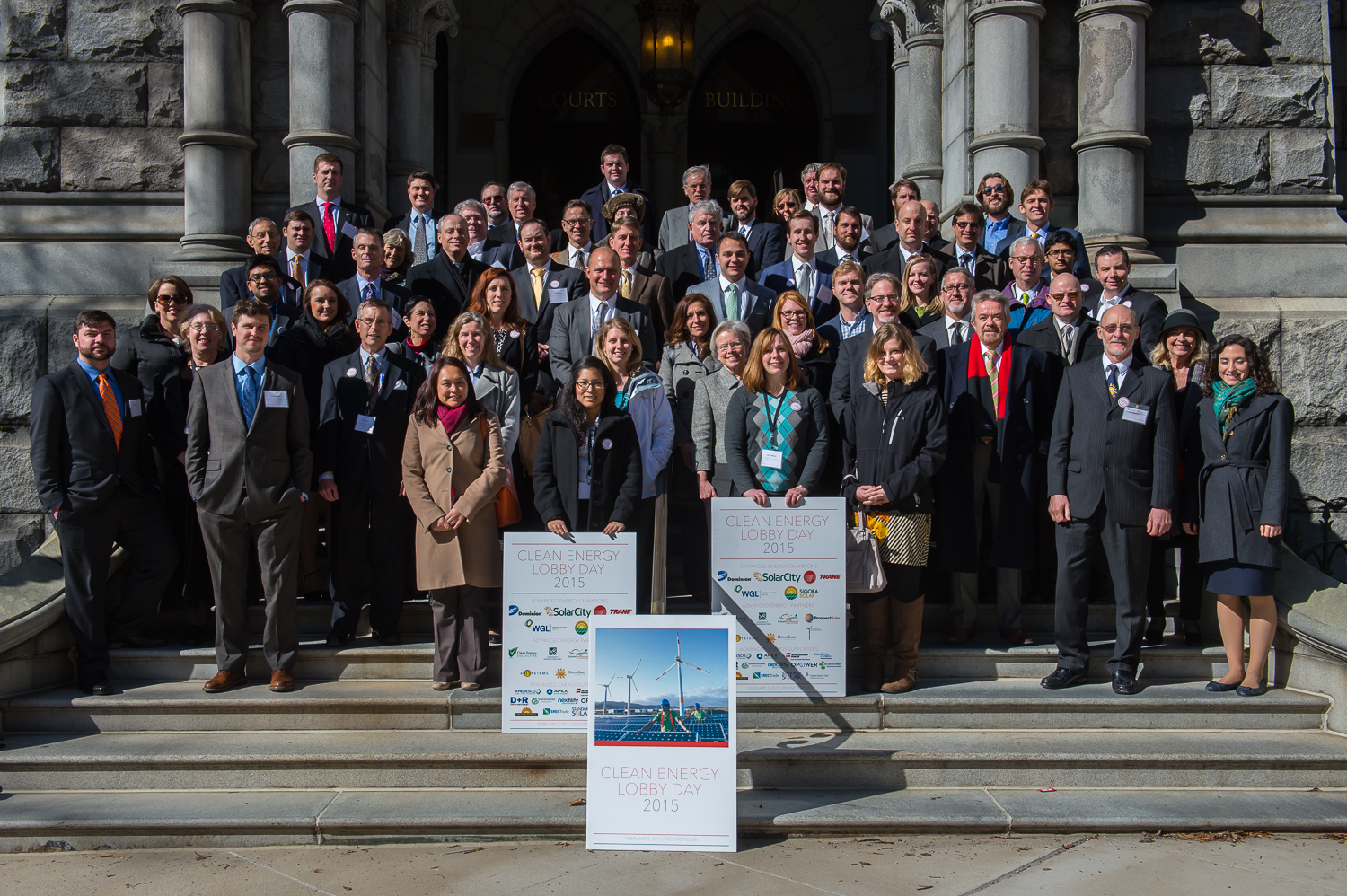
The fourth annual Clean Energy Lobby Day on February 3d brought representatives from businesses across the state to Richmond. Photo courtesy of MDV-SEIA.

The fourth annual Clean Energy Lobby Day on February 3d brought representatives from businesses across the state to Richmond. Photo courtesy of MDV-SEIA.

More than a hundred representatives of energy efficiency and renewable energy businesses descended on Richmond Tuesday for Clean Energy Lobby Day. After meetings with legislators, many of them stayed to attend a critical subcommittee meeting where most of this year’s clean energy bills came up for votes. And they came away with one overpowering impression: the only bills that can make it out of committee are the ones supported by the state’s utilities, especially Dominion Power.

But that wasn’t quite the end of the story. Because by the end of the week, they also found that the groundwork they had laid with their lobbing, and their tenaciousness before the subcommittee, created an opening they would not otherwise have had.

First, the bad news, and plenty of it

Things started bleakly. The House Commerce and Labor Subcommittee on Energy turned back multiple proposals that would have benefited Virginia’s small renewable energy and energy efficiency businesses, as well as their customers. Going down to defeat were bills to improve the renewable portfolio standard (HB 1913), create an energy efficiency resource standard (HB 1730), require a more rigorous study before utilities can impose standby charges (HB 1911), make third-party PPAs legal across the state (HB 1925), and enable an innovative vehicle-to-grid (V2G) project (HB 2073).

Left in limbo for the day was Delegate Minchew’s community solar bill, HB 1636. Minchew wasn’t ready to give up on it, but he had not found a way to get the utilities to back off their opposition. It went without saying that, without Dominion’s buy-in, the subcommittee members wanted nothing to do with it. Out of respect for a fellow Republican, however, they were willing to give him a couple of days’ grace. (On Thursday they killed the bill off.)

One small success was the raising of the cap for individual commercial renewable energy projects from the current 500 kilowatts to 1 megawatt (MW) (HB 1950). Bills to increase it to 2 MW were discarded. The bill was also passed out of the full committee on Thursday.

Also reported out was HB 2267, creating the Virginia Solar Development Authority. It passed in the full committee on Thursday but was then referred to the Committee on Appropriations.

With a few exceptions, the good bills lost on party-line voice votes following testimony from utilities in opposition to the measures. Republican committee members repeatedly expressed their concern about the potential impact on other ratepayers of bills that would make it easier for utility customers to generate their own power, or that would require utilities to buy a smidgeon more renewable energy.

Indeed, anyone who thinks Republicans don’t care about poor people should have been in that room. The outpouring of concern for struggling families was tremendously affecting. These brave souls made it abundantly clear that nothing that could be construed as a subsidy would sneak by on their watch.

Those of us who had seen some of the same delegates vote just last week to continue giving tens of millions of dollars annually in subsidies to coal companies, could not help noting the inconsistency.

Then a funny thing happened on the way to rubber-stamping Dominion’s solar bill

The anti-subsidy rhetoric was further undercut when, a few minutes later, the subcommittee unanimously approved Delegate Yancey’s bill (HB 2237) declaring it in the public interest for the state’s largest utility to install up to 500 MW of solar and offshore wind projects. Chairman Terry Kilgore did ask Dominion Power’s lobbyist if it would raise rates, but he was easily satisfied with the assurance that it would not—even though solar was “marginally more expensive.”

This was all the committee wanted to hear, and a motion had already been made to report the bill when the members were suddenly treated to an earful from the solar industry—not in support of the bill, but in opposition. Francis Hodsoll of Virginia Advances Energy Industries and Jon Hillis of MDV-SIEA, the solar industry trade association, praised the goal but urged that the bill be amended to open up competition for building the solar projects. Utilities might prefer to build the projects themselves to earn their guaranteed return on investment, said Hodsoll, but ratepayers would benefit from lower costs and in-state jobs if independent companies were eligible to bid.

Tony Smith of Secure Futures, LLC, further explained that federal tax incentives strongly favor independent companies developing projects instead of the utilities doing it themselves. He said an independent firm that develops a 20 MW project can sell solar for 5 cents per kilowatt-hour, a far better price than a utility can achieve building the same project itself.

Andy Bidea of Sigora Solar put the case most simply. “This is America. Let’s give capitalism a chance, right?”

Catchy idea. The committee proceeded to report the bill without changes, but Kilgore encouraged the patron to work with the solar industry on possible amendments prior to the full committee meeting on Thursday.

The industry’s stand had an effect. When the bill was taken up on Thursday, it included an amendment allowing utilities to buy power from a third-party developer before purchasing the project itself. This should be significant because the SCC would presumably insist on the lowest-cost approach. In an email, Francis Hodsoll told me the industry now supports the bill, which passed the full committee.

With Dominion’s recent announcements of its plans to move forward with as much as 400 MW of large-scale solar projects in Virginia, this is a hopeful sign for utility solar in the state. Only one project has actually been announced, a 20 MW project in Remington, Virginia. It should also make it easier for Dominion to move forward on offshore wind, a major plus.

Admittedly, the struggle for distributed solar continues. The happy ending on the Yancey bill means little to members of the industry struggling to make a living doing residential and small commercial projects. They had pinned a lot of hope on the grant program that passed with such fanfare a year ago, only to sink like a stone in a House subcommittee this session.

On the other hand, those who take the long view believe that once Virginians get familiar with the benefits of solar, it will become an unstoppable force. The indicators point to success in coming years whether utilities like it or not.

Climate? What climate?

In addition to the clean energy bills, the subcommittee also took action on two climate bills Tuesday. It rejected Delegate Villanueva’s HB 2205, which would have had Virginia join the Regional Greenhouse Gas Initiative as a vehicle to reduce carbon emissions. (The Senate companion bill died on a party-line vote last week.) It was the only legislation this year that would have taken positive action to address climate change and raise some of the enormous sums of money that will be needed to address the consequences of sea level rise.

Instead, it passed HB 2291 (O’Quinn), a bill that would require the Department of Environmental Quality (DEQ) to get approval from the General Assembly before submitting to the U.S. EPA a plan to implement the Clean Power Plan. Since the Republican majority has made its hostility to the Clean Power Plan clear, this is widely seen as a way to keep the state from acting at all. The bill also passed the full committee Thursday on a straight party-line vote, a clear indication that it is about party politics and anti-Obama Administration sentiment, not climate change.

Over in the Senate, however, saner heads prevailed. Senator Watkins amended his companion bill, SB 1365, simply to give DEQ direction on what to consider in developing the plan, and to require it to consult with the SCC and to meet with General Assembly members. The substitute bill passed Senate Agriculture unanimously.

Dominion’s Ratepayer Rip-off Act hits a bump in the road

Meanwhile, Senator Wagner’s bill to protect utility profits and shield Dominion (and now APCo too) from SCC scrutiny through the end of the decade sailed through Senate Commerce and Labor in spite of sparking the kind of outrage and condemnation in the press usually reserved for bills on guns and abortion. Editorial boards excoriated the legislation; Wagner was forced to sell his Dominion stock. Environmental groups, which had first sounded the alarm, staged a protest outside the General Assembly on Thursday morning and spurred thousands of constituents to write letters opposing the ratepayer rip-off.

As a consequence, SB 1349 ran into trouble on the Senate floor Thursday afternoon, and a substitute was introduced consisting of two pages of such dense regulatory detail that I cannot possibly tell you what it means. Anyone with the gumption to try to understand it may be wasting their time anyway, because I hear it remains in flux, with negotiations underway right now. Senator Donald McEachin reportedly is working to make it less objectionable. One thing seems certain: the senators who will be asked to vote on this will have no chance to review the language and reach their own conclusions.

It’s a lousy way to make sausage, but it’s ours.


Unknown's avatar

And the coal gravy train rolls on

Your taxpayer dollars at work!

Your taxpayer dollars at work!

This should have been the year to end more than two decades of corporate welfare for companies whose business model involves the destruction of Virginia’s mountains. All the facts line up against the coal subsidies: the unremitting decline of coal employment since the 1990s, the waste of half a billion dollars that could have gone towards diversifying the southwest Virginia economy, the unfair advantage it gives coal over 21st century clean energy technologies that promise real job growth, and even all that anti-subsidy rhetoric from Republicans that ought to make them uncomfortable with crony capitalism and a blatant giveaway to a mature industry.

Delegate Toscano led a spirited charge against them that included a hard-hitting op-ed in the Richmond Times-Dispatch. But the coal companies whined in committee hearings, and Dominion’s Bill Murray explained that the utility supports making coal cheaper, saying ratepayers would benefit. (Since the money comes out of taxpayers’ pockets, and taxpayers are also presumably ratepayers, it’s a little hard to follow this logic. If you want to get your money’s worth, use more energy?)

No one but a few lonely environmentalists spoke up against the subsidies. Where are the clean energy businesses? Where is the Tea Party? Where are the people who actually care about the dire need for new industries and new jobs in southwest Virginia?

They certainly weren’t being heard in the General Assembly. By mid-week it was clear the giveaway will continue, though perhaps with one welcome change. Under HB 1879, reported from House Finance on Wednesday, the credit for the companies that mine the coal would have a limit on how much any given coal company can claim. However, the credit for those who burn coal is not limited and will actually be extended out to 2019, keeping coal’s unfair advantage over other fuels. (Like, say, renewable energy.)

SB 741, which passed the Senate 32-6 on Thursday, merely contains the extension of the subsidy for coal use out to 2019. So few Senators seem to have their heads on straight on this issue that it’s worth thanking them by name here: Adam Ebbin, Barbara Favola, Janet Howell, Mamie Locke, Donald McEachin, and Jennifer Wexton.

SB 1161 (Colgan), which also passed the Senate, contains the same limitation found in HB 1879. In this case, passing the bill was better than the status quo.


Update: On February 19, the Richmond Times-Dispatch reported, “The House of Delegates and state Senate have agreed to leave untouched a tax credit for electric utilities that burn Virginia coal, even though the policy reversal will create a $5.2 million hole in each chamber’s proposed budget. The House amended and passed Senate Bill 1161, introduced by Sen. Charles J. Colgan, D-Prince William, to include a substitute drafted by Dominion Virginia Power, the state’s largest power company.”


Unknown's avatar

Tomorrow’s Clean Energy Lobby Day will highlight top legislative initiatives, but many are likely to fail in Dominion-friendly subcommittee

solar installation public domainOver a hundred representatives of renewable energy and energy efficiency businesses will descend on the General Assembly tomorrow, February 3d, for Clean Energy Lobby Day. The annual event gives legislators the chance to hear from small businesses across the state that are set to grow if Virginia gets the policies right.

The tradition of a lobby day for clean energy businesses began four years ago as a way to create a counterweight to the outsized influence of utility and fossil fuel interests in the legislature. The Sierra Club organized the popular, bipartisan event its first three years. For 2015, the businesses themselves have taken over, led by a coalition group called Virginia Advanced Energy Industries, and MDV-SEIA, the solar industry trade association.

Participants will primarily discuss with legislators the bills with the greatest potential to affect their own business interests. I’ve described most of these bills in previous posts, so I’ll just list a few here, with their current status.

  • Legislation to promote Property Assessed Clean Energy (PACE) financing for energy efficiency and renewable energy on commercial properties. SB 801 (Watkins) has already passed the Senate unanimously. Its companion bill, HB 1446 (Danny Marshall), and the somewhat similar HB 1665 (Minchew) have been assigned to a subcommittee of the Counties, Cities and Towns and are on the docket for Wednesday, February 3.
  • Delegate Randy Minchew’s HB 1636, creating a program for community net metering. This is a top priority of the solar industry. Sadly, it has been assigned to the Commerce and Labor Committee’s subcommittee on Energy, typically considered a wholly-owned subsidiary of Dominion Power. Prospects aren’t good unless Delegate Minchew negotiates a deal with Dominion.
  • House bills to increase the size limit for commercial renewable energy projects eligible for net metering will also be heard in the energy subcommittee. These include HB 1950 (McClellan), HB 1912 (Lopez), and HB 1622 (Sullivan). On the Senate side, SB 764 (Edwards) and SB 1395 (Dance) were scheduled to be heard in Commerce and Labor today. I’ll update this when I hear the outcome. [Update: the Senate bills were rolled together and heard as SB 1395, which passed the committee unanimously; however, as amended it increases the project cap to 1 MW, rather than the 2MW that was originaly proposed. In addition, it contains new language limiting the project capacity to the amount of energy used, and requiring the owner to pay for the costs of interconnection equipment and other costs.]
  • The renewable energy grant program, HB 1650 (Villanueva), which passed the GA unanimously last year, has already died in a House subcommittee.
  • HB 1725 (Bulova) and SB 1099 (Stuart) would establish the Virginia Solar Energy Development Authority. Bulova’s bill is before the House Subcommittee on Energy. Stuart’s bill has already passed the Senate, with an (unfortunate) amendment to give the legislature more power over appointments.

Many of the clean energy bills on the House side will be heard in the Commerce and Labor Committee’s subcommittee on energy Tuesday afternoon. The timing is not exact; the meeting will follow the conclusion of the meeting of the full committee, in House Room D of the General Assembly building. The subcommittee’s docket has been posted here.

In addition to legislation mentioned above, the subcommittee docket includes other bills of interest, like Yost’s HB 2219 and Yancey’s HB 2237, which promote utility-owned solar, Lopez’s RPS bill, HB 1913, and Villanueva’s Coastal Protection Act, HB 2205.

Some lobby day participants will also be urging opposition to legislation that would prevent Virginia from moving forward quickly to comply with the EPA’s Clean Power Plan, which favors renewable energy and energy efficiency. One such bill, HB 2291 (O’Quinn), is on the House energy subcommittee docket. The equivalent Senate bills are in Agriculture and Natural Resources, where they have not been heard yet.


Unknown's avatar

Criticism mounts over Dominion’s effort to lock in earnings, lock out audits

Dominion buildingSenator Frank Wagner’s bill to permit Virginia’s largest utility to keep its books closed until 2023 cleared a Senate subcommittee last week, but not without a bruising. What Dominion Virginia Power thought would be an easy sell—a promise to freeze rates at their current level—is being widely criticized as another money grab from a company known for resorting to legislative maneuvers to hang on to overearnings. As a result, SB 1349 faces an uncertain future in full committee today, and if it passes, should expect rough treatment on the Senate floor.

As I explained last week, the bill plays on fears that the EPA’s carbon-cutting Clean Power Plan will be costly to implement. According to Senator Wagner and Dominion spokesman Dan Weekly, ratepayers need protection from jarring rate increases.

Of course, if the Clean Power Plan were really likely to raise costs, a for-profit company like Dominion would hardly want to give up the ability to raise rates. Dominion’s eager embrace of a rate freeze puts me in mind of Brer Rabbit’s pleading not to be thrown into the briar patch.

Last year Dominion got away with legislation allowing it to keep hundreds of millions of dollars in over-earnings, catching the press, the new Administration and many legislators flat-footed. It may get away with it again this year, but it won’t be pretty.

For one thing, the press is fully awake this time around. Several papers raised questions, and a hard-hitting article in the Washington Post correctly reframed the issue as whether Dominion should be allowed to escape routine public financial audits. The Post article also hit one of my favorite themes, the outsized influence Dominion wields in the state due to the campaign cash it lavishes on Republicans and Democrats alike. But then it did me one better, noting that Senator Wagner owns stock in Dominion Resources.

An article in the Virginian-Pilot put the value of that stock at $250,000. [Update: a February 2 AP story put the value of Wagner’s stock at only $5,000. Regardless of the actual amount, on February 3, the AP reported that, in response to the story, Wagner sold his Dominion stock.]

Meanwhile the Capital News Service had caught on that the “rate freeze” actually puts a floor, not a ceiling, on utility bills. “Proposal would let Dominion hike electric bills,” ran the headline in multiple newspapers.

So when a small subcommittee of Senate Commerce and Labor* met to consider the bill on Thursday, it was not the easy pass that Senator Wagner and Dominion expected. Lining up against the bill were environmental groups, the Attorney General’s office, SCC staff, and the Virginia Citizens Consumer Council.

Even Senator Dick Saslaw, usually a reliable ally of Dominion, expressed his discomfort with the bill and told Dominion spokesman Dan Weekly that he had better answer the concerns that had been expressed.

But then Saslaw and the other senators voted to move it along. Apparently, just being a bad bill wasn’t enough to kill it.

Update: the full committee of Senate Commerce and Labor reported SB 1349 on a 14-1 vote, with only Senator Newman dissenting. Action now moves to the full Senate, which has many saner heads. But lest optimism get the better of us, I should note that pretty much all of them take Dominion money too.

———————————————

*This is the little hand-picked group I reported on that was supposed to form a joint subcommittee with House members to review all Clean Power Plan legislation. That’s not what happened. The joint subcommittee held two meetings that could best be described as EPA bash-fests, but only Wagner’s bill ended up assigned to the subcommittee, and only the Senate members met to consider his bill. The House members seem to have been unceremoniously dropped from the process altogether.

So what happened to the other climate bills? The Senate bills mostly ended up in Agriculture and Natural Resources, and the House bills mostly in Commerce and Labor (where they have been assigned to the Energy subcommittee). Why the change in plan? Beats me.

Unknown's avatar

Your 2015 legislative session cheat sheet, part 3: climate bills

Photo credit: Corrina Beall

Photo credit: Corrina Beall

Anti-Clean Power Plan bills

When the EPA released its Clean Power Plan last June, clean energy advocates celebrated America’s first serious response to rising carbon emissions. At hearings held across Virginia, supporters of the plan outnumbered opponents by as much as five to one, making it clear the public welcomes EPA’s plan as a way to break the rise in carbon emissions while opening the door to new economic opportunities in solar, wind, and energy efficiency.

Alas, the response of most Republican legislators was to man the barricades and protect the fossil fuel status quo. That impulse to panic translated into a spate of bills aimed at rejecting or undermining EPA authority and hobbling the ability of the state to implement the Clean Power Plan.

SB 740 (Carrico), SB 1365 (Watkins and Chaffin), and HB 2291 (O’Quinn) instruct the state Department of Environmental Quality (DEQ) to hold hearings and examine witnesses in the development of its compliance plan and take a “least-cost” approach to compliance. DEQ is also required to get approval from the General Assembly for the plan before it can submit it to the EPA for approval—and if either chamber doesn’t like it, DEQ has to do it over again, until the time allowed for state compliance runs out.

SB 1202 (Wagner) goes further. Before DEQ can even write its plan, the State Corporation Commission has to find that the EPA has made changes to the Clean Power Plan that fix all the things the SCC staff claim are wrong with it. The SCC staff have already accused the EPA of acting illegally, arbitrarily, and capriciously, so it’s safe to say that under Wagner’s bill, we’ll see pigs fly before DEQ writes a carbon plan.

HJ 608 (Kilgore) is a resolution asserting that electricity regulation is a sovereign state function and complaining that EPA is infringing on state turf. The resolution is silly on its face; Virginia’s grid is part of an interstate transmission system (PJM), our utilities operate in multiple states, much of our electricity is generated outside our borders, and all of our generating plants, transmission lines, and everything else associated with providing power in Virginia are covered by federal regulations of one sort or another. HJ 608 has nothing to do with reality. But reality is not the point. The point is that Terry Kilgore and the fossil fuel companies he represents are loaded for bear and want to prove it.

SJ 273 (Wagner) directs DEQ to study whether the health benefits of the Clean Power Plan are really any different from those already expected from compliance with other air quality regulations. The reason, according to the bill, is that “if the EPA is claiming the same health benefits under two different sets of regulations, its effort to attribute future pollution reductions to the proposed Plan amounts to ‘double counting.’” If you’re wondering how that is relevant to Virginia’s obligation to comply with the Clean Power Plan, then once again you’re missing the point. This is about posturing, not compliance.

SJ 308 (Wagner yet again!) would let the GA’s Joint Rules Committee hire its own counsel to sue the EPA to block the Clean Power Plan if the Attorney General won’t do it. HJ 529 (Bob Marshall) would have a similar effect, though his bill is more of an all-caps version aimed at anything the federal government does that he opposes.

Virginia Republicans didn’t invent the attack-challenge-delay approach that is the common theme of these bills. The strategy comes from the American Legislative Exchange Council (ALEC), the conservative “bill mill” heavily funded by fossil fuel interests, and of which Dominion Power is a member. ALEC developed a game plan for state-by-state resistance to the EPA plan.

ALEC’s model bill, called the RASP Act, forbids a governor from complying with the EPA regulations without getting approval from the legislature. Sound familiar? And yet it’s a cut-off-your-nose-to-spite-your-face reaction. The longer a state delays, the harder compliance becomes. Delay too long, and EPA writes your plan for you. That’s not a good outcome for either Virginia or the climate.

Coastal Protection Plan

The EPA Clean Power Plan allows multiple pathways to compliance. On of them is the regional compliance plan: states can band together on a market approach to reduce cost and disruption. Several northeastern states already have this cap-and-trade approach in place, known as the Regional Greenhouse Gas Initiative (RGGI). Similar regional efforts exist for some Midwestern and Western states as well. These all predate the Clean Power Plan, but a recent analysis by PJM, the regional transmission operator that runs Virginia’s grid, found that a regional cap-and-trade approach would cost 30% less than a state-by-state approach to meeting carbon regulations.

Even many Virginia Republicans have said they favor a regional approach to compliance with the Clean Power Plan, once they have done challenging everything they can about it.

One of the attractive elements of RGGI is the market mechanism. Polluters must buy carbon allowances, generating money for the state. HB 2205 (Villanueva) and SB 1428 (McEachin), the Coastal Protection Plan, would have Virginia join RGGI, and use half of the money generated to address the problems created by sea level rise. SB 1323 (Lewis) would merely have DEQ study the idea.

For a fuller explanation of the bill, see Dawone Robinson’s guest post here. The Coastal Protection Act is already picking up endorsements, from the Washington Post to the Virginia Housing Coalition and local governments including Norfolk.

The Dominion Power Ratepayer Rip-Off Act of 2015

When Dominion Virginia Power offers to do something to protect ratepayers, watch your wallet. Last year’s act of generosity cost us hundreds of millions of dollars to cover Dominion’s initial expenses for a nuclear plant it may never build.

This year it’s a bill, SB 1349 (Wagner), that would freeze rates (but notably not utility bills) until at least 2023. Like last year’s money bill, this one prevents the State Corporation Commission from requiring the utility to refund money to ratepayers and/or lower rates if the utility earns more than the law entitles it to. In other words, it lets Dominion keep the windfall.

Senator Wagner presents his bill as a protection for ratepayers in the face of the EPA’s Clean Power Plan, which he claims will be costly for ratepayers. But here’s the thing: Dominion’s obligation to its shareholders is to maximize profit. The company wouldn’t support a rate freeze if it meant losing money. Dominion’s support for Wagner’s bill can only mean the utility expects to make a lot of money at current rates, even under the EPA plan.

This makes sense to the clean energy advocates, who point to analyses showing the Clean Power Plan will benefit consumers rather than costing them more. That’s because energy efficiency—a major component of the plan—saves money. If Virginia consumers do save money under the plan, though, the Wagner bill makes sure they won’t see the benefit.

Indeed, it doesn’t even protect them from higher bills, because Dominion can still increase other charges that make up customers’ bills. The “rate freeze,” in other words, will set a floor on electric utility bills, but not a ceiling.

Unknown's avatar

Your 2015 Virginia legislative session cheat sheet, part 2: Fossil Fuels

Photo credit: Corrina Beall

Photo credit: Corrina Beall

My last post covered clean energy bills introduced into the 2015 legislative session, which began last week and ends at the end of February. Time to hustle on to the oil, gas, and coal bills.

Coal subsidies

Coal companies claim to be victims of a “war on coal,” but for nearly two decades they’ve been conducting a war on Virginia taxpayers. Virginia’s tax code offers so many preferences that a 2012 study concluded the coal industry costs Virginia more than it gives back. Among other preferences, two different subsidies in the Code have allowed coal companies to siphon off tens of millions of dollars annually from the General Fund since 1996.

The subsidies come with nominal sunset dates, currently January 1, 2017. Over nearly twenty years, no matter how fat or lean the state’s financial condition, the legislature has repeatedly passed extensions, and they are being asked to do so again this year. HB 1879 (Kilgore) and SB 741 (Carrico) would extend the giveaway out to 2022.

(According to VPAP.org, Delegate Kilgore, chairman of the Commerce and Labor Committee, gets a check for $10,000 every year from coal giant Alpha Natural Resources. Alpha also gives ten grand a year to Senator Carrico, who just happens to sit on Senate Finance, which will hear the bill. I mention these facts only in passing. It would be cynical to suggest a connection.)

Supporters of the subsidies seem to believe coal companies need the inducement to blow up our mountains and dump waste into stream valleys. And they maintain this is a good thing for the people of Southwest Virginia, who can enjoy gainful employment by participating in the destruction of their communities.

The coal companies certainly do benefit from this arrangement, but coal jobs have declined to less than 5,000 total in Virginia today, and it’s clear to everyone that Southwest Virginia needs to diversify its economy or face a future of poverty and high unemployment. The coal subsidies suck up money that could be spent on new jobs and a better-educated workforce.

The McAuliffe administration, facing a budget shortfall, has suggested cutting the subsidies way back, and has no plans to extend them. HB 2181 (Toscano) reduces the amount of the subsidies for 2015 and 2016 but does not eliminate them. It also limits the amount that can be claimed on any one tax return to $500,000 under each Code provision.

HB 1877 (Krupicka) would end the subsidies altogether a year early. His bill goes further: it would redirect the savings into a fund to provide grants to students enrolled in Virginia public colleges and universities. Half the money would be required to go to students from the Coalfields region.

Natural gas

SB 1338 (Hanger) repeals a provision of the Code known as the Wagner Act (after Senator Frank Wagner, who introduced the legislation ten years ago). That provision allows interstate natural gas companies to enter private property without the consent of the owner in order to make “examinations, tests, hand auger borings, appraisals, and surveys.”

The Wagner Act gained notoriety last year when Dominion Power sued landowners who resisted efforts to survey their land. We think of Dominion as an electric utility, but Dominion Resources also owns a gas transmission company, and it plans to build a huge new pipeline to bring fracked gas from Ohio and West Virginia and deliver it to industrial customers and export facilities on the coast. Turns out, a lot of people don’t like strangers coming on their land without permission, especially when the point is to let the strangers decide whether they might want to seize the land for a pipeline. Well, who could have expected that?

But in case the GA doesn’t have an appetite for repealing the Wagner Act, how about making it harder to use? SB 1169 (Hanger again) amends it to add a pre-condition. Before any natural gas company can enter someone’s property without permission, the governing board of the locality must have adopted a resolution in support of the pipeline or gas works. Moreover, the resolution “shall not be adopted unless the governing body has found that locating the line or works within the city or county is consistent with its comprehensive plan, master plan, or any general development plan and that there exists a demonstrated public need for the line or works.”

HB 1475 (Ware) and SB 1163 (Saslaw) allow natural gas utilities to expand their systems to reach more retail customers. This legislation is not related to the interstate gas pipelines sought by Dominion and others. It deals with pipelines within the state that would connect customers who currently don’t have access to natural gas for heating and cooking (a more efficient use of energy than burning gas for electricity to perform the same functions).

But the gas utilities have taken a page from the Dominion playbook and overreached with their legislative language, including by declaring its plans and business goals to be “in the public interest” (the magic words that limit SCC review). We hear the bill is likely to be amended to take out the offending language.

Really a bill about energy efficiency, SB 1331 (Petersen) changes how the SCC evaluates natural gas conservation programs proposed by utilities. It instructs the SCC to determine the cost-effectiveness of a program by looking at the utility’s whole portfolio of conservation programs and not each judged separately. This should make it easier to get conservation programs approved, and it’s to the credit of the retail gas companies that they want it passed. Senator Petersen’s office informed me the bill originated with the governor’s office, which supports it.

Offshore oil drilling

Virginia doesn’t control the deep waters off our coast where oil may be lurking, and drilling is still years away, if it happens at all. But that has never stopped state lawmakers from making plans to spend the money we might earn from oil drilling, if Congress were to share some of the revenue with us. Most of us will recognize this game as, “Imagine if you won the lottery.”

Back in 2010, Governor McDonnell pushed through a bill to fund transportation projects with the imaginary money. In 2014, the law was amended to put $50 million into an emergency response fund to combat what would have to be a pretty small imaginary oil spill, with all the extra imaginary money going to the General Fund.

HB 1702 (Davis) proposes to amend the law again to take half of the imaginary General Fund money and put it into public schools. Well, who could object to that? Except for the imaginary part, of course.

Unknown's avatar

Your 2015 Virginia legislative session cheat sheet, part one: Clean energy bills

photo credit: Amadeus

photo credit: Amadeus

I’m starting my review of 2015 energy legislation with a look at bills dealing with renewable energy and energy efficiency. Most of these bills will be heard in the committees on Commerce and Labor, though bills that cost money (tax credits and grants) usually go to Finance.

Bills referred to Senate Commerce and Labor are heard by the full committee, which meets on Monday afternoons. It consists of 14 members: 11 Republicans and 3 Democrats. They form a tough lineup; none of these senators received better than a “C” on the Sierra Club’s Climate and Energy Scorecard.

The House bills are typically assigned to the 13-member Special Subcommittee on Energy (10 Republicans and 3 Democrats, no fixed schedule). Bills that do not meet the approval of Dominion Power can expect a quick death here on an unrecorded voice vote, never to be heard from again. But on the plus side, the meetings are often quite lively, like old-fashioned hangings.

Net metering bills

Net metering is the policy that allows owners of solar (or other renewable) energy systems to be credited for the excess power they feed back into the grid when the systems produce a surplus; the owners use the credits when their systems aren’t supplying power and they need to draw electricity from the grid. Virginia law restricts who can use net metering, and how much. Expanding net metering is a major goal of renewable energy advocates, who argue it offers a free market approach to growth—give customers the freedom to build solar projects, get the utility out of the way, and solar will thrive.

This year’s initiatives include:

  • SB 833 and SB 764 (Edwards—apparently identical bills), HB 1950 (McClellan), and HB 1912 (Lopez) raise the maximum size of a commercial project eligible for net metering, from 500 kilowatts (kW) currently to 2 megawatts (MW). This is a much-needed expansion of the net metering program if Virginia is going to make real headway with solar. We are told Edwards plans to conform his legislation to HB 1622, below.
  • HB 1622 (Sullivan) raises the maximum size of a commercial project to 1 MW, and the maximum size of a residential system from the current 20 kW to a whopping 40 kW. But note that it does nothing to limit the standby charges utilities can charge for residential projects over 10 kW. Given that these charges are so punitive as to kill the projects, raising the cap wouldn’t create new market opportunities unless it is accompanied by a limit on the amount of standby charges that utilities can tack on.
  • HB 1911 (Lopez) amends the language allowing utilities to impose standby charges on residential and agricultural customers with systems over 10 kW to add the requirement that the State Corporation Commission conduct a “value of solar” analysis prior to approving the charges. Most solar advocates would rather see the legislature repeal the standby charge provision altogether, given how the utilities have abused it. Barring that, legislators should set a dollar limit of no more than five or ten bucks a month. But in the absence of any such reforms, it does make sense to at least require the SCC to do this more substantive analysis, ideally building on the framework developed over the summer by the Solar Stakeholder Group.
  • HB 1636 (Minchew) establishes “community net metering” as well as increasing the commercial project cap to 2 MW. This bill is a high priority for the solar industry and the environmental community. It provides the solution for owners with shaded roofs, renters and others who can’t install solar themselves by letting them subscribe to a community generation facility in their own or a neighboring county. Other forms of renewable energy are also allowed, so residents in windy areas could go in on a small wind turbine that wouldn’t make sense for a single household.
  • HB 1729 (Sullivan) creates “solar gardens” consisting of community organizations with 10 or more subscribers. The generation facility can be as large as 2 MW. The bill seems intended to accomplish much the same purpose as Minchew’s bill, although it is limited to solar. However, it allows the utility to impose “a reasonable charge as determined by the [State Corporation Commission] to cover the utility’s costs of delivering to the subscriber’s premises the electricity generated by the community solar garden, integrating the solar generation with the utility’s system, and administering the community solar garden’s contracts and net metering credits.” Boy, we’ve seen that movie before. Given what we’ve seen the SCC do with standby charges, the bill should be amended to put a cap on the amount of that “reasonable charge” so legislators know they aren’t writing a blank check.
  • SB 350 (Edwards) authorizes programs for local governments to use net metering for municipal buildings, using renewable energy projects up to 5 MW. It also allows a form of community net metering targeted to condominiums, apartment buildings, homeowner associations, etc., with a renewable energy facility located on land owned by the association. These customers would be exempt from standby charges.

Third-party power purchase agreements (PPAs)

HB 1925 (Lopez) and SB 1160 (Edwards) replace the current PPA program in Dominion territory with one that applies to both Dominion and APCo territories. It increases the project cap from the current 500 kW to 1 MW, and raises the overall program size to 100 MW from (50 MW). As with the current program, projects under 50 kW aren’t eligible unless the customer is a tax-exempt organization.

Utility-scale solar

HB 2219 (Yost) declares it to be in the public interest for Dominion Virginia Power or Appalachian Power to build up to 500 MW of solar power—a truly welcome objective—and authorizes the utilities to apply to the SCC for a certificate of public convenience and necessity for individual facilities of at least 20 MW in size, regardless of whether the facility is located in the utility’s own service territory.

“In the public interest” are the magic words that push the SCC to approve something it might not otherwise. Both utility giants have shown an interest in building and owning utility-scale solar, even as they have taught the SCC to believe that solar owned by anyone else burdens the grid. The magic words let them escape the corner they backed themselves into. That would be necessary here, given that our SCC wrongly believes the public interest requires the lowest cost energy regardless of the consequences to public health, the environment, national security, and the economy.

The solar industry has two concerns about HB 2219: the effect on ratepayers, since Dominion’s previous solar efforts have cost well above market rates; and the effect on the Virginia solar industry—or rather, the lack of an effect, since Dominion has hired only out-of-state companies. Virginia ratepayers could save money and the state could build more solar if legislation simply required the utilities to buy 500 MW of solar, and let the market decide who builds it. But of course, that’s now how things work in Virginia.

I also think it is unfortunate that the bill allows utilities to build solar plants that are not in the utilities’ own service territories, and that it does not require them to use Virginia contractors. Surely there would be more support for a bill promising projects that support local economies with jobs and tax revenues, and that requires the hiring of local installers. These seem like small enough things to ask.

HB 2237 (Yancey) allows Dominion or APCo to recover the costs of building or buying a solar facility in the state of Virginia of at least 5 MW, plus an enhanced rate of return on equity, through a rate adjustment clause. It also states that construction or purchase of such a facility, and the planning and development activities for solar energy facilities, are in the public interest. (The magic words again.)

This bill doesn’t require anything or make huge changes. It simply treats solar the way the Code currently treats other forms of generation, with the exception that the “in the public interest” language was previously used only to endorse a coal plant (what became the Virginia City Hybrid Energy Plant in Wise County). And note that this bill requires that the facility be in Virginia, and opens up the possibility of our utilities buying the facility rather than constructing it themselves, which could open the door to competition. This seems like a good way to proceed.

Grants and tax credits

HB 1728 (Sullivan) establishes a tax credit for renewable energy. Great idea, but last year the Senate Finance Committee made it clear they would not pass a new tax credit, so I assume this is a non-starter.

Last year’s renewable energy tax credit bill was amended to create a grant program instead. It passed both houses, but without funding and with the requirement that it be passed again this year. It is back this year as HB 1650 (Villanueva). (It has been assigned to House Committee on Agriculture, Chesapeake and Natural Resources and is on the docket for 8:30 a.m. Wednesday, January 21. Odd: it ought to be in Finance.) The grant would equal 35% of the costs of a renewable energy facility, including not just wind and solar, but also things like biomass, waste, landfill gas, and municipal waste incinerators. Facilities paid for by utility ratepayers are not eligible, and the grant total is capped at $10 million per year. Prospects for the program aren’t great given the state’s tight budget situation, but the bill is a high priority for the solar industry.

Another tax-related bill is HB 1297 (Rasoul), which authorizes localities to charge a lower tax on renewable projects than on other kinds of “machinery and tools.” Last year, you may recall, the solar industry was successful in getting passage of a bill that exempted solar equipment entirely from local machinery and tools taxes. Proponents are trying to ensure that Delegate Rasoul’s well-intentioned bill doesn’t reverse last year’s victory on solar.

Bills specific to energy efficiency

HB 1730 (Sullivan) establishes energy efficiency goals for electric and natural gas utilities. The good news: the goals are mandatory. The bad news: the goals are modest to a fault: a total of 2% energy savings by 2030 for electricity and 1% for natural gas.

HB 1345 (Carr) extends the sales tax holiday for Energy Star and WaterSense products to include all Energy Star light bulbs; currently only compact fluorescent light bulbs are eligible.

PACE bills

PACE (Property Assessed Clean Energy) is a way to finance energy efficiency, renewable energy and water conservation upgrades to commercial and non-profit-owned buildings. Local governments sponsor the financing for improvements and collect payments via property tax bills. Since the energy savings more than pay for the increased assessments, PACE programs have been hugely successful in other states.

Last year a bill that would have let localities extend “service districts” to cover clean energy (PACE by another name) failed in the face of opposition from the banking industry. This year’s bills are also not labeled PACE bills, but they achieve the same end. Apparently the parties have worked out the problems, a hopeful sign that a multi-year effort will finally meet with success.

SB 801 (Watkins) and HB 1446 (Danny Marshall) are companion bills that would authorize local governments to work with third parties to offer loans for clean energy and water efficiency improvements, creating “voluntary special assessment liens” against the property getting the improvements. The Department of Mines, Minerals and Energy would develop underwriting guidelines for local loans to finance the work. HB 1665 (Minchew) is similar, and we are told it will be conformed to HB 1446.

Virginia Solar Energy Development Authority

HB 1725 (Bulova) and SB 1099 (Stuart) establish the Virginia Solar Energy Development Authority to “facilitate, coordinate, and support the development of the solar energy industry and solar-powered electric energy facilities in the Commonwealth.” This implements a proposal in the 2014 Virginia Energy Plan and is not expected to be controversial.

Virginia SREC registry

HB 2075 (Toscano) requires the SCC to establish a registry for solar renewable energy certificates (SRECs). It would not suddenly make Virginia SRECs valuable, but it would put the administrative framework in place to support a voluntary SREC market, or even a real one if Virginia were to adopt legislation requiring utilities to buy solar power.

Cross-cutting approaches to clean energy

A few bills would have a more sweeping effect on energy efficiency and renewable energy. HB 2155 (Sickles) is billed as an “Energy Diversity Plan.” It was supposed to be a “grand bargain” between utilities and the clean energy industries, with the McAuliffe administration participating as well, but we understand there are outstanding issues that make the bill’s future uncertain.

The big idea is to put all non-emitting energy sources into one category: primarily wind, solar, hydro and nuclear, but also adding in combined heat and power, demand response and energy efficiency. The bill creates a timeline that requires utilities to ramp up use of new, non-emitting sources gradually, beginning with 0.25% of retail sales in 2016 and ramping up to 35% in 2030.

The bill has the support of clean energy industries, but the idea of treating nuclear as a benign source of power on an even footing with efficiency and renewables concerns the environmental community.

I’ll write more about this bill if it looks like it has legs.

HB 1913 (Lopez) is the only bill of the bunch that directly targets Virginia’s Renewable Portfolio Standard (RPS). Maybe that shouldn’t be a surprise. Our RPS is a poor, sickly thing that most people have left for dead. To his credit, Lopez keeps trying. His bill keeps the RPS voluntary but beefs up the provisions to make the program meaningful, if a utility chooses to participate. Instead of mostly buying renewable energy certificates from things like old, out of state hydro dams, the bill would ensure that actual, real-world renewable projects get built. You know, what an RPS is supposed to do.

In addition, the bill folds into the RPS the state’s existing goal of 10% energy efficiency gains by 2022. Utilities have done very little toward meeting this goal. Putting it into the voluntary RPS might be the prod needed to get more efficiency programs underway.

Or it might cause a utility to drop out. Either way, the result would be better than what we have now, where Virginia pretends to have an RPS, and utilities pretend to care.

Update: Another net metering bill has been filed. SB 1395 (Dance) raises the commercial net metering cap from 500 kW to 2 MW.

Unknown's avatar

Pass the Coastal Protection Act to cut carbon, raise millions

With today’s start of the Virginia legislative session, a lot of energy and climate bills are pouring in–some good, some not so good, some downright terrible. I’ll have an overview of them coming soon, but meanwhile guest blogger Dawone Robinson gives us a look at one of the best of the bills, the Coastal Protection Act, HB 2205 (Villanueva). A shorter version of his post appeared as an oped in the January 12 edition of the Richmond Times-Dispatch. Many thanks to Dawone for letting me run this. 

——————————

A house in the process of being elevated, a very expensive solution to the problem of recurrent flooding due to sea level rise in Virginia. Photo credit: CCAN

A house in the process of being elevated, a very expensive solution to the problem of recurrent flooding due to sea level rise in Virginia. Photo credit: CCAN

Have you ever put together a list of items you would purchase if you won the lottery—before you remembered that you haven’t even purchased a ticket? Upon reflection, how premature was that list you so perfectly pieced together?

In Virginia, we face a similar dilemma when it comes to addressing the mounting crisis of flooding along our coast.

We’ve got plenty of laudable lists in the works. Last year, Virginia lawmakers unanimously passed a resolution establishing a joint subcommittee to study recurrent flooding issues and adopt recommendations. Legislators from both parties sent a unified message: flooding is a problem in Hampton Roads and we need to do something about it.

In 2008, former Governor Tim Kaine’s Climate Change Commission laid out more than 100 recommendations to mitigate and adapt to climate change and sea level rise. So far the state has failed to adopt a plan to execute them. To his credit, Governor Terry McAuliffe recently launched a similar commission. This panel, the state’s Secure Commonwealth Panel, and the General Assembly’s aforementioned recurrent flooding subcommittee all have the same mandate: convene, discuss, deliberate, and draft a set of recommendations.

So what’s the catch? While what needs to be done is relatively easy to identify, the cost is significant—if not staggering. Virginia needs to win the equivalent of a multi-hundred-million-dollar lottery every year to fund the adaptation measures required to protect coastal residents and infrastructure.

Hampton Roads is home to the world’s largest naval base, more than $80 billion in economic activity, and 1.7 million residents who routinely feel the effects of sea level rise. Streets need to be raised, levees need to be built, and homes and businesses need to be protected. The U.S. branch of the Dutch engineering firm Fugro estimated that it would cost the city of Norfolk at least $1 billion to fully adapt to rising seas and frequent flooding—which equals Norfolk’s entire annual government operating budget.

The non-profit group Wetlands Watch reports that the cost to either elevate or purchase the homes of residents in just five Hampton Roads localities that have sustained multiple flood losses of $1,000 or more in the last ten years would exceed $430 million. Relying on federal assistance alone, it could take up to 244 years to assist all homeowners seeking help in these five localities.

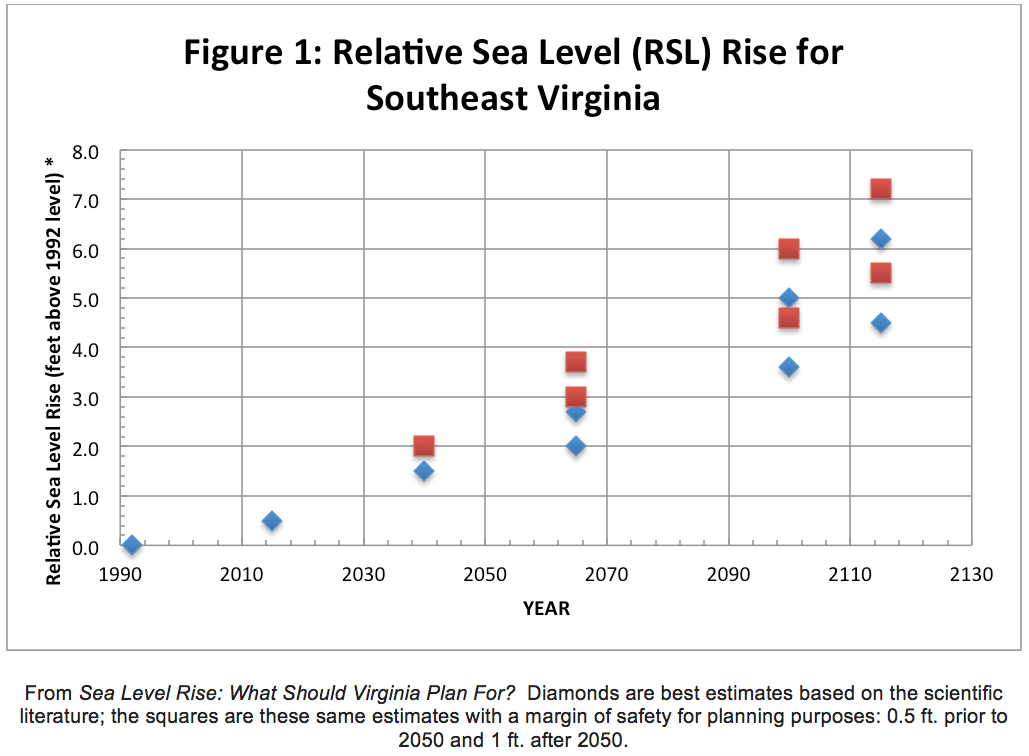
Meanwhile, the Virginia Institute of Marine Science warns that sea levels could rise by as much as seven feet along Virginia’s coast within this century. We can’t afford to keep creating unfunded wish lists, and we can’t wish the problems away.

Virginia needs a dedicated stream of state funding to help coastal families and localities fight climate change. Obviously, there’s no lottery for this. But thankfully there is a common-sense legislative approach being introduced in the Virginia General Assembly by Republican Virginia Beach Delegate Ron Villanueva. His bill, called the Virginia Coastal Protection Act, would help solve our massive coastal flooding problem with a first-ever state funding mechanism that is good for the economy and good for our communities.

By joining the state into the highly successful and fully established Regional Greenhouse Gas Initiative, or RGGI, the bill would generate more than $200 million per year in new state funds to invest in coastal adaptation and other climate change solutions. This relief could come when localities in Hampton Roads need it most. It would come without adding any new demands to the state’s tight budget. It would also come through a system proven to rein in energy costs while reducing emissions and raising revenue.

RGGI is a cooperative effort of nine East Coast states that caps and reduces greenhouse gas pollution. Since the program’s inception in 2008, RGGI states have reduced their carbon footprint 2.7 times faster than non-RGGI states. In the same time period, electricity prices have dropped by 8 percent in participating states, compared to a 6 percent rise throughout the rest of the nation.

Under RGGI, power plants purchase allowances for every ton of carbon they emit. The sale of carbon allowances gets reinvested back to the states. Under Del. Villanueva’s bill, half of Virginia’s projected $200 million in annual auction revenues would fund coastal adaptation efforts, 35 percent would fund energy efficiency and renewable energy projects, and 10 percent would fund workforce development, education, and economic assistance in Southwest Virginia.

The Virginia Coastal Protection Act is a win-win-win solution. We can establish a consistent and significant source of revenue to tackle flooding in Hampton Roads and generate funds to invest in other statewide priorities, while putting policies in place to help Virginia meet carbon reduction goals in an efficient and practical manner.

Virginia’s lawmakers are on the record in their overwhelming bipartisan support for finding solutions to the state’s growing flooding woes. Delegate Villanueva has put forward the best plan to take us beyond wish lists, and to start funding urgently needed solutions.

Dawone Robinson is Virginia Policy Director with the Chesapeake Climate Action Network, a regional climate-change policy and advocacy organization with more than 30,000 supporters in Virginia. You can reach him at dawone@chesapeakeclimate.org

UPDATE: State Senator Don McEachin (D-Richmond) has agreed to introduce the Coastal Protection Act into the Senate as a companion bill to Delegate Villanueva’s (SB 1428), making this now a bipartisan effort.

Unknown's avatar

Solar industry group tells Virginia HOAs to let the sunshine in

Solar panels on the sunny front roof of a house should be cheered, not banned. Photo credit: NREL

Solar panels on the sunny front roof of a house should be cheered, not banned. Photo credit: NREL

Solarize Blacksburg had barely gotten underway last spring when the first complaints came in: homeowners who wanted to participate in the community bulk purchase of solar panels reported resistance from homeowner associations (HOAs) worried about aesthetics. Some HOAs were willing to work with residents, but others were not. Some HOAs refused to allow solar installations at all, even though most blanket prohibitions now violate state law.

The problem repeated itself around the state as more solarize programs took off. Many HOAs hadn’t heard about the new law, passed during the 2014 session, that nullifies HOA rules banning solar panels, including bans that have been in place for decades. Under the law, the only prohibition still legal would be one written into the HOA’s “recorded declaration”—something pretty much unheard of in Virginia, according to Senator (and lawyer) Chap Petersen, who wrote the bill.

But the law still allows “reasonable restrictions” on the “size, place and manner of placement” of solar panels, and what that means is open to interpretation. The Blacksburg organizers consulted lawyers and industry members to come up with a set of guidelines they hoped their local HOAs would use. But meanwhile, the same problem kept popping up across the state.

Now the Maryland, DC and Virginia Solar Energy Industries Association—or MDV-SEIA, as the trade association is known—has weighed in with its own guide. Not surprisingly, it recommends that HOAs be as accommodating as possible to residents who want to install solar panels. It is, nonetheless, a good starting point for HOA officers coming to the question for the first time. In the absence of any other guidance, it also puts HOAs on notice that restrictions going beyond MDV-SEIA’s recommendations may be challenged.

The industry guide contains a list of restrictions it considers reasonable, and those it does not. In general, restrictions that make a solar energy system either more expensive, or less effective, won’t pass muster. The classic example here is a requirement that solar panels not be visible from the street. If the street side of the house happens to be the only sunny side, then restricting solar panels to the rear is per se unreasonable.

Restrictions the industry group thinks are reasonable include requiring homeowners to get approval from the HOA before installing the system, placing the panels more or less flat on the roof, and concealing the wiring and components as much as possible.

Virginians dealing with this issue will take cold comfort in knowing that the fight over solar panels is playing out among HOAs and homeowners nationwide. Start typing “can HOAs” into Google, and the first phrase that pops up is “ban solar panels.” Moreover, while many states now prohibit solar bans, allowing “reasonable restrictions” is also common, and there is no consensus on what that means.

The nonprofit Solar Foundation, working with the Department of Energy’s Sunshot Solar Outreach Partnership, prepared a guide for community associations that contains a comprehensive discussion of this issue. “A Beautiful Day in the Neighborhood” was published before Virginia’s law was revised last year, but it remains an excellent resource for homeowners who want to educate their neighbors about the value of solar—and with any luck, head off disputes about what kind of restrictions the law allows.